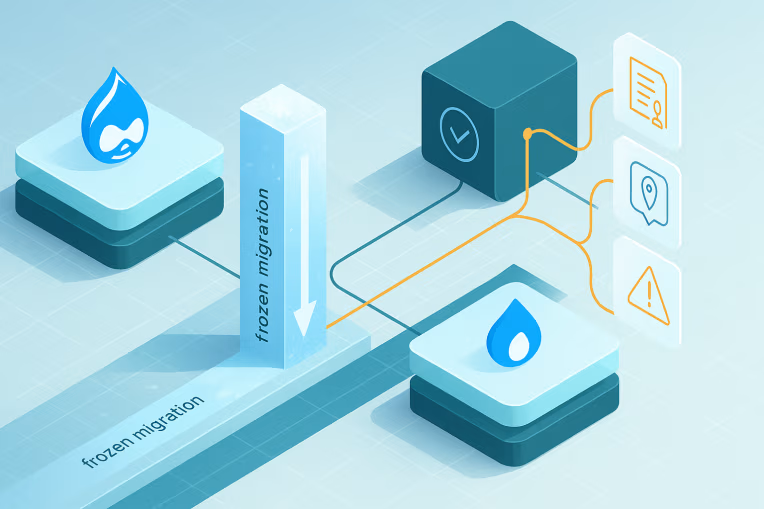
Most enterprise migration plans include a content freeze. On paper, that sounds straightforward: stop publishing, migrate the remaining content, validate the target platform, and cut over with confidence.
In practice, that assumption often breaks down.
Large Drupal programs frequently support multiple brands, markets, business units, and publishing teams. Some content can wait. Some cannot. Regulatory updates may have hard deadlines. Regional teams may need market-specific changes. Executive communications may arrive late. Incident-driven updates may be non-negotiable.
That is why the operational question is not simply whether to freeze content. It is how to control the exceptions when publishing cannot stop completely.
A strong freeze exception model helps migration teams reduce data divergence without pretending divergence can be eliminated. It gives content operations, platform owners, and technical teams a shared decision framework for what is allowed, who approves it, how it is tracked, and how it reaches the new Drupal environment safely.
Why full content freezes rarely survive real enterprise publishing needs
A full freeze is attractive because it simplifies the final migration window. If no one changes content in the source system, the target should remain stable after the last migration pass.
But enterprise publishing environments usually involve constraints that are operational, not technical:
- regulated content that must be updated on a fixed timeline
- active campaigns tied to media schedules or launch dates
- localized or regional publishing calendars that do not align with central cutover timing
- executive announcements that are approved close to release time
- outage, security, or service incident communications that cannot wait for platform milestones
When a migration plan assumes none of those things will happen, the risk does not disappear. It merely moves underground. Teams start making informal exceptions, working around the freeze in email or chat, or pushing untracked edits late in the process.
That is usually worse than allowing exceptions formally.
An unrealistic freeze plan creates three common problems:
- Hidden divergence: content changes are made in the source after a migration checkpoint, but are not visible in cutover reporting.
- Approval ambiguity: editorial, legal, marketing, and technical teams operate with different assumptions about what is allowed.
- Late operational stress: engineers and migration managers spend the cutover window triaging avoidable surprises instead of executing the runbook.
A better approach is to define a constrained exception model ahead of time. That preserves governance while acknowledging the publishing reality of enterprise CMS migration.
The exception types that matter: legal, campaign, market, executive, and incident-driven updates
Not every late change should be treated the same way. A useful exception model starts with classification.
When all exception requests flow into one undifferentiated queue, teams struggle to prioritize and apply the right controls. Classification helps determine approval level, migration handling, validation requirements, and rollback options.
A practical starting taxonomy includes the following categories.
Legal and compliance updates
These are usually the clearest candidates for exception handling because the business impact of delay can be significant.
Examples can include:
- privacy policy changes
- terms and conditions updates
- regulatory disclosures
- accessibility statements
- market-specific compliance content
These changes often need strong auditability. Teams should know exactly what changed, who approved it, when it was published, and whether it was included through delta migration, manual replication, or post-cutover publishing.
Campaign and launch-driven updates
Campaign content is often time-sensitive, but not always equally critical. A homepage hero swap tied to paid media may matter far more than a lower-priority landing page revision.
This category benefits from sub-prioritization:
- launch-blocking campaign content n- time-bound promotional updates
- non-critical optimization edits
The goal is to prevent the word campaign from automatically overriding migration controls. Some campaign work belongs in the exception path; some should wait.
Market or region-specific updates
Multi-site and multi-region Drupal programs often have staggered publishing needs. A global freeze may be manageable for one market but disruptive for another.
Region-specific exceptions can be especially tricky because they may appear small while still affecting:
- translated content sets
- localized legal copy
- market-specific taxonomies or navigation
- content dependencies across shared and local templates
This is where central governance and local operational ownership need to meet. Regional teams need a path to request necessary updates, but the migration team still needs a complete picture of source-to-target divergence.
Executive or corporate communications
Leadership messages, investor communications, internal-to-external announcements, and other high-visibility updates often arrive late in the approval cycle.
These items usually require tight handling because the reputational sensitivity is high. Even when the volume is low, teams should treat them as controlled exceptions rather than ad hoc editorial changes.
Incident-driven updates
These are the changes that can disrupt the cleanest plan.
Examples include:
- service status changes
- temporary alerts or banners
- emergency content updates
- security notices
- customer-impact communications
Incident-driven updates need the fastest path, but they also need defined handling. Otherwise, urgency becomes a reason to bypass logging, reconciliation, and validation entirely.
Designing a freeze exception workflow with ownership and approval boundaries
Exception handling should be designed as an operating model, not just a ticket type.
The most effective workflows answer five questions clearly:
- What qualifies as an exception?
- Who can request one?
- Who approves it?
- How will it be implemented and synchronized?
- How will it be validated and recorded?
Without those answers, teams end up renegotiating the rules during the most time-sensitive part of the migration.
Start with explicit eligibility rules
Define what is in scope for exception requests and what is not.
For example, an exception policy may allow:
- compliance-mandated updates
- launch-critical content with documented business dependency
- region-specific content with market owner approval
- incident communications approved by operational leadership
It may explicitly reject:
- cosmetic copy refinements
- non-essential SEO tweaks
- backlog publishing requests delayed by poor planning
- broad structural content changes during the freeze window
The point is not to be inflexible. It is to remove subjective debate from the cutover period.
Separate requester, approver, and implementer roles
One common failure mode is allowing the same team to request, approve, and execute an exception without a review boundary.
For enterprise migrations, a more resilient model often includes:
- requester: editorial lead, market owner, legal stakeholder, campaign owner, or incident manager
- approver: migration manager, product owner, governance lead, or designated business authority
- implementer: content operations, Drupal administrators, migration engineers, or release manager
- validator: QA lead, content analyst, or platform owner
Not every exception needs four people in the loop, but every exception should have distinct accountability.
Capture the minimum data needed for safe handling
Exception requests should be lightweight enough to use under pressure, but structured enough to support technical execution.
A practical request record often includes:
- exception category
- business justification
- affected site, market, or content type
- source content identifiers or URLs
- requested publish deadline
- implementation method
- approval record
- validation owner
- migration or reconciliation status
If a team cannot answer which content items changed, when they changed, and how they reached the target platform, cutover risk rises quickly.
Define implementation paths in advance
Not every exception should be handled through the same mechanism. Common patterns include:
- publish in the source and include in the next delta migration pass
- manually recreate the change in the target under controlled release procedures
- defer the change and publish immediately after cutover
- apply a temporary operational workaround such as an alert component or feature flag
The right path depends on timing, content complexity, and confidence in the migration tooling.
What matters most is that the choice is deliberate and documented.
How delta migration, reconciliation, and validation should handle late changes
A Drupal migration content freeze plan becomes credible when exception handling is reflected in the technical process, not just the governance deck.
If late changes are allowed, then delta migration strategy, reconciliation logs, and validation rules need to account for them directly.
Use delta migrations for controlled change capture, not as a substitute for planning
Delta migration is often the natural tool for handling approved late changes. It can reduce manual effort by moving only content that changed after a previous migration checkpoint.
But delta migration is not magic. It works best when teams are clear about:
- the time window covered by each delta pass
- which entities and dependencies are included
- how changed records are identified
- whether unpublished, scheduled, translated, or referenced content is handled correctly
- what is excluded from the delta logic
If those boundaries are vague, teams can gain false confidence from the phrase we will just run a delta.
A good operating practice is to map each exception type to an expected technical path. For example, simple content edits may be delta-eligible, while changes involving complex relationships, media dependencies, or structural reconfiguration may need manual handling or post-cutover publishing.
Maintain a reconciliation log for every approved exception
A reconciliation log bridges business approvals and technical execution.
At minimum, it should record:
- unique exception ID
- source entity or content reference
- change timestamp
- environment and migration wave affected
- chosen sync method
- target validation outcome
- unresolved issues or follow-up actions
This helps teams answer practical cutover questions:
- Was the change included in the last migration pass?
- Was it manually replicated instead?
- Does the target now match the approved source state?
- Is there any remaining divergence to resolve after go-live?
That visibility is especially important in multi-site or multi-region programs where exceptions may be happening in parallel.
Validate exceptions separately from general migration QA
General migration validation often focuses on representative samples, template checks, field mapping, and broader platform readiness.
Exception validation is narrower and more operational. It should confirm that the specific late change reached the target correctly and is ready for release.
That may include:
- field-level comparison for changed entries
- URL and routing confirmation
- translation presence where applicable
- publication status checks
- media and reference resolution
- workflow state confirmation
Treating exception validation as a dedicated stream helps prevent critical late edits from getting lost inside broader QA reporting.
Plan for scheduled and workflow-dependent content
Late changes are not always immediate publishes. Some are scheduled, in review, regionally staged, or subject to legal signoff.
Migration teams should decide in advance how to handle:
- scheduled publish dates that fall inside the freeze window
- content stuck in approval workflows near cutover
- revisions that exist but are not yet live
- market variants moving at different times
These cases often create subtle divergence because the content record exists, but its state is easy to misinterpret during migration and validation.
Runbook design for cutover windows, rollback paths, and auditability
If exception handling exists, it belongs in the cutover runbook.
That sounds obvious, but many runbooks still assume a clean freeze while the real operational work is happening somewhere else. The result is fragmented decision-making during cutover.
A runbook should define not only migration steps, but also how exception traffic is managed before, during, and immediately after the release window.
Include decision checkpoints, not just execution steps
Your runbook should identify checkpoints such as:
- final time to submit exception requests
- final approval authority during the cutover window
- last delta migration window for approved source changes
- point after which changes must be applied only in the target
- criteria for deferring non-critical requests to post-cutover
These checkpoints reduce ambiguity when teams are under time pressure.
Distinguish pre-cutover, in-cutover, and post-cutover exception handling
The operational rules should change as the migration progresses.
A practical structure might look like this:
- pre-cutover: approved exceptions can still be published in source and captured through controlled delta processing
- in-cutover: only critical exceptions are accepted, with named decision-makers and constrained implementation methods
- post-cutover: all new changes are directed to the target platform, with reconciliation of any temporary divergence
This phased model is often more workable than trying to hold a single freeze rule across the entire transition period.
Define rollback implications for exception paths
Rollback planning is often discussed at the environment or deployment level, but content exceptions have rollback implications too.
For each exception path, ask:
- If cutover is delayed, where does the authoritative content live?
- If the target release is rolled back, does the approved change need to remain live in source?
- If a manual target-side change was made, how will it be preserved or re-applied?
- If a delta pass fails, how will affected exception items be identified quickly?
Content rollback is rarely as simple as application rollback. That is why exception-aware cutover runbook design matters.
Preserve auditability throughout the window
Auditability is not only for regulated industries. It is basic operational hygiene for enterprise migration.
Teams should be able to reconstruct:
- who requested an exception
- who approved it
- when the source changed
- how the target was updated
- what validation confirmed the result
- whether any divergence remained at go-live
This record becomes especially valuable when issues are discovered after launch. It shortens investigation time and reduces guesswork.
Signs the migration plan is relying on unrealistic editorial assumptions
Many content freeze problems can be detected early if teams look for the warning signs.
A migration plan may be too optimistic when:
- the freeze policy says publishing stops, but no one has confirmed business-unit agreement
- legal, regional, or incident communication stakeholders were not included in planning
- exception requests are expected, but no approval workflow exists
- delta migration is assumed to solve everything, without entity-level rules or validation coverage
- the cutover runbook does not mention late content changes at all
- local markets are told to pause publishing without a fallback path for urgent updates
- content operations teams are asked to enforce the freeze but do not own the escalation process
- post-cutover reconciliation is treated as optional
When these signs appear, the right response is not necessarily to widen the exception process indefinitely. It is to make the rules more explicit and operationally credible.
A practical way to keep publishing moving without losing cutover control
The strongest migration teams do not treat content freeze as an all-or-nothing doctrine. They treat it as a control mechanism with well-defined exceptions.
That means accepting a reality of enterprise CMS migration: some publishing must continue. The real discipline lies in deciding which changes qualify, who can approve them, how they move, how they are validated, and how divergence is tracked.
For Drupal programs, that usually requires close coordination across content operations, platform ownership, engineering, QA, and release management. It also requires the humility to avoid unrealistic promises such as a perfectly silent publishing window across every market and stakeholder group.
A workable freeze exception model does not eliminate complexity. It contains it.
And during cutover, containment is often what protects delivery confidence the most.
Tags: Drupal, Drupal migration content freeze, Drupal cutover planning, delta migration strategy, enterprise CMS migration, publishing freeze exceptions, Drupal migration governance, cutover runbook