In many enterprise CMS migrations, redirect work gets pushed toward the end of the program. Teams focus first on templates, content models, integrations, search, authoring workflows, and release timelines. URLs are often assumed to be a simple cleanup task that can be handled once the new site structure is mostly in place.
That assumption creates risk.
At enterprise scale, redirects are not just technical routing rules. They sit at the intersection of content operations, SEO, analytics, campaign continuity, platform behavior, and cutover readiness. A weak redirect approach can leave users landing on dead pages, search engines encountering inconsistent signals, and internal teams trying to patch issues under launch pressure.
A strong CMS migration redirect strategy treats URL decisions as part of migration governance. It gives teams a way to classify what is changing, decide what must be preserved, and validate behavior before production traffic shifts. That is true whether the program involves Drupal, WordPress, Sitecore, AEM, or a broader CMS migration effort.
Why redirect work gets underestimated in enterprise migrations
Redirects are easy to underestimate because each individual decision can appear small.
One page moved. One campaign URL changed. One section was consolidated. One legacy pattern no longer matches the new information architecture.
But enterprise migrations rarely involve a handful of isolated changes. They often include:
- multiple business units or brands
- years of accumulated content debt
- inconsistent historical URL patterns
- regional or language variations
- retired microsites and landing pages
- old campaign links still active in email, paid media, PDFs, or partner content
- dependencies between CMS routing, CDN behavior, reverse proxies, and analytics tooling
At that scale, redirects stop being a tactical task and become a systems problem.
The risk is amplified by how migrations are usually organized. Content teams may define destination pages. SEO teams may identify high-value legacy URLs. Engineers may implement rules in edge infrastructure or application code. Platform operations may own release controls. If no governance model exists, teams can all be partially responsible while nobody is fully accountable.
That is why redirect planning should start earlier than many teams expect. Not because every rule must be finalized immediately, but because URL change decisions affect architecture, content mapping, QA scope, cutover sequencing, and launch support.
Common failure modes: loops, chain depth, orphaned URLs, analytics breaks
Most teams know they want to avoid 404s after launch. But redirect risk is broader than broken pages.
A few common failure modes show up repeatedly in enterprise URL migration work.
Redirect loops occur when rules send a request back to a previous URL or into a circular pattern. This can happen when multiple rule sets are maintained by different teams, or when legacy redirects are left in place and conflict with new cutover logic.
Excessive redirect chains happen when a URL passes through two or more hops before reaching its final destination. Chains are often created when an organization already has historical redirects in production and adds new migration rules on top without rationalizing what exists. This can affect crawl efficiency, performance, and debugging.
Orphaned URLs are legacy pages with inbound links, search history, or campaign usage that were never included in migration mapping. These are especially common when teams rely only on CMS exports and fail to consider logs, sitemaps, analytics landing pages, paid media destinations, or older campaign inventories.
Analytics breaks happen when URL changes are not coordinated with measurement planning. The destination may resolve correctly, but reporting continuity can still be affected if key landing pages, campaign destinations, or tagged URLs are not accounted for. Teams can lose comparability across pre- and post-launch reporting windows even when users technically reach a valid page.
Pattern overreach is another frequent problem. A broad regex or wildcard rule may look efficient, but if it captures more legacy URLs than intended, users can end up on irrelevant destinations. That tends to surface only after launch when edge cases appear in real traffic.
Conflicting platform behavior can also create issues. A redirect may be configured at the CDN layer while the application or CMS enforces its own canonical routing. If the layers are not reconciled, teams may see inconsistent behavior by environment, device, or locale.
These failures are not just implementation defects. They are usually symptoms of weak governance: incomplete inventory, unclear ownership, insufficient review, or rushed validation.
Redirect inventory: templates, patterns, one-off exceptions, legacy campaign URLs
One of the biggest mistakes in redirect mapping at scale is treating every URL as a manual row in a spreadsheet.
A useful redirect inventory should be structured by decision type. That helps teams identify where rules can be pattern-based, where exceptions matter, and where business review is required.
A practical classification model often includes four categories.
1. Template-driven migrations
These are URLs that follow a predictable content or routing model both before and after migration. Examples might include article pages, product detail pages, resource entries, or office-location pages. If the content type is stable and the new route pattern is known, these URLs can often be migrated with rule-based logic and sample validation.
2. Pattern-level transformations
These are broader structural changes, such as:
/insights/post-namemoving to/blog/post-name/en-us/section/...moving to/us/...- removing dated archive structures from article URLs
- standardizing case, trailing slashes, or file extensions
These changes should be modeled as explicit redirect patterns with clear inclusion and exclusion logic.
3. One-off exceptions
Not every high-value legacy URL fits the new structure. Some pages may merge into broader destination pages. Others may be retired but still need an intentional landing experience. High-authority legacy pages, executive content, investor resources, or long-running campaign destinations often fall into this category.
These exceptions should not be buried inside generic pattern logic. They need separate visibility because they often carry disproportionate business or reputational importance.
4. Legacy campaign and non-CMS URLs
Many migrations miss URLs that do not cleanly appear in the current CMS inventory. These can include:
- historical paid media landing pages
- vanity URLs used in print or events
- downloadable asset paths
- email campaign destinations
- old microsite routes now handled by the main domain
- manually created server redirects from past launches
This is where platform migration readiness often falls apart. The team may have complete content migration mapping while still lacking a reliable view of active URL demand.
A stronger inventory combines several sources:
- CMS exports
- XML sitemaps
- crawl data
- web server or CDN request logs
- analytics landing page reports
- backlink and referral reports where available
- campaign URL lists from marketing teams
- existing redirect configuration from infrastructure or application repositories
The goal is not to preserve every historical URL forever. The goal is to make deliberate decisions about what must resolve, what can consolidate, and what can be retired with acceptable impact.
Ownership model across content, SEO, engineering, and platform operations
Redirect governance works best when responsibilities are explicit.
Without that, redirect planning tends to bounce between teams. SEO identifies problems but does not own implementation. Engineering implements rules but does not know business priority. Content owners approve destination pages but are not aware of legacy traffic patterns. Operations controls cutover but enters the process too late.
A practical ownership model usually includes the following roles.
Content owners should validate whether proposed destination pages are contextually appropriate. A redirect that technically resolves is not necessarily a good user outcome.
SEO leads should help define redirect principles, identify high-value legacy URLs and sections, and review pattern-level decisions that may affect discoverability or continuity.
Solution architects or technical leads should determine where redirect logic belongs, how rule precedence works, how multiple layers interact, and how environments will be tested. In larger replatforming programs, that kind of decision-making often sits within broader headless platform strategy or headless CMS architecture work.
Engineering teams should implement rules in the selected layer, maintain version control, and support automated or scripted validation where possible.
Platform operations or release managers should ensure redirect deployment is part of cutover planning, rollback readiness, and post-launch monitoring.
Analytics stakeholders should review URL change impacts on measurement continuity, reporting expectations, and campaign handling.
What matters most is a clear decision path. For example:
- Who approves destination logic for consolidated pages?
- Who decides whether a legacy section should redirect to a category page or be retired?
- Who owns the source of truth for redirect rules?
- Who signs off that pre-launch validation is complete?
- Who monitors production behavior during and after cutover?
Even lightweight governance can make a major difference. A shared redirect policy, a RACI model, and a single tracked source of truth are often more valuable than an overly complex process.
Validation methods before and after cutover
Redirects should be validated as a release control, not just a content QA task.
Pre-launch validation should happen in layers.
Rule logic review comes first. Teams should inspect pattern definitions, exceptions, precedence, and exclusions before testing at scale. This is where many chain and overmatch issues can be found early.
Sample-based validation by URL class should test representative URLs from each major pattern, content type, locale, and business unit. The point is to confirm that the transformation logic behaves correctly before large-volume testing begins.
Bulk validation should then test the mapped URL inventory. For enterprise migrations, this usually means using scripts, crawlers, or QA tooling to check status codes, destination URLs, chain depth, canonical outcomes, and response consistency.
Critical-path validation should cover the URLs that matter most to the business, such as:
- top landing pages from analytics
- high-value search entry pages
- active campaign destinations
- support or help content
- investor, legal, or compliance pages
- known high-authority backlinks
Cross-layer validation should confirm that behavior is consistent through the actual delivery stack: CDN, WAF, load balancer, application routing, and CMS behavior where relevant. Redirects that work in a lower environment but fail in the full production path are a common cutover surprise.
Post-launch validation is equally important.
After cutover, teams should monitor:
- unexpected spikes in 404s or soft 404 behavior
- redirect loops or chain increases
- requests hitting retired URL patterns
- analytics anomalies on landing pages and campaign destinations
- log-based evidence of missed legacy URLs
A short-term triage workflow is useful here. Not every missed URL requires a permanent redirect, but teams should have a defined way to assess impact, prioritize fixes, and deploy updates safely during the stabilization window.
Edge, application, and CMS-layer redirect tradeoffs
One of the most important architectural questions in enterprise URL migration is where redirect logic should live.
There is no single correct answer for every platform. The right choice depends on scale, ownership, infrastructure maturity, and how dynamic the redirect requirements are. Still, teams should make the decision intentionally.
Edge-layer redirects at the CDN or proxy layer can be effective for high-volume, performance-sensitive, and platform-agnostic handling. They are often a strong fit for migration cutovers because they can intercept requests before they hit the application stack. This can simplify domain, path, and legacy route handling across replatforming programs, including AEM to Drupal, Sitecore to Drupal, and WordPress migrations.
However, edge-layer logic can become hard to govern if it is maintained separately from content and application change processes. Debugging may also be more specialized, especially when multiple infrastructure teams are involved.
Application-layer redirects can work well when routing logic depends on application context, business rules, or integration with structured mappings stored in code or services. They may offer better developer visibility and testability than ad hoc server configuration.
The tradeoff is that application redirects still consume application resources and may be more tightly coupled to the platform being migrated.
CMS-managed redirects can be useful for author-controlled exceptions, editorial flexibility, or ongoing content operations after launch. They can help business users manage smaller redirect needs without engineering intervention.
But CMS-layer redirects are rarely sufficient as the sole migration solution at enterprise scale. They may be too manual, too late in the request flow, or too dependent on content-entry processes for large cutover scenarios.
A balanced model is often best:
- edge layer for broad migration patterns and high-volume legacy handling
- application layer for logic requiring structured control or integration awareness
- CMS layer for limited editorial exceptions and post-launch operational maintenance
The important thing is to define precedence, ownership, deployment workflow, and rollback strategy. Teams should know which layer is authoritative for which redirect class.
A practical redirect governance checklist for launch readiness
Before cutover, teams should be able to answer the following questions with confidence.
- Do we have a documented redirect policy aligned to migration goals?
- Have we classified URL changes into patterns, templates, exceptions, and campaign or legacy edge cases?
- Are the highest-value legacy URLs identified from more than just the CMS export?
- Is there a single source of truth for redirect rules and approvals?
- Are content, SEO, engineering, analytics, and operations roles clearly assigned?
- Have we defined which redirect layer handles which use case?
- Have we tested rule precedence and conflict scenarios across delivery layers?
- Have we validated representative samples for each major section, locale, and content type?
- Have we run bulk testing for mapped URLs and reviewed failures systematically?
- Have we confirmed that critical landing pages and campaign destinations resolve as intended?
- Do we have post-launch monitoring for 404s, redirect errors, and analytics anomalies?
- Is there a stabilization workflow for triaging missed URLs after launch?
If several of those questions do not yet have clear answers, the redirect workstream is probably not launch-ready.
That does not mean the migration is failing. It means redirects need to be treated as a formal readiness topic rather than a last-minute implementation detail.
Conclusion
Enterprise URL migration is not just about sending old pages somewhere new. It is about preserving continuity across user journeys, search entry points, campaign traffic, reporting, and platform behavior during a period of structural change.
That is why redirect governance matters.
When teams approach redirects as a governed architecture and operations workstream, they can make better decisions earlier. They can identify which URL changes are routine, which need business review, which belong at the edge, and which require deeper validation. They can also reduce the likelihood that cutover week becomes an emergency exercise in patching avoidable issues.
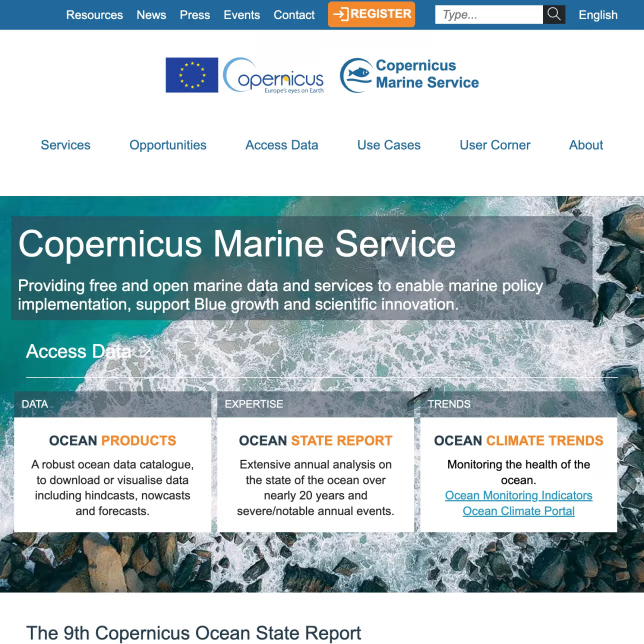
Whether your program involves Drupal, WordPress, AEM, Sitecore, or another enterprise platform, redirect planning should be built into migration readiness from the start. Not because redirects guarantee performance outcomes, but because poor URL decisions often become visible only after launch, when the cost of fixing them is higher. Programs such as UNCCD and Copernicus Marine Service show how migration governance and consolidation work benefit from treating URL continuity as part of the wider delivery model rather than a last-minute spreadsheet task.
A mature CMS migration redirect strategy is ultimately about control: clear ownership, deliberate rules, thorough validation, and a safer path through cutover.
Tags: CMS migration redirect strategy, redirect governance, enterprise URL migration, CMS cutover planning, SEO migration redirects, Content Operations