Customer data deletion sounds straightforward until it has to happen across a real enterprise stack.
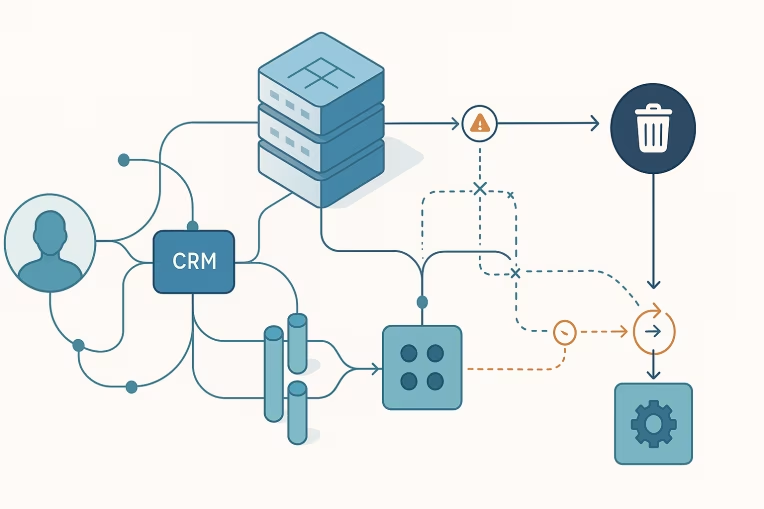
A user record may begin in a CRM, expand into a CDP profile, resolve through an identity graph, land in a warehouse, feed analytics stores, and activate into advertising, email, support, or personalization tools. When an erasure request arrives, the risk is not only whether one system can delete a record. The real challenge is whether the deletion decision propagates consistently across all places where that customer can still be recognized, targeted, measured, or re-created.
That is why CDP deletion propagation governance should be treated as an operational workflow rather than a one-time privacy action. The most resilient programs define clear deletion states, participating systems, ownership boundaries, propagation rules, reconciliation controls, and evidence that the workflow executed as intended.
This article stays platform-agnostic and focuses on architecture and operations rather than legal interpretation. The goal is practical: help enterprise teams design deletion workflows that can hold up under scale, retries, replays, identity complexity, and audit scrutiny.
Why deletion fails in multi-system customer data stacks
Deletion often breaks because customer data stacks are not truly centralized, even when the CDP is presented as the system of intelligence.
In practice, teams operate a mesh of systems with different roles:
- A CRM may be the source for account and contact records.
- A CDP may assemble profiles and audience logic.
- Event pipelines may deliver behavioral data in near real time.
- Warehouses may retain history for modeling and reporting.
- Activation tools may maintain exported lists or synchronized audiences.
- Support, commerce, or product systems may store customer identifiers independently.
An erasure request can fail when any of these conditions exist:
- Unclear system of record for deletion decisions. Teams know where the request was received, but not which system authoritatively publishes the decision.
- Inconsistent identifiers. Email, CRM ID, cookie ID, mobile ID, internal profile ID, and warehouse surrogate keys may not map cleanly.
- Asynchronous processing gaps. One system deletes immediately while another waits for a nightly job.
- Replay or backfill pipelines. A deleted record can be reintroduced from historical logs or reprocessed batches.
- Audience persistence downstream. Deletion in a CDP does not always remove data already copied to activation platforms.
- Warehouse history retention. A current-state table may be cleaned while historical partitions, snapshots, or derived marts still contain identifiable data.
- Ownership ambiguity. Marketing operations, data engineering, privacy, and application owners may each assume another team is responsible.
The result is a familiar pattern: one team marks a profile as deleted, but the same person still appears in an audience, re-enters a segment after an identity stitch, or remains queryable in analytics history.
The difference between delete, suppress, anonymize, and tombstone states
One of the most common governance failures is using the word delete to describe multiple very different outcomes.
Enterprise teams need a state model that distinguishes between operational actions that are often conflated:
- Delete means the record or attributes are removed from a given system or storage layer according to that system's data model.
- Suppress means the record may still exist, but it must not be used for activation, messaging, or certain processing purposes.
- Anonymize means direct or indirect identifiers are transformed or removed so the data is no longer associated with a person in the intended operational context.
- Tombstone means a minimal marker is retained to prevent accidental re-creation, re-ingestion, or reactivation of the entity.
These are not interchangeable.
For example, consent withdrawal may require a change in allowed processing or activation behavior, but that is not automatically the same as full deletion. Likewise, a suppression rule may block campaign use while leaving profile data intact for operational or reconciliation purposes. A tombstone can be essential after deletion, especially in event-driven architectures, because a complete hard delete with no residual marker may allow the same profile to reappear on the next replay.
A practical governance model usually defines:
- the allowed states for a customer entity
- the trigger events that move an entity into a new state
- the systems required to honor each state
- the evidence required to prove the state change propagated
- the retention of minimal tombstone metadata, if used
Without this state discipline, teams end up arguing about whether deletion was completed when what actually happened was partial suppression in one layer and no action in another.
Systems that must participate: CRM, CDP, warehouse, event stores, destinations
Deletion propagation should be designed as a cross-system contract. Even if the request originates in one application, the workflow usually spans multiple technical domains.
CRM
The CRM often holds durable customer identifiers and business context. It may be the point where service teams receive requests or where account status changes are managed.
Governance questions include:
- Is the CRM the originator of the deletion request, or only one participant?
- Which identifiers from the CRM are used to fan out the workflow?
- How are merged contacts, duplicate leads, or parent-child account relationships handled?
- Does the CRM publish a deletion event, a suppression event, or both?
CDP
The CDP is often where profile assembly, audience qualification, and activation orchestration happen. That makes it a critical enforcement point, but not the only one.
The CDP should usually be able to:
- receive authoritative deletion or suppression instructions
- propagate state changes to profile stores and audience logic
- stop new activations for affected profiles
- attempt removals from exported or synced downstream audiences where supported
- emit status events for observability and reconciliation
The CDP should not be assumed to erase all downstream copies automatically. That assumption is where many programs become fragile.
Warehouse and analytics storage
Warehouses complicate deletion because they often contain:
- raw ingestion tables
- curated dimensional models
- snapshots and slowly changing records
- analytical extracts
- machine learning feature sets
- archived historical partitions
Current-state deletion is not enough if identifiable records remain in historical structures that are still accessible for operational use. Teams need clear rules for how deletion is represented in raw, refined, and derived layers, and whether historical reprocessing will respect tombstones or suppression registries.
Event stores and streaming infrastructure
Event-driven stacks can unintentionally resurrect data.
If deletion occurs in a serving layer but upstream immutable logs still contain identifiable payloads, then replay jobs, backfills, or consumer restarts can repopulate downstream systems. This does not mean immutable infrastructure cannot be governed. It means deletion design must account for how future reprocessing is prevented or transformed.
Common patterns include:
- filtering deleted identities during replay
- maintaining a deletion registry used by stream consumers
- stripping identifiers from historical payloads when reprocessing into analytical stores
- versioning downstream consumers so they enforce the latest state model
Activation destinations
Advertising, messaging, personalization, and support tools often receive customer data through audience syncs, file exports, APIs, or event forwarding. These systems can retain data beyond the originating CDP run.
Governance here usually requires teams to document:
- which destinations receive identifiable data
- whether removal is supported and on what timing model
- whether exports create independent retained copies
- whether audience membership removal is distinct from record deletion
- how evidence of downstream action is captured
A deletion workflow is only as complete as the least-governed destination that still recognizes the customer.
Identity graph complications and profile reappearance risk
Identity resolution makes CDP programs powerful, but it also makes deletion harder.
When multiple identifiers are stitched into a unified profile, deletion cannot be treated as removing a single row keyed by a single ID. The operational question becomes: which identities, edges, aliases, and household or account relationships must be affected to prevent recognition from re-emerging?
Typical complications include:
- A CRM contact ID is deleted, but device IDs remain active and rebuild the profile later.
- An email-based profile is erased, but web event cookies still qualify the customer into anonymous audiences.
- A merged profile is deleted under one identifier, while a sibling source record survives and re-stitches the graph.
- Warehouse modeling rebuilds identity edges from raw event history and recreates the profile on the next batch run.
To reduce profile reappearance risk, teams often need governance around identity graph architecture:
- Identifier scope. Which IDs are in scope for propagation: source IDs, resolved IDs, aliases, hashed identifiers, household IDs, device IDs, or account IDs?
- Graph edge behavior. Should links be removed, blocked, or marked unusable for future stitching?
- Anonymous-to-known transitions. What happens if future activity arrives from an identifier previously associated with a deleted person?
- Reingestion controls. How do ingestion services check tombstones or suppression registries before creating new entities?
A strong identity strategy does not just improve matching and activation. It defines what it means to prevent identity reconstruction after deletion.
Designing propagation contracts, SLAs, and evidence trails
Deletion governance becomes far more manageable when it is designed as a contract, not an assumption.
A propagation contract should state, in plain operational terms, how a deletion or suppression instruction moves through the stack. That contract can be expressed through architecture documentation, interface specifications, event schemas, and runbooks.
Core elements usually include:
1. Trigger definition
Document what events can initiate the workflow, such as:
- customer-submitted erasure request
- service-agent initiated request
- upstream application deletion decision
- policy-driven lifecycle deletion
Each trigger should produce a normalized internal event with a unique request ID.
2. Identity payload requirements
Define the minimum identity package needed for propagation. Depending on the environment, this may include:
- primary source system ID
- resolved profile ID
- email or hashed email
- account or household ID
- mobile or device identifiers where relevant
- request timestamp and source channel
The goal is not to over-share data, but to ensure participating systems can find the right records consistently.
3. State semantics
Specify exactly what downstream systems must do for each state:
- delete profile data
- suppress activation
- remove audience membership
- block identity restitching
- retain tombstone only
If systems interpret the same event differently, governance has already failed.
4. Service-level expectations
Not every system can act immediately, but every system should have a defined expectation. For example:
- near-real-time suppression in activation control layers
- scheduled deletion in warehouse derivatives
- periodic reconciliation for destinations with delayed APIs
The specific time window will vary, but the presence of a documented SLA or SLO matters because it makes incomplete propagation visible.
5. Completion signals and evidence
A deletion request should not disappear into a queue with no traceable outcome. Teams need evidence trails such as:
- request ID and correlation IDs across systems
- timestamps for receipt, processing, retry, and completion
- system-level action results
- exception codes and manual review flags
- reconciliation reports showing unresolved endpoints
This evidence supports internal governance, operational troubleshooting, and audit readiness.
Failure recovery, reconciliation, and audit readiness
Deletion workflows should be designed on the assumption that some steps will fail.
Destinations time out. APIs rate-limit. Warehouses miss a partition. A replay job loads old data. An identity service reconnects previously deleted aliases. The question is not whether failures occur, but whether the operating model can detect, contain, and resolve them.
Useful patterns include:
Idempotent processing
Deletion events should be safe to process more than once. This matters because retries are normal in distributed systems. Idempotency prevents retries from creating inconsistent secondary effects.
Dead-letter and exception handling
Requests that cannot be completed should move into a controlled exception path with ownership, not vanish silently. That path should capture:
- what failed
- where it failed
- whether activation must be halted immediately while deletion remains incomplete
- who owns remediation
Reconciliation jobs
Periodic reconciliation is essential because a successful API response is not the same as verified end-state consistency.
Reconciliation can compare:
- deletion registry entries against active CDP profiles
- suppressed identities against audience membership
- warehouse deletion manifests against queryable tables
- outbound destination rosters against removal confirmations
This is often where hidden failures are discovered, especially in systems with asynchronous or opaque downstream behavior.
Controlled replay and backfill rules
Teams should define what happens when historical pipelines are rerun. A practical rule is that replay must always consult the latest deletion and suppression registry before materializing output. Without that rule, remediation today can be undone by maintenance tomorrow.
Audit-ready evidence packages
Audit readiness is not only about policy documents. It is also about operational proof.
An evidence package often includes:
- workflow design and system inventory
- state definitions and ownership map
- sample request traces with timestamps
- exception logs and remediation notes
- reconciliation results
- change history for deletion logic and data contracts
This is especially valuable in large enterprises where privacy, marketing, engineering, and governance teams all need a shared view of what “completed” means.
A practical operating model for governed deletion workflows
For most enterprise teams, the best approach is not to chase perfect real-time deletion everywhere. It is to establish a governed, observable operating model that reduces risk systematically.
A practical model often includes the following components.
1. A canonical deletion decision source
Choose the authoritative source that publishes deletion and suppression instructions. This does not have to be the CDP. In many organizations, it is a privacy workflow service, master data process, or governed CRM process.
What matters is that downstream systems subscribe to one authoritative decision stream rather than infer intent from scattered status fields.
2. A shared state model
Define and socialize the meaning of delete, suppress, anonymize, and tombstone. Make sure engineering, marketing operations, analytics, and governance teams all use the same language.
3. A system participation matrix
Maintain a living inventory of every system that can store, transform, activate, or export customer data. For each system, document:
- what identifiers it uses
- what deletion-related actions it supports
- expected SLA
- evidence it can return
- owning team
- recovery path if automated processing fails
This is one of the simplest and highest-value governance assets a program can maintain.
4. Identity-aware propagation logic
Do not propagate using only the most visible customer key. The workflow should account for the identifiers actually used throughout the stack, including aliases and resolved IDs where appropriate.
5. Observability built into the workflow
Treat deletion propagation like any other critical distributed process. Instrument it with customer data infrastructure:
- correlation IDs
- queue and latency monitoring
- endpoint success and failure metrics
- aging reports for incomplete requests
- reconciliation dashboards
If leaders cannot see backlog, exceptions, and unresolved destinations, they do not really have governance.
6. Recovery and change management
Every deletion workflow should have runbooks for retries, manual remediation, replay safety, and downstream incident response. It should also have change control, because adding a new destination or identity rule can quietly expand deletion scope without corresponding operational updates.
7. Cross-functional ownership
This work sits between disciplines. It usually requires collaboration among:
- CDP architecture
- data engineering
- marketing operations
- privacy or compliance teams
- CRM/application owners
- analytics governance
The strongest programs assign explicit ownership for orchestration, destination compliance, warehouse remediation, and audit evidence rather than treating deletion as a shared but vague responsibility.
What mature teams do differently
Mature teams usually stop framing deletion as a feature and start managing it as a governed service.
They recognize that the hardest problems are not the delete API call itself, but the questions around identity scope, downstream copies, replay safety, and evidence. They build contracts between systems. They distinguish suppression from deletion. They track exceptions. They reconcile outcomes. They maintain enough tombstone logic to prevent accidental resurrection. And they update the model when new destinations, data products, or identity rules are introduced.
This is where customer data governance becomes inseparable from CDP architecture and activation engineering. A CDP program is only as trustworthy as its ability to honor customer state changes consistently across the ecosystem it coordinates.
For organizations investing in modern customer data platforms, the practical goal is clear: design deletion propagation so it works not only in policy diagrams, but in the messy reality of distributed systems. That means better contracts, better observability, stronger identity controls, and a shared operating model that turns erasure from a fragile request into a dependable enterprise workflow.
Tags: CDP, Customer Data Governance, Data Architecture, Identity Resolution, Marketing Operations, Privacy Operations, Data Engineering