Enterprise activation problems rarely start where they are first noticed.
A marketer sees a customer missing from a paid media audience. An analyst notices a campaign population dropped unexpectedly. A support team asks why a supposedly suppressed user still received a message. In most enterprise CDP environments, the visible issue appears at the end of the process, but the actual cause can sit much earlier: a missing event, a delayed identity merge, a stale profile trait, a rule conflict, a failed sync batch, or a destination-side acceptance problem.
That is why CDP audience lineage matters. It gives teams a traceable explanation of how a membership decision was formed and how that decision moved, or failed to move, into activation. Without that trace, debugging becomes slow, political, and inconsistent. Teams argue over which system is authoritative instead of working from shared evidence.
Operationally, audience lineage is the ability to answer questions like:
- What source event or attribute contributed to this audience decision?
- Which identity state was used when the segment was computed?
- Which rule version qualified or excluded the customer?
- When did the membership state change?
- Was the change exported to the destination?
- Did the downstream channel receive, accept, delay, or reject it?
That level of explainability helps enterprise teams reduce trust erosion around activation. It also makes incident response faster because the conversation moves from assumption to verifiable sequence.
Why audience bugs are hard to explain in enterprise CDPs
Audience bugs are hard to explain because the word "audience" hides a chain of separate systems and decisions.
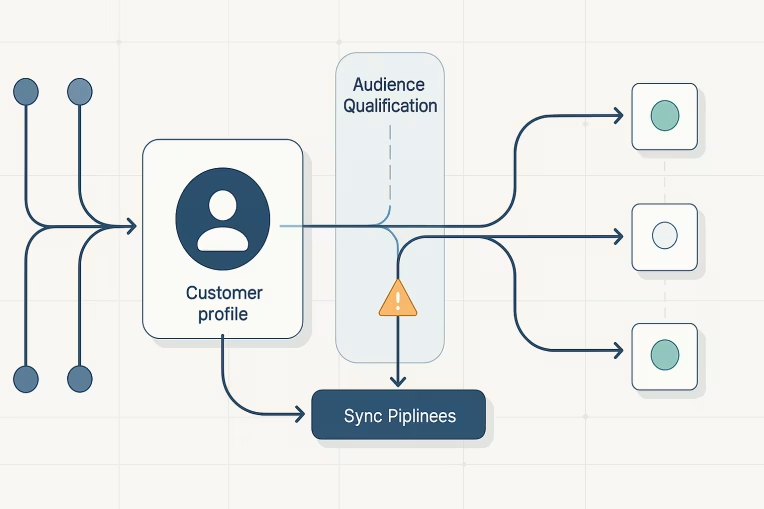
In a typical enterprise pattern, audience delivery depends on at least five layers:
- Data collection: events and traits arrive from web, app, backend, CRM, or batch pipelines.
- Identity resolution: identifiers are linked, merged, or kept separate based on configurable rules.
- Profile and trait materialization: attributes are calculated, enriched, or refreshed on different schedules.
- Segment computation: audience rules evaluate against profile state and event history.
- Activation and destination sync: memberships are exported, transformed, rate-limited, retried, or rejected downstream.
A person can disappear at any of those points.
The difficulty increases in enterprise settings because these layers often have different owners. Marketing operations may manage the segment definition. Data engineering may own event quality. Platform teams may own identity logic. Another team may operate destination connectors. When no one owns the end-to-end decision trail, every incident turns into a cross-functional reconstruction exercise.
There is also a timing problem. Many CDP issues are not strictly wrong; they are temporally wrong.
For example:
- An event arrived after the segment evaluation window had already closed.
- An identity link was created after an export job had already run.
- A trait refresh lagged behind the campaign audience cut.
- A destination accepted the batch hours later than expected.
If teams only inspect current state, they miss the historical conditions that actually drove the decision. Good lineage therefore needs to preserve not just what the audience is now, but what the system knew at the moment it qualified, removed, or exported a member.
What audience lineage actually needs to capture
A workable lineage model does not need to record every internal detail of every platform component. It does need to preserve enough evidence to reconstruct membership decisions with confidence.
At minimum, audience lineage should capture the following categories.
1. Source evidence
For each important qualification path, teams should be able to inspect the underlying inputs:
- event name
- event timestamp
- ingestion timestamp
- source system
- key properties used by audience rules
- profile attributes used by audience rules
- transformation or enrichment steps that altered those values
This is what lets a team distinguish between "the event never happened," "the event happened but was not collected," and "the event was collected but transformed incorrectly."
2. Identity context
Many audience issues are really identity issues. A trace should show:
- which identifiers were present when the event arrived
- whether those identifiers were already linked
- whether the membership calculation used a pre-merge or post-merge profile
- when identity links changed
- whether an identity split or merge changed historical qualification
Without this context, segment debugging often produces false conclusions because teams inspect the customer as they exist now rather than as the system saw them when the decision was made.
3. Rule evaluation evidence
Lineage should preserve more than the final in-or-out result. It should show:
- the segment definition version used
- the evaluation time
- the specific rule branches passed or failed
- threshold values and lookback windows applied
- precedence behavior where inclusion and exclusion rules compete
This matters when a segment is logically valid but operationally surprising. For instance, a marketer may assume a customer qualifies based on recent activity while an exclusion rule on consent, geography, or product status took precedence.
4. Membership state changes
A useful audit trail records when a profile:
- entered the audience
- remained in the audience
- exited the audience
- was re-qualified after a prior exit
- was suppressed by an override or policy condition
That history turns one-off screenshots into an actual timeline.
5. Activation evidence
The audience decision and the activation result are not the same thing. Lineage should therefore capture:
- export job or sync run identifier
- export eligibility time
- payload creation time
- destination mapping version if relevant
- send status, retry status, and failure reason when available
- downstream acknowledgement or rejection if the channel exposes it
This is the difference between saying "the customer was in the audience" and saying "the customer was in the audience, included in sync run X, but not delivered because the destination throttled the batch."
Tracing membership across events, identities, attributes, and rule evaluations
A practical audience trace usually works best as a timeline, not a static profile page.
Consider a safe, generic example. A loyalty campaign should include customers who purchased in the last 30 days, have an active loyalty flag, and are not currently suppressed for consent reasons. A specific customer is missing from the activation list.
A good trace would let the team walk through the sequence:
- Event creation: a purchase event was generated in the commerce backend on July 1.
- Event ingestion: the event reached the CDP on July 2 due to upstream processing delay.
- Identity association: the purchase arrived under an email-based identifier that was not linked to the known web profile until July 3.
- Trait refresh: the loyalty flag was still true, but the consent suppression trait refreshed on July 2 from a separate source.
- Segment evaluation: the audience evaluated on July 2 before the identity merge completed, so the purchase was not visible on the qualifying profile.
- Re-evaluation: the customer entered the audience on July 3 after the merge.
- Activation: the destination sync on July 3 skipped the customer because the consent suppression state had turned true before the export job ran.
Without lineage, different teams might each tell a partial story:
- marketing says the purchase should have qualified the customer
- data engineering says the event was present
- platform owners say the segment logic worked
- activation operators say the export was healthy
All of those statements could be locally true while still failing to explain the end result. The lineage view connects them.
In implementation terms, this usually means treating audience traceability as a join across several evidence layers rather than a single table:
- raw event history
- profile snapshot or trait history
- identity link history
- segment evaluation logs or derived evaluation artifacts
- export and sync run history
- destination response logs where available
The goal is not perfect forensic reconstruction of every micro-event. The goal is consistent enough evidence that teams can answer the operational question: why did this person get this audience outcome at this time?
Where activation pipelines distort the original audience decision
One of the most common mistakes in CDP operations is assuming the destination audience mirrors the source audience exactly.
In practice, activation pipelines often distort the original decision.
Some distortions are intentional:
- field mappings may normalize identifiers differently for each destination
- exports may only include users with destination-compatible identifiers
- sync schedules may batch changes at fixed intervals
- suppression policies may be applied again before send
Some distortions are failures:
- destination throttling delays delivery
- retries create lag between qualification and channel availability
- stale traits are exported because the sync job read an older snapshot
- payload validation errors silently drop some records
- incremental sync logic misses membership changes after job restarts
This is why audience lineage needs a clear handoff between qualification truth and activation truth.
Qualification truth answers whether the CDP considered the person a member at a given moment.
Activation truth answers whether that membership was successfully transformed into a downstream audience state.
Those are related but separate facts.
A strong debugging model explicitly checks both. For every activation incident, teams should ask:
- Was the customer ever qualified?
- If yes, when did qualification occur?
- Was the qualification still valid when the export window ran?
- Was the customer eligible for this destination's identifier and policy requirements?
- Was the payload generated and sent?
- Did the destination confirm ingestion?
- If ingestion occurred, did the channel apply the membership in time for campaign execution?
This separation prevents a common anti-pattern: overcorrecting segment logic to solve what is really a delivery pipeline issue.
Audit trails, replay views, and evidence for incident response
Lineage becomes operationally valuable when teams can use it during incidents, not just architecture reviews.
Three capabilities are especially useful.
Audit trails
An audience membership audit trail should show chronological state transitions with timestamps and evidence references. It does not need to be visually elaborate. It does need to be queryable and durable enough to support debugging after the fact.
At minimum, incident responders should be able to retrieve:
- membership entered/exited times
- identity change events that affected evaluation
- relevant trait changes
- rule version applied
- export attempt history
- known downstream status signals
Replay views
Current state is often misleading. Replay views help teams inspect the customer and the audience as of a specific time.
Useful replay questions include:
- What did the profile look like at the time of evaluation?
- Which identifiers were linked then?
- Which event window was actually visible to the segment engine?
- Which version of the audience logic was active?
- What suppression conditions existed before export?
Even a partial replay model can drastically reduce ambiguity. Teams do not need a perfect simulator to get value. Often, reconstructing profile state, identity state, and evaluation time is enough to isolate the likely failure mode.
Evidence packs for incidents
Enterprise teams benefit from a standard incident artifact that can be shared across stakeholders. For a single affected profile or sampled set of profiles, that evidence pack can include:
- profile identifier set
- qualification timeline
- identity linkage timeline
- source event references
- rule pass/fail summary
- activation job references
- destination-side outcomes if known
- likely root cause and confidence level
This keeps incident communication grounded. It also builds institutional memory because repeat issues become easier to classify.
Common failure modes that benefit from this approach include:
- missing events: events expected by the segment were never collected or were filtered upstream
- late identity merges: the qualifying behavior existed but was attached to a different profile at evaluation time
- stale traits: profile attributes lagged behind source-of-truth systems
- rule precedence conflicts: exclusion logic overrode expected inclusion logic
- destination throttling: qualification occurred, but delivery lagged beyond campaign relevance
Recovery patterns should be equally explicit. Depending on the issue, teams may:
- backfill events and re-run qualification
- trigger re-evaluation after identity repair
- shorten trait refresh intervals for high-value attributes
- clarify or simplify audience rule precedence
- add export health alerts and retry visibility
- create destination-specific eligibility checks before campaign launch
A workable operating model for lineage ownership and tooling
Audience lineage usually fails not because teams do not value it, but because they frame it as a single platform feature instead of an operating model.
In most enterprises, no universal CDP capability will automatically solve all lineage needs across collection, identity, segmentation, and activation. That means teams should define ownership deliberately.
A practical model often includes the following responsibilities.
Data engineering or event pipeline owners
- validate collection completeness for audience-critical events
- preserve source and ingestion timestamps
- maintain observability around schema and transformation changes
- support replay or backfill paths when gaps are found
Identity or customer data platform owners
- define how identity link history is recorded
- document merge and split behavior relevant to audience evaluation
- expose profile and trait state changes for debugging
- maintain evidence on when audience computations occur
Marketing operations or activation owners
- document audience intent and business logic clearly
- validate inclusion and exclusion precedence before launch
- monitor destination-specific eligibility and sync health
- provide campaign timing context during incident analysis
Architecture or platform governance leads
- define minimum lineage requirements for business-critical audiences
- establish standard incident evidence templates
- prioritize observability investments where trust risk is highest
- align tooling decisions across teams rather than letting every function debug differently
Tooling should follow the same principle: start with the questions you need to answer, then decide how much instrumentation is necessary.
A sensible maturity path often looks like this:
Level 1: basic traceability
- membership change logs
- export run logs
- event and trait freshness monitoring
Level 2: cross-layer debugging
- identity link history
- rule evaluation artifacts
- destination error classification
- searchable timelines for individual profiles
Level 3: operational lineage
- time-based replay views
- standardized evidence packs
- alerting tied to audience health and delivery confidence
- governance for business-critical audience definitions and activation dependencies
The right target state depends on business complexity. Not every audience needs deep forensic treatment. But high-impact audiences tied to suppression, paid media spend, lifecycle messaging, or revenue-critical journeys usually justify stronger lineage controls.
The key is to avoid treating lineage as documentation alone. Documentation helps, but operational explainability comes from observable signals, retained history, and shared debugging workflows.
Conclusion
Enterprise CDP teams do not build trust by claiming audience systems are flawless. They build trust by making audience decisions explainable.
That is the real value of CDP audience lineage. It gives teams a structured way to trace membership from source event to identity state to rule evaluation to export outcome. It separates qualification issues from activation issues. It exposes timing distortions that static profile views hide. And it gives marketing, analytics, and engineering teams a common evidence base during incidents.
If your organization is struggling with recurring audience disputes, start small but concrete. Pick a high-value audience. Define the minimum evidence needed to explain one member's journey end to end. Instrument the event, identity, rule, and activation checkpoints that matter most. Then turn that trace into a repeatable incident workflow supported by data activation architecture, customer segmentation architecture, and privacy and consent architecture.
Once teams can answer "why did this customer get this audience outcome at this time?" with confidence, activation debugging becomes much faster, and audience trust becomes much easier to maintain.
Tags: CDP, CDP audience lineage, audience activation debugging, segment traceability, CDP observability, customer data lineage, identity resolution, activation architecture