In a headless platform, search freshness is rarely guaranteed by default. Content can be published in one system, cached in another, transformed in middleware, indexed by a separate search service, and presented through multiple frontends with different release cycles. When teams treat search as a downstream detail, the result is predictable: newly published content does not appear when expected, updated content shows old fields, deleted records linger, and large editorial releases create index lag that nobody owns end to end.
That is why headless search index freshness should be designed as a platform capability. The goal is not simply to make indexing work. The goal is to make content discoverable within acceptable time boundaries, with predictable failure handling, clear ownership, and operating signals that tell teams when search has drifted from the source of truth.
Check your content platform for search freshness gapsRun Health CheckFor enterprise digital platforms, this matters because search is often one of the main access paths to content. If search freshness is weak, publishing loses credibility, business users work around the platform, and customer experiences become inconsistent even when the CMS itself is functioning correctly.
This article outlines a practical architecture for keeping search aligned with content delivery without reindexing everything every time something changes.
Why search freshness fails in headless platforms
Search freshness problems usually come from architectural gaps rather than search engine limitations. Headless ecosystems create separation between authoring, delivery, indexing, and presentation, which makes latency and inconsistency easier to introduce.
Common failure modes include:
- Stale results after publish because the publish event never triggered indexing, or the trigger did not include all affected derived records.
- Orphaned records because content was unpublished, deleted, or disconnected from routing logic without a corresponding delete event reaching the index.
- Partial updates where one field changed in the CMS but the indexed document depends on related content, taxonomy, computed labels, or access rules that were not recalculated.
- Index lag after bulk publish because event volume exceeded queue capacity or downstream indexing throughput.
- Search and page delivery drift because CDN or application caches were updated on a different timeline than the search index.
- Silent schema breakage because a content model change altered mapping logic but indexing pipelines had no validation or replay plan.
A recurring mistake is to assume search freshness can be solved with a plugin, webhook, or nightly job alone. Those can be part of the solution, but they are not the architecture. Enterprise teams need a deliberate design for how content changes become index updates, how failures are detected, and how drift is reconciled over time.
Define freshness requirements by content type and journey
Not all content needs the same freshness target. A product support article, a press release, a store page, and a legal notice may each have different business expectations. The right design starts by defining freshness requirements based on content type and user journey, not by choosing an indexing mechanism first.
Useful questions to answer include:
- How quickly should newly published content be searchable?
- How quickly must updates to critical fields appear?
- How fast must deletes or unpublishes be removed from results?
- Which content changes require immediate indexing, and which can wait for batch processing?
- Which journeys are most sensitive to stale or missing results?
A practical way to frame this is with service levels such as:
- Near-real-time for high-value or time-sensitive content.
- Fast but not immediate for standard editorial publishing.
- Scheduled freshness for low-risk content or large supporting datasets.
These do not need unrealistic benchmarks. What matters is that they are explicit and agreed upon. If the business expects content to appear in search within minutes, but the platform only reconciles every few hours, the architecture is already misaligned.
It is also important to define freshness at the right level. Searchable content often depends on more than the primary entry itself. A page index document may depend on:
- the content item
- referenced assets
- taxonomy labels
- related entities
- route generation logic
- audience or access metadata
- localization state
If any of those can change what the user should find, they belong in the freshness model.

See where publish-to-index drift is coming from
Assess event flow, indexing reliability, cache coordination, and reconciliation coverage across your content platform.
- Audit indexing flow
- Find stale content risks
- Check replay readiness
Publish events, queues, and indexing triggers
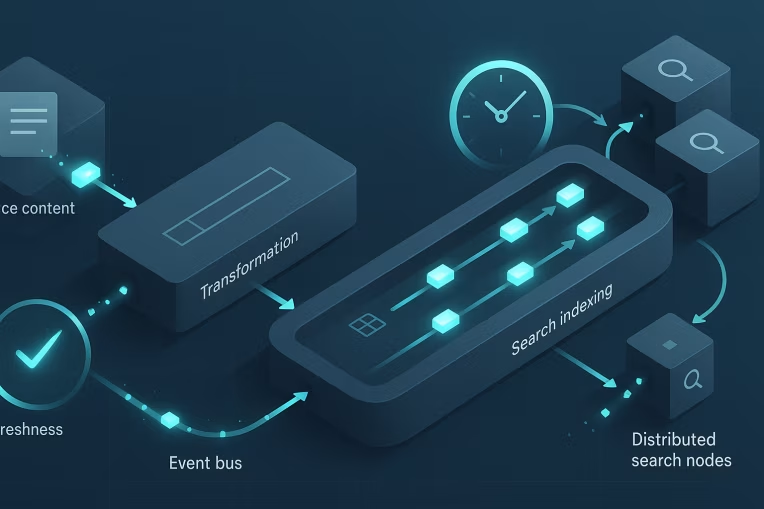
In most enterprise headless environments, event-driven indexing is the backbone of freshness. When content is published, updated, unpublished, or deleted, the platform emits a change event that flows into a queue and then into indexing workers.
This pattern matters because it decouples editorial activity from indexing execution. Editors should not wait for search to finish, and the CMS should not need to manage indexing throughput directly.
A sound event-driven design usually includes these components:
- Change event source from the CMS or content platform.
- Event normalization layer that converts source-specific events into a stable internal contract.
- Queue or stream that absorbs bursts and enables retry.
- Indexing workers that enrich content, build search documents, and call the search platform.
- Status and observability layer that records success, failure, and lag.
The event contract should be designed carefully. At minimum, it typically needs:
- content identifier
- content type
- event type such as publish, update, unpublish, delete
- locale or market
- version or revision marker
- timestamp
- correlation or trace identifier
That contract should be independent from any one vendor if possible. Otherwise, indexing logic becomes tightly coupled to the CMS event shape, making migration and governance harder.
A key architectural decision is whether events carry the full document payload or only a reference. In most cases, passing a reference and having workers fetch the current canonical state is safer. It reduces payload size and avoids indexing obsolete snapshots when multiple updates happen close together. The tradeoff is increased dependency on source availability at processing time.
Queues help absorb spikes, but they do not solve everything on their own. You still need rules for:
- deduplicating repeated events
- handling out-of-order updates
- collapsing rapid publish bursts into a single effective index action
- retrying transient failures without creating endless loops
- dead-lettering events that need manual investigation
If these controls are absent, event-driven indexing can become noisy and fragile instead of fast.
Full reindex vs partial update vs delete handling
Many teams get stuck between two extremes: full reindexing, which is expensive and slow, and narrowly scoped partial updates, which can miss dependencies. A better approach is to treat indexing actions as several distinct patterns, each used for the right reason.
Full reindex is appropriate when:
- the search schema changed significantly
- document composition logic changed broadly
- relevance fields were restructured
- a large data correction affects most records
A full reindex can restore consistency, but it is not a freshness strategy for day-to-day publishing. It consumes capacity, introduces longer validation cycles, and can create avoidable operational risk if run too often.
Partial update or targeted reindex is usually the primary mechanism for routine changes. It works well when:
- only a subset of fields changed
- a single content item or bounded set of related records is affected
- document identity remains stable
- the mapping logic can safely reconstruct the current document state
The challenge is dependency awareness. A category rename might affect thousands of documents indirectly. A simple item-level update trigger may not be enough unless the platform also knows which dependent documents must be rebuilt.
Delete handling is often the weakest part of search freshness architecture. Yet delayed deletes can be more damaging than delayed publishes because they expose users to content that should no longer be discoverable.
Delete logic should clearly cover:
- unpublish events
- hard deletes
- route removals
- locale-specific removals
- access rule changes that should remove content from a public index
Where possible, teams should maintain a stable search document identifier and a deterministic rule for when a record must be removed. Ambiguous delete behavior is a common cause of orphaned records.
A useful model is to define document lifecycle states explicitly:
- eligible for indexing
- temporarily ineligible
- permanently removed
- pending rebuild
That gives operations teams a clearer way to reason about what search should contain at any point in time.
Cache, CDN, and search consistency boundaries
Even if indexing is fast, users may still experience inconsistency because search is only one part of the delivery path. The page itself may be cached at the CDN, derived APIs may have stale responses, and frontend applications may hydrate from data sources that lag behind the index.
This means freshness must be defined across boundaries:
- Content source freshness: is the latest content stored and available?
- Search index freshness: has the index been updated?
- Delivery cache freshness: are APIs or pages serving updated data?
- Frontend freshness: is the user interface requesting current data or serving stale client cache?
A common enterprise scenario looks like this: a new article becomes searchable before the page route is live everywhere, or the updated page is live while search still shows the old title and snippet. From the user perspective, both are quality failures.
To manage this, teams need clear consistency rules. For example:
- Search can surface content only after the route is resolvable.
- Delete events should invalidate search and delivery caches together where feasible.
- Snippet generation should use the same canonical fields as page rendering where possible.
- Cache invalidation signals should be coordinated with publish and unpublish flows.
Absolute atomic consistency is often unrealistic in distributed systems, but known and bounded inconsistency is manageable. The aim is to define acceptable windows and remove avoidable drift.
Observability: lag, failure, replay, and SLA signals
Search freshness cannot be operated well if it is invisible. Many platforms know whether a publishing workflow succeeded, but they do not know whether the corresponding search document is current. That makes search issues hard to diagnose and easy to dismiss.
A useful observability model includes both technical and business-facing signals.
Lag signals often include:
- time from publish event to queue ingestion
- time from queue ingestion to processing start
- time from processing start to index acknowledgement
- end-to-end publish-to-index latency
Failure signals often include:
- retry counts
- dead-letter volume
- indexing error rate by content type
- schema or mapping validation failures
- delete failures and unresolved orphan records
Coverage signals can include:
- ratio of published items to indexed items for in-scope content
- count of documents missing required searchable fields
- divergence between source timestamps and indexed timestamps
These signals support a real service view of enterprise search operations. Without them, teams only know there is a problem when editors or users complain.
Replay is equally important. If an event consumer fails, a mapping bug is fixed, or a downstream outage causes missed updates, teams need a safe replay mechanism. That usually means:
- retaining events long enough to reprocess them
- supporting idempotent indexing operations
- storing processing outcomes with traceable identifiers
- enabling bounded replays by time range, content type, locale, or source system
Replay design reduces the need for emergency full reindexing. It gives operators a middle path between doing nothing and rebuilding the world.
Governance model for schema changes and indexing ownership
Search freshness problems often begin as governance problems. A content model changes, a field is repurposed, a taxonomy hierarchy is reworked, or a route rule is updated, but the indexing pipeline is not part of the change process. Weeks later, search quality degrades and nobody can explain why.
This is why search indexing should have explicit ownership and change governance.
At a minimum, enterprise teams should define:
- who owns the index document contract
- who approves schema and mapping changes
- who is responsible for event definitions
- who monitors freshness and failure signals
- who decides when reconciliation or full reindexing is required
It also helps to treat the search document as a versioned product artifact. If a content schema changes, teams should assess:
- whether the search mapping must change
- whether existing documents remain valid
- whether dependent content types are affected
- whether backfill or replay is needed
- whether relevance behavior changes as a side effect
This governance model prevents a common anti-pattern: assuming that content architecture and search architecture are separate concerns. In practice, they are tightly linked.
Indexing ownership should also extend beyond engineering. Content platform owners, search architects, and operations leads should agree on freshness policy, exception handling, and incident response. Search is not just a backend pipeline; it is a customer-facing capability with editorial impact.
Event-driven indexing vs scheduled reconciliation
Enterprise teams often ask whether event-driven indexing is enough on its own. In most cases, the answer is no. Event-driven indexing should be the primary path for freshness, but scheduled reconciliation is the safety net that detects and repairs drift.
The tradeoff is straightforward.
Event-driven indexing is best for:
- low publish-to-index latency
- responsive day-to-day updates
- bounded per-change processing
- support for editorial workflows that expect quick visibility
But it can miss updates if:
- events are not emitted consistently
- consumers fail silently
- dependency changes are not modeled
- deletes or unpublishes are handled inconsistently
Scheduled reconciliation is best for:
- finding missed or orphaned records
- validating source and index consistency
- repairing drift after outages or deployment issues
- processing broad dependency changes more safely
But it introduces:
- longer freshness windows
- additional processing cost
- complexity in diffing source and index states
- operational decisions about scan scope and frequency
The best enterprise pattern is usually a hybrid:
- event-driven updates for immediate publish, update, and delete actions
- scheduled reconciliation for integrity checks and drift correction
- targeted replay tools for incident recovery and controlled backfill
This avoids turning scheduled jobs into the primary freshness mechanism while still acknowledging that distributed systems need a repair path.
Decision checklist for enterprise teams
If you are designing or modernizing search freshness for a headless platform, use this checklist to evaluate readiness.
- Have you defined freshness expectations by content type and journey?
- Do publish, unpublish, update, and delete events share a stable internal contract?
- Can the platform identify dependent documents, not just the changed source record?
- Do you have queueing, retry, deduplication, and dead-letter handling?
- Is delete behavior explicit and testable?
- Are cache invalidation and search update timing aligned well enough for user-facing consistency?
- Can you measure publish-to-index latency end to end?
- Do you have replay and reconciliation processes that avoid unnecessary full reindexing?
- Are schema and mapping changes governed with search impact assessment?
- Is there clear ownership for search operations, not just search implementation?
If several of these answers are unclear, the issue is probably not the search engine. It is the surrounding content platform architecture.
Conclusion
Keeping published content discoverable in a headless ecosystem is not about avoiding full reindexing at all costs. It is about using full reindexing sparingly because you have designed better everyday mechanisms: event-driven updates for speed, reconciliation for safety, observability for confidence, and governance for change control.
That is the core of a durable search freshness architecture. It acknowledges that search sits inside a distributed content system with independent failure modes, competing latency boundaries, and multiple owners. When enterprise teams design for those realities, search becomes more trustworthy, publishing becomes more predictable, and platform operations become far less reactive.
Content platform assessment
Pressure-test your platform for search freshness and indexing reliability
Use the CDP Health Check to uncover latency, delete handling, schema governance, and observability gaps that affect content discoverability.
In practice, the strongest solution is rarely the most elaborate one. It is the one that clearly defines what fresh means, reliably turns content changes into index changes, and gives teams the controls to detect, replay, and correct drift before users notice it.
Tags: Headless, Enterprise Search, Content Architecture, Search Operations, Digital Platforms, Indexing