A CMS replatform can look successful on the surface while quietly damaging one of the most important parts of the user experience: internal search.
Templates may be cleaner, authoring may improve, and content may be migrated on schedule. But if search was treated as a downstream integration instead of a core platform capability, users often feel the gap immediately. Results become less relevant. Important documents disappear. Facets stop helping. Protected content leaks into indexes or becomes impossible to find for authorized users. Teams then discover that search quality was not preserved by the migration itself.
Check your Drupal search migration risksRun a quick Drupal Platform Health CheckThis is a common pattern in enterprise digital platforms because search is influenced by more than the CMS alone. It depends on content structure, metadata, taxonomy, indexing pipelines, query behavior, and access control. If any of those layers change during migration without a search strategy, the new platform can launch with weaker search than the old one.
For solution architects, content platform leads, and search owners, the lesson is straightforward: search should be planned as a migration workstream, not a post-launch cleanup task.
Why search is usually treated too late in replatforming programs
Search often gets deferred because it sits across multiple delivery tracks.
Content teams assume the search platform team will handle relevance. Search teams assume migrated content will preserve the same structure and metadata. CMS teams focus on templates, publishing workflows, and integrations that are more visible during launch readiness. Program leadership may treat search as an enhancement because the site technically functions without it.
That framing is risky.
Internal search is not a cosmetic feature. On large content estates, it is a primary navigation mechanism. Users rely on it when taxonomy is broad, when content volume is high, and when the same topic appears across multiple business units, document types, or protected areas.
Search also tends to fail in subtle ways. A broken page template is obvious. A relevance problem is harder to spot unless teams test real tasks with realistic content. A launch may pass acceptance criteria while users still struggle to find policies, product documentation, support content, or knowledge assets.
In replatforming programs, search is usually treated too late for a few predictable reasons:
- migration success is defined by content movement rather than content findability
- search requirements are documented at a feature level, not an architecture level
- old relevance assumptions are not captured before legacy systems are retired
- permission logic is simplified during migration and only later tested in search experiences
- metadata fields are redesigned for authoring convenience rather than retrieval quality
When search enters planning late, teams inherit structural decisions they can no longer change cheaply.

Spot search gaps before they reach launch
Assess Drupal content models, indexing, relevance, and permissions before migration issues turn into findability problems.
- Audit search-critical fields
- Validate indexing and access rules
- Surface relevance risks early
The architecture layers behind search quality: source content, index pipeline, query logic, access control
Search quality is the outcome of a system, not a single tool.
A useful way to frame enterprise search replatforming is to look at four layers that must stay aligned.
1. Source content
The CMS stores the content and the fields that describe it. This includes titles, summaries, body copy, taxonomies, dates, content types, relationships, locale data, and any business metadata such as audience, region, product line, or document status.
If source content is inconsistent, search inherits that inconsistency.
2. Index pipeline
The indexing layer determines what gets extracted, transformed, enriched, and sent to the search engine. This can include field mapping, HTML cleanup, file text extraction, URL normalization, canonical handling, content freshness rules, and exclusion logic.
A migration often changes field names, markup patterns, and publishing events. If the index pipeline is not updated to reflect those changes, results degrade quickly.
3. Query logic
Query-time behavior shapes what users actually see. This includes field weighting, phrase matching, stemming behavior, typo tolerance, synonyms, facet configuration, filtering, sorting, and promoted results.
Relevance tuning that worked on the old platform may not work on the new one because the indexed fields and content patterns have changed.
4. Access control
Enterprise search is rarely public-only. Many platforms mix open content with secure content for customers, partners, members, employees, or regional teams. Search therefore depends on permission-aware indexing and delivery.
If access logic is not designed carefully, teams can create two equally serious failures: exposing restricted content in results, or suppressing valid content for authorized users.
A replatform affects all four layers at once. Treating search as only a search-engine integration ignores the actual source of most failures.
How poor content models create weak search results
Search quality starts with content modeling.
Many migration programs redesign content types to support cleaner authoring, reusable components, or headless delivery. Those are valid goals, but they can unintentionally weaken retrieval if search needs are not represented in the model.
Common examples include:
- collapsing distinct content types into generic page models that remove useful signals
- storing important labels in presentation components instead of structured fields
- replacing meaningful summaries with auto-generated snippets
- flattening taxonomy relationships so search loses topic, audience, or product context
- moving critical metadata into free text fields that are difficult to filter or boost reliably
A content model that is efficient for page assembly is not automatically good for search.
Search needs explicit, durable signals. For example, a user looking for a policy document may benefit from results informed by document type, business unit, effective date, region, and audience. If those are no longer structured after migration, search has to infer intent from body text alone. That usually leads to noisier results.
A stronger pattern is to model content with retrieval in mind:
- preserve distinct content types where they affect user intent
- define structured summary fields that can be indexed separately from body content
- maintain normalized taxonomy references instead of relying on ad hoc tags
- include lifecycle metadata where freshness or validity matters
- separate display components from the canonical fields search should read
This is especially important in Drupal, WordPress, and headless ecosystems, where teams often have flexibility in how content structures are designed. Flexibility helps, but it also makes it easier to under-specify search-critical fields. In Drupal environments, that usually means treating entity and taxonomy design as part of data architecture, not just editorial configuration. In more API-first implementations, the same concern often sits within broader content platform architecture decisions about schemas, delivery contracts, and integration boundaries.
What changes during migration that silently damage relevance
Relevance problems after launch are often caused by small changes that did not look risky during implementation.
A few common ones appear repeatedly in CMS migration search strategy work:
Field mapping drift
Legacy search may have boosted a combination of title, teaser, taxonomy labels, and curated keywords. During migration, one of those fields may be renamed, deprecated, or populated differently. The search engine still works, but the weighting model no longer reflects real content importance.
URL and canonical changes
Replatforming usually changes URL patterns, redirects, and canonical rules. If old and new versions of content coexist in the index, or if canonical targets are unclear, users can see duplicate or competing results.
Rich text and componentization changes
A legacy CMS might have stored long-form content as a single body field. A modern platform may split it into modular components. Unless the index pipeline reassembles those components sensibly, the indexed document can lose context, headings, or meaningful sequence.
Metadata normalization loss
Legacy systems often contain years of imperfect but operational metadata rules. During migration, those rules can be simplified in ways that reduce consistency. For search, that may mean fewer reliable filters, weaker facets, and less predictable ranking.
Attachment and binary extraction gaps
Documents, PDFs, and downloadable assets are often critical in enterprise search. If extraction, metadata inheritance, or parent-child content relationships are not rebuilt correctly, high-value documents can disappear from results even though they are technically published.
Content freshness signals changing
Dates can shift semantics during migration. A field once used for "last substantive update" may be replaced by a generic publish timestamp. Search sorting or ranking that relied on freshness now reflects workflow events rather than actual content currency.
These issues are dangerous because they rarely look like outright defects. They look like a search experience that "feels worse," which is harder to triage after launch.
Planning for synonyms, facets, taxonomy, and multilingual search
Search architecture should account for language, vocabulary, and filtering before migration content is finalized.
Synonyms
Enterprise vocabulary is rarely consistent. Users search with acronyms, old product names, internal terminology, and regional variants. Migration is the right time to capture those patterns because content labels are already being reviewed.
Teams should decide:
- which synonyms are editorially managed versus search-managed
- whether legacy terminology should continue to resolve after renaming content
- how acronyms, abbreviations, and alternate product names should behave
- when synonym expansion helps recall and when it introduces noise
Synonyms are not just a relevance feature. They are part of migration continuity.
Facets
Facets only work when the underlying fields are structured, complete, and governed. If a replatform reduces metadata quality, facet navigation becomes confusing or misleading.
Before launch, confirm that facet candidates are:
- populated consistently across migrated content
- meaningful to end users rather than only to authors or administrators
- stable enough to avoid exploding into low-value values
- compatible with permissions and locale behavior
Taxonomy
Taxonomy changes are common in replatforming because organizations want cleaner information architecture. That is reasonable, but search depends on taxonomy for clustering, filtering, and semantic relevance.
A practical approach is to map old taxonomy to new taxonomy explicitly and identify where equivalence is imperfect. If the migration introduces new categories, search rules may need transitional support so users can still find content using legacy labels and mental models. In larger estates, this usually benefits from explicit taxonomy and content classification work rather than relying on ad hoc cleanup during migration.
Multilingual search
Multilingual platforms add another layer of complexity. Teams need to define whether indexes are shared or language-specific, how fallback behavior works, and whether facets, synonyms, and stemming differ by locale.
A migration can break multilingual search when localized metadata is incomplete, when translations are indexed inconsistently, or when language detection is left implicit. These are architecture decisions, not copyediting issues.
Permission-aware indexing and protected content delivery
Permissions are one of the most overlooked causes of enterprise search failure after a CMS migration.
In complex platforms, access control can depend on roles, audience segments, customer entitlements, geography, business relationships, or application state. A page can be published and still not be universally visible. Search therefore needs a clear strategy for how protected content enters the index and how result visibility is enforced.
There are several broad models, each with tradeoffs:
- index everything with access metadata and filter at query time
- maintain separate indexes for public and protected audiences
- precompute audience-specific visibility during indexing
- expose only public metadata while gating full content downstream
The right approach depends on scale, sensitivity, and identity architecture. What matters is that it is designed deliberately.
Migration introduces risk because permission logic often changes between systems. Legacy access rules may have been implemented through CMS roles, custom code, section inheritance, or external identity checks. In the new platform, those same rules may be represented differently. If search integration only understands the new CMS in simplified terms, it may not reproduce the effective visibility model users relied on before.
Teams should validate at least three things before launch:
- Index eligibility: which content is allowed to enter the search index at all?
- Result visibility: how does the search experience decide whether a user can see a given result?
- Content access consistency: does clicking through from a visible result produce the expected access outcome?
This is particularly important for document repositories, knowledge bases, partner portals, and employee content platforms. Permission-aware search is not a nice-to-have in those environments. It is part of the platform trust model. On Drupal programs with secure or role-sensitive discovery, this usually requires explicit search architecture rather than treating permissions as an afterthought.
A migration checklist for search readiness before launch
Teams do not need a perfect search platform before launch, but they do need search readiness. A practical readiness review can prevent the most common post-migration failures.
Use a checklist like this:
Content and metadata
- Have search-critical content types been identified?
- Are title, summary, taxonomy, audience, locale, and lifecycle fields modeled explicitly?
- Are key filters and facets backed by consistent structured data?
- Have document and attachment relationships been preserved?
Indexing architecture
- Is there a documented field mapping from CMS data to the search index?
- Are componentized pages transformed into coherent search documents?
- Are canonical URLs, redirects, and duplicate handling defined?
- Are index triggers and recrawl logic aligned with publishing workflows?
Relevance design
- Have core user tasks and representative search journeys been documented?
- Are important fields weighted intentionally rather than inherited by default?
- Have synonym sets, promoted results, and query rules been reviewed for the new platform?
- Have teams tested search against migrated content, not just sample pages?
Access and security
- Is the permission model documented in terms the search platform can enforce?
- Are protected and public content paths clearly separated where necessary?
- Have authorized and unauthorized result behaviors been tested with real roles?
- Are snippets, previews, and metadata safe for partially protected content?
Operations and governance
- Who owns search after launch: platform engineering, product, content operations, or a shared model?
- How will relevance issues be reported, triaged, and tuned?
- What observability exists for failed indexing, stale content, or permission mismatches?
- Is there a backlog for post-launch improvements that were consciously deferred?
This checklist is valuable because it changes the conversation. Instead of asking whether search is integrated, teams ask whether search is operationally and architecturally ready.
Search should be migrated, not merely reconnected
The core mistake in many replatforming programs is assuming search will survive if the CMS content survives.
It usually does not.
Search is an interpretation layer over content and access rules. When a migration changes content models, metadata, publishing events, taxonomy, URLs, and permissions, it also changes the conditions that made search effective. If those changes are not planned intentionally, the launch can preserve pages while degrading findability.
A better approach is to treat search as part of platform architecture from the beginning. Capture the retrieval signals the legacy platform depended on. Design the new content model with search in mind. Define indexing rules, relevance logic, synonyms, facets, and permission behavior before launch. Test with real tasks and real access scenarios, not only technical connectivity.
When teams do that, search becomes a protected capability during migration rather than collateral damage after it. And for enterprise platforms with complex content estates, that can make the difference between a launch that is technically complete and one that is genuinely usable.
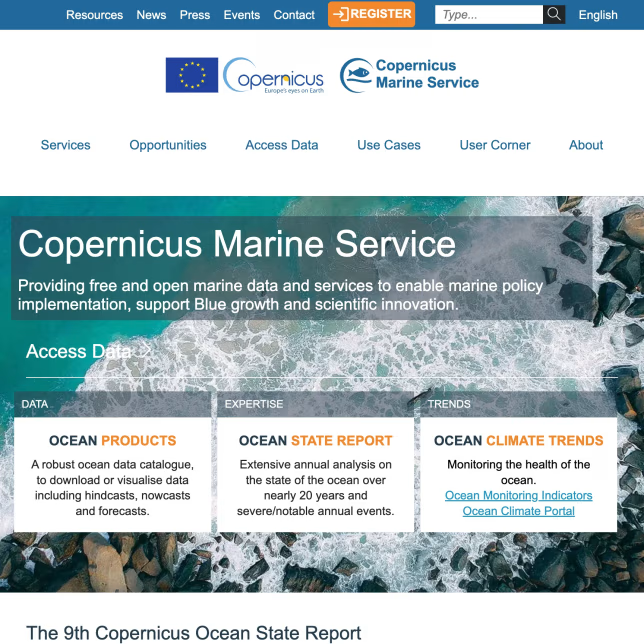
Large Drupal consolidation programs such as Copernicus Marine Service show how search, migration mapping, and secure access need to be treated as part of the same delivery architecture rather than separate post-launch fixes.
Drupal migration readiness
Protect search quality during your Drupal replatform
Use the Health Check to uncover weak metadata, indexing drift, facet issues, and permission risks before they damage search performance.
Tags: Content Operations, enterprise search replatforming, CMS migration search strategy, search indexing architecture, content model for search, search platform integration