 [01]
[01]Discovery and Baseline
Run stakeholder and engineering workshops to map the current ecosystem, constraints, and critical journeys. Produce a current-state view of services, integrations, data flows, and operational risks.
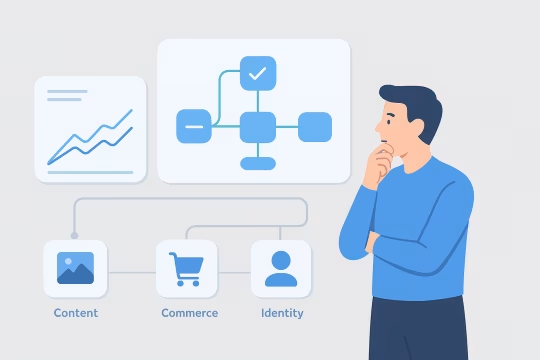
Composable platform architecture defines how independent capabilities—content, commerce, search, identity, personalization, and experience delivery—work together through stable contracts. For enterprise headless ecosystem design, this architecture is the difference between a flexible platform and a distributed set of tightly coupled integrations that are difficult to change safely.
Organizations need this capability when multiple teams deliver across channels, products, and regions, and when vendor ecosystems evolve faster than internal release cycles. A composable architecture establishes domain boundaries, ownership, and interface standards (APIs, events, schemas) so teams can ship independently while preserving platform coherence.
The result is a platform blueprint that supports scalable delivery: a reference architecture, integration and data flow patterns, security and identity model, and an operating model for change. It enables modernization without large rewrites by defining migration paths, compatibility strategies, and governance that keeps the ecosystem maintainable as it grows.
Core Focus
Best Fit For
Key Outcomes
Technology Ecosystem
Platform Integrations



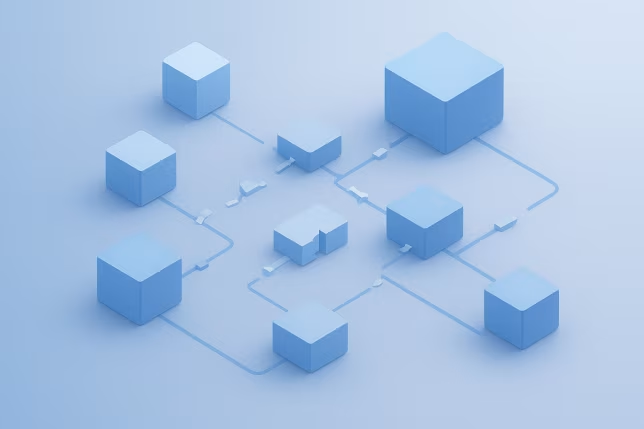
As headless ecosystems grow, teams often add services and vendors incrementally: a CMS here, a commerce engine there, a search provider, a CDP, and multiple frontend applications. Without an explicit composable architecture, integrations evolve as point-to-point connections and implicit assumptions. Over time, the platform becomes a web of dependencies where changes in one system ripple unpredictably across others.
Engineering teams then spend more time coordinating releases than delivering product value. API contracts are undocumented or unstable, domain ownership is unclear, and data flows are duplicated across services. Frontend teams compensate by embedding business logic in clients, while backend teams introduce ad-hoc orchestration that is hard to test and observe. Security and identity become inconsistent across channels, and incident response is slowed by limited traceability.
Operationally, this increases delivery risk: migrations stall because compatibility is not planned, vendor changes require broad refactoring, and performance issues are difficult to isolate. The platform may still function, but it becomes expensive to evolve, and architectural decisions are made reactively under delivery pressure.
Assess current ecosystem components, team topology, delivery constraints, and critical user journeys. Capture existing integrations, data flows, and operational pain points to establish a baseline architecture and risk profile.
Define bounded contexts, capability ownership, and service responsibilities using domain and event modeling. Identify where composition happens (experience, orchestration, or data) and where strict separation is required.
Specify API and event contracts, schemas, versioning strategy, and error semantics. Establish standards for idempotency, pagination, caching, and backward compatibility to support independent releases.
Select integration approaches per interaction type: synchronous APIs, asynchronous events, orchestration, or choreography. Define gateway policies, routing, transformation, and resilience patterns such as retries, circuit breakers, and timeouts.
Design identity, authorization, and secrets management across services and channels. Define token flows, service-to-service authentication, least-privilege access, and audit requirements aligned to enterprise controls.
Define observability standards (logs, metrics, traces), SLOs, and incident workflows. Establish deployment topology, environment strategy, and runbooks so the architecture is operable, not just diagrammed.
Create a phased plan to move from current-state to target-state with minimal disruption. Include strangler patterns, compatibility layers, data migration sequencing, and measurable checkpoints for risk-managed evolution.
Introduce lightweight governance: architecture decision records, contract review gates, and reference implementations. Align on ownership and change processes so standards persist as teams and vendors change.
This service establishes the technical foundations required for a composable headless ecosystem to evolve safely. The focus is on explicit boundaries, stable contracts, and integration patterns that reduce coupling while supporting performance, security, and operability. The architecture is expressed as actionable standards and reference implementations so teams can apply it consistently across products and channels.

A target-state architecture that defines the major platform building blocks and how they interact: experience delivery, content, commerce, search, identity, integration, and data services. Includes deployment topology, trust boundaries, and a clear separation between domain services and cross-cutting platform capabilities.

A domain model that assigns ownership and responsibilities to teams and services, reducing overlap and duplicated logic. Defines bounded contexts, shared kernel rules (when necessary), and explicit interaction points so changes can be localized and tested within a domain.
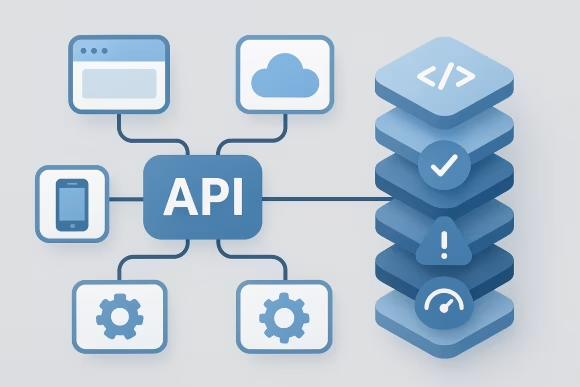
A consistent approach to API design and lifecycle management, including versioning, compatibility rules, schema governance, and error semantics. Establishes conventions for performance-related concerns such as caching, pagination, and rate limiting to keep consumer behavior predictable.

Event models and messaging patterns for asynchronous integration, including event naming, schema evolution, ordering expectations, and idempotency. Clarifies when to use events versus synchronous APIs and how to handle eventual consistency without leaking complexity into clients.
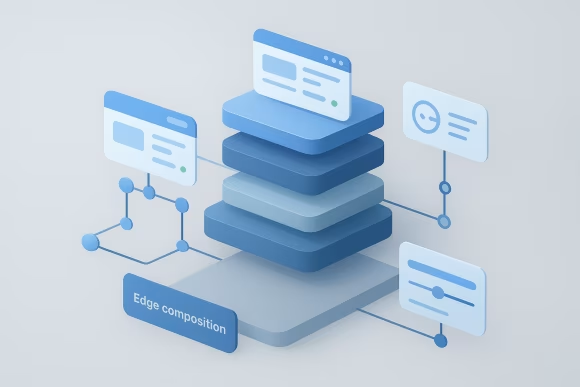
A defined approach for where and how composition occurs: frontend composition, backend-for-frontend, orchestration services, or edge composition. Includes guidance on minimizing cross-domain queries, controlling latency, and preventing business logic from drifting into presentation layers.

A unified security architecture covering user authentication, authorization, and service-to-service trust. Defines token flows, scopes/claims strategy, secrets management, and audit logging expectations so security is consistent across channels and vendors.
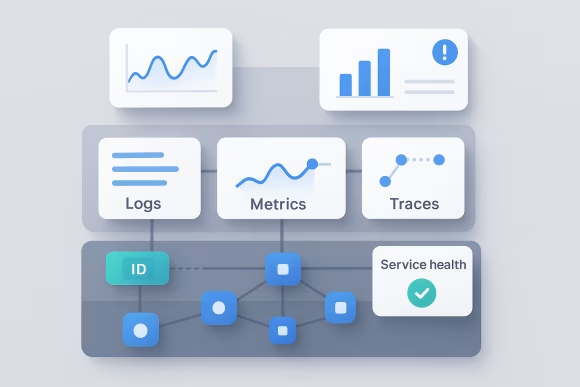
Standards for logs, metrics, traces, correlation IDs, and service health reporting across the ecosystem. Defines SLOs, alerting signals, and dependency mapping so teams can diagnose incidents and performance regressions across distributed services.
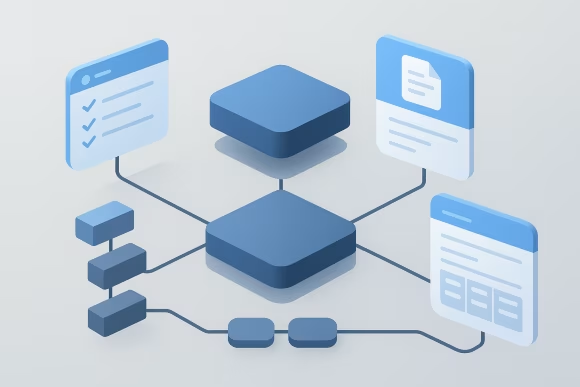
Practical governance artifacts such as architecture decision records, contract review checklists, and reference templates. Establishes change control for shared interfaces while preserving team autonomy through clear ownership and lightweight review gates.
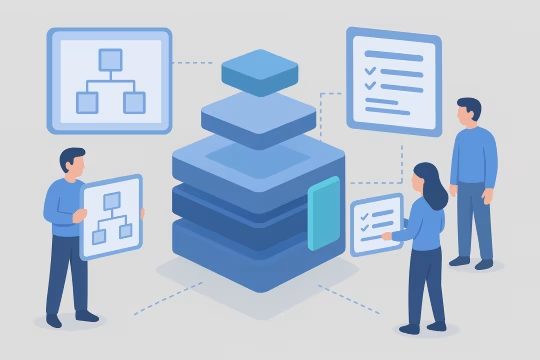
Delivery follows a clear engineering sequence—from discovery and domain decomposition through API-first contract design, integration patterns, and operational readiness. We validate decisions against real constraints (latency, security, compliance, and team topology) and produce standards and reference patterns that can be implemented and evolved across a cloud infrastructure composable architecture.
[01]Run stakeholder and engineering workshops to map the current ecosystem, constraints, and critical journeys. Produce a current-state view of services, integrations, data flows, and operational risks.
 [02]
[02]Define target-state architecture, domain boundaries, composition approach, and integration patterns. Capture key decisions as ADRs and align on non-functional requirements such as latency, availability, and compliance.
 [03]
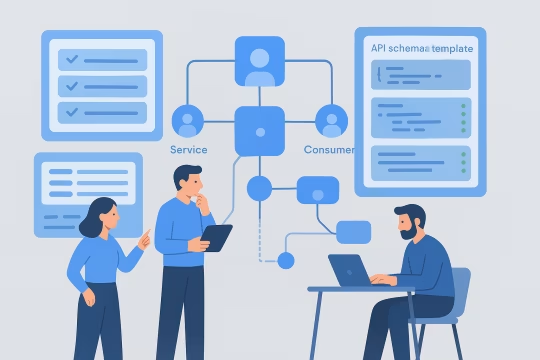
[03]Design API and event contracts, versioning strategy, and schema governance. Provide templates and examples that teams can apply consistently across services and consumers.
 [04]
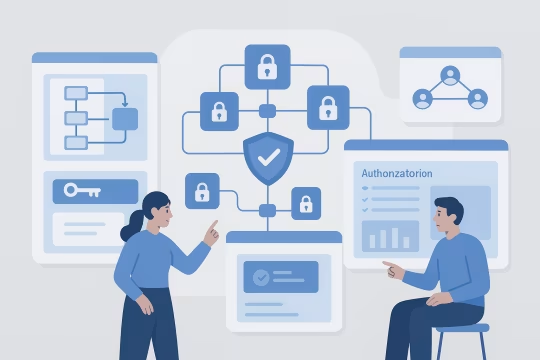
[04]Define identity flows, authorization model, and service-to-service trust. Align architecture with enterprise security controls, audit requirements, and secrets management practices.
 [05]
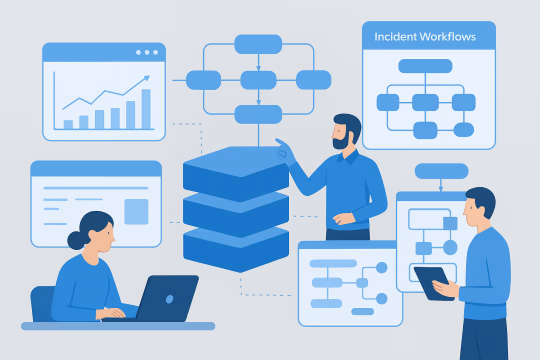
[05]Specify observability standards, SLOs, and incident workflows. Define deployment topology and environment strategy so the platform is operable across teams and vendors.
 [06]
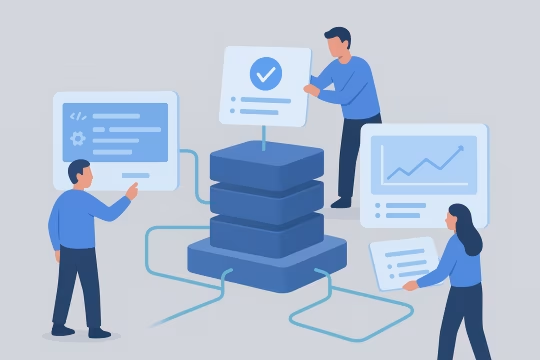
[06]Implement a thin vertical slice or reference components to validate patterns in real code. Use the slice to test performance assumptions, integration behavior, and developer workflows.
 [07]
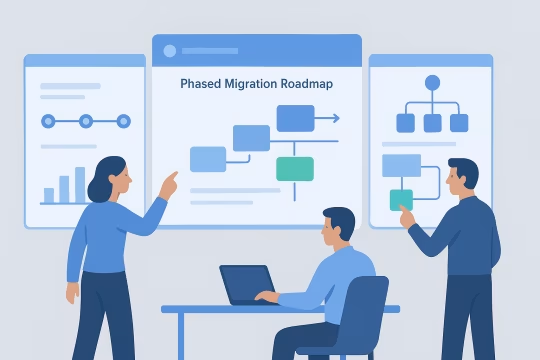
[07]Create a phased roadmap with sequencing, dependencies, and rollback considerations. Define compatibility layers and strangler patterns to reduce risk during transition.
 [08]
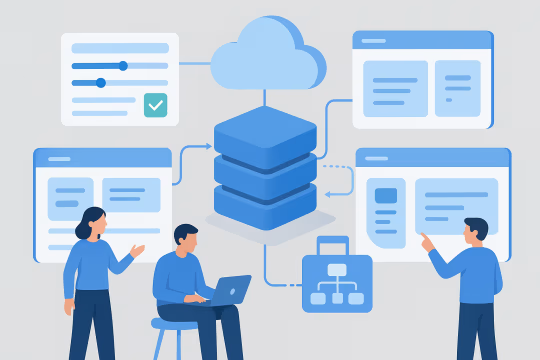
[08]Establish governance routines, review gates for shared contracts, and ownership boundaries. Deliver playbooks and enablement sessions so teams can sustain the architecture over time.
Composable architecture improves delivery flow by reducing coupling and clarifying ownership, while strengthening reliability through explicit contracts and operational standards. The impact is realized through fewer cross-team blockers, safer platform changes, and a clearer path for modernization and vendor evolution.
Clear domain boundaries and stable contracts reduce cross-team coordination for routine changes. Teams can release services and frontends independently with fewer integration surprises and less regression risk.
Standardized API and event semantics reduce brittle point-to-point integrations. Versioning and compatibility rules make changes predictable for consumers and reduce emergency fixes during releases.
Composition and integration patterns are designed with latency, throughput, and failure modes in mind. This supports growth in traffic, channels, and services without forcing repeated architectural rewrites.
Observability standards and SLO-driven monitoring improve detection and diagnosis across distributed services. Incident response becomes faster because dependencies and failure domains are explicit and traceable.
A unified identity and authorization model reduces inconsistent access controls across vendors and channels. Service-to-service trust and auditability are designed in, supporting enterprise governance requirements.
Composable boundaries and integration layers reduce lock-in and isolate vendor changes. Teams can replace or upgrade components with less platform-wide refactoring and clearer migration steps.
Governance mechanisms and reference patterns prevent ad-hoc architecture drift. Decisions are recorded, interfaces are reviewed, and shared standards reduce the accumulation of inconsistent implementations.
A phased migration roadmap clarifies sequencing, dependencies, and measurable milestones. Leadership can plan budgets and capacity with a clearer view of risk, effort, and platform outcomes.
These related services extend composable platform architecture services into adjacent work such as API platform architecture, headless integrations, implementation enablement, and operational maturity across the enterprise headless ecosystem.
Enterprise API design for scalable, secure foundations
Composable DXP content architecture and API-first platform design
API-first enterprise headless CMS platform architecture for content delivery
Structured schemas for an API-first content strategy
Contract-first headless API development for enterprise delivery
Headless CMS API integration, contracts, and integration layer engineering
Enterprise GraphQL schema design and governance
Target architecture and platform operating model
Headless DXP architecture planning for modular experience platforms
Headless architecture roadmap and target architecture definition
Headless CMS CI/CD pipelines for decoupled web platforms
Metrics, traces, and alerts across APIs
Answers to common questions on how to build a composable digital platform architecture—covering domain boundaries, API-first composable architecture for enterprise, integration patterns, governance, security, operations, and engagement approach.
We start from domain boundaries, team ownership, and operational constraints rather than defaulting to a style. If a capability has clear boundaries, independent release needs, and distinct scaling or compliance requirements, a separate service can be justified. If boundaries are still evolving, or the organization lacks mature operational tooling, a modular monolith can provide strong separation with lower distributed-systems overhead. In practice, composable platforms often mix both. We define a target decomposition and then choose an incremental path: begin with a modular monolith for a domain, enforce internal module contracts, and extract services only when the interface stabilizes and the operational cost is acceptable. We also evaluate latency budgets, data consistency needs, and failure isolation. The output is a decision record that ties architecture choices to measurable constraints (release cadence, incident load, performance targets) so the platform can evolve without ideology-driven rewrites.
Composition location depends on latency, personalization needs, and how much cross-domain coordination you can tolerate. Frontend composition can work well when domains are truly independent and the client can tolerate multiple calls, but it often pushes business logic and error handling into many clients. A backend-for-frontend (BFF) centralizes composition per channel, reduces client complexity, and can enforce caching and security consistently. An orchestration layer is appropriate when workflows span multiple domains and require coordination, retries, and compensating actions. We typically avoid a single “god orchestrator” by defining orchestration per business workflow and keeping domain services authoritative for their data. We model the critical journeys, set a latency and resiliency budget, and then select a composition strategy that minimizes coupling while meeting performance and operability requirements. The result includes clear rules for what logic belongs where and how to prevent composition layers from becoming new monoliths.
Reliable operation requires consistent observability, clear ownership, and disciplined change management across services and vendors. At minimum, each service should emit structured logs, metrics, and traces with correlation IDs, and teams should agree on health endpoints and dependency reporting. We define SLOs for critical user journeys and map them to alerts that indicate user impact rather than internal noise. You also need an environment strategy (dev/test/stage/prod), deployment standards, and incident workflows that work across teams. For vendor components, we document integration failure modes, rate limits, and fallback behavior. Operational readiness includes runbooks, on-call expectations, and a way to manage configuration and secrets consistently. We typically deliver an operational model that specifies what “done” means for a service entering the ecosystem: required telemetry, dashboards, alert thresholds, rollback strategy, and ownership metadata. This reduces incident time-to-diagnosis and prevents the platform from becoming unmanageable as the number of components grows.
We treat performance as an architectural constraint, not a post-launch tuning exercise. First, we define latency budgets per journey (e.g., page render, search, checkout) and allocate budgets across calls. Then we choose patterns that reduce round trips: BFF aggregation, caching at the edge, precomputation, and selective denormalization where it does not violate domain ownership. We also design for resilience under partial failure: timeouts, retries with backoff, circuit breakers, and graceful degradation. For headless platforms, caching strategy is critical—what can be cached, for how long, and how invalidation works across content and commerce updates. We define cache keys, surrogate keys, and event-driven invalidation when appropriate. Finally, we validate assumptions with a reference slice and load tests. The goal is to make performance predictable through contracts and budgets, rather than relying on ad-hoc optimizations that break as the ecosystem evolves.
Stability comes from explicit contract ownership, versioning rules, and compatibility testing. We define contract standards for request/response shapes, error semantics, pagination, and idempotency, and we document what is guaranteed versus best-effort. For change management, we adopt a compatibility policy (e.g., additive changes are allowed; breaking changes require a new version) and define deprecation windows. For vendor-backed APIs, we often introduce an anti-corruption layer or facade that presents a stable internal contract while isolating vendor-specific behavior. This reduces churn when vendor APIs change or when you replace a component. We also recommend contract tests and schema validation in CI so consumers can detect breaking changes early. The deliverable is not just an API spec; it is a lifecycle model: how contracts are proposed, reviewed, published, tested, and retired. This is essential in enterprise environments where multiple teams and external partners depend on the same interfaces.
Events are a good fit when you need loose coupling, eventual consistency is acceptable, and multiple consumers may react to the same change (e.g., content published, order placed, customer updated). Synchronous APIs are better when the caller needs an immediate authoritative response to proceed (e.g., pricing calculation, inventory check) and when consistency requirements are strict. We design event-driven integration with clear rules: what constitutes an event, how schemas evolve, and how consumers handle duplicates and out-of-order delivery. We also define how to correlate events to user journeys for observability. A common anti-pattern is using events as a replacement for query APIs; we avoid that by keeping read models explicit (CQRS where justified) and ensuring domain services remain the source of truth. The outcome is a hybrid integration model: synchronous calls for command/query needs, events for propagation and decoupling, and orchestration only where workflows require coordination and compensating actions.
We use lightweight, enforceable governance rather than heavy centralized control. The core mechanisms are: architecture decision records (ADRs) for key choices, contract standards with review gates for shared interfaces, and reference implementations/templates that teams can copy. Governance also depends on clear ownership: each domain has an accountable team, and shared platform capabilities (gateway, identity, observability) have explicit maintainers. To keep governance practical, we define what must be consistent (security controls, API conventions, telemetry) and what can vary (internal implementation details). We also recommend automated checks where possible: linting for API specs, schema validation, and CI policies for required telemetry fields. Regular architecture reviews focus on exceptions and emerging risks rather than re-litigating decisions. The goal is to preserve autonomy while keeping the ecosystem coherent, so teams can move fast without creating incompatible patterns that increase long-term maintenance cost.
Enterprise-scale versioning requires a shared policy and a predictable process. We define how versions are represented (URI, header, semantic versioning), what constitutes a breaking change, and how long old versions are supported. For events, we define schema evolution rules, compatibility expectations, and how consumers discover and validate schemas. Governance includes a publishing workflow: proposal, review, approval, and release notes. We also define deprecation management: communication channels, timelines, and migration guidance. For critical contracts, we recommend consumer-driven contract testing and a compatibility suite that runs in CI before deployment. Importantly, versioning governance must align with organizational reality. If teams cannot coordinate frequently, the policy must favor backward-compatible evolution and additive changes. If regulatory constraints require strict change control, the process must include audit trails and approvals. We tailor the model so it is enforceable and does not become a bottleneck for delivery.
Common risks include over-decomposition, inconsistent contracts, and underestimating operational overhead. Teams may split services too early, creating distributed complexity without clear boundaries or ownership. Another risk is “integration sprawl,” where each team builds bespoke connectors and data transformations, leading to fragile dependencies. We mitigate these by grounding decomposition in domain boundaries and team topology, and by introducing contract standards early. We also define a composition strategy to avoid pushing business logic into clients or creating a single orchestration bottleneck. Operationally, we require baseline observability and resilience patterns so services are supportable. A further risk is vendor lock-in through leaky abstractions. We address this with facades/anti-corruption layers and by documenting exit strategies for critical components. Finally, we manage migration risk with phased roadmaps, compatibility layers, and reference slices that validate patterns before broad rollout. The goal is controlled evolution rather than a big-bang transformation.
We start by distinguishing operational consistency from analytical consistency. For operational flows, we define authoritative sources per domain and choose consistency models explicitly: strong consistency where required, eventual consistency where acceptable. We design commands and events so state changes are traceable and replayable, and we define idempotency and deduplication rules. For reporting and analytics, we typically recommend a separate data platform approach: event streams or CDC into a warehouse/lakehouse, with curated models for cross-domain reporting. This avoids forcing domain services to support complex cross-domain queries and reduces coupling. Where read performance is critical, we may introduce read models or materialized views owned by the consuming domain, with clear refresh and reconciliation rules. We also address data governance: PII classification, retention, access controls, and lineage. The outcome is a data flow architecture that supports both product needs and enterprise reporting without undermining domain ownership or creating hidden dependencies.
A typical engagement produces a target-state reference architecture, domain boundaries and ownership model, contract standards (API and/or events), integration and composition patterns, security and identity model, and an operational model (observability, SLOs, incident workflows). We also deliver a migration roadmap with sequencing, dependencies, and risk controls. When appropriate, we include a reference implementation or thin vertical slice to validate patterns. From your side, we need access to current architecture artifacts (diagrams, API specs, runbooks), key stakeholders (platform, security, product), and engineering representatives from major domains. We also need clarity on constraints: release cadence, compliance requirements, vendor contracts, and current operational maturity. We run structured workshops and then iterate on artifacts with your teams. The goal is to produce outputs that are implementable: standards that fit your tooling and organization, and a roadmap that aligns with delivery realities rather than an idealized end state.
Collaboration usually begins with a short alignment phase to confirm scope, constraints, and the decisions that need to be made. We start with a discovery workshop covering platform goals, current ecosystem components, team topology, and critical user journeys. In parallel, we review existing artifacts such as API specifications, integration diagrams, incident reports, and deployment topology to understand real operational behavior. Next, we agree on a working cadence and stakeholders for architecture decisions: who owns domains, who approves shared contracts, and how security and operations are represented. We then define the initial outputs for the first iteration—typically a current-state map, a draft target reference architecture, and a prioritized list of architectural decisions (ADRs) to resolve. Within the first few weeks, we aim to produce an actionable baseline: clear domain boundaries, a proposed composition strategy, and initial contract standards. From there, we iterate toward a validated architecture and migration roadmap, optionally proving key patterns through a reference slice implemented with your teams.
These case studies showcase real-world implementations of composable platform architecture principles, including domain boundary definition, API-first design, and scalable headless CMS ecosystems. They highlight practical delivery models, integration patterns, and governance frameworks that align closely with the service's focus on scalable, cloud-ready enterprise platforms. The selected work demonstrates measurable outcomes in platform modernization, multi-region content operations, and operational observability within headless and composable architectures.
Users were abandoning the website before fully engaging with content due to slow loading times and an overall poor performance experience.
The updated platform significantly improved speed and usability, resulting in higher user engagement, longer session durations, and increased content exploration.
Arvesta required a modern, scalable headless CMS for enterprise corporate marketing—supporting rapid updates, structured content operations, and consistent UI delivery across multiple teams and repositories.
The platform enabled faster delivery of marketing updates, improved UI consistency across pages, and strengthened editorial operations through structured content models and reusable components.
UNCCD operated four separate websites (two WordPress, two Drupal), leading to inconsistencies in design, content management, and user experience. A unified, scalable solution was needed to support a large-scale CMS migration project and improve efficiency and usability.
The modernization effort resulted in a cohesive, user-friendly, and scalable website, improving content management efficiency and long-term digital sustainability.
It was my pleasure working with Oleksiy (PathToProject) on a new Drupal website. He is a true full-stack developer—the ideal mix of DevOps expertise, deep front-end knowledge, and the structured thinking of a senior back-end developer.
He is well-organized and never lets anything slip. Oleksiy understands what needs to be done before being asked and can manage a project independently with minimal involvement from clients, product managers, or business analysts.
One of the best consultants I’ve worked with so far.

Andrei Melis
Technical Lead at Eau de Web
Oleksiy (PathToProject) worked with me on a specific project over a period of three months. He took full ownership of the project and successfully led it to completion with minimal initial information.
His technical skills are unquestionably top-tier, and working with him was a pleasure. I would gladly collaborate with Oleksiy again at any opportunity.

Nikolaj Stockholm Nielsen
Strategic Hands-On CTO | E-Commerce Growth
Oleksiy (PathToProject) was the Lead Developer on a number of client projects which I managed. He is highly skilled and incredibly hardworking. When assigning work to him, I could always rely on it being completed to a high quality and on time.
His technical expertise was valued across the team and he was often our 'go to' for technical challenges, which he loved to get stuck into. Oleksiy is proactive and engaged in a professional manner with our clients.
I have no hesitation in recommending him.

Daniela Graf
Senior Project Manager | Change Mgmt Practitioner | Process Improvement Geek
These articles expand on the architecture and governance decisions that make composable platforms maintainable in practice. They cover migration strategy, API and publishing controls, and the operational guardrails needed to keep headless ecosystems flexible without becoming fragile.
Share your current ecosystem and delivery constraints. We will map domain boundaries, contract standards, and an operational model that supports scalable headless platform evolution.