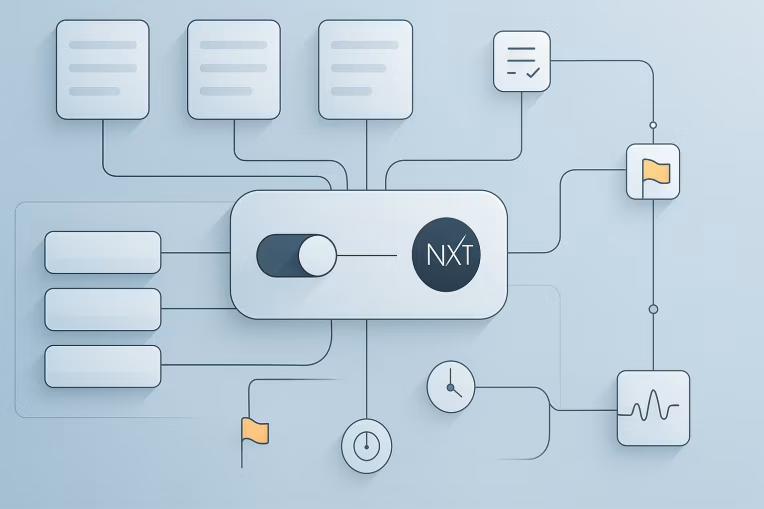
Feature flags are often introduced for a good reason: they let teams separate deployment from release. In enterprise frontend delivery, that is powerful. A team can ship code behind a release toggle, expose a new flow to a small audience, turn off a problematic feature without a full rollback, or coordinate rollout timing across product, engineering, and operations.
That flexibility is real. So is the cost.
In large Next.js and React platforms, flags do not stay confined to one conditional statement. They affect render paths, analytics events, caching behavior, personalization, design system variation, QA scope, and operational response. As more teams use them, flags can quietly become a second architecture layer: dynamic, partially documented, and hard to reason about.
That is why feature flag governance matters. The core problem is not whether flags are good or bad. It is whether the organization treats them as temporary release controls and bounded runtime decisions, or as an unmanaged source of permanent application complexity.
For enterprise digital platforms, governance should answer a simple question: who is allowed to create which kinds of flags, under what rules, for how long, and with what visibility into user and system impact?
Why feature flags solve one problem and create another at scale
At small scale, feature flags feel lightweight.
A product team adds a boolean, wires it into a component tree, and enables the feature for internal users. Release risk goes down. Delivery looks more flexible. Everyone moves on.
At platform scale, the same pattern produces different consequences:
- multiple teams create overlapping flags for the same journey
- old release toggles remain in production long after rollout
- SSR and client-side rendering evaluate flags at different times
- analytics events fragment because users see different variants of the same flow
- cache keys multiply when page output varies by segment or entitlement
- support, QA, and operations teams lose confidence in what any user actually experienced
This is the tradeoff leaders often underestimate. Feature flags reduce release coupling, but they increase runtime branching. If the organization only optimizes for release safety, it can accumulate runtime debt that is harder to see than traditional code debt.
In enterprise web platforms, that debt usually shows up in four ways:
- Cognitive complexity: teams cannot easily predict all active combinations.
- Experience inconsistency: users in similar contexts receive different journeys.
- Operational uncertainty: incidents become harder to isolate because behavior depends on runtime config, not just deployed code.
- Removal failure: temporary logic becomes permanent because no one owns cleanup.
A mature operating model accepts the benefit of flags while constraining these costs.
The flag types teams should not govern the same way: release, experiment, ops, entitlement
One of the most common governance mistakes is treating all flags as the same thing. They are not.
Different flag types create different risks, require different owners, and should follow different lifecycle rules.
Release flags
Release flags are temporary controls used to decouple deployment from launch. They are often the healthiest use of flags when they are short-lived.
Typical use cases include:
- shipping an unfinished interface safely
- progressively enabling a new component or route
- controlling rollout by environment or internal audience
Governance implication: release flags should have the strongest expiry expectations. If a release is complete, the flag should usually be removed, not normalized into permanent branching.
Experiment flags
Experiment flags support A/B tests, journey comparisons, or controlled UX validation.
They usually involve:
- audience segmentation n- analytics instrumentation
- variant consistency across sessions
- coordination with product, design, and experimentation stakeholders
Governance implication: experiment flags need stricter analytics and tracking discipline than release flags. Teams should know which events differ by variant, how attribution works, and when the experiment formally ends.
Ops flags and kill switches
Ops flags exist to reduce operational risk. They may disable an integration, turn off a costly frontend behavior, or provide a fast mitigation path during incidents.
These flags can be appropriate for long-term use, but only when their purpose is explicit.
Governance implication: ops flags need documented operational ownership, clear runbooks, and controlled access. They should not become a vague bucket for unresolved product or architecture issues.
Entitlement and access flags
Some runtime controls are really about product packaging, permissions, or contractual access. They determine what a user, tenant, or account is allowed to see or do.
These are often not temporary flags at all. They are closer to domain rules.
Governance implication: entitlement logic should be treated differently from release management. If it represents stable business behavior, it may belong in a formal policy, permission, or configuration model rather than in an ad hoc feature flag service.
A practical governance model starts by classifying flags before teams create them. If a platform cannot distinguish between a two-week rollout toggle and a long-lived entitlement rule, it will govern both poorly.
Ownership boundaries between product teams, platform teams, and marketing or experimentation functions
Flags become risky when ownership is assumed instead of declared.
In multi-team delivery, the frontend platform usually sits between several functions:
- product teams shipping features
- platform teams maintaining shared rendering, routing, observability, and deployment foundations
- marketing or experimentation teams influencing campaign, personalization, or testing behavior
- operations or SRE functions concerned with resilience and rollback
Without explicit ownership boundaries, the experience layer becomes a shared decision surface with unclear rules.
A more durable model separates responsibilities.
Product teams should own
- the business intent of release and experiment flags in their domain
- acceptance criteria for enabled and disabled states
- expiry dates for temporary flags
- cleanup of feature-conditional code after rollout
Platform teams should own
- approved flag categories and usage standards
- SDK and integration patterns for Next.js and React
- server/client evaluation guidelines
- auditability, access control, and environment governance
- guardrails for cache variation, analytics consistency, and rendering behavior
Experimentation or marketing functions should own
- variant definitions and targeting rules where relevant
- reporting interpretation for active experiments
- consistency between campaign intent and implemented experience logic
But they should not bypass frontend engineering standards for rendering, tracking, or accessibility.
Operations or incident response functions should own
- kill switch policies
- emergency access and rollback procedures
- documentation for operational toggles that remain available in production
The point is not bureaucracy. It is traceability. At any moment, teams should be able to answer:
- why does this flag exist?
- who can change it?
- what user journeys does it affect?
- when should it be removed or reviewed?
If those answers are missing, the flag is already a governance issue.
Flag lifecycle policy: creation, review, expiry, removal, and auditability
The strongest predictor of flag debt is not flag count alone. It is the absence of lifecycle policy.
A useful policy does not need to be complex, but it should be mandatory. In practice, every flag should have a record with a small set of required fields:
- type: release, experiment, ops, entitlement, or another approved category
- owner: named team, not a generic department
- purpose: what decision the flag controls
- scope: routes, components, users, or systems affected
- creation date and target review date
- expiry expectation: especially for release and experiment flags
- removal criteria: what must be true before cleanup
- analytics and observability notes: what signals should be watched
From there, governance becomes operational rather than theoretical.
Creation
Require teams to justify a new flag before implementation. A simple intake checklist is usually enough:
- Is a flag actually needed, or would environment-based rollout or staged deployment solve the problem more cleanly?
- Is this truly temporary, or is it domain configuration?
- Where will the flag be evaluated: server, edge, client, or multiple layers?
- Does the flag change markup, data loading, personalization, pricing, or analytics behavior?
Review
Flags should be reviewed on a schedule aligned to their type.
- Release flags: review quickly and often.
- Experiment flags: review at experiment milestones.
- Ops flags: review with operational runbooks and architecture changes.
- Entitlement logic: review as part of business rule governance.
The review question is not just "is this still used?" It is also "is this still the right control mechanism?"
Expiry
Temporary flags need an explicit expiry window. If there is no expected end state, teams are more likely to normalize indefinite branching.
Expiry does not mean automatic deletion without thought. It means a flagged condition must trigger attention: remove it, renew it with justification, or redesign the underlying behavior.
Removal
Removal discipline is where many organizations fail.
A flag is not finished when it reaches 100% rollout. It is finished when:
- inactive paths are deleted
- tests are updated
- analytics assumptions are simplified
- cache and rendering conditions are reduced
- documentation reflects the steady-state behavior
Treat removal as part of delivery completion, not as optional cleanup.
Auditability
In enterprise settings, auditability matters for reliability and governance even when there is no formal compliance requirement.
Teams should be able to inspect:
- who changed a flag
- when it changed
- which environments were affected
- what rollout state existed during a support or incident window
When user-facing behavior can change at runtime, change history is operationally important.
Runtime risks in Next.js and React platforms: hydration paths, cache variation, SSR and edge behavior
Governance for enterprise frontend architecture has to address more than process. It must also account for the technical places where flags create instability.
Next.js and React platforms are especially sensitive because the same user experience may be shaped across several layers:
- server-side rendering
- static generation with revalidation
- edge middleware or edge rendering
- client-side hydration
- downstream APIs providing personalized data
A flag that looks harmless in a component can behave very differently when these layers disagree.
Hydration mismatches and render divergence
If a flag is evaluated one way on the server and another way in the browser, users can see flicker, layout shifts, or hydration warnings. Even when the UI eventually settles, the experience can feel unstable.
This often happens when:
- targeting depends on client-only information
- user context is unavailable during SSR
- local storage or browser state changes the branch after initial render
Governance response: define approved patterns for where flags are evaluated and what kinds of conditions are allowed to affect initial markup. This is usually part of broader React frontend architecture decisions, not just a tooling choice.
Cache variation and invalidation complexity
Flags can multiply cache states across CDNs, edge layers, and application caches. If full page output varies by audience, geography, entitlement, or experiment bucket, cache design becomes significantly more complex.
Poorly governed variation can lead to:
- incorrect content served to the wrong segment
- reduced cache efficiency
- hard-to-debug inconsistencies between users
Governance response: require teams to declare whether a flag changes cacheable output, and involve platform or edge architecture owners when it does.
SSR, edge, and client evaluation drift
A multi-team platform may evaluate the same decision in more than one place. For example, middleware may route a user based on one signal while the React tree evaluates a separate copy of the flag using another context source.
That drift creates subtle failures. A route can resolve to one version while downstream components assume another.
Governance response: establish a canonical evaluation strategy for each flag category and avoid duplicating decision logic across layers unless there is a clear reason.
Analytics fragmentation
Flags can also affect analytics integrity. If one variant changes event names, form structure, page composition, or conversion sequencing, reporting becomes harder to interpret.
This is especially risky when experiments and release flags overlap on the same journey. Teams may think they are measuring one change while another runtime branch is also influencing user behavior.
Governance response: require analytics review for flags that change journey structure, instrumentation timing, or content visibility. The delivery lessons are similar to platforms such as Organogenesis, where cross-site tracking and release governance had to be made consistent.
Design system variation drift
In large React platforms, design systems are supposed to reduce inconsistency. But flags can reintroduce it by allowing multiple versions of a component, interaction pattern, or content hierarchy to coexist indefinitely.
Governance response: if a flag drives variation in shared UI primitives or major templates, the design system and frontend architecture functions should be involved early.
Observability signals that show flag debt is affecting delivery
Most teams notice flag debt late, after delivery velocity or production confidence has already declined.
You do not need speculative metrics to detect it. There are practical signals that often indicate governance is slipping.
Delivery signals
- release flags remain open long after rollout decisions are complete
- teams hesitate to remove branches because impact is unclear
- QA scope expands with every change because active combinations are unknown
- incident triage starts with reconstructing which flags were enabled rather than understanding the code path
Runtime signals
- users report inconsistent experiences in similar contexts
- support teams struggle to reproduce issues because behavior varies by runtime configuration
- hydration or rendering inconsistencies appear around targeted experiences
- cache behavior becomes harder to predict after introducing new segmented rollouts
Data and reporting signals
- analytics definitions require repeated qualification by flag state
- experiment interpretation is weakened by overlapping release conditions
- product and engineering teams disagree about what users actually saw
Organizational signals
- no single team can produce a trusted inventory of active flags
- ownership is tracked informally or in scattered documents
- platform teams discover long-lived flags embedded in shared components too late
- temporary controls become dependencies for business-as-usual operations
Observability for flag governance should therefore include both technical and operational dimensions:
- flag inventory by type and age
- upcoming and overdue review dates
- changes to high-risk production flags
- correlation between incidents and recent runtime config changes
- affected routes or shared components for each active flag
The goal is not to build observability around the flag tool alone. It is to make runtime decision complexity visible enough that teams can manage it.
A governance model and decision checklist for enterprise teams
A workable governance model should help teams move faster with fewer surprises, not slow them down with ceremony.
A practical approach for enterprise Next.js and React platforms often includes the following layers.
1. Classify before implementation
Require every new flag to be assigned a category. This avoids the common trap of using one mechanism for fundamentally different problems.
2. Define approved evaluation patterns
Document where each flag type may be evaluated:
- server
- edge
- client
- API layer
And define what requires architecture review, especially for flags that affect markup, routing, caching, or entitlements.
3. Make ownership explicit
Each flag should have:
- a business owner
- a technical owner
- a review date
- a removal expectation when temporary
Team ownership is better than individual dependence, but ownership still needs named accountability.
4. Set lifecycle rules by flag type
Not every flag needs the same expiry window, but every flag needs a review policy. Release toggles should face the highest pressure to disappear.
5. Add observability and change history
Make flag state visible in operations and delivery workflows. During incidents, teams should be able to see recent runtime changes as easily as recent deployments. In practice, this often overlaps with Headless DevOps controls around release orchestration, auditability, and rollback.
6. Treat cleanup as part of done
If teams are rewarded for shipping but not for removing temporary controls, runtime debt will grow by default. Delivery completion should include branch removal where appropriate.
A short decision checklist can help teams apply the model consistently:
- What exact problem is this flag solving?
- Is this a temporary release control or a durable business rule?
- Which users, routes, or shared components are affected?
- Where is the decision evaluated, and can those layers disagree?
- Does it change cacheable output, analytics behavior, or design system variation?
- Who owns the flag after launch?
- When will it be reviewed?
- What condition tells us it should be removed?
If a team cannot answer these questions upfront, it is usually safer to pause and simplify the design.
Final perspective
Feature flags are valuable because they give teams control under uncertainty. In enterprise frontend delivery, that control can improve rollout safety, incident response, and experimentation discipline.
But the same mechanism can also become a hidden source of architectural drag when every team adds conditions without shared rules. Over time, the platform stops behaving like a coherent product and starts behaving like a shifting matrix of runtime exceptions.
That is the real reason feature flag governance matters.
It protects more than release safety. It protects experience consistency, analytical trust, operational clarity, and the ability of multiple teams to keep evolving a Next.js platform without losing confidence in how it behaves.
The healthiest goal is not to eliminate flags. It is to make them intentional, observable, and removable. When enterprise teams do that well, feature flags remain what they should be: a delivery capability, not a permanent substitute for architecture.
Tags: feature flag governance, Next.js feature flags, enterprise frontend architecture, frontend release governance, runtime configuration management, React frontend architecture, edge rendering architecture