Core Focus

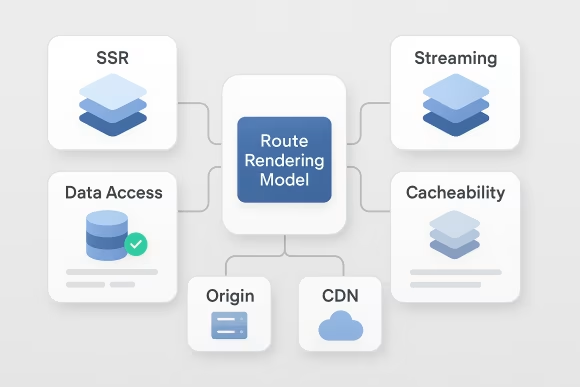
Edge rendering strategy
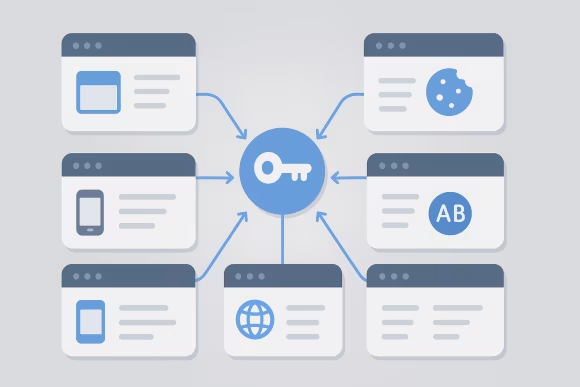
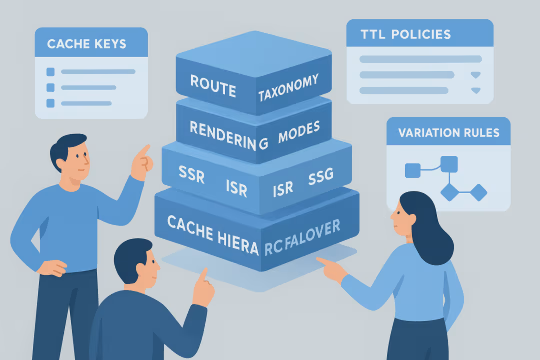
Cache hierarchy and keys
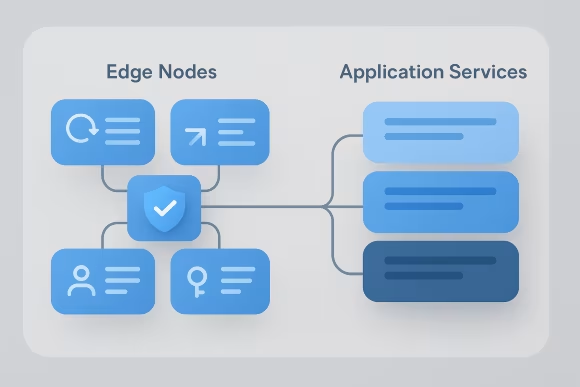
Global routing patterns
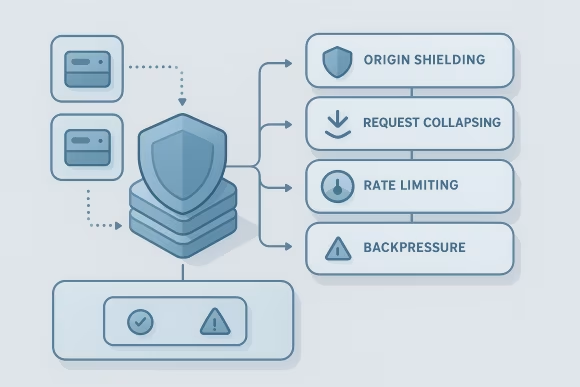
Origin protection design

Best Fit For

  • Multi-region headless platforms
  • High-traffic marketing sites
  • Personalized experiences at scale
  • Teams adopting Next.js

Key Outcomes

  • Lower time-to-first-byte
  • Reduced origin request volume
  • Predictable cache behavior
  • Safer releases at edge

Technology Ecosystem

  • Next.js rendering modes
  • CDN edge compute
  • HTTP caching semantics
  • Observability instrumentation

Platform Integrations

  • Headless CMS APIs
  • Identity and session layers
  • Feature flag services
  • WAF and security headers

Inconsistent Rendering and Caching Increase Latency

As headless platforms expand, teams often mix rendering approaches and CDN behaviors without a shared model. Pages may switch between SSR and static generation based on local decisions, while caching headers, cache keys, and invalidation rules evolve organically. The result is uneven performance across geographies, unpredictable freshness, and hard-to-reproduce issues that only appear under specific cookies, headers, or device variants.

These inconsistencies create architectural friction. Frontend teams struggle to reason about where computation happens and which data is safe to cache. Platform and DevOps teams see rising origin load, noisy cache hit ratios, and brittle purge workflows. Small changes to headers or routing can bypass caches, amplify API traffic, or introduce subtle personalization leaks when cache variation is incomplete.

Operationally, delivery becomes riskier. Incident response is slowed by limited edge observability and unclear ownership of caching rules. Release pipelines may not validate edge behavior, leading to regressions in TTFB, increased error rates from origin saturation, and higher costs from unnecessary compute and bandwidth.

Edge Rendering Architecture Methodology

Platform Discovery

Review current delivery topology, CDN configuration, rendering modes, and origin dependencies. Capture traffic patterns, geography distribution, personalization requirements, and failure modes that influence edge behavior and caching safety.

Rendering Strategy Design

Define where SSR, streaming, ISR, and SSG are appropriate per route group. Specify data-fetch boundaries, session handling, and constraints for cacheability so teams can implement predictable rendering behavior.

Cache Architecture

Design cache hierarchy across browser, CDN, and origin layers. Establish cache keys, variation rules (headers, cookies, device), TTLs, stale-while-revalidate behavior, and invalidation mechanisms aligned to content models.

Routing and Failover

Specify request routing, geo steering, and origin selection patterns. Add origin shielding, retry policies, and graceful degradation paths so edge delivery remains stable during partial outages or traffic spikes.

Security and Compliance

Define security headers, WAF integration points, bot controls, and rules for handling authenticated traffic at the edge. Ensure caching rules prevent data leakage and support auditability for regulated environments.

Implementation Enablement

Provide reference implementations and configuration templates for Next.js and CDN providers. Establish conventions for headers, middleware, and edge functions so product teams can adopt the architecture consistently.

Observability and Testing

Instrument edge and origin with logs, metrics, and traces focused on cache hit ratio, TTFB, and error budgets. Add automated checks for headers, cache variation, and routing behavior in CI.

Governance and Evolution

Create guardrails and review workflows for changes to caching, routing, and edge compute. Maintain runbooks, performance budgets, and a backlog for iterative optimization as content and traffic evolve.

Core Edge Delivery Capabilities

Edge rendering architecture establishes a consistent model for how requests are routed, rendered, and cached across the delivery stack. The capability set focuses on making performance and freshness predictable, protecting origin systems, and enabling teams to ship changes without accidental cache bypass or data exposure. It also introduces measurable controls through observability, testing, and governance so edge behavior can evolve safely as the platform grows.

Capabilities
  • Edge rendering strategy and route taxonomy
  • CDN caching and invalidation design
  • Next.js SSR, ISR, and streaming architecture
  • Edge middleware and rewrite rules
  • Origin shielding and resilience patterns
  • Security headers and WAF alignment
  • Performance budgets and observability setup
  • Governance for edge configuration changes
Target Audience
  • Platform Engineers
  • Frontend Architects
  • DevOps Teams
  • SRE and operations leads
  • CTO and engineering leadership
  • Product platform owners
  • Security and compliance stakeholders
Technology Stack
  • Edge computing runtimes
  • Next.js (SSR, ISR, middleware)
  • CDN configuration and caching
  • HTTP caching headers
  • Origin shielding patterns
  • Observability (logs, metrics, traces)
  • WAF and security headers
  • Headless CMS APIs

Delivery Model

Delivery is structured to make edge behavior explicit, testable, and governable. We start by mapping current rendering and caching behavior, then design a target architecture with clear conventions, reference implementations, and operational controls that teams can adopt incrementally.

Delivery card for Discovery and Baseline[01]

Discovery and Baseline

Assess current CDN configuration, Next.js rendering usage, and origin dependencies. Establish baseline metrics for TTFB, cache hit ratio, and origin load, and identify routes with the highest risk from personalization or inconsistent headers.

Delivery card for Target Architecture[02]

Target Architecture

Define the route taxonomy, rendering modes, cache hierarchy, and routing/failover behavior. Produce an architecture spec that includes cache keys, TTL policies, variation rules, and boundaries for edge compute versus origin services.

Delivery card for Reference Implementation[03]

Reference Implementation

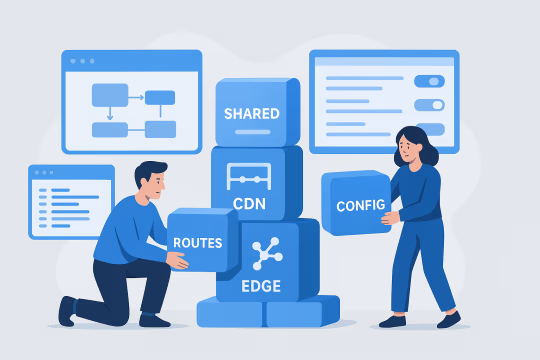
Implement representative routes and shared utilities (headers, middleware patterns, fetch wrappers) in a controlled environment. Provide configuration templates for CDN rules and edge functions to standardize adoption across teams.

Delivery card for Integration and Hardening[04]

Integration and Hardening

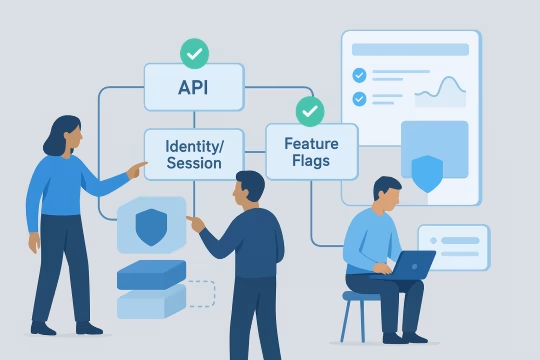
Integrate with headless CMS APIs, identity/session layers, and feature flags while preserving cache safety. Add origin shielding and resilience controls, and validate behavior under traffic and failure scenarios.

Delivery card for Testing and Validation[05]

Testing and Validation

Add automated checks for caching headers, cache variation, redirects/rewrites, and routing rules in CI. Run performance tests to confirm improvements and to detect regressions in edge latency or origin saturation.

Delivery card for Deployment and Cutover[06]

Deployment and Cutover

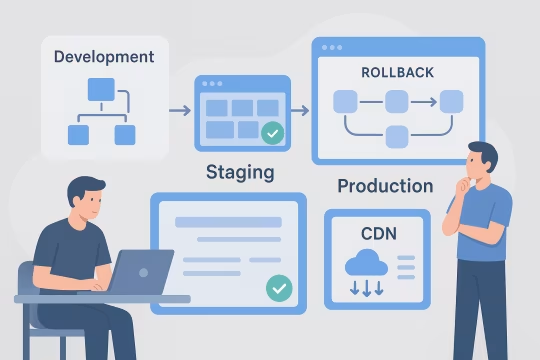
Roll out changes using progressive delivery, canary releases, and controlled cache warming where needed. Ensure rollback paths are defined for CDN configuration and application changes that affect edge behavior.

Delivery card for Observability and Runbooks[07]

Observability and Runbooks

Finalize dashboards and alerts for delivery-layer signals, and document runbooks for cache incidents, purge workflows, and regional failover. Align operational ownership and escalation paths across platform and product teams.

Delivery card for Continuous Optimization[08]

Continuous Optimization

Iterate on TTLs, cache keys, and rendering choices based on real traffic and content change patterns. Maintain governance for edge changes, and evolve the architecture as new routes, regions, and personalization requirements are introduced.

Business Impact

Edge rendering architecture improves delivery predictability by reducing latency variance, controlling origin load, and making caching behavior governable. The impact is most visible in global performance, operational stability, and the ability to evolve a headless platform without repeated delivery regressions.

Lower Global Latency

Improves time-to-first-byte by serving more requests from edge caches and minimizing round trips to origin services. Reduces performance variance across regions by aligning routing and rendering modes to geography and traffic patterns.

Reduced Origin Load

Decreases unnecessary API and rendering traffic through cache hierarchy design and request collapsing. Protects upstream systems during spikes, lowering the likelihood of cascading failures and throttling events.

Predictable Freshness

Establishes explicit TTL and invalidation rules tied to content models and release workflows. Teams can change content and code with clearer expectations about when users will see updates.

Lower Delivery Risk

Introduces guardrails and automated validation for headers, cache variation, and routing changes. This reduces regressions caused by subtle configuration drift and makes rollbacks more reliable.

Improved Platform Resilience

Adds failover and degradation patterns so the edge can continue serving cached or simplified responses when origins degrade. Improves incident containment by reducing dependency on single-region origin availability.

Better Observability

Provides measurable signals for cache effectiveness, edge compute latency, and origin health with correlation across layers. Shortens time to diagnose delivery issues and supports SLO-driven operations.

Faster Change Adoption

Standardizes conventions and reference patterns so product teams can implement new routes without re-learning caching pitfalls. Reduces review overhead by making edge behavior consistent and testable.

Cost Control Levers

Creates tunable parameters for cache TTLs, compute placement, and bandwidth usage. Enables informed trade-offs between freshness, performance, and infrastructure cost as traffic and content volumes grow.

FAQ

Common architecture, operations, integration, governance, risk, and engagement questions for edge rendering on headless platforms.

How do you decide between SSR, ISR, SSG, and edge streaming?

We start by classifying routes by data volatility, personalization, and dependency criticality. For highly cacheable content with predictable updates, SSG or ISR is usually appropriate, with TTLs and revalidation tied to content change events. For routes that must reflect near-real-time data or user-specific state, SSR or streaming can be used, but we constrain what data is fetched during render and how sessions are handled. We then map each route group to an explicit rendering contract: what inputs vary (locale, device, experiment), what can be cached, and where computation runs (edge vs origin). This avoids accidental cache bypass and makes performance characteristics predictable. Finally, we validate the model against operational constraints: origin capacity, regional availability, and failure modes. The goal is not to maximize edge compute usage, but to place computation where it reduces latency and risk while keeping the system maintainable.

What does a good cache hierarchy look like for headless delivery?

A good cache hierarchy is explicit about responsibilities across browser cache, CDN edge cache, and origin-side caching. We define which responses are cacheable at the edge, how long they live (TTL), and what triggers revalidation or invalidation. For headless platforms, we also design how API responses are cached or shielded so page rendering does not amplify origin traffic. Key elements include: consistent Cache-Control and surrogate headers, a cache key strategy that captures only the necessary variation, and origin shielding to reduce the number of requests that reach application services. We also define how authenticated traffic is handled, typically separating public cacheable content from private responses. The architecture is validated with metrics such as cache hit ratio, origin request rate, and TTFB by route group. This ensures the hierarchy is not just theoretical but measurable and operable.

How do you operate and monitor edge rendering in production?

We treat edge delivery as an operational layer with its own SLOs and runbooks. Monitoring focuses on signals that explain user-perceived performance and system stress: TTFB, cache hit ratio, edge function latency, origin response times, error rates, and regional anomalies. Where possible, we correlate edge logs with origin traces so teams can see whether a request was served from cache, executed at the edge, or forwarded to origin. Operational practices include alert thresholds aligned to error budgets, dashboards segmented by route group and geography, and incident playbooks for common failure modes such as cache fragmentation, misconfigured headers, or regional origin degradation. We also recommend controlled change management for CDN and edge configuration, including versioning, peer review, and automated validation in CI to reduce configuration drift and production-only surprises.

How do you handle cache invalidation without creating operational risk?

We prefer designs that minimize reliance on large-scale purges. Instead, we use TTLs, stale-while-revalidate, and targeted invalidation keyed to content models and route groups. When invalidation is required, we scope it narrowly using predictable URL patterns, tags, or surrogate keys supported by the CDN, and we document the blast radius and expected propagation time. We also design for safe fallback behavior: serving slightly stale content is often preferable to over-purging and forcing a thundering herd to origin. For high-change areas, ISR or revalidation workflows can provide freshness without global cache flushes. Operationally, we add guardrails: purge rate limits, approval workflows for broad invalidations, and post-change monitoring that checks cache hit ratio and origin load. This makes invalidation a controlled operation rather than an emergency tool.

How does edge rendering integrate with a headless CMS and content APIs?

Integration starts with understanding content freshness requirements and API characteristics. We design how pages and API responses are cached, including whether the CMS can emit webhooks or events to trigger revalidation. For read-heavy content, we typically cache at the edge and use revalidation keyed to content types or route groups, reducing direct dependency on CMS availability for every request. We also define data-fetch boundaries in the frontend: which calls happen during render, which can be deferred, and which should be precomputed. This reduces latency and avoids coupling critical routes to slow or rate-limited endpoints. Finally, we align headers and cache keys so that CMS-driven variation (locale, preview mode, personalization flags) is handled safely. Preview and editorial workflows are usually isolated from public caching to prevent leakage and to keep cache behavior predictable.

How do you support personalization, experiments, and authenticated sessions at the edge?

We start by separating public cacheable content from user-specific responses. Personalization can be handled through edge-side routing, lightweight middleware, or client-side composition depending on sensitivity and performance needs. When personalization affects HTML, we define explicit cache variation rules and ensure that cookies or headers used for segmentation are included in the cache key only when necessary. For experiments, we often use a stable bucketing mechanism and propagate the variant via a header or cookie, then decide whether the experiment should fragment cache or be applied client-side. For authenticated sessions, we typically avoid caching private HTML at shared edges unless the CDN supports private caching semantics and the risk is acceptable. The integration design includes security review, data classification, and automated tests that validate cache variation and header behavior to prevent cross-user content leakage.

What governance is needed to keep edge behavior consistent across teams?

Edge behavior changes can be as impactful as application code changes, so governance should treat CDN configuration, headers, and routing rules as versioned artifacts. We recommend a shared set of conventions: standard headers, cache directives, route taxonomy, and approved patterns for middleware and edge functions. These conventions are documented and reinforced through code review checklists and automated linting. We also define ownership boundaries: who can change cache keys, TTL policies, or routing rules, and what approvals are required for high-blast-radius changes. For larger organizations, a platform team often maintains the baseline configuration while product teams consume it via templates and shared libraries. Finally, we establish measurable budgets (performance and cache effectiveness) and require validation in CI. This keeps governance practical: teams can move quickly, but changes that risk cache fragmentation or security issues are caught early.

How do you manage configuration drift between environments and regions?

We manage drift by making edge configuration declarative and environment-aware. CDN rules, edge functions, and header policies should be defined in code, versioned, and promoted through the same pipeline as application changes. Differences between environments are expressed as controlled parameters (origins, domains, feature toggles), not ad hoc manual edits. For multi-region setups, we define a single source of truth for routing and failover logic and validate it with automated tests that simulate requests from different geographies and with different variation inputs. We also recommend periodic reconciliation checks that compare deployed configuration to the repository state. Operationally, drift is detected via monitoring: sudden changes in cache hit ratio, increased origin traffic, or unexpected redirect patterns often indicate configuration divergence. Runbooks should include steps to verify and restore known-good configurations quickly.

What are the main security risks with edge caching and how are they mitigated?

The primary risk is serving the wrong content variant, especially when authenticated or personalized data is involved. This can happen when cache keys do not vary on the right inputs or when private responses are accidentally marked cacheable. Mitigation starts with strict header policies: explicit Cache-Control directives, separation of public and private routes, and defensive defaults that prevent caching unless a route is classified as safe. We also design and test variation rules for cookies, headers, locale, and device. Automated checks validate that sensitive routes return no-store and that public routes do not vary on high-cardinality inputs that fragment cache. For edge middleware, we review how tokens and session identifiers are handled and ensure logs do not capture sensitive values. Finally, we integrate WAF controls, security headers, and bot protections at the edge. Security review is part of the architecture, not an afterthought, because caching and routing decisions directly affect exposure and data handling.

What failure modes are common in edge rendering architectures?

Common failure modes include cache fragmentation (low hit ratio due to excessive variation), cache bypass (headers or routing changes that prevent caching), and origin overload (purges or misses causing traffic spikes). Another frequent issue is inconsistent behavior across regions due to routing rules, DNS configuration, or partial rollout of edge functions. We mitigate these by designing explicit cache keys and TTL policies, adding origin shielding and request collapsing, and implementing progressive delivery for configuration changes. We also define fallback behavior: serving stale content, simplified pages, or static error responses when origins degrade. From an operational standpoint, observability is critical. Without edge logs and metrics, teams cannot distinguish between edge compute latency, cache misses, and origin slowness. We ensure the architecture includes the telemetry needed to diagnose issues quickly and to validate that resilience mechanisms behave as intended.

What inputs do you need from our teams to design the edge architecture?

We need a clear view of your current delivery stack and constraints. Typical inputs include: CDN provider and configuration access (or exports), Next.js application structure and deployment model, route inventory (including traffic and criticality), and a description of personalization, authentication, and experimentation requirements. We also request baseline metrics: TTFB and latency by region, cache hit ratio, origin request rates, and error rates. For headless integrations, we need API characteristics such as rate limits, response times, and content change frequency, plus any webhook or event capabilities for revalidation. Finally, we align on operational expectations: incident response ownership, change management practices, and compliance requirements. These inputs let us design an architecture that is not only fast, but also operable within your organization’s governance model.

How long does an edge rendering architecture engagement typically take?

Timelines depend on platform complexity and how much implementation is included. An architecture-focused engagement that produces a route taxonomy, cache key strategy, header policy, and reference configuration typically takes 2–4 weeks, assuming access to current configuration and baseline metrics. If the engagement includes reference implementation in Next.js, CI validation, and observability setup, it often extends to 4–8 weeks. Multi-region routing, failover testing, and integration with identity or experimentation systems can add time, especially if changes require coordination across multiple teams. We usually structure work in phases so you can adopt improvements incrementally: start with the highest-traffic routes and the most impactful caching fixes, then expand coverage as conventions and tooling are established.

How do you work with our existing Next.js and DevOps teams?

We collaborate by establishing shared artifacts and clear ownership. For Next.js teams, we provide a route-level rendering model, reference patterns for data fetching and headers, and shared utilities that make cache behavior consistent. For DevOps and platform teams, we define declarative CDN configuration, deployment workflows, and observability requirements. Work is typically organized around joint design sessions, followed by implementation pairing on a small set of representative routes and configurations. This ensures the architecture is grounded in your codebase and operational realities. We also set up review and validation mechanisms so teams can continue independently: CI checks for headers and routing, dashboards for delivery metrics, and runbooks for cache incidents. The goal is to leave behind a maintainable system, not a one-off configuration snapshot.

How does collaboration typically begin for this service?

Collaboration typically begins with a short technical intake to align on goals, constraints, and access. We schedule a working session with platform, frontend, and DevOps stakeholders to review the current delivery topology, identify critical routes, and agree on the primary risks to address first (latency variance, origin load, personalization safety, or operational drift). Next, we request the minimum artifacts needed to build an accurate baseline: CDN configuration exports, deployment pipeline overview, route inventory, and performance metrics by region. If metrics are incomplete, we define a lightweight measurement plan to capture cache hit ratio, TTFB, and origin request rates. We then propose a phased plan with clear outputs: an architecture specification, reference implementation targets, validation checks to add to CI, and an operational handover package (dashboards and runbooks). This keeps the engagement measurable and aligned to engineering execution.

Evaluate your edge delivery architecture

Share your current routing, rendering, and caching model, and we will identify the highest-impact architectural changes for performance, resilience, and operability.

Oleksiy (Oly) Kalinichenko

Oleksiy (Oly) Kalinichenko

CTO at PathToProject

Do you want to start a project?