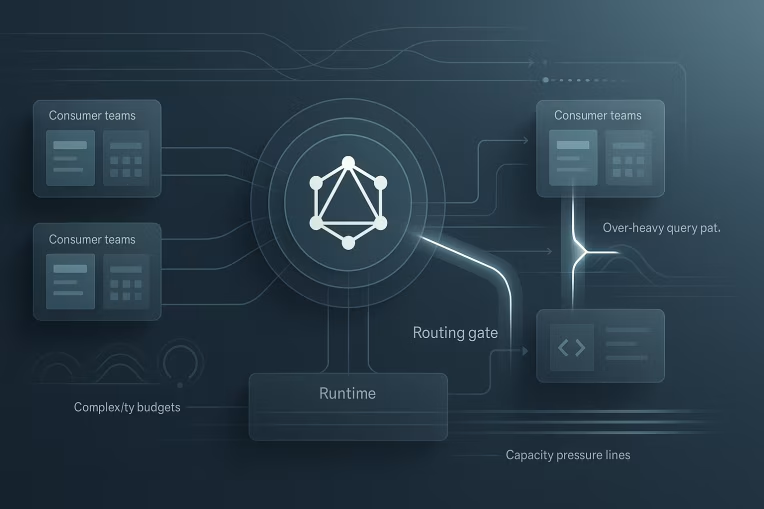
In enterprise headless environments, GraphQL often succeeds for the exact reason it later becomes difficult to operate: it gives many teams the freedom to shape responses around product needs.
That flexibility is valuable. It reduces over-fetching in many cases, supports composable frontend delivery, and lets different channels move at different speeds. But once the same GraphQL layer is shared across multiple brands, product lines, internal tools, preview experiences, and dashboard-style consumers, the cost of a query stops being a local concern. It becomes a platform concern.
That is where GraphQL query cost governance matters.
This is not the same as teaching developers to write better queries, and it is not just about blocking obviously bad requests. It is about creating a set of runtime controls, review paths, and observability signals that protect a shared API from accidental or repeated misuse while still preserving useful flexibility for consuming teams.
A strong governance model answers practical questions such as:
- What level of query complexity is acceptable by default?
- Which dimensions matter most: depth, breadth, resolver fan-out, timeout risk, or backend dependency pressure?
- When should a product team get an exception?
- How should internal tools and preview traffic be treated?
- Who owns intervention when one consumer creates platform-wide degradation?
For multi-team headless platforms, these are operating model questions as much as engineering questions.
Why GraphQL performance degrades even when the schema looks healthy
A GraphQL schema can appear well-designed and still create runtime problems.
That happens because schema quality and query behavior are related, but they are not the same thing. A clear type system, sensible naming, and clean domain boundaries do not automatically prevent expensive execution paths. Teams can still combine fields in ways that produce high resolver fan-out, repeated downstream calls, large list expansions, or cache-unfriendly access patterns.
In shared enterprise platforms, degradation often emerges gradually:
- One team adds a dashboard that refreshes frequently.
- Another introduces preview experiences that bypass normal caching behavior.
- A third consumer requests wide content trees for convenience.
- An internal reporting tool begins polling aggressively because it was never treated like a production consumer.
No single change looks catastrophic in isolation. But together, they increase origin pressure, raise tail latency, and make performance less predictable.
This is why GraphQL runtime risk often shows up as a platform symptom before it is recognized as a query design problem. The schema may still look healthy in architecture review. The issue is that execution cost is being created dynamically by many consumers at once.
The difference between schema governance and query cost governance
Schema governance and query cost governance should work together, but they solve different problems.
Schema governance focuses on structural quality and long-term maintainability:
- domain boundaries
- naming and consistency
- deprecation policy
- field ownership
- versioning and evolution
- authorization patterns at the type and field level
Query cost governance focuses on runtime behavior:
- how expensive a request is to execute
- how much downstream work it creates
- whether it can bypass cache layers
- whether it threatens latency objectives for other consumers
- whether it should be allowed, throttled, rewritten, or reviewed
A team can have mature schema governance and still operate a fragile runtime if cost controls are weak. The reverse is also true: strict runtime blocking cannot compensate for a poorly structured schema forever.
The distinction matters because many organizations assume existing API review boards or schema change processes already cover performance risk. Typically, they do not. Most review processes assess what fields are exposed, not how combinations of fields behave under real traffic conditions.
For a platform team, the practical takeaway is simple: govern the shape of the API and the cost of using it as separate concerns.
Common failure patterns: nested joins, broad lists, preview traffic, and dashboard-style consumers
Enterprise GraphQL cost issues are usually repetitive rather than exotic. The same patterns appear across headless CMS integrations, BFF layers, and shared experience APIs.
1. Nested joins across multiple backing services
A query may look reasonable at the top level but trigger chained lookups across content, search, commerce, profile, or entitlement systems. If those lookups are not efficiently batched or cached, a single request can multiply into dozens or hundreds of backend operations.
2. Broad list expansion
Large collections are frequently the hidden problem. A query that asks for a list of 100 items and then requests several nested relationships for each item can quickly become expensive even when query depth is not extreme.
This is why depth limits alone are rarely enough. A shallow query can still be operationally heavy if breadth is unbounded.
3. Preview and editorial traffic
Preview use cases often bypass CDN caching, request draft content, and hit fresh backend data more often. In headless environments, preview traffic is easy to underestimate because it may not be as visible as public site traffic, yet it can create disproportionate load during publishing cycles.
4. Dashboard-style consumers
Internal applications, reporting screens, and admin dashboards often fetch many data slices at once and refresh on intervals. They are valuable business tools, but they can become some of the most expensive API consumers because they prioritize convenience over strict runtime efficiency.
5. Consumer convenience queries
Teams often ask for "one query to get everything needed for the page." That request is understandable, but without guardrails it can push aggregation logic into a shared runtime layer that becomes harder to scale and reason about.
6. High-frequency retries and polling
Even moderately expensive queries become harmful when paired with aggressive retry behavior, short polling intervals, or client-side error loops.
These patterns are common enough that governance should be designed around them explicitly instead of relying on ad hoc intervention after incidents occur.
Defining cost budgets: depth, breadth, resolver weight, and timeout policy
A usable governance model starts with a budget system. The goal is not mathematical perfection. The goal is to create a consistent and explainable way to decide which queries are safe by default, which need optimization, and which require exceptions.
Most enterprise teams benefit from combining several control dimensions rather than relying on one rule.
Depth limits
Depth limits help prevent excessively nested queries. They are easy to understand and can stop obvious abuse or accidental recursion-like behavior.
But depth should be treated as a coarse control. It is useful, not sufficient.
A depth rule works best when it is paired with context, such as:
- lower default depth for public or anonymous traffic
- higher tolerated depth for trusted internal consumers
- stricter thresholds on fields known to expand into expensive relationships
Breadth and list size limits
Breadth controls often matter as much as depth.
Examples include:
- maximum page size or list size
- maximum number of sibling selections on expensive object types
- limits on repeated fragments over large collections
- connection rules that enforce pagination
In practice, many runtime problems come from retrieving too many items or too many nested children per item, not from exceptionally deep queries.
Resolver weight or complexity scoring
Complexity scoring adds more realism by assigning weight to fields or patterns that are known to cost more. For example:
- a simple scalar field may have minimal cost
- a field that calls another service may have higher cost
- a field returning a collection may multiply cost by the requested item count
- fields that bypass cache or require live assembly may carry additional weight
The exact formula does not need to be overly sophisticated on day one. It just needs to reflect operational reality well enough to separate safe requests from risky ones.
This can be especially useful in BFF and shared API environments where some fields are almost free while others represent expensive orchestration.
Timeouts and execution policy
Cost budgets should connect to execution policy.
If a request exceeds complexity thresholds, the platform should have clear behavior such as:
- reject before execution
- throttle based on consumer class
- require persisted or reviewed queries for that pattern
- reduce allowable concurrency
- enforce tighter timeouts
Timeouts alone are not governance, but they are an important last line of defense. A request that ties up compute or downstream connections for too long can hurt unrelated traffic even if it eventually fails.
Budget design principles
When defining budgets, useful principles include:
- start with conservative defaults and adjust from observed traffic
- separate public, partner, internal, and preview traffic classes
- document why a limit exists, not just the number itself
- avoid rules so complex that product teams cannot understand them
- calibrate against real query patterns rather than hypothetical extremes
A governance model earns adoption when it is predictable. Teams do not need unlimited flexibility; they need clarity on what is normal and how to request something outside the default envelope.
Exception handling for trusted consumers and internal tools
Exceptions are not a sign of governance failure. In enterprise platforms, they are inevitable.
The mistake is allowing exceptions to happen informally.
Some consumers have legitimate reasons to exceed standard budgets:
- editorial preview tools
- internal operations dashboards
- migration utilities
- controlled back-office workflows
- premium product experiences with special caching strategies
The right response is not to pretend all consumers are equal. The right response is to create a controlled exception path.
A practical exception model usually includes:
- a named consumer identity
- an approved use case and owner
- a documented scope of higher limits
- a review of expected traffic volume and concurrency
- an expiry or revalidation date
- telemetry dashboards specific to that consumer
This turns exceptions into governed contracts instead of silent permanent loopholes.
Where possible, trusted consumers should also accept stronger obligations in exchange for elevated limits, such as:
- using persisted queries
- following stricter release review for query changes
- using lower polling frequency
- routing traffic through a dedicated BFF for aggregation-heavy needs
- avoiding peak publishing or campaign windows where feasible
The principle is simple: if a consumer receives more runtime freedom, it should also accept more runtime discipline.
Observability signals: slow queries, repeated offenders, cache bypass, and origin pressure
Cost governance only works if teams can see what is actually happening.
Platform telemetry should make query behavior visible at the consumer level, not just as aggregate API latency. Otherwise, one noisy consumer disappears inside blended averages until the problem becomes severe.
Important signals typically include:
Slow query patterns
Track which query signatures, persisted operations, or request shapes create high p95 and p99 latency. Focus on recurring patterns, not only one-off outliers.
Repeated offenders
Identify consumers that repeatedly approach or exceed budget thresholds. A good governance model supports intervention before incidents occur.
Cache bypass behavior
Flag traffic that frequently misses cache or deliberately bypasses it, especially preview and authenticated flows. Cache-bypass traffic is often operationally expensive even when volume appears modest.
Origin pressure and downstream dependency load
Correlate GraphQL request patterns with backend impact:
- spikes in CMS origin calls
- increased search or commerce API latency
- connection pool exhaustion
- queue backlogs
- elevated error rates in downstream systems
This is critical because GraphQL often acts as an orchestration layer. The visible problem may appear in GraphQL latency while the root cause is dependency pressure created by specific query shapes.
Consumer segmentation
Break telemetry down by:
- application or client identity
- environment
- channel
- operation name or persisted query id
- preview vs published mode
- authenticated vs anonymous traffic
Without segmentation, governance becomes guesswork.
Budget decision metrics
Teams should be able to answer questions such as:
- What percentage of requests are near the current complexity ceiling?
- Which fields are most associated with expensive operations?
- Which consumers would be affected by stricter breadth limits?
- Are exception consumers staying within expected behavior?
This is where headless observability becomes strategically important. It gives platform owners a way to manage shared runtime risk using evidence rather than anecdotes.
Governance workflow: who approves, who monitors, and when to intervene
Even well-designed technical controls will underperform if ownership is unclear.
In multi-team environments, query cost governance should be treated as a lightweight platform process with explicit roles.
A common model looks like this:
Platform team responsibilities
The platform or API enablement team typically owns:
- default cost budget definitions
- complexity analysis and runtime enforcement mechanisms
- telemetry and reporting standards
- exception policy design
- incident response playbooks for abusive or unstable consumers
This team should not become a bottleneck for every normal query change, but it should own the rules of the shared runtime.
Product or consumer team responsibilities
Consumer teams typically own:
- query design within published limits
- remediation when their operations create avoidable pressure
- clear ownership of approved exceptions
- release coordination for major query behavior changes
This keeps accountability close to the team creating the demand pattern.
Architecture or review leadership responsibilities
Solution architects or platform architects can help in cases where the issue is not just a bad query but a broader design problem, such as:
- a frontend trying to aggregate too many concerns in one request
- a shared API taking on responsibilities better handled by a BFF
- editorial tooling using public runtime paths for heavy internal workflows
- a multi-brand platform needing segmentation or tiered service boundaries
Intervention triggers
Intervention should not depend on subjective frustration. Define explicit triggers, such as:
- repeated budget threshold breaches
- sustained impact on latency objectives
- downstream dependency pressure beyond safe ranges
- rising timeout or retry loops from a known consumer
- exception consumers operating outside approved parameters
When those triggers are met, the response path should be known in advance: notify the owner, constrain the query pattern, introduce a temporary throttle, or require architectural remediation.
Governance works best when it is predictable and non-dramatic. The goal is to avoid debates during incidents by deciding the process before the incident happens.
Rollout plan for adding cost controls without breaking active consumers
Many organizations delay query cost governance because they assume the only path is a hard cutover that will immediately break consuming applications. That risk is real if controls are introduced abruptly. It is much lower if rollout is phased.
A practical rollout plan can look like this:
Phase 1: Baseline and observe
Start by measuring current behavior without enforcement.
Use telemetry to identify:
- highest-cost query patterns
- major consumer classes
- preview and internal traffic characteristics
- fields most associated with backend fan-out
- natural thresholds for safe default limits
At this stage, the goal is understanding, not blocking.
Phase 2: Publish policy and consumer guidance
Document the governance model in plain language.
Include:
- the dimensions being measured
- default budgets
- how exceptions work
- what teams should do when they need more
- how to contact the platform owner
This step matters because enforcement without documentation feels arbitrary.
Phase 3: Warn before blocking
Introduce soft enforcement first.
Examples include:
- response headers indicating budget score
- logs or dashboards visible to consumer teams
- alerts when operations exceed recommended thresholds
- review tickets for high-cost persisted queries
This gives teams time to remediate without causing immediate delivery disruption.
Phase 4: Enforce default controls
Once the baseline is understood and communication is established, enforce default limits for new or changed query patterns.
Prefer targeted enforcement over broad surprise failures. For example:
- require pagination on known collection fields
- block queries above a defined complexity score
- apply stricter thresholds to anonymous traffic
- require persisted queries for high-value public surfaces
Phase 5: Formalize exceptions and escalation
As enforcement matures, move exception handling into a durable workflow with approval records, ownership, and expiry dates.
This is especially important in enterprise headless platforms where internal tools, editorial systems, and regional brand implementations may all have distinct runtime behaviors.
Phase 6: Refine architecture where policy alone is not enough
Some expensive patterns should not merely be tolerated under exception. They should trigger architectural improvement.
Examples include:
- moving heavy aggregation into a dedicated BFF
- separating preview infrastructure paths from published traffic
- introducing stronger caching or precomputation
- redesigning fields whose cost is consistently disproportionate
Governance should not become a permanent wrapper around avoidable design problems.
Practical design choices that reduce shared runtime risk
Although cost governance is not just a tooling exercise, a few implementation choices consistently support better outcomes:
- Persisted queries can improve visibility and control by making common operations explicit and reviewable.
- Consumer identity is essential; anonymous shared traffic is difficult to govern well.
- Rate limiting remains useful, especially when paired with cost scoring rather than request count alone.
- Tiered policies for public, partner, preview, and internal traffic usually work better than one universal threshold.
- Field ownership helps platform teams know who can remediate expensive resolver behavior.
- BFF patterns can be appropriate when a single product experience needs aggregation logic that does not belong in a general-purpose shared API.
None of these replaces governance. They make governance easier to enforce and easier to explain.
For companies operating a GraphQL API platform, API platform architecture, headless API development, or headless observability model at scale, the core challenge is not whether GraphQL is flexible. It is how to preserve that flexibility without allowing one consumer's convenience to become every consumer's reliability problem.
Conclusion
GraphQL query cost governance is best understood as a platform discipline.
In multi-team headless environments, runtime risk rarely comes from one obviously broken query. It usually comes from many legitimate use cases interacting inside a shared execution layer with too few guardrails. That is why the solution cannot be limited to occasional optimization work or post-incident cleanup.
Teams need a model that defines what normal looks like, what exceptions are allowed, how expensive patterns are observed, and when platform owners are expected to intervene.
If you get that model right, GraphQL remains what enterprises want it to be: a flexible contract for fast product delivery.
If you skip it, flexibility can slowly turn into a shared runtime liability.
The practical goal is not to eliminate expensive queries entirely. It is to make their cost visible, intentional, and governable before they affect the broader platform.
Tags: GraphQL query cost governance, Frontend Architecture, GraphQL complexity analysis, Headless API performance governance, Multi-team GraphQL operations