 [01]
[01]Discovery and Mapping
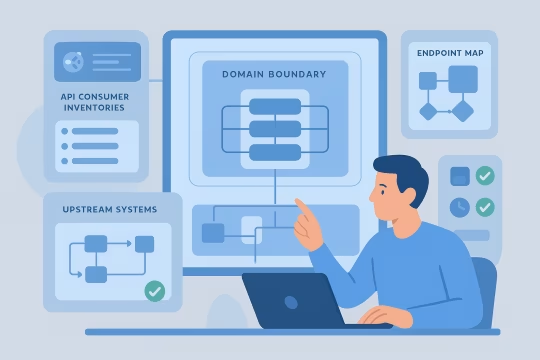
We inventory consumers, upstream systems, and existing endpoints. The output is a prioritized API backlog, domain boundary map, and non-functional requirements including security, latency, and availability targets.
Headless API development services focus on designing and implementing stable interfaces that decouple content, commerce, and domain services from consuming applications. In a headless architecture, APIs become the product surface area: they define how web, mobile, kiosks, and partner systems access capabilities and data through enterprise REST API engineering and GraphQL schema design services.
Organizations need this capability when channel teams move faster than backend change cycles, when multiple systems must be composed into a single experience layer, or when integrations have grown organically without consistent contracts. Without deliberate REST API design and schema governance, teams accumulate breaking changes, inconsistent semantics, and duplicated business logic across services.
A well-engineered API layer supports scalable platform integration architecture by enforcing clear boundaries, enabling independent deployment, and providing predictable evolution through an API versioning strategy and deprecation policies. It also creates an operational foundation for reliability and security through OAuth2 and JWT security for headless APIs, rate limiting, observability for APIs, and automated testing aligned to API contracts.
Core Focus
Best Fit For
Key Outcomes
Technology Ecosystem
Delivery Scope



As headless platforms grow, APIs often emerge from incremental feature delivery rather than intentional interface design. Teams add endpoints to meet immediate channel needs, introduce inconsistent naming and semantics, and couple client behavior to internal data models. Over time, the API surface becomes difficult to reason about, and changes in one system ripple across multiple consumers.
This fragmentation affects engineering teams in predictable ways: backend teams spend cycles supporting multiple “almost the same” endpoints, frontend teams implement defensive logic for inconsistent responses, and platform architects struggle to enforce boundaries between domain services. Without clear contracts, integration work becomes negotiation-heavy, and testing shifts from automated validation to manual coordination across teams.
Operationally, the risk increases as traffic and consumers scale. Missing rate limits, weak authentication patterns, and limited observability make incidents harder to detect and resolve. Release management becomes conservative because breaking changes are discovered late, and deprecation becomes politically and technically expensive. The result is slower delivery, higher maintenance overhead, and reduced confidence in the platform’s ability to evolve.
Review current consumers, upstream systems, and integration constraints. We map API use cases, identify domain boundaries, and capture non-functional requirements such as latency targets, security posture, and expected change frequency.
Define API contracts before implementation, including resource models or GraphQL schema, error semantics, pagination, and filtering. We align on backward-compatibility rules, deprecation approach, and documentation standards.
Design service boundaries, data access patterns, and integration topology. This includes gateway strategy, caching considerations, authN/authZ flows, and decisions on orchestration versus choreography for composed responses.
Implement endpoints and resolvers with consistent validation, error handling, and idempotency where required. We build reusable middleware for authentication, authorization, rate limiting, and request tracing.
Connect APIs to headless CMS, identity providers, and downstream services using adapters and anti-corruption layers. We handle mapping, transformation, and resilience patterns such as timeouts, retries, and circuit breakers.
Automate contract tests, integration tests, and security checks. We validate backward compatibility, enforce schema rules, and add performance tests for critical flows to prevent regressions under load.
Deploy with controlled rollout strategies and environment parity. We instrument logs, metrics, and traces, define SLOs, and configure alerting so API behavior is measurable and supportable in production.
Establish versioning, change management, and documentation workflows. We implement deprecation policies, consumer communication patterns, and a backlog for iterative improvements based on usage analytics and incidents.
This service builds the technical foundation required for APIs to function as stable platform interfaces in headless architectures. The focus is on contract-first API development, consistent semantics, and integration patterns that reduce coupling between consumers and internal systems. Capabilities include OAuth2/JWT API security, an API versioning strategy, API gateway integration patterns, and production-grade observability for APIs. The result is an API layer that can evolve safely while supporting multiple channels and teams.
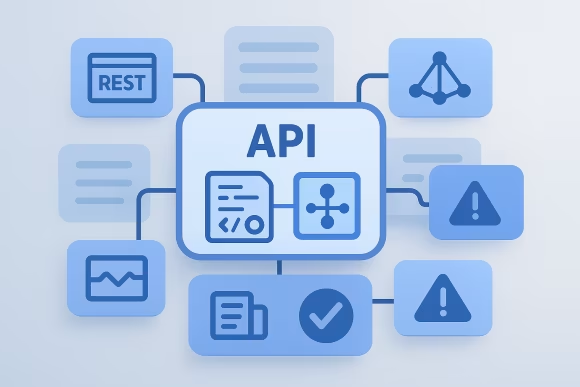
Define API behavior through explicit contracts before implementation, using OpenAPI for REST or schema-first GraphQL. Contracts cover request/response shapes, error models, pagination, filtering, and compatibility rules. This reduces ambiguity between teams and enables automated validation in CI/CD pipelines.
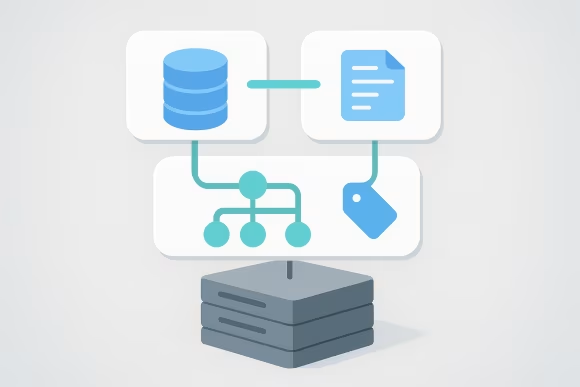
Model resources, relationships, and domain concepts to avoid leaking internal persistence structures into public interfaces. For GraphQL, this includes type design, query boundaries, and resolver responsibilities. For REST, this includes consistent naming, hypermedia considerations where appropriate, and predictable query patterns.
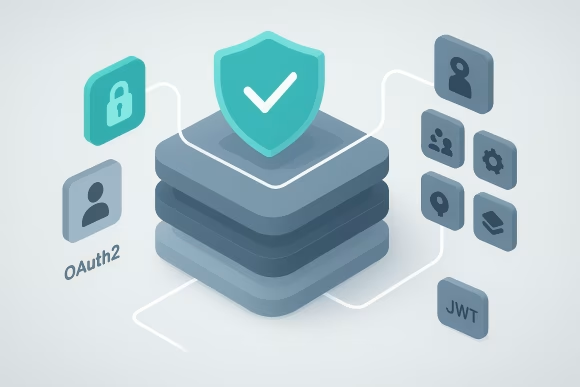
Implement authentication and authorization patterns aligned to enterprise identity, typically using OAuth2 and JWT. Capabilities include scoped access, role-based authorization, tenant isolation where required, and secure defaults for sensitive fields. Security controls are enforced consistently via middleware and policy checks.
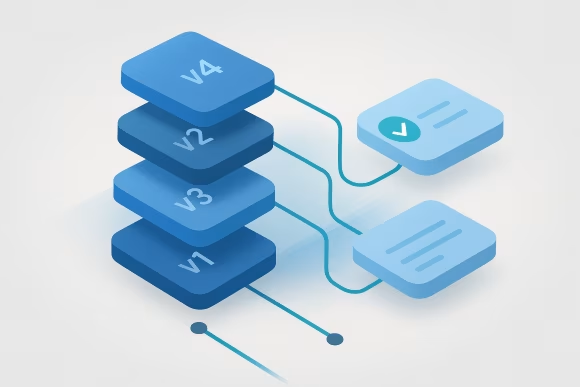
Provide mechanisms to evolve APIs without breaking consumers, including versioned routes, header-based negotiation, or schema evolution rules for GraphQL. Deprecation is treated as an engineering workflow with timelines, telemetry, and consumer communication. Compatibility checks can be automated through contract testing.
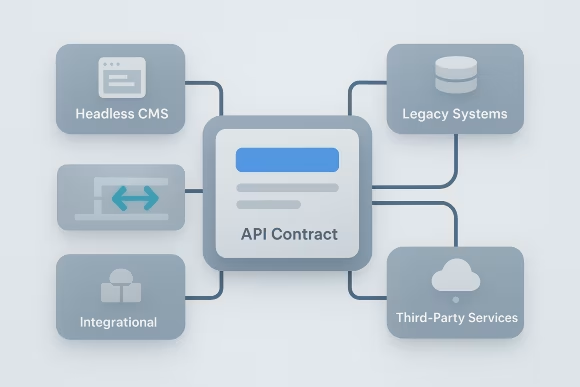
Build adapters and anti-corruption layers to integrate headless CMS, legacy systems, and third-party services without coupling the API contract to upstream quirks. This includes transformation, normalization, and resilience patterns. The API remains stable even when upstream systems change or behave inconsistently.
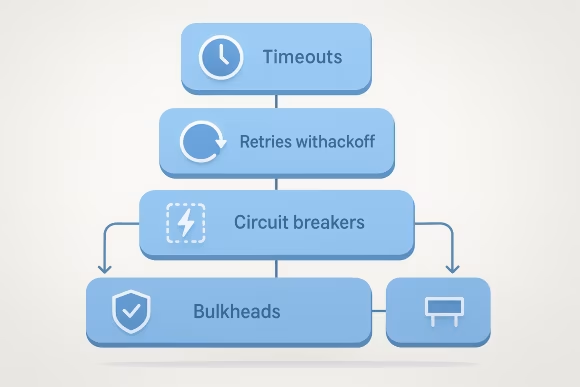
Engineer for predictable behavior under failure and load using timeouts, retries with backoff, circuit breakers, and bulkheads. Implement idempotency for write operations where needed and protect upstream systems with rate limiting. These patterns reduce incident frequency and limit blast radius.
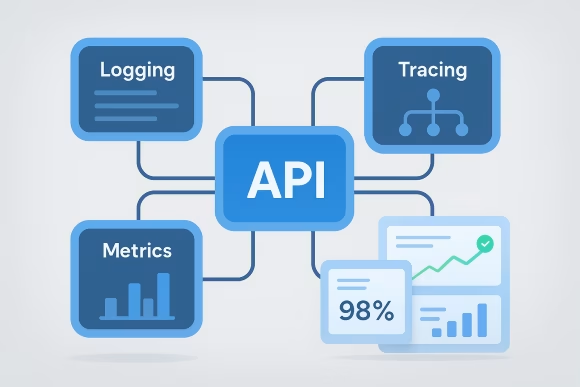
Instrument APIs with structured logging, distributed tracing, and metrics that map to user-facing behavior. Define SLOs for latency and error rates, and implement correlation IDs across services. This enables faster root-cause analysis and supports operational ownership across teams.
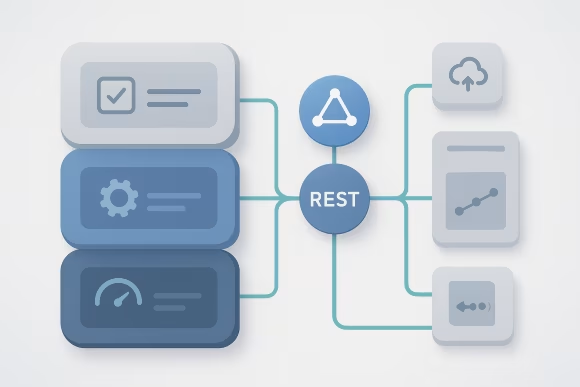
Implement layered testing including contract tests, integration tests against real dependencies, and performance tests for critical paths. For GraphQL, validate schema changes and resolver behavior; for REST, validate OpenAPI conformance. Automated tests reduce regression risk and support continuous delivery.
Delivery is structured to establish API contracts early, implement integrations safely, and reach operational readiness before production rollout. Work is organized in short iterations with measurable acceptance criteria, automated testing, and clear ownership boundaries between platform and product teams.
[01]We inventory consumers, upstream systems, and existing endpoints. The output is a prioritized API backlog, domain boundary map, and non-functional requirements including security, latency, and availability targets.
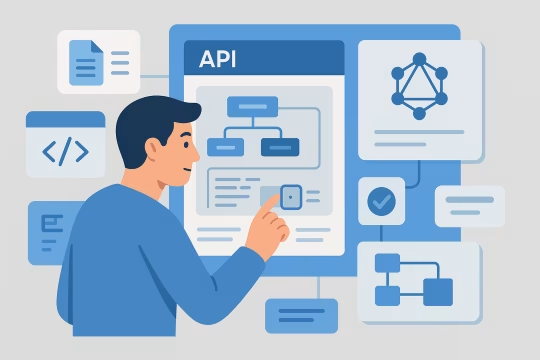 [02]
[02]We define REST resources or GraphQL schema, including error semantics and compatibility rules. Documentation and examples are produced alongside the contract to support consumer adoption and automated validation.
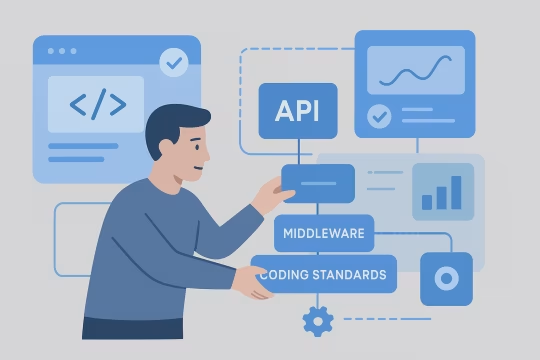 [03]
[03]We build a thin vertical slice to validate architecture decisions, integration patterns, and performance assumptions. This establishes coding standards, middleware patterns, and a baseline for testing and observability.
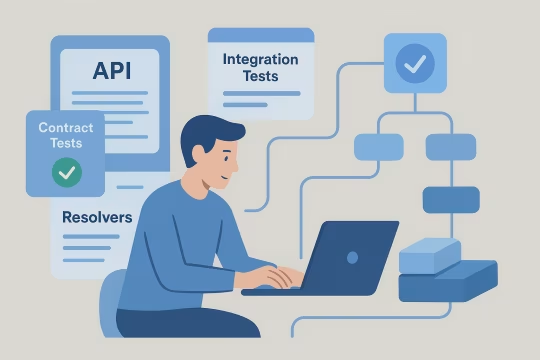 [04]
[04]Endpoints and resolvers are implemented iteratively with contract tests and integration tests. Changes are reviewed for consistency, backward compatibility, and alignment to domain boundaries.
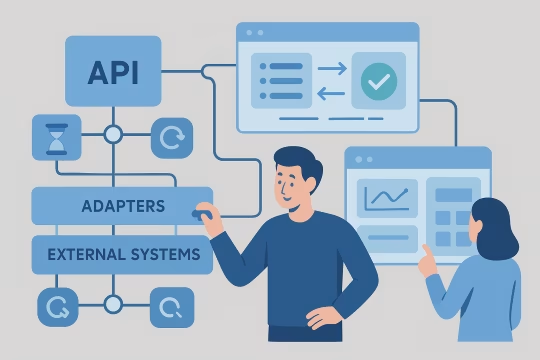 [05]
[05]We implement adapters to headless CMS and downstream services with timeouts, retries, and circuit breakers. Data mapping and normalization are centralized to prevent duplication across consumers.
 [06]
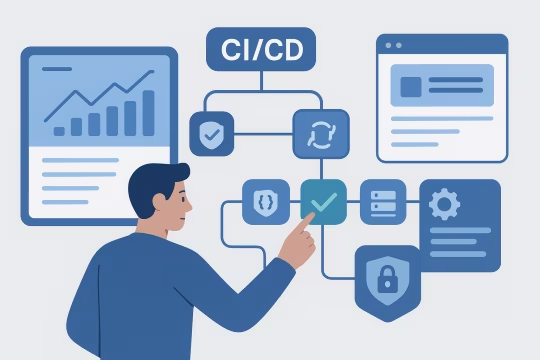
[06]CI/CD pipelines enforce linting, unit tests, contract conformance, and security checks. Performance tests are added for critical flows, and release notes capture consumer-impacting changes.
 [07]
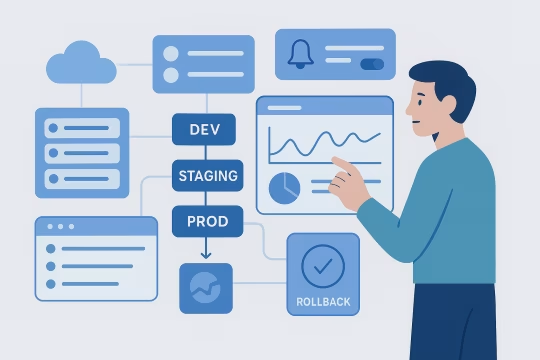
[07]We configure monitoring, alerting, dashboards, and runbooks aligned to SLOs. Rollout plans include staged deployments and rollback strategies to control risk during adoption.
 [08]
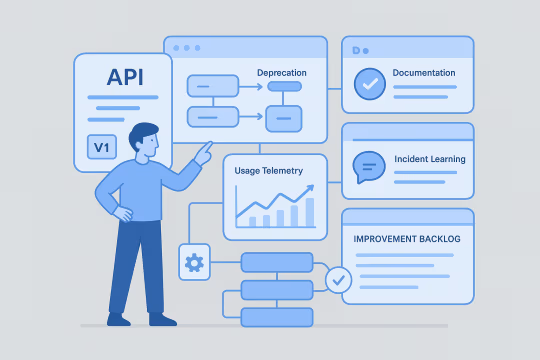
[08]We establish versioning, deprecation, and documentation workflows. Usage telemetry and incident learnings feed an improvement backlog to keep the API surface coherent as the platform evolves.
Headless APIs become a stable platform interface when contracts, security, and operational controls are engineered intentionally. The impact is primarily seen in delivery throughput, reduced integration risk, and improved ability to evolve platform capabilities without disrupting channels.
Stable API contracts reduce coordination overhead between frontend and backend teams. Channel teams can build against predictable interfaces and iterate independently, shortening lead time for multi-channel features.
Contract-first design and compatibility rules reduce breaking changes discovered late in release cycles. Automated contract and integration tests catch regressions earlier and make releases more routine.
Clear boundaries and reliability patterns support growth in consumers and traffic. Rate limiting, caching strategies, and resilient integrations reduce load amplification and protect upstream systems.
Consistent semantics, shared middleware, and adapter layers reduce duplicated logic across services and clients. This makes the API surface easier to extend and decreases long-term support effort.
Centralized authN/authZ patterns and scoped access reduce accidental exposure of sensitive data. Security controls become auditable and consistent across endpoints and consumers.
Metrics, logs, and traces aligned to API behavior improve incident detection and diagnosis. Teams can manage performance and reliability using SLOs rather than anecdotal reports.
Versioning and deprecation workflows allow the platform to evolve without forcing synchronized rewrites across consumers. Telemetry-driven decisions help prioritize changes based on real usage.
These related services extend headless API development into adjacent architecture and delivery concerns—platform integration architecture, headless CMS integration, GraphQL platform patterns, and operational readiness—so teams can design, integrate, and run APIs consistently across the broader headless ecosystem.
Enterprise API design for scalable, secure foundations
API-first platform design with clear domain boundaries
Composable DXP content architecture and API-first platform design
API-first enterprise headless CMS platform architecture for content delivery
Structured schemas for an API-first content strategy
Headless CMS API integration, contracts, and integration layer engineering
Enterprise GraphQL schema design and governance
Headless CMS CI/CD pipelines for decoupled web platforms
Metrics, traces, and alerts across APIs
Common questions about engineering, operating, and evolving APIs in headless architectures, including contracts, integrations, governance, and engagement models.
We start from consumer needs and operational constraints rather than preference. REST is often a strong fit when resources map cleanly to domain entities, caching via HTTP semantics is valuable, and you want simpler tooling and predictable query shapes. GraphQL is typically a better fit when multiple channels need different projections of the same domain data, when over-fetching/under-fetching is a recurring issue, or when you need to compose data from multiple systems behind a single schema. We also evaluate governance and runtime complexity. GraphQL requires disciplined schema ownership, resolver performance management, and query cost controls. REST requires consistent resource modeling and a clear approach to versioning and compatibility. In many enterprise ecosystems, a hybrid approach is appropriate: REST for coarse-grained domain services and GraphQL as an experience layer that composes those services for channel teams. The decision is documented as an architecture choice with explicit trade-offs, including caching strategy, observability, security model, and expected evolution patterns.
Contract-first means the API interface is defined and reviewed before implementation. For REST, this is typically an OpenAPI specification that describes endpoints, payloads, status codes, and error models. For GraphQL, it is a schema-first approach where types, queries, mutations, and deprecations are designed up front. This matters because the contract becomes the shared boundary between teams and systems. It reduces ambiguity, prevents accidental coupling to internal data models, and enables automation: contract validation, generated client SDKs (when appropriate), and consumer-driven tests. It also supports governance by making changes explicit and reviewable. In headless architectures, where multiple channels and partners consume the same capabilities, contract-first design is one of the most effective ways to reduce breaking changes and integration friction. It creates a stable surface area that can evolve through controlled versioning and deprecation rather than ad hoc modifications.
Operational readiness is treated as part of the build, not a post-launch activity. We define non-functional requirements early, including latency targets, error budgets, availability expectations, and security controls. Instrumentation is implemented alongside endpoints: structured logs, metrics, and distributed traces with correlation IDs across services. We also implement reliability patterns appropriate to the dependency graph: timeouts, retries with backoff, circuit breakers, and bulkheads. Rate limiting and request validation protect upstream systems and reduce abuse risk. For write operations, we consider idempotency and safe retry behavior. Before production rollout, we establish dashboards and alerts aligned to SLOs, and we produce runbooks that describe common failure modes and mitigation steps. Release strategies (staged rollout, feature flags where relevant, rollback plans) are defined so adoption can scale without increasing incident frequency.
We recommend a layered set of signals that connect technical behavior to consumer impact. At minimum: request rate, error rate (by status code or GraphQL error category), and latency percentiles (p50/p95/p99) per route or operation. For GraphQL, we also track resolver timings, query complexity or cost, and top operations by volume. Distributed tracing should include spans for upstream calls, database queries, and external integrations, with consistent correlation IDs. Logs should be structured and include request identifiers, consumer identity (where permitted), and sanitized error context to support debugging without leaking sensitive data. We also add dependency health signals: timeout rates, retry counts, circuit breaker open events, and queue depth if asynchronous processing is involved. These signals enable faster root-cause analysis and help teams manage performance regressions and integration instability as the platform evolves.
We use an adapter or anti-corruption layer between the API contract and the CMS. The API exposes domain-oriented models and semantics, while the adapter handles CMS-specific concerns such as content structure, localization fields, workflow states, and delivery API limitations. This prevents CMS schema changes from directly breaking consumers. We also define clear ownership of transformation logic. Normalization, mapping, and enrichment should happen in one place rather than being duplicated across multiple clients. For example, the API can standardize pagination, error semantics, and content relationships even if the CMS represents them differently. Where performance is a concern, we evaluate caching and precomputation strategies, including edge caching for read-heavy content and selective denormalization for expensive joins. The goal is to keep the API contract stable while allowing the CMS to evolve as an internal implementation detail.
We start by deciding whether the API should orchestrate multiple systems (compose responses) or expose separate domain services and let an experience layer compose them. When orchestration is required, we design for resilience: strict timeouts, partial failure strategies, and clear error semantics so consumers understand what is guaranteed. We implement adapters per downstream system to isolate protocol and data-model differences. This includes transformation, validation, and normalization so the public API remains consistent. For high-latency or unreliable dependencies, we consider asynchronous patterns, caching, or prefetching to avoid coupling consumer performance to the slowest system. We also ensure observability across the dependency chain. Traces and metrics must show which downstream calls dominate latency or error rates, enabling targeted improvements without destabilizing the overall API surface.
We recommend lightweight but enforceable governance centered on the contract. This includes a shared style guide (naming, error models, pagination, filtering), a review process for contract changes, and automated checks in CI/CD that validate conformance. For GraphQL, governance also covers schema ownership, deprecation rules, and query cost controls. Documentation is treated as part of the contract, with examples and change logs. We also define how consumers request changes and how those requests are prioritized, ideally through an API backlog with clear acceptance criteria. Finally, we establish compatibility rules and deprecation timelines. Changes that affect consumers must be visible, measurable (usage telemetry), and communicated. Governance should reduce friction by making decisions predictable, not by adding heavy process overhead.
We choose a versioning strategy that matches the API style and consumer landscape. For REST, this is often a versioned base path or header-based negotiation; for GraphQL, we typically prefer schema evolution with additive changes and explicit deprecations rather than hard version forks. Deprecation is managed as a workflow: mark fields or endpoints as deprecated, publish timelines, and track usage via telemetry to identify remaining consumers. We define what constitutes a breaking change and enforce it through contract tests and review gates. Where possible, we provide migration guides and parallel support windows. In enterprise settings, deprecation must account for long-lived consumers and partner integrations. The goal is to make evolution safe and predictable while avoiding indefinite support for legacy behavior. Clear ownership and measurable adoption metrics are essential to keep the process practical.
Common risks include overly broad authorization, token leakage, insufficient input validation, and unintended data exposure through flexible query mechanisms. For REST, this can appear as inconsistent authorization checks across endpoints. For GraphQL, it can appear as introspection exposure in production, excessive query depth, or expensive queries that enable denial-of-service. Mitigations start with a consistent authN/authZ approach, typically OAuth2 with JWT and scoped permissions. Authorization must be enforced centrally and tested. We implement request validation, strict content-type handling, and safe error responses that avoid leaking internal details. For GraphQL, we add query depth/complexity limits, persisted queries where appropriate, and careful control of introspection. We also recommend rate limiting, audit logging for sensitive operations, and regular security testing integrated into CI/CD. Security is treated as an architectural property, not a checklist at the end.
We reduce breaking-change risk through explicit contracts, compatibility rules, and automated verification. Contract-first design makes changes visible early, and contract tests ensure implementations stay aligned. We also recommend consumer-driven testing for critical integrations, where key consumers publish expectations that the API must satisfy. Versioning and deprecation policies provide a controlled path for evolution. Rather than changing behavior in place, we add new fields or endpoints, mark old ones as deprecated, and measure usage to plan removal. For REST, we standardize error semantics and avoid reusing fields with changed meaning. For GraphQL, we prefer additive schema changes and avoid altering field types or semantics. Operationally, staged rollouts and monitoring help detect consumer impact quickly. When combined, these practices make API evolution predictable even when many teams and external partners are involved.
We typically work as an extension of your engineering organization with clear ownership boundaries. Early on, we align on domain boundaries, contract ownership, and decision-making mechanisms (architecture reviews, RFCs, or design reviews). We then implement in short iterations with shared repositories, coding standards, and CI/CD practices. We emphasize transparency through artifacts that teams can reuse: OpenAPI specs or GraphQL schema, reference implementations, test suites, and operational dashboards. Pairing and structured reviews are used to transfer context, especially around integration adapters and reliability patterns. Where multiple teams consume the API, we help establish a consumer feedback loop: change logs, deprecation notices, and a predictable request process. The goal is to improve delivery throughput without creating a parallel organization that is hard to integrate back into your platform team.
Collaboration usually begins with a short discovery phase focused on scope and constraints. We review existing APIs (if any), identify current and planned consumers, and map upstream systems such as headless CMS, identity, and core domain services. We also capture non-functional requirements: security posture, compliance constraints, latency targets, and expected scale. From that, we propose an initial contract and architecture plan for a thin vertical slice that proves the approach end to end. This includes the contract (OpenAPI or GraphQL schema), integration strategy, testing approach, and observability baseline. We agree on ownership, working agreements, and delivery cadence with your engineering teams. The first implementation increment is designed to be production-representative: it establishes patterns for middleware, adapters, CI/CD checks, and runbooks. Once that foundation is validated, we expand iteratively across additional domains and integrations.
These case studies showcase advanced headless architecture implementations, focusing on API-driven content delivery, GraphQL integration, and scalable multi-region platforms. They highlight real-world applications of contract-first API design, OAuth2/JWT security, and operational readiness that align closely with headless API development services. Explore how these examples demonstrate measurable outcomes in performance, security, and integration governance.
Users were abandoning the website before fully engaging with content due to slow loading times and an overall poor performance experience.
The updated platform significantly improved speed and usability, resulting in higher user engagement, longer session durations, and increased content exploration.
UNCCD operated four separate websites (two WordPress, two Drupal), leading to inconsistencies in design, content management, and user experience. A unified, scalable solution was needed to support a large-scale CMS migration project and improve efficiency and usability.
The modernization effort resulted in a cohesive, user-friendly, and scalable website, improving content management efficiency and long-term digital sustainability.
It was my pleasure working with Oleksiy (PathToProject) on a new Drupal website. He is a true full-stack developer—the ideal mix of DevOps expertise, deep front-end knowledge, and the structured thinking of a senior back-end developer.
He is well-organized and never lets anything slip. Oleksiy understands what needs to be done before being asked and can manage a project independently with minimal involvement from clients, product managers, or business analysts.
One of the best consultants I’ve worked with so far.

Andrei Melis
Technical Lead at Eau de Web
Oleksiy (PathToProject) worked with me on a specific project over a period of three months. He took full ownership of the project and successfully led it to completion with minimal initial information.
His technical skills are unquestionably top-tier, and working with him was a pleasure. I would gladly collaborate with Oleksiy again at any opportunity.

Nikolaj Stockholm Nielsen
Strategic Hands-On CTO | E-Commerce Growth
Oleksiy (PathToProject) was the Lead Developer on a number of client projects which I managed. He is highly skilled and incredibly hardworking. When assigning work to him, I could always rely on it being completed to a high quality and on time.
His technical expertise was valued across the team and he was often our 'go to' for technical challenges, which he loved to get stuck into. Oleksiy is proactive and engaged in a professional manner with our clients.
I have no hesitation in recommending him.

Daniela Graf
Senior Project Manager | Change Mgmt Practitioner | Process Improvement Geek
These articles expand on the architectural and governance decisions that make headless API programs reliable in practice. They cover schema control, deprecation, security boundaries, and the operational risks that emerge as more teams depend on shared APIs.
Let’s review your current consumers, integration landscape, and operational constraints, then define an API contract and delivery plan that supports safe evolution and reliable production operations.