Core Focus

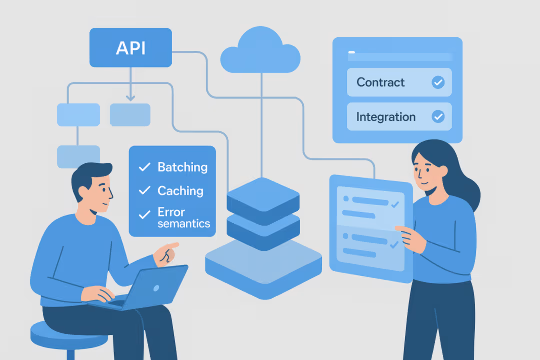
Schema-first API design
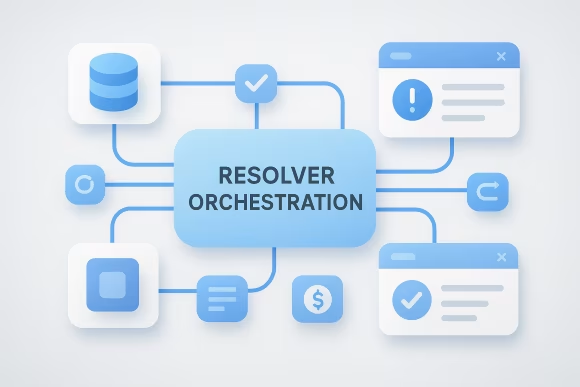
Resolver and data orchestration
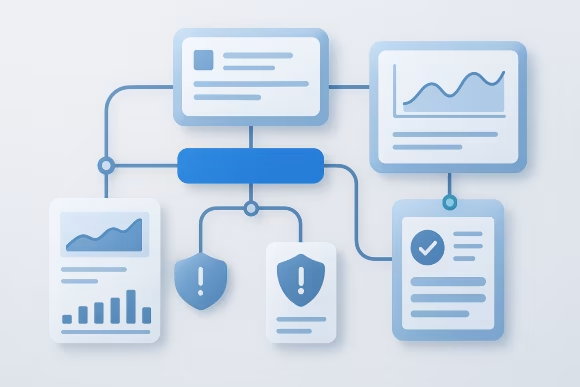
Federation and composition patterns
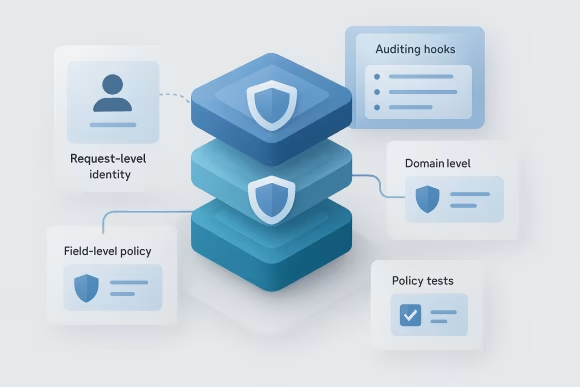
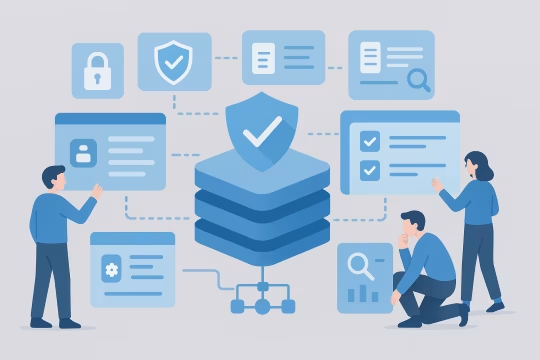
Security and query controls

Best Fit For

  • Multi-channel headless delivery
  • Multiple backend system owners
  • High-change product environments
  • Shared API across teams

Key Outcomes

  • Stable typed API contracts
  • Reduced client-backend coupling
  • Predictable performance under load
  • Controlled breaking-change risk

Technology Ecosystem

  • GraphQL schema tooling
  • Apollo Server and Gateway
  • Node.js runtime services
  • CI/CD for schema changes

Platform Integrations

  • REST and event-backed services
  • Identity and authorization systems
  • Caching and CDN layers
  • Observability and tracing tools

Uncontrolled API Growth Creates Integration Fragility

As headless platforms scale, teams often add GraphQL incrementally on top of existing services without a shared schema strategy. The result is a schema that reflects short-term delivery needs rather than domain boundaries, with duplicated types, inconsistent naming, and resolver logic that embeds business rules in ad hoc ways. Over time, the API becomes harder to reason about and harder to change safely.

These issues compound when multiple teams contribute. Without clear ownership and governance, schema changes are introduced without impact analysis, deprecations are unmanaged, and breaking changes reach production. Resolver implementations may create N+1 query patterns, unbounded fan-out to downstream services, or inconsistent authorization checks. Frontend teams then compensate with defensive querying, client-side workarounds, and duplicated data fetching strategies.

Operationally, the platform becomes difficult to operate under load. Lack of query cost controls, caching strategy, and observability makes performance regressions hard to detect and diagnose. Incidents often manifest as elevated latency across multiple products because the API layer is a shared dependency, and the absence of disciplined release and rollback practices increases deployment risk.

GraphQL Platform Engineering Process

Platform Discovery

Assess current API landscape, consumers, and backend systems. Identify domain boundaries, ownership model, performance constraints, and security requirements. Establish baseline metrics for latency, error rates, and downstream dependency behavior.

Schema Architecture

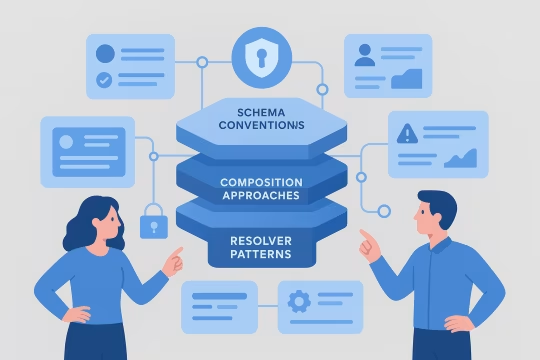
Define schema design principles, naming conventions, and domain modules. Decide on composition approach (single graph vs federation) and establish rules for type ownership, deprecation, and backward compatibility to support multi-team contributions.

Resolver Design

Design resolver patterns for orchestration, batching, and error handling. Specify data access boundaries, caching opportunities, and authorization enforcement points. Document resolver contracts to keep business logic consistent and testable.

Integration Buildout

Implement connectors to existing services and data sources, including REST, gRPC, and event-backed read models where applicable. Standardize pagination, filtering, and error semantics so clients experience consistent behavior across domains.

Security Controls

Implement authentication and authorization models aligned to enterprise identity systems. Add query cost analysis, depth limits, persisted queries, and rate limiting where needed. Ensure auditability of access decisions and sensitive field exposure.

Quality Engineering

Add schema validation in CI, contract tests for resolvers, and integration tests against downstream dependencies. Introduce performance testing for representative query workloads and regression checks for query plans and caching behavior.

Operations Readiness

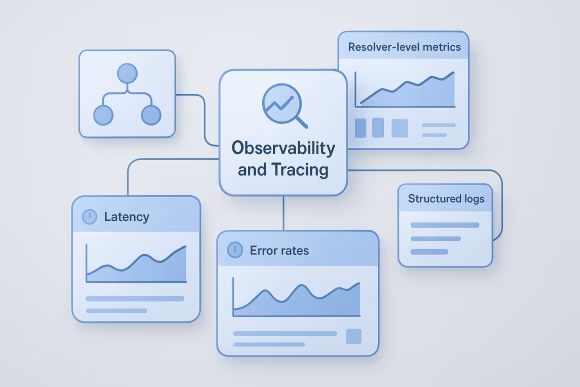
Instrument the graph with tracing, structured logging, and metrics for resolver latency and downstream calls. Define SLOs, alerting thresholds, runbooks, and incident response workflows for a shared API dependency.

Governance and Evolution

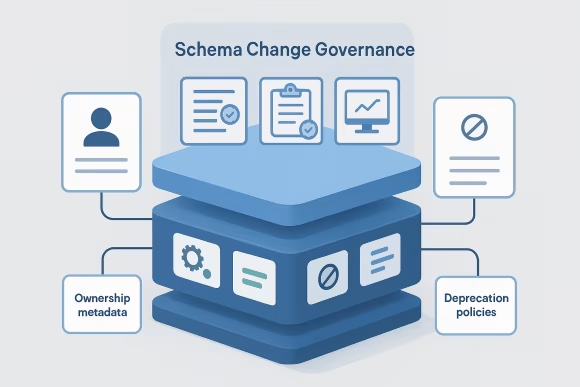
Establish review workflows for schema changes, ownership mapping, and deprecation timelines. Implement release processes for schema and runtime changes, and create a roadmap for incremental modernization of integrations and domain modules.

Core GraphQL Platform Capabilities

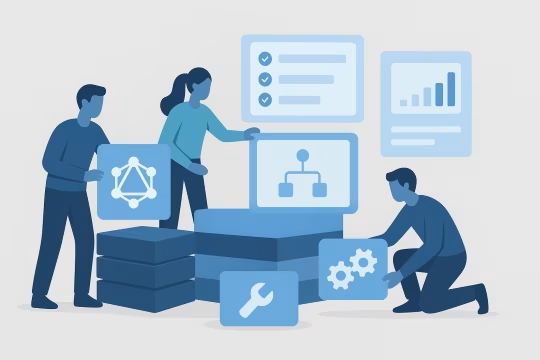
This service focuses on the engineering capabilities required to run GraphQL as a platform component, not just an API implementation. It covers schema architecture, resolver and integration patterns, and the controls needed for safe evolution across teams. The result is a typed contract that can scale with product growth while remaining observable, secure, and operationally predictable. Emphasis is placed on composition, change management, and performance characteristics under real query workloads.

Capabilities
  • GraphQL schema architecture and domain modeling
  • Apollo Federation and gateway configuration
  • Resolver engineering and data orchestration
  • Integration patterns for existing APIs
  • Authorization and policy enforcement
  • Query cost controls and caching strategy
  • Observability, tracing, and SLO definition
  • Schema governance and change management
Target Audience
  • Backend Engineers
  • Frontend Engineers
  • Platform Architects
  • API Platform Owners
  • Engineering Managers
  • Product and Platform Leads
Technology Stack
  • GraphQL
  • Apollo Server
  • Apollo Gateway
  • Apollo Federation
  • Node.js
  • TypeScript
  • OpenTelemetry
  • Docker
  • Kubernetes
  • CI/CD pipelines

Delivery Model

Delivery is structured to establish a stable schema and operating model early, then iterate through integrations and platform controls. Work is organized around measurable API behavior: contract stability, performance under representative queries, security enforcement, and operational readiness for a shared dependency.

Delivery card for Discovery and Assessment[01]

Discovery and Assessment

Review current APIs, consumers, and data sources, and map critical user journeys to query workloads. Identify domain ownership, integration constraints, and operational requirements. Produce a baseline of performance and reliability risks to guide architecture decisions.

Delivery card for Architecture and Standards[02]

Architecture and Standards

Define schema conventions, composition approach, and resolver patterns. Establish governance rules for ownership, deprecation, and compatibility. Align security model and operational requirements with enterprise identity and platform constraints.

Delivery card for Platform Foundation Build[03]

Platform Foundation Build

Implement the core GraphQL runtime, gateway configuration, and developer workflow. Set up schema validation, local development tooling, and CI checks for schema changes. Establish initial observability instrumentation and baseline dashboards.

Delivery card for Integration Implementation[04]

Integration Implementation

Build resolvers and connectors for prioritized domains and backend systems. Apply batching, caching, and error semantics consistently across integrations. Validate behavior with contract and integration tests against real downstream dependencies.

Delivery card for Security and Controls[05]

Security and Controls

Implement authentication integration, authorization policies, and query control mechanisms such as persisted queries and complexity limits. Add audit logging and policy tests. Validate controls under realistic traffic and misuse scenarios.

Delivery card for Performance and Reliability Testing[06]

Performance and Reliability Testing

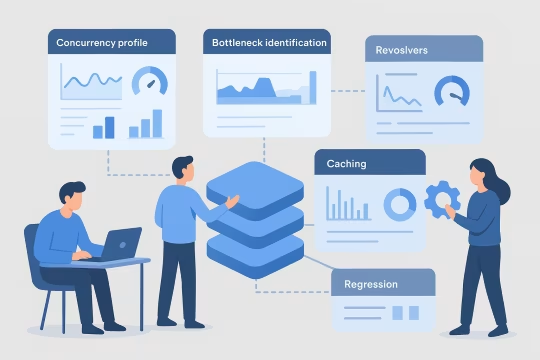
Run performance tests using representative operations and concurrency profiles. Identify bottlenecks in resolvers, downstream services, and caching layers. Implement mitigations and regression checks to keep performance predictable as the schema evolves.

Delivery card for Deployment and Operations[07]

Deployment and Operations

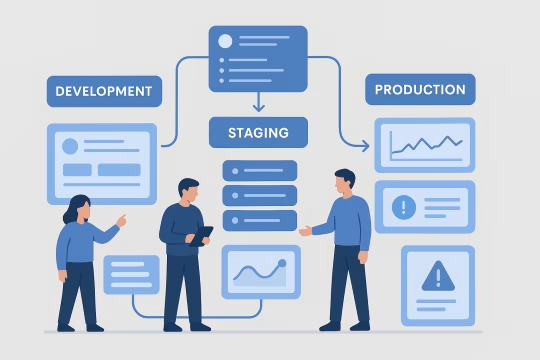
Deploy with a controlled release process, rollback strategy, and environment parity. Configure alerting, SLOs, and runbooks for incident response. Ensure operational ownership and on-call expectations are clear for a shared platform component.

Delivery card for Governance and Evolution[08]

Governance and Evolution

Operationalize schema review workflows, ownership mapping, and deprecation timelines. Plan incremental expansion to additional domains and teams. Continuously improve observability, performance controls, and integration patterns based on production feedback.

Business Impact

A well-governed GraphQL API platform reduces integration friction while keeping change safe at scale. The primary impact comes from stabilizing contracts, improving performance predictability, and enabling parallel delivery across teams without increasing operational risk.

Faster Frontend Delivery

Frontend teams work against a stable, typed contract rather than multiple backend interfaces. This reduces time spent coordinating endpoint changes and implementing client-side workarounds. Delivery becomes more parallel as domains can evolve behind the schema.

Lower Integration Complexity

A unified schema standardizes how data is accessed across systems. Resolver-based orchestration isolates downstream differences and reduces duplicated integration logic across applications. Teams spend less time translating between inconsistent APIs.

Reduced Breaking-Change Risk

Governance, deprecation policies, and CI validation make schema evolution explicit. Compatibility checks and controlled rollouts reduce the chance of client regressions. Changes become auditable and easier to coordinate across multiple consumers.

Improved Performance Predictability

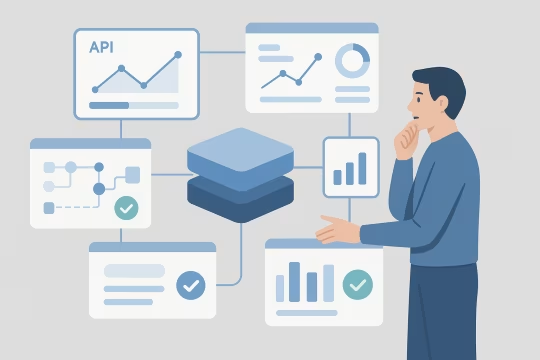
Query controls, caching strategy, and resolver optimization reduce latency variance under load. Bottlenecks are identified through resolver-level metrics and tracing. This helps maintain consistent user experience across channels that share the API layer.

Stronger Security Posture

Centralized enforcement of authentication and authorization reduces policy drift across services. Field-level controls and auditing improve visibility into sensitive data access. Query limits and rate controls reduce exposure to abusive or accidental expensive operations.

Better Operational Observability

Tracing and metrics connect client operations to downstream dependencies, improving incident diagnosis. Teams can detect regressions earlier and attribute failures to specific resolvers or services. Shared dashboards support cross-team operational alignment.

Scalable Multi-Team Contribution

Federation or modular schema ownership enables teams to deliver independently within defined boundaries. Review workflows and ownership metadata reduce coordination overhead. The platform supports growth without turning the schema into an unmanageable shared artifact.

Controlled Technical Debt

Standard patterns for resolvers, errors, and pagination reduce divergence over time. Incremental migration paths allow modernization without big-bang rewrites. The API layer becomes easier to maintain as systems and teams change.

FAQ

Common questions about architecture, operations, integration, governance, risk management, and how engagements are typically structured for a GraphQL API platform.

How do you structure schema ownership across multiple teams?

Schema ownership works best when it is explicit, enforceable, and aligned to domain boundaries. We typically define domains (or subgraphs) with clear owners, then establish rules for who can introduce or modify types and fields within those boundaries. Ownership metadata is stored with the schema and validated in CI so changes cannot be merged without the right reviewers. For cross-domain relationships, we define patterns for references (for example, entity keys in federation or shared identifiers in a single graph) and document which domain is the source of truth. We also standardize conventions for naming, pagination, error semantics, and nullability so the overall graph remains coherent even when implemented by different teams. Finally, we define a deprecation and compatibility policy that applies to all teams. This includes how long deprecated fields remain available, how breaking changes are detected, and how consumers are notified. The goal is to make multi-team contribution routine and low-risk rather than a coordination bottleneck.

When should you use Apollo Federation versus a single GraphQL server?

Federation is a good fit when multiple teams own distinct services and need to deliver independently while contributing to a unified graph. It provides a composition model where each team publishes a subgraph schema and implementation, and a gateway composes them into a single API. This can reduce coordination overhead, but it introduces additional operational considerations such as gateway configuration, composition validation, and cross-subgraph performance behavior. A single GraphQL server can be simpler when one team owns most of the API layer, when domains are not yet stable, or when the backend landscape is still being consolidated. It can also be appropriate when the graph is primarily an orchestration layer over a small number of systems and the organization is not ready for distributed ownership. We typically decide based on team topology, release independence requirements, and operational maturity. In both cases, the key is to design domain boundaries and governance early so you can evolve toward federation later without rewriting the schema contract.

What observability do you implement for a GraphQL API platform?

We implement observability at three levels: API operations, resolver execution, and downstream dependencies. At the API level, we capture metrics such as request rate, error rate, latency percentiles, and operation names (or persisted query identifiers). This provides a stable way to understand traffic patterns and detect regressions. At the resolver level, we instrument execution timing, error counts, cache hit ratios, and fan-out behavior. This is critical for diagnosing N+1 patterns, slow resolvers, and unexpected dependency calls. We also propagate correlation IDs and distributed traces so a single client operation can be followed through the gateway, resolvers, and downstream services. Operationally, we define SLOs and alerting thresholds that reflect the graph as a shared dependency. Dashboards are organized by domain and dependency to support ownership. The goal is to make performance and reliability issues attributable, not just visible, so teams can act quickly and consistently.

How do you prevent GraphQL queries from degrading platform performance?

We combine guardrails, design patterns, and testing. Guardrails include query depth and complexity limits, rate limiting, and persisted queries for high-traffic clients. These controls reduce the risk of accidental expensive queries and make traffic more predictable. Where appropriate, we also introduce allowlists for critical applications and enforce operation naming standards. On the implementation side, we engineer resolvers to batch and cache downstream calls, avoid per-field network requests, and apply timeouts and circuit-breaking behavior when dependencies are slow. We standardize pagination and filtering patterns to prevent unbounded result sets. Finally, we validate performance with representative query workloads. We run load tests against key operations, track resolver-level latency, and add regression checks in CI/CD where feasible. This ensures performance characteristics remain stable as the schema and integrations evolve.

How do you integrate existing REST APIs into a GraphQL platform?

We treat REST integration as a connector and mapping problem rather than a direct exposure of REST shapes. We define GraphQL types that represent the domain model consumers need, then implement resolvers that call REST endpoints, normalize responses, and apply consistent error and pagination semantics. This keeps the schema stable even if REST endpoints change or have inconsistent conventions. We also standardize cross-cutting concerns in the connector layer: authentication, retries, timeouts, and response validation. Where REST endpoints are chatty or require multiple calls, we use batching and caching to reduce fan-out and improve latency. If the REST APIs are not suitable for real-time orchestration, we may recommend introducing read models or aggregation services behind the graph. The integration approach is incremental. You can start with a small set of high-value queries, validate performance and ownership, and expand coverage without forcing a rewrite of existing services.

How does authentication and authorization work in GraphQL resolvers?

Authentication typically happens at the edge of the API platform, where the request is validated against an enterprise identity provider and a principal is established (user, service account, roles, scopes, and tenant context). That identity context is then propagated through the resolver execution so authorization decisions can be made consistently. Authorization can be enforced at multiple layers: request-level (who can access the graph), operation-level (who can execute specific operations), and field-level (who can see specific fields). We prefer explicit policy enforcement that is testable and auditable, rather than scattered conditional logic across resolvers. For federation, we ensure policy is consistent across subgraphs and that sensitive fields are not inadvertently exposed through composition. We also address practical concerns such as caching with authorization, multi-tenant isolation, and audit logging. The objective is to make access control predictable for consumers and maintainable for teams as the schema grows.

How do you govern schema changes and deprecations over time?

We implement a change management workflow that treats the schema as a contract. Changes go through review with domain owners, and automated checks validate composition, naming conventions, and compatibility rules. For example, removing fields, tightening nullability, or changing argument behavior is flagged as breaking and requires an explicit migration plan. Deprecations are handled with a defined policy: how deprecations are announced, how long fields remain available, and how usage is tracked. We typically instrument field usage (via operation analytics or logging) so teams can see which consumers still depend on deprecated fields before removal. We also align schema governance with release management. Schema changes are versioned and deployed through CI/CD with clear rollback strategies. The goal is to make evolution routine: frequent small changes with low risk, rather than infrequent large changes that require heavy coordination.

What standards do you define to keep the schema consistent?

We define standards that reduce ambiguity for both implementers and consumers. This typically includes naming conventions, type and input modeling rules, pagination patterns, filtering and sorting conventions, error semantics, and nullability guidelines. We also define how to represent identifiers, timestamps, localization, and multi-tenant context when applicable. On the implementation side, we standardize resolver patterns for batching, caching, timeouts, and error mapping. This prevents each team from inventing its own approach and creating inconsistent behavior across domains. For federation, we add standards for entity boundaries, reference resolution, and ownership of shared concepts. Standards are enforced through tooling where possible: linting, schema validation in CI, and templates for new domains or subgraphs. Documentation is kept close to the schema so it stays current. The objective is to keep the graph coherent as it grows, without relying on tribal knowledge.

How do you reduce the risk of breaking changes for consuming applications?

We reduce breaking-change risk through a combination of schema design discipline, automated validation, and consumer visibility. At design time, we prefer additive changes and avoid patterns that force frequent contract churn. We define compatibility rules around nullability, enum evolution, and argument behavior, and we document what constitutes a breaking change. In CI/CD, schema checks compare proposed changes against the published contract and flag breaking modifications. For federation, we validate composition and ensure subgraph changes do not introduce conflicts. We also run contract and integration tests for critical operations, especially where resolvers orchestrate multiple dependencies. On the consumer side, we encourage persisted queries or operation registries so you can track which applications use which fields. This enables targeted communication and staged migrations. Deprecation policies and usage analytics make removals predictable rather than surprising, which is essential when many products share the same API platform.

What are the main security risks in GraphQL, and how do you address them?

Key GraphQL security risks include over-fetching exposure (clients can request sensitive fields), denial-of-service via expensive queries, inconsistent authorization across resolvers, and data leakage through error messages or introspection in inappropriate environments. In a platform context, these risks are amplified because the graph aggregates multiple systems. We address them by implementing strong authentication integration, explicit authorization policies (including field-level controls where needed), and consistent enforcement patterns across resolvers and subgraphs. We add query controls such as depth and complexity limits, rate limiting, and persisted queries for high-traffic clients. We also ensure timeouts, retries, and circuit breakers are configured to prevent dependency failures from cascading. Operationally, we implement audit logging and observability to detect misuse and anomalies. We review schema exposure, error mapping, and environment-specific settings (such as introspection) as part of security hardening. The goal is to make access predictable, measurable, and defensible under enterprise security requirements.

How do you work with internal teams that own backend services?

We work as an enabling platform team alongside service owners. Early on, we align on domain boundaries, ownership, and the operating model: who owns which parts of the schema, who is on-call for which dependencies, and how changes are reviewed and released. This prevents the API layer from becoming an unowned integration surface. During implementation, we typically pair with service teams to build the first integrations and establish patterns for resolvers, connectors, and policy enforcement. We provide templates and CI checks so teams can contribute safely without needing deep platform expertise. For federation, we help teams publish and validate subgraphs with consistent standards. We also set up feedback loops: performance dashboards by domain, schema change reviews, and incident postmortems that feed into platform improvements. The objective is to make contribution predictable and low-friction while keeping operational accountability clear.

What do you typically deliver in the first 6–10 weeks?

In the first phase, we aim to establish a usable platform foundation and a repeatable contribution workflow. This usually includes an initial schema architecture with documented conventions, a running GraphQL runtime (server or gateway), and CI validation for schema changes. We also implement baseline observability so performance and errors are measurable from the start. We then integrate a small number of high-value domains or use cases to validate patterns end-to-end. That includes resolvers, connectors to existing services, authorization integration, and representative tests. We use these integrations to refine standards for pagination, errors, and caching, and to identify downstream constraints that affect platform behavior. By the end of this period, you should have a clear operating model: ownership mapping, schema review workflow, deprecation policy, and an incremental roadmap for expanding coverage. The goal is a platform that can grow safely, not a one-off API implementation.

How does collaboration typically begin for a GraphQL API platform engagement?

Collaboration typically begins with a short assessment focused on consumers, domains, and operational constraints. We start by reviewing the current API landscape (REST, existing GraphQL, gateways), the primary frontend applications, and the backend systems that will be integrated. We also identify the highest-value user journeys and translate them into representative GraphQL operations to anchor architecture decisions. Next, we run an architecture workshop with platform and product stakeholders to agree on domain boundaries, ownership, and the composition model (single graph or federation). In parallel, we align on non-functional requirements: authentication and authorization approach, performance targets, availability expectations, and observability standards. From there, we propose a phased plan with a platform foundation milestone and a small set of initial integrations. The first implementation sprint is designed to validate the end-to-end workflow: schema change review, CI validation, deployment, and operational monitoring. This creates a stable baseline for scaling contributions across teams.

Define a governed GraphQL API platform roadmap

Let’s review your current API landscape, agree on schema ownership and integration patterns, and establish the controls needed for safe, scalable headless delivery.

Oleksiy (Oly) Kalinichenko

Oleksiy (Oly) Kalinichenko

CTO at PathToProject

Do you want to start a project?