DevOps Focus

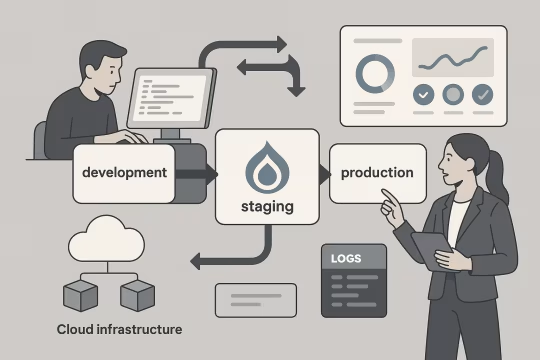
CI/CD pipeline design
Infrastructure as Code
Automated testing workflows

Platforms

  • AWS / Azure / GCP
  • DigitalOcean
  • Kubernetes & Docker

Outcomes

  • Faster releases
  • Lower downtime risk
  • Improved deployment confidence

Manual Deployments Slow You Down

Many Drupal platforms still rely on manual deployments, inconsistent environments, and fragile release processes. This leads to production incidents, configuration drift, unpredictable downtime, and slow feature delivery. Without structured DevOps practices, scaling Drupal becomes risky and expensive.

Our DevOps Approach

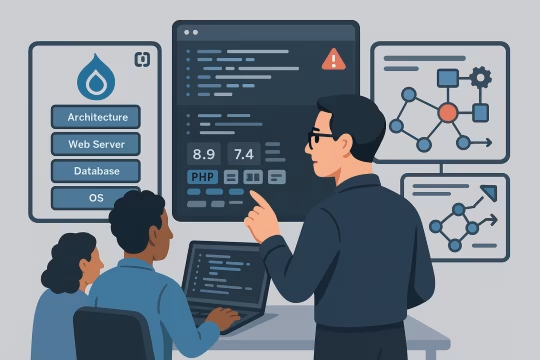
Audit & Infrastructure Review

We assess current hosting, deployment workflows, and CI/CD maturity.

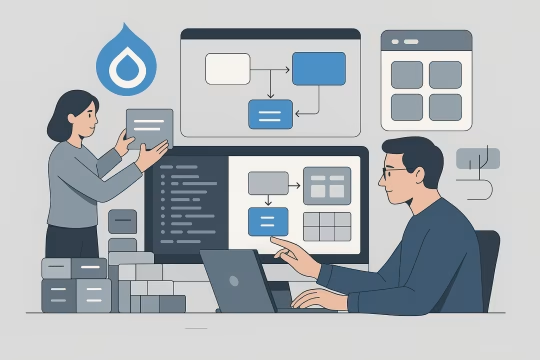
Pipeline Architecture

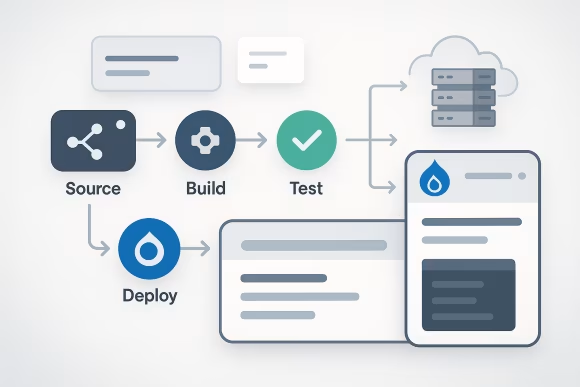
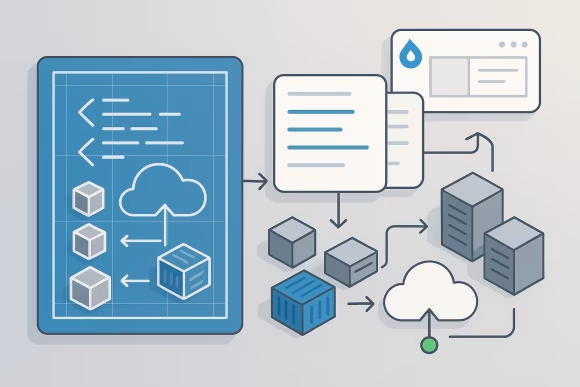
Design Git-based CI/CD pipelines with automated build, test, and deploy stages.

Environment Standardization

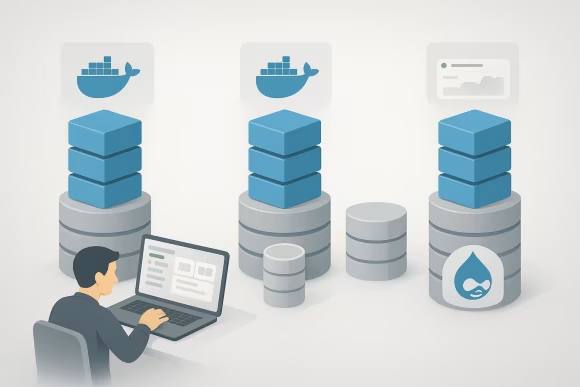
Containerize Drupal environments using Docker for consistency.

Infrastructure as Code

Provision servers and services using Terraform or similar tools.

Automated Testing Integration

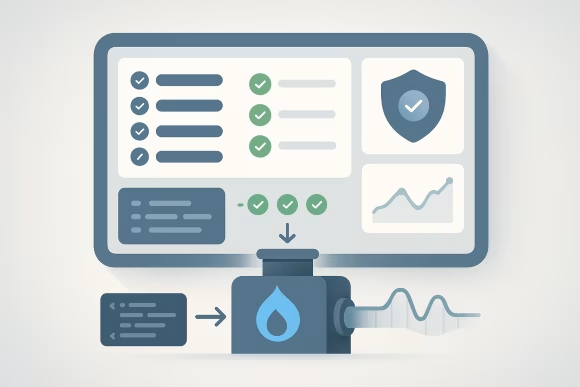
Integrate PHPUnit, Behat, and code quality checks into CI.

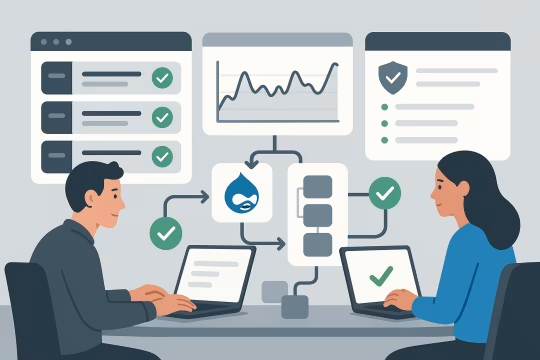
Monitoring & Incident Response

Implement logging, monitoring, and alerting for proactive reliability.

Core DevOps Capabilities

Drupal DevOps & CI/CD establishes a structured delivery framework that ensures repeatable, auditable, and reliable releases. Automated pipelines, containerized environments, and infrastructure-as-code practices eliminate environment drift and reduce manual intervention. Kubernetes orchestration and zero-downtime deployment strategies provide resilience under variable traffic conditions while preserving service continuity. Integrated automated testing and quality gates enforce governance across every release cycle. The result is a modern operational foundation that supports scalable growth and controlled platform evolution.

What We Deliver
  • Automated Drupal deployments
  • Cloud-native hosting setups
  • Secure secrets management
  • Configuration management automation
  • High-availability infrastructure
  • Scalable container clusters
Best Fit For
  • Enterprise Drupal platforms
  • Multisite environments
  • High-traffic platforms
  • Organizations with frequent releases
  • Teams migrating to cloud infrastructure
Technologies & Tools
  • Docker
  • Kubernetes
  • Terraform
  • GitHub Actions / Bitbucket Pipelines / GitLab CI
  • Ansible
  • AWS / Azure / GCP
  • New Relic / Datadog / Cloud Monitoring

Delivery Process

Our Drupal DevOps & CI/CD delivery model ensures structured execution from assessment to post-launch stabilization. We combine automated pipelines, controlled environments, rigorous testing, and secure deployment practices to minimize risk and maximize reliability. Every phase is engineered for predictable releases, faster iteration cycles, and long-term operational excellence.

Delivery card for Discovery & Audit[01]

Discovery & Audit

Comprehensive technical assessment of the existing Drupal platform, infrastructure, deployment workflows, and custom code complexity. We identify bottlenecks, security risks, upgrade blockers, and DevOps gaps to build a precise execution roadmap.

Delivery card for Upgrade Execution[02]

Upgrade Execution

Controlled upgrade of Drupal core, contributed modules, and dependencies within isolated environments. We implement version alignment, dependency resolution, and compatibility fixes while preserving stability and data integrity.

Delivery card for Refactoring Phase[03]

Refactoring Phase

Modernization of custom modules, deprecated APIs, and legacy integrations. We improve code quality, adopt current Drupal best practices, optimize architecture, and prepare the platform for future scalability.

Delivery card for QA & Regression Testing[04]

QA & Regression Testing

Automated and manual validation covering functional workflows, performance benchmarks, security checks, and regression scenarios. We ensure system reliability and eliminate unexpected production risks before release.

Delivery card for Deployment & Monitoring[05]

Deployment & Monitoring

Zero-downtime deployment through CI/CD pipelines with rollback strategies, environment isolation, and staged rollouts. Continuous monitoring and logging ensure rapid detection of anomalies post-release.

Delivery card for Post-Launch Support[06]

Post-Launch Support

Structured stabilization phase including performance observation, log analysis, patch management, and incident response readiness. We validate operational health and provide continuous improvement recommendations.

Business Outcomes

A mature DevOps framework reduces deployment risk and accelerates time-to-market without compromising stability. Automated pipelines and standardized environments lower the probability of production errors and unplanned downtime. Containerization and infrastructure-as-code improve cost predictability and simplify scaling decisions. Structured monitoring and performance validation strengthen operational transparency and compliance alignment. For executive leadership, this translates into faster innovation cycles, controlled operational costs, and a more resilient digital platform.

DevOps Assessment

Comprehensive infrastructure and deployment workflow evaluation with a structured roadmap to improve reliability and automation maturity.

Pipeline Setup

Automated CI/CD pipelines reduce manual deployment effort, accelerate releases, and enforce consistent quality controls.

Containerization

Docker-based environments ensure environment parity, faster onboarding, and predictable builds across teams.

Cloud Migration (Optional)

Transition to scalable, cloud-native infrastructure aligned with long-term growth and availability objectives.

Monitoring & Optimization

Continuous monitoring and performance tuning improve uptime visibility, operational predictability, and resilience.

Reduced Deployment Risk

Structured automation and rollback mechanisms minimize production incidents and support controlled release cycles.

Related Services

Drupal DevOps plays a central role in maintaining reliable deployment pipelines, infrastructure consistency, and operational resilience across enterprise Drupal platforms. These related services strengthen the surrounding ecosystem by improving architectural foundations, platform security, and long-term maintainability. Together they help organizations operate scalable Drupal environments with predictable delivery and governance practices.

Frequently Asked Questions

Implementing Drupal DevOps and CI/CD is not only about automation — it is about operational reliability, governance, and controlled scalability. For enterprise platforms, deployment discipline directly impacts security posture, release velocity, and infrastructure cost predictability. These FAQs address the most common architectural, operational, and strategic concerns raised by CTOs and IT leaders adopting modern Drupal DevOps practices.

Why does an enterprise Drupal platform require a structured DevOps approach?

As Drupal platforms grow in complexity, manual deployments and inconsistent environments introduce operational risk. Configuration drift, unstable releases, and undocumented infrastructure changes often lead to production incidents and delayed feature delivery.

A structured Drupal DevOps approach establishes repeatable CI/CD pipelines, standardized environments, and automated quality controls. This reduces deployment errors, strengthens governance, and ensures predictable release cycles. For enterprise organizations, DevOps maturity directly influences stability, scalability, and long-term operational efficiency.

What does a Drupal CI/CD pipeline typically include?

A mature Drupal CI/CD pipeline includes automated build processes, dependency validation, code quality checks, unit and functional testing, configuration synchronization, and controlled deployment stages. Each commit passes through predefined quality gates before reaching production.

Pipelines are integrated with version control systems and infrastructure automation tools, ensuring traceability and auditability. This structured workflow reduces regression risk, enforces coding standards, and shortens release cycles without sacrificing reliability.

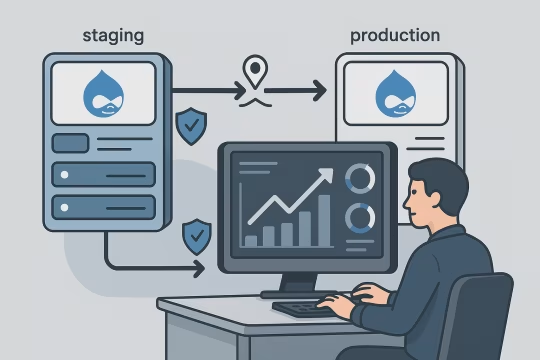
How do you prevent environment drift across development, staging, and production?

Environment drift is mitigated through containerized infrastructure and Infrastructure as Code practices. Docker ensures consistent runtime environments, while version-controlled configuration management guarantees predictable builds.

Infrastructure provisioning is automated using reproducible scripts, eliminating manual configuration changes. By treating infrastructure as versioned code, teams maintain parity across environments and reduce unexpected behavior during deployments.

Is Kubernetes required for running Drupal at scale?

Kubernetes is not mandatory for every Drupal project, but it becomes valuable for high-traffic or multi-service architectures requiring horizontal scaling and resilience.

For enterprise workloads, Kubernetes enables automated scaling, self-healing containers, rolling updates, and improved workload isolation. The decision depends on traffic patterns, availability requirements, and operational maturity rather than trend adoption.

How are zero-downtime deployments achieved in Drupal environments?

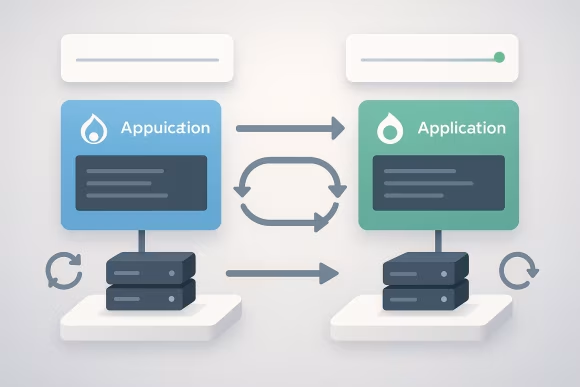
Zero-downtime deployments rely on blue-green or rolling deployment strategies combined with automated health checks and controlled traffic switching. New releases are deployed alongside existing environments and validated before activation.

Database updates and configuration changes are executed in structured sequences to prevent service interruption. Rollback mechanisms are predefined to ensure rapid recovery if unexpected behavior occurs.

How is security integrated into Drupal DevOps workflows?

Security is embedded into CI/CD pipelines through automated dependency checks, vulnerability scanning, and controlled access management. Secrets management systems prevent exposure of credentials within repositories.

Regular patch validation, environment isolation, and monitoring integration strengthen the platform’s security posture. By shifting security left into the development lifecycle, risks are identified earlier and mitigated systematically.

How does DevOps improve release speed without increasing risk?

Automation reduces manual deployment effort while enforcing quality controls. Instead of accelerating releases through shortcuts, DevOps improves speed by eliminating repetitive tasks and standardizing workflows.

Automated testing, containerized builds, and pipeline validation ensure that each release is consistent and traceable. As a result, organizations achieve shorter iteration cycles while maintaining operational stability.

Can implementing DevOps practices reduce infrastructure costs?

Yes. Infrastructure automation improves resource utilization, while scalable cloud-native architectures align compute capacity with real traffic demand. Container orchestration enables efficient scaling rather than static over-provisioning.

Automated monitoring and logging also help identify inefficiencies and optimize performance proactively. Over time, disciplined DevOps practices contribute to more predictable and controlled infrastructure spending.

What is the typical engagement model for Drupal DevOps implementation?

Engagement typically begins with a DevOps maturity assessment covering infrastructure, deployment workflows, testing coverage, and operational bottlenecks. Based on findings, a phased implementation roadmap is defined.

Implementation may include pipeline setup, environment standardization, infrastructure automation, and monitoring integration. For some organizations, DevOps evolves into an ongoing optimization retainer supporting continuous improvement and governance alignment.

What is the first step toward modernizing our Drupal DevOps framework?

The process starts with a structured technical audit of your current hosting architecture, CI/CD maturity, configuration management, and deployment reliability. This establishes a baseline of operational risks and inefficiencies.

From there, a prioritized roadmap defines automation milestones, infrastructure standardization goals, and governance improvements. Modernization is executed incrementally to ensure controlled transformation rather than disruptive change.

Related Projects

What Clients Say

Ready to Modernize Your Drupal DevOps?

Let’s implement secure, automated, and scalable CI/CD pipelines for your Drupal platform. Reduce deployment risk and accelerate innovation.

Oleksiy (Oly) Kalinichenko

Oleksiy (Oly) Kalinichenko

CTO at PathToProject

Do you want to start a project?