Enterprise Drupal upgrades rarely fail because the target version is unclear. They fail because teams underestimate the operational complexity around the platform.
A Drupal 11 migration often touches far more than core code. It can affect contributed module compatibility, custom integrations, deployment workflows, hosting assumptions, frontend build pipelines, editorial processes, and governance decisions that have accumulated over time. For large organizations managing multiple brands, regions, or business units on a shared platform, those dependencies matter as much as the technical upgrade itself.
That is why migration planning should begin well before implementation. The goal is not only to confirm that Drupal 11 is possible. The goal is to determine how to move safely, what to sequence first, which risks to isolate, and where governance decisions need to be made before engineering work accelerates.
Check Drupal 11 migration readinessRun a quick Drupal Platform Health CheckStart with upgrade readiness, not execution
A common mistake in Drupal upgrade planning is moving too quickly into task estimates before the estate is understood. Enterprise teams should first establish an upgrade-readiness view that answers a few basic questions:
- What are we actually upgrading?
- Which properties or applications are in scope?
- Which teams own which parts of the platform?
- What dependencies are business-critical?
- What release windows, compliance constraints, or seasonal freezes affect the timeline?
For a single-site implementation, this may be straightforward. For a multi-site or distributed enterprise platform, it often is not. Teams may have inconsistent ownership models, uneven documentation, and different levels of technical debt across environments.
A readiness phase should produce a shared baseline across engineering, product, platform leadership, and content stakeholders. That baseline usually includes:
- Current Drupal version and hosting model
- Inventory of custom modules, contributed modules, themes, and integration points
- Frontend architecture and build tooling assumptions
- Content model and editorial workflow overview
- Environment topology and deployment process
- Known risks, blocked dependencies, and decision points
This creates a planning artifact that people can work from. Without it, migration work tends to become reactive and fragmented.
Review the platform dependency chain end to end
For enterprise teams, the most important early activity is a dependency audit. Drupal 11 readiness is not just about whether core can be upgraded. It depends on whether the broader stack is supportable and maintainable.
That audit should cover several layers.
Core, contributed, and custom Drupal modules
Begin with the application layer:
- Which contributed modules are still required?
- Which modules have a clear upgrade path?
- Which modules appear abandoned, replaced, or strategically risky?
- Which custom modules are tightly coupled to deprecated APIs or legacy patterns?
The point is not to produce a yes-or-no compatibility list and stop there. Teams should classify module findings into action categories such as:
- upgrade directly
- refactor before upgrade
- replace with supported alternative
- retire because the capability is no longer needed
This matters because not all migration work belongs in the same release. Some modules can move with the platform. Others should be removed first so they do not increase complexity during the core upgrade.
PHP, infrastructure, and hosting assumptions
Enterprise migrations also require review of infrastructure dependencies:
- Runtime versions and support expectations
- Container, build, or CI pipeline constraints
- Hosting platform compatibility and operational policies
- Caching, CDN, and search service integrations
- Security scanning and deployment controls
A Drupal 11 migration can expose outdated assumptions in the delivery stack. For example, a codebase may technically run after application changes, but still fail organizational readiness because build steps, deployment images, or hosting policies have not been updated to support the new baseline.
That is why platform owners should treat infrastructure review as part of the migration program, not as an afterthought.
Integration dependencies
Enterprise CMS platforms often sit in the middle of a wider digital estate. Audit integrations such as:
- CRM and marketing automation connectors
- SSO and identity services
- DAM or media systems
- Search platforms
- Translation workflows
- Analytics and tag governance layers
- Downstream content consumers or APIs
Not every integration will break in a Drupal 11 migration, but every integration should be assessed for coupling. The planning question is whether the migration changes APIs, data structures, authentication flows, or release coordination requirements.
If an integration is business-critical, it needs explicit ownership and test coverage in the migration plan.

Surface upgrade risks before delivery starts
Assess module debt, infrastructure gaps, and governance blockers shaping your Drupal 11 migration plan.
- Audit platform dependencies
- Flag upgrade blockers
- Prioritize remediation work
Review the content model before upgrading the platform
In many enterprise programs, the content model is the hidden source of migration complexity.
Teams sometimes assume that content structures can be left alone while the platform version changes underneath them. That can be true for well-governed systems. But in large Drupal estates, years of incremental delivery often leave behind content types, fields, taxonomies, paragraph structures, media patterns, and editorial rules that are difficult to maintain.
A Drupal 11 migration is a good point to review whether the current content model is still serving the organization.
Key questions include:
- Are content types still aligned to business use cases?
- Are field structures overly duplicated or inconsistent across sites?
- Are paragraph or component patterns creating editorial confusion?
- Are there legacy content structures that should be consolidated before upgrade work proceeds?
- Are workflow and moderation rules still appropriate?
This is not an argument for turning every migration into a full content redesign. That usually adds unnecessary scope. The better approach is to identify which content-model issues directly affect upgrade safety, maintainability, or rollout complexity.
In practice, teams often benefit from separating findings into three groups:
- issues that must be resolved before migration
- issues that can be addressed during migration with limited impact
- issues that should be deferred to a post-upgrade optimization roadmap
That distinction protects the schedule while still using the migration as a governance checkpoint.
Evaluate frontend and experience-layer implications
Drupal upgrades in enterprise environments frequently intersect with modern frontend architectures. Even when Drupal remains the primary CMS, the presentation layer may involve design systems, component libraries, decoupled or hybrid rendering patterns, or separate frontend build pipelines.
Planning should account for questions like:
- Does the active theme depend on outdated tooling or templates?
- Are there custom integrations between Drupal and a design system that need refactoring?
- Do API contracts used by a decoupled frontend need validation?
- Is this the right time to simplify the rendering model rather than carry forward legacy complexity?
The planning tradeoff here is important. A migration can be an opportunity to clean up architectural drift, but only if the program distinguishes between required modernization and optional reinvention.
Enterprise teams should resist the temptation to use Drupal 11 as a reason to redesign everything at once. If the frontend layer is stable, supported, and well-governed, keep the upgrade focused. If the frontend layer is a source of repeated delivery pain, document that explicitly and decide whether remediation belongs in the same program or a later phase.
Define governance checkpoints early
For large organizations, governance is not overhead. It is what keeps migrations from becoming unstructured technical work.
A strong Drupal platform governance model helps answer questions that engineering teams should not be forced to resolve ad hoc during implementation. For example:
- Which teams approve scope changes?
- Who decides whether unsupported modules are replaced or retired?
- What architectural standards must be met before release?
- How will exceptions be handled across business units or site owners?
- What is the escalation path if migration timing conflicts with business priorities?
Governance checkpoints do not need to be heavy. They do need to be explicit. A practical model often includes review points at:
- readiness assessment completion
- dependency audit sign-off
- architecture and content-model decisions
- implementation plan approval
- pre-release go/no-go review
- post-launch stabilization review
These checkpoints create decision boundaries. That reduces the chance that unresolved issues will be discovered too late, when the cost of change is much higher.
Build a phased migration strategy
The safest enterprise migrations are usually phased rather than monolithic.
A phased plan lets teams reduce risk by validating assumptions in smaller increments. The exact structure depends on the estate, but common sequencing approaches include:
Phase 1: Stabilize and reduce avoidable complexity
Before the Drupal 11 upgrade itself, remove obvious sources of risk where possible:
- retire unused modules and themes
- archive or remove obsolete integrations
- clean up configuration drift
- document environment inconsistencies
- resolve known ownership gaps
This phase creates a cleaner baseline. It can also expose whether the platform has deeper maintainability issues that should affect timeline or scope.
Phase 2: Address blocking dependencies
Next, handle the dependencies that would otherwise prevent or complicate the upgrade:
- refactor incompatible custom code
- replace unsupported modules
- update build and hosting assumptions
- confirm integration ownership and testing paths
This phase is where many enterprise programs gain clarity. Once blocking dependencies are addressed, the remaining migration work is easier to estimate and sequence.
Phase 3: Upgrade and validate core platform behavior
Only after readiness and blocking dependencies are understood should teams execute the main platform upgrade.
Validation here should focus on business-critical behavior, including:
- editorial workflows
- publishing and moderation paths
- search and navigation behavior
- authentication and access control
- integration reliability
- performance-sensitive user journeys
The objective is not abstract technical completeness. It is confidence that the upgraded platform behaves as expected in the areas that matter most.
Phase 4: Roll out by estate segment or release wave
For larger Drupal estates, release planning often benefits from rollout sequencing by:
- site group
- brand or region
- business criticality
- shared feature set
- operational readiness
This allows teams to apply lessons from early waves before moving to broader rollout. It also gives platform leaders more flexibility around business calendars and risk tolerance.
Use release planning to manage organizational risk
Migration planning is also release planning. Enterprise teams should align technical sequencing with operational realities.
That means accounting for:
- blackout periods and campaign windows
- legal or compliance review cycles
- editorial peak periods
- dependent product launches
- support-team availability during stabilization
A technically sound migration can still fail if it lands at the wrong moment for the business. Release planning should therefore include both engineering criteria and organizational readiness criteria.
A practical release plan usually defines:
- scope for each release wave
- entry and exit criteria
- rollback expectations
- validation ownership
- communication responsibilities
- hypercare or stabilization period
This is especially important when multiple teams share the same Drupal platform but have different priorities and release tolerances.
Establish testing priorities around business-critical flows
Enterprise migrations can drown in undifferentiated testing if teams do not prioritize. Rather than attempting to validate everything equally, create a testing model centered on critical flows.
Examples often include:
- editor creates, reviews, and publishes content
- authenticated user access and role behavior
- form submissions and lead-routing paths
- search indexing and content discoverability
- API responses consumed by other channels
- media handling and asset delivery
Testing should map back to risk. A lower-value administrative path does not need the same level of regression attention as a publishing workflow or revenue-supporting customer interaction.
Where possible, define ownership for each critical journey. In enterprise settings, unclear ownership often causes late-stage testing gaps more than technical difficulty does.
Clarify what will not be solved in the migration
One of the most valuable planning activities is writing down what is out of scope.
Enterprise teams often use upgrades as a container for unresolved platform frustrations: content redesign, component rationalization, analytics cleanup, governance resets, accessibility improvements, workflow redesign, and more. Some of those may be worthwhile. Few of them belong in the core migration path unless they are direct blockers.
A disciplined plan explicitly separates:
- mandatory upgrade work
- adjacent improvements that are justified within the program
- desirable but deferred optimization work
This protects delivery quality. It also makes the business case clearer because stakeholders can see what is necessary for platform continuity versus what belongs in a broader modernization roadmap.
Recommended planning outputs for enterprise teams
By the end of planning, teams should ideally have a concise but decision-ready set of outputs:
- upgrade readiness assessment
- dependency audit with action categories
- content-model and architecture review summary
- risk register with named owners
- phased implementation and rollout plan
- governance checkpoints and approval path
- testing strategy tied to critical user and editorial journeys
- scope boundaries and deferred work list
These documents do not need to be large. They do need to be usable. The purpose is to reduce ambiguity before implementation begins.
Common planning mistakes to avoid
A few patterns show up repeatedly in enterprise Drupal migration programs:
- treating module compatibility as the entire migration strategy
- underestimating custom code and integration coupling
- ignoring content-model complexity until late in delivery
- combining upgrade work with broad redesign ambitions without clear controls
- leaving governance decisions unresolved until implementation is underway
- planning release timing around engineering convenience instead of business readiness
Avoiding these mistakes does not guarantee a simple migration. It does make the program more predictable.
Final thought
For enterprise teams, Drupal 11 migration planning is really an exercise in platform decision-making. The technical upgrade matters, but the quality of the migration depends on whether the organization can clearly understand its dependencies, govern tradeoffs, and sequence work in a way that matches operational reality.
A good plan does not attempt to eliminate every uncertainty. It creates enough structure to move with confidence: know what is changing, know what is risky, know who decides, and know how rollout will be staged. That is usually the difference between an upgrade that becomes a controlled platform transition and one that turns into a prolonged recovery effort.
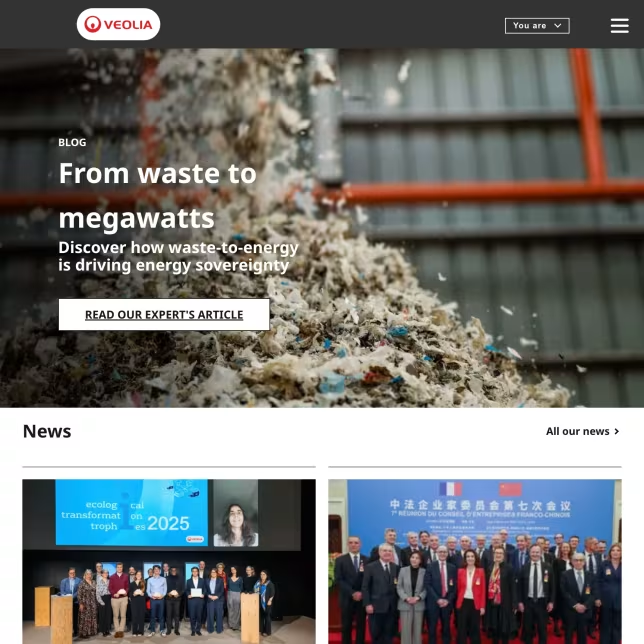
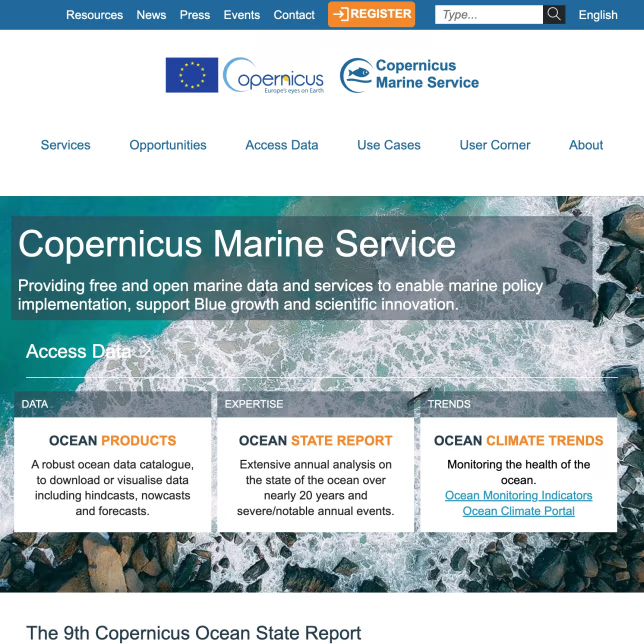
Teams working through large multisite estates, integration-heavy environments, or phased rollout concerns often face the same delivery patterns seen in projects like Veolia, where governance, dependency control, and release sequencing were central to reducing migration risk, or in more iterative consolidation programs such as Copernicus Marine Service, where platform modernization had to account for legacy systems, SSO, and controlled publishing workflows.
Drupal 11 planning
Reduce migration risk with a platform health baseline
Use a focused assessment to uncover support gaps, dependency issues, and rollout risks across your Drupal estate before implementation begins.
In practice, that is why many organizations treat early readiness work, dependency remediation, and phased execution as part of a broader Drupal version upgrade effort rather than as isolated technical tasks.
Tags: Drupal, Drupal 11 migration, enterprise Drupal migration, Drupal upgrade planning, Drupal platform governance, Enterprise CMS