



 [01]
[01]Discovery and Baseline
Assess current architecture, environments, and operational processes. Establish an availability baseline using existing telemetry and incident data, and identify the most critical failure modes and dependencies.
Drupal high availability readiness
Review Drupal failover paths, cache and session resilience, deployment dependencies, and observability gaps before committing to infrastructure changes.
Built for teams validating upgrade, integration, and governance readiness across high availability Drupal estates.
No login required. Takes 2–3 minutes.
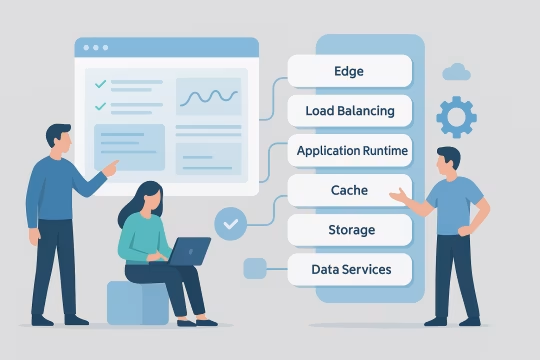
High availability architecture for Drupal is the engineering discipline of designing high availability Drupal infrastructure—deployment topology, redundancy, and operational controls—so the platform continues serving traffic during component failures, maintenance events, and regional disruptions. It combines redundancy across tiers (edge, load balancing, application runtime, cache, storage, and data services) with automation, observability, and tested recovery procedures.
Organizations need this capability as Drupal estates grow into multi-site, multi-environment platforms with strict uptime expectations and frequent releases. Without explicit Multi-AZ Drupal deployment design and resilience planning, single points of failure emerge in caching layers, shared storage, deployment pipelines, or operational processes. HA architecture makes these dependencies explicit and replaces them with resilient patterns such as multi-AZ scheduling, health-based routing, cache replication strategies, and controlled failover.
A well-defined HA approach supports scalable platform architecture by standardizing reference topologies, defining SLOs and error budgets, and aligning infrastructure-as-code governance, runbooks, and monitoring with real failure modes. The result is a Drupal platform that can evolve safely while maintaining predictable availability under load and during incidents.
Core Focus
Best Fit For
Key Outcomes
Technology Ecosystem
Delivery Scope
As Drupal platforms expand, availability issues often come from incremental growth rather than a single architectural mistake. A platform may start with a simple load balancer and a few application nodes, then add shared files, a cache layer, and multiple environments. Over time, critical dependencies accumulate: a single cache node holding sessions, a shared storage mount with limited redundancy, or a deployment process that requires manual intervention during peak traffic.
These weaknesses surface during routine events such as node replacements, scaling activities, certificate rotations, or Drupal releases. Engineering teams then compensate with ad hoc procedures, extended maintenance windows, and conservative release practices. Architecture becomes harder to reason about because failure modes are not documented, health checks are inconsistent across tiers, and observability does not map to user-facing SLOs. The result is that incidents are diagnosed late and mitigations are reactive.
Operationally, this creates delivery bottlenecks and elevated risk. Teams hesitate to patch dependencies, infrastructure changes are delayed, and incident response relies on a small set of individuals. Without tested failover and recovery paths, even minor component failures can cascade into prolonged outages or partial degradation that is difficult to detect and quantify.
Review current Drupal topology, traffic patterns, release cadence, and incident history. Identify critical user journeys, availability targets, and constraints such as compliance, data residency, and existing cloud landing zones.
Define service-level objectives, error budgets, and measurable availability indicators. Map platform components to failure modes and quantify risk areas such as session handling, cache dependency, shared storage, and deployment coupling.
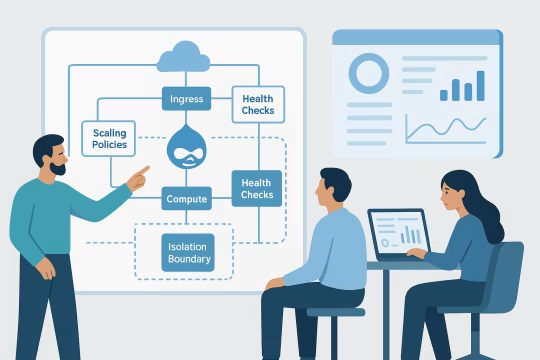
Design a target multi-AZ topology across edge, load balancing, compute, cache, and data tiers. Specify health checks, routing behavior, scaling policies, and isolation boundaries between sites, environments, and workloads.
Implement infrastructure-as-code changes for redundancy, autoscaling, and safe rollouts. Configure Drupal runtime patterns for stateless application nodes, durable file strategies, and cache/session approaches aligned to the chosen topology.
Integrate CDN, load balancers, DNS routing, and Kubernetes ingress policies with consistent health signals. Plan cutover with staged traffic migration, rollback paths, and validation of behavior under normal and degraded conditions.
Execute controlled failure scenarios such as node termination, AZ impairment, cache loss, and deployment interruptions. Validate recovery time objectives, confirm alerting accuracy, and refine runbooks based on observed behavior.
Establish ownership, change controls, and documentation for HA-critical components. Define patching and upgrade procedures, on-call expectations, and post-incident review practices tied to SLOs and platform evolution.
This service focuses on engineering the platform characteristics that keep Drupal available during failures and routine change. The emphasis is on eliminating single points of failure, making runtime behavior predictable under load, and ensuring recovery paths are automated and tested. Capabilities include Multi-AZ Drupal deployment topology, Drupal Kubernetes resilience patterns, resilient caching and session handling, health-based routing, and observability aligned to SLOs. The result is an operationally maintainable architecture that supports frequent releases without increasing outage risk.
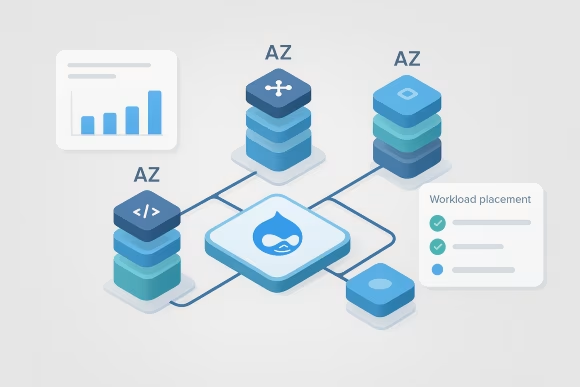
Design application and supporting tiers to tolerate the loss of an availability zone without user-visible downtime. This includes workload placement rules, redundancy for ingress and load balancing, and capacity planning so the remaining zones can absorb traffic during failover.
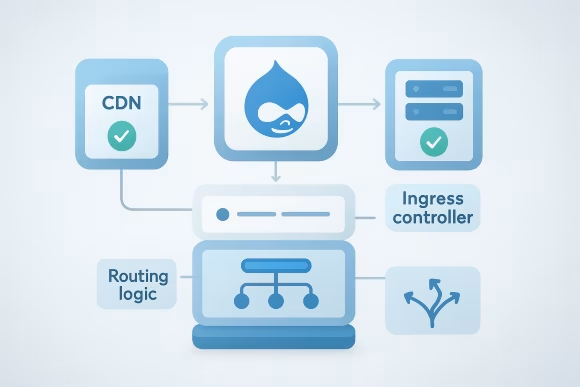
Implement consistent health checks from edge to application, with clear definitions of readiness and liveness. Configure load balancers, ingress controllers, and CDN behaviors to route around unhealthy targets and prevent partial failures from cascading across the platform.
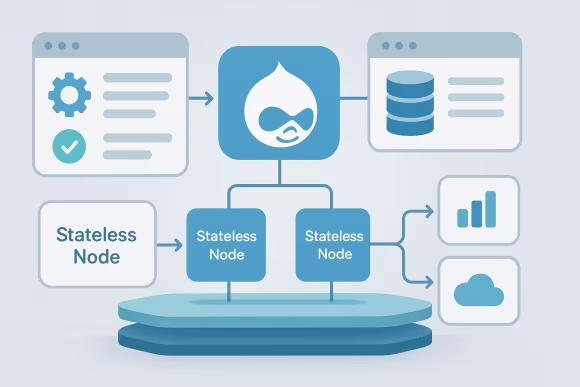
Engineer the Drupal runtime so application nodes can be replaced at any time. This typically includes externalizing sessions, standardizing configuration management, and ensuring that deployments do not rely on node-local state that breaks scaling or failover behavior.
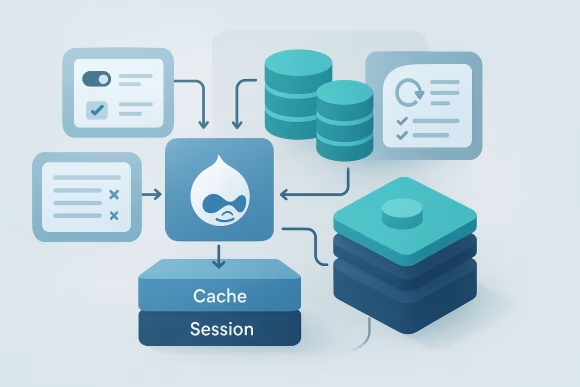
Design Redis usage for cache and session workloads with availability and recovery in mind. Address replication or clustering strategy, persistence trade-offs, eviction behavior, and client configuration so cache loss degrades gracefully and does not become a platform-wide outage trigger.
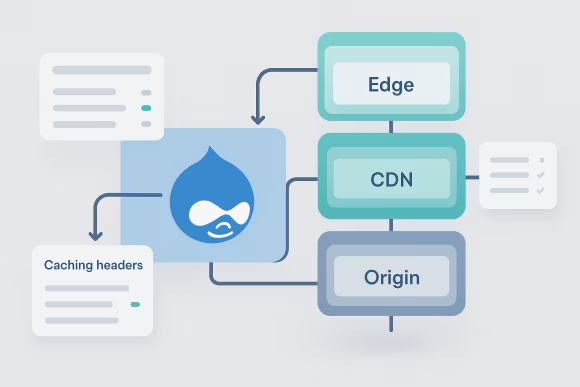
Define caching, origin shielding, and invalidation patterns that reduce origin load and improve resilience during traffic spikes or partial outages. Align CDN configuration with Drupal caching headers, purge workflows, and safe fallback behavior when origins are impaired.
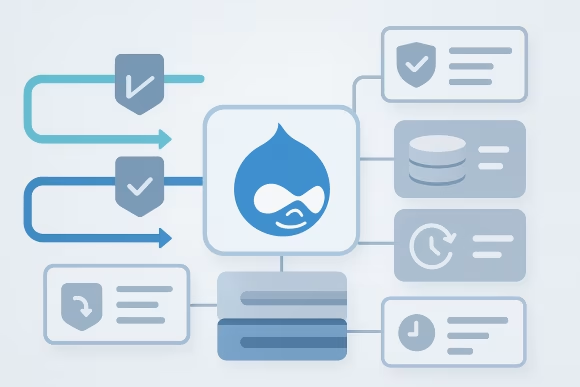
Implement rollout strategies that minimize downtime and reduce blast radius, such as blue/green or progressive delivery where appropriate. Ensure database and configuration changes are compatible with rollback, and that health gates prevent broken releases from receiving traffic.
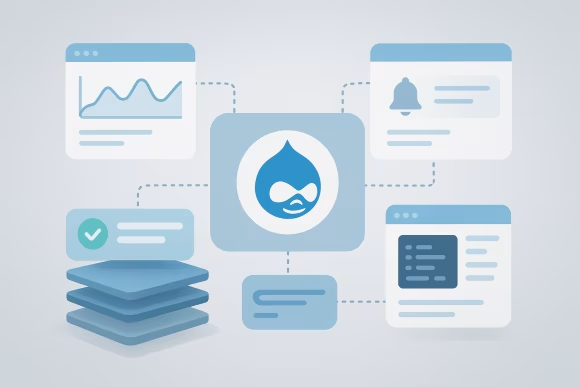
Establish monitoring that reflects user-facing availability, not just infrastructure metrics. Define SLO dashboards, alert thresholds, and tracing/logging correlations that speed diagnosis, and maintain runbooks that match the actual failure modes validated in testing.
Surface the architecture and governance issues that create fragile releases, hidden failure modes, and slow incident response across Drupal environments.
Engagements follow a clear engineering sequence: discovery and baseline measurement, SLO and risk modeling, Multi-AZ Drupal deployment design, implementation via infrastructure as code, and validation through controlled failure testing. Where required, the sequence also covers Drupal disaster recovery design and cutover planning so failover and recovery are repeatable and observable.
[01]Assess current architecture, environments, and operational processes. Establish an availability baseline using existing telemetry and incident data, and identify the most critical failure modes and dependencies.
 [02]
[02]Define SLOs, recovery objectives, and non-functional requirements. Produce a target architecture and decision record set that clarifies trade-offs across cost, complexity, and resilience.
 [03]
[03]Design multi-AZ networking, ingress, and compute patterns aligned to Drupal runtime needs. Specify scaling policies, health checks, and isolation boundaries for environments and workloads.
 [04]
[04]Implement changes using infrastructure-as-code and repeatable deployment workflows. Configure Kubernetes, load balancers, and caching layers so failover behavior is deterministic and observable.
 [05]
[05]Run functional and resilience tests, including controlled failure scenarios. Verify that monitoring detects degradation early and that recovery steps are documented and executable under time pressure.
 [06]
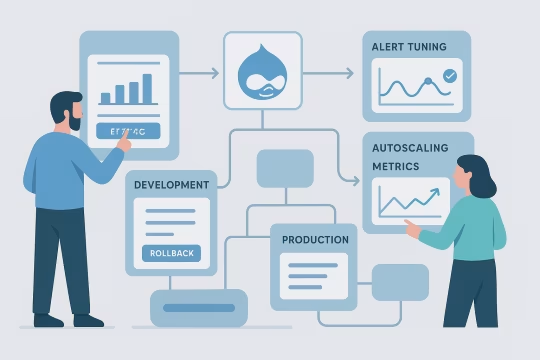
[06]Plan and execute migration or cutover with staged traffic and rollback options. Stabilize alerting, tune autoscaling and caching, and confirm operational readiness with the on-call team.
 [07]
[07]Deliver runbooks, architecture diagrams, and ownership guidance. Align governance for change management, patching, and incident reviews so the platform remains maintainable over time.
Drupal high availability architecture reduces outage probability and limits blast radius when failures occur. It improves the predictability of releases and infrastructure changes by making runtime behavior measurable and repeatable through observability and SLOs. For organizations running public-facing Drupal platforms, Multi-AZ Drupal deployment and tested recovery paths support faster incident recovery and lower operational risk without slowing delivery.
Redundancy and health-based routing reduce downtime from common infrastructure and runtime failures. Availability targets become measurable through SLOs and user-centric monitoring rather than inferred from component metrics.
Tested failover paths and documented runbooks reduce reliance on tribal knowledge during incidents. Change becomes safer because recovery procedures are designed and validated as part of the architecture.
Clear failure-mode mapping and better observability shorten time to detect and time to restore. Teams can distinguish between edge, ingress, application, and cache issues quickly and apply targeted mitigations.
Deployment patterns and health gates reduce the chance that a release causes an outage. Rollback and compatibility considerations are built into the delivery workflow, enabling more frequent updates with controlled risk.
Autoscaling policies, cache strategy, and CDN configuration reduce origin pressure during spikes. The platform is better able to absorb traffic shifts during partial failures without saturating remaining capacity.
Architecture decisions explicitly remove or mitigate critical dependencies across tiers. This lowers the likelihood that a single component, configuration, or operational step can take down the entire Drupal estate.
Capacity planning based on failure scenarios prevents over-provisioning while still meeting availability targets. Teams can justify resilience investments with clear trade-offs and measurable risk reduction.
Decision support for Drupal architecture
Use a focused Drupal health check to identify single points of failure, integration dependencies, and operational gaps that affect availability, upgrades, and governance.
Adjacent services that extend Drupal operations and reliability—covering delivery pipelines, performance, observability, security, and architecture governance that commonly support Drupal Kubernetes resilience, multi-AZ operations, and disaster recovery readiness.
Kubernetes Drupal infrastructure design for Drupal workloads
Automated CI/CD Pipelines. Reliable Infrastructure.
Prometheus Grafana Drupal monitoring with metrics, logs, and alerting
Speed Is Not a Feature. It’s Infrastructure.
Automated Deployments. Reliable Infrastructure.
Keeping Mission-Critical Drupal Platforms Stable with Ongoing Drupal Support
24/7 Drupal Support When Production Is at Risk
Ongoing Drupal Support Retainer for Enterprise Teams
Drupal GA4 event tracking and enterprise instrumentation
Answers to common questions about Drupal high availability architecture, including enterprise Drupal uptime engineering, multi-AZ topology, Drupal Kubernetes resilience and failover design, blue-green deployment patterns, observability/SLOs, governance, and disaster recovery considerations.
A typical high availability Drupal architecture removes single points of failure across the request path and the stateful dependencies. At minimum, that means redundant ingress (CDN and load balancers), multiple application runtimes (often Kubernetes-managed) spread across availability zones, and a strategy for state: sessions, cache, files, and data services. For Drupal specifically, the architecture usually emphasizes stateless application nodes so instances can be replaced or rescheduled without impact. Shared concerns include where sessions live (Redis or another external store), how cache invalidation is handled, and how file assets are served (object storage and CDN rather than node-local disks). Health checks must be consistent so traffic is only routed to nodes that are actually ready to serve Drupal. Finally, HA is not only topology. It includes operational controls: infrastructure-as-code, deployment patterns that avoid downtime, observability tied to SLOs, and tested failover runbooks. The goal is predictable behavior during failures and during routine change, not just “more servers.”
Multi-AZ resilience starts with identifying which components must survive an AZ loss and which can degrade temporarily. We model failure modes and define recovery objectives, then design a reference topology that keeps the request path available even when capacity is reduced. This typically means distributing application workloads across zones, ensuring ingress and routing are zone-independent, and confirming that remaining zones can handle peak or acceptable degraded traffic. To avoid unnecessary complexity, we standardize patterns: consistent health checks, a small set of deployment strategies, and clear boundaries between stateless and stateful services. We also avoid “hidden coupling,” such as zone-affine storage mounts or node-local session state, which can break failover. Where trade-offs exist (for example, cache replication cost versus recovery behavior), we document decisions and align them to SLOs and error budgets. The result is a design that is resilient by default but still operable by the teams who own it day to day.
High availability degrades if operations are not aligned to the architecture. The core practices are: infrastructure-as-code for repeatability, a controlled change process for HA-critical components, and continuous validation that monitoring and failover behaviors still match reality. Practically, that means maintaining runbooks for common incidents (cache loss, node churn, ingress failures), running periodic failure drills, and ensuring on-call teams have dashboards that reflect user impact. Patch management and dependency upgrades must be routine, not exceptional, because delayed updates often become forced changes during incidents. We also recommend defining ownership boundaries and service-level indicators that map to the platform’s critical journeys. Alerts should be actionable and tied to SLOs rather than noisy component thresholds. Finally, post-incident reviews should result in concrete changes: improved health checks, better rollback paths, or adjusted capacity assumptions. HA is sustained through disciplined operations, not a one-time design exercise.
Maintenance windows are often a symptom of coupling between deployments, stateful dependencies, and traffic routing. For Drupal, we aim to reduce or eliminate downtime by making application nodes replaceable and by using deployment patterns that keep a healthy version serving traffic while changes roll out. This typically includes: readiness checks that validate Drupal can serve requests, rolling updates with conservative surge/unavailable settings, and a strategy for database and configuration changes that supports backward compatibility. Where schema changes are required, we plan phased migrations so the old and new application versions can run concurrently during the transition. At the edge, we ensure load balancers and CDNs respect health signals and do not route to nodes mid-deploy. Operationally, we define clear rollback criteria and automate as much as possible so changes are repeatable. The outcome is that routine patching and releases become safer, and maintenance windows are reserved for truly exceptional events.
A CDN improves availability by reducing dependency on the origin during traffic spikes and by providing a resilient edge layer when parts of the origin are impaired. For Drupal, the CDN strategy must align with caching headers, authenticated versus anonymous traffic, and purge/invalidation workflows. We typically design CDN configuration around: origin shielding to reduce load on the application tier, cache key rules that avoid fragmentation, and safe fallback behavior when the origin returns errors. For content updates, we define purge patterns that are operationally manageable and do not create thundering herds against the origin. The CDN is also part of observability and incident response. Edge metrics can reveal whether an outage is origin-side or edge-side, and can help quantify user impact. When designed correctly, the CDN is not just performance infrastructure; it is a resilience component that reduces blast radius and stabilizes the platform under stress.
The most common pitfalls are inconsistent health checks, timeouts that do not match Drupal behavior, and routing rules that unintentionally bypass resilience controls. For example, a liveness probe might pass while Drupal is not actually ready to serve requests, causing traffic to hit nodes during warm-up or while dependencies are unavailable. Timeout and buffering settings also matter. If load balancers or ingress controllers have timeouts shorter than typical Drupal responses for certain endpoints, you can get intermittent failures that look like application bugs. Conversely, overly long timeouts can hide upstream issues and delay failover. We address this by defining a single health model across layers: CDN, load balancer, ingress, and application. We standardize headers, TLS termination strategy, and session affinity requirements (ideally avoiding sticky sessions by externalizing sessions). The goal is deterministic routing and predictable failure behavior under node churn and deployments.
Governance for HA-critical components focuses on reducing unreviewed change and ensuring that changes are testable and reversible. We recommend managing infrastructure-as-code in version control with code review, automated validation (linting, policy checks), and environment promotion rules that prevent direct production edits. For Drupal HA, HA-critical components typically include ingress and routing, Kubernetes cluster configuration, Redis/session settings, and CDN rules. We define which changes require additional review (for example, changes affecting health checks or routing) and ensure there is a documented rollback path. We also align governance with operational ownership: who approves changes, who is on-call, and how incidents feed back into architecture decisions. Decision records are useful for documenting trade-offs (cost versus resilience, complexity versus operability). The objective is not bureaucracy; it is maintaining predictable behavior as teams and platforms evolve.
Environment drift is a common cause of failed releases and unreliable failover behavior. We address this by defining a reference architecture and implementing it through reusable infrastructure modules and standardized deployment templates. The goal is that environments differ primarily by scale and credentials, not by topology or configuration semantics. In practice, this means using the same Kubernetes manifests/Helm charts (or equivalent) across environments, the same health checks, and the same routing patterns. Where production requires additional controls (WAF rules, stricter network policies), we still keep the underlying model consistent so behavior remains predictable. We also recommend automated checks that detect drift: configuration diffs, policy-as-code validation, and periodic reconciliation. For Drupal-specific concerns, we ensure configuration management and secrets handling are consistent, and that caching/session behavior is representative in pre-production. This reduces surprises during cutover and makes resilience testing meaningful.
The biggest risks are usually architectural coupling and untested assumptions. Common examples include relying on node-local state (sessions or files), treating cache as “optional” when it is actually required for correctness, or implementing health checks that do not reflect real readiness. These issues can make failover appear to work in theory but fail under real traffic. Another risk is introducing complexity without operational maturity. Adding more components (clusters, replication, routing layers) can increase the number of failure modes if monitoring, runbooks, and ownership are not established. Cost can also become a risk if capacity planning does not account for N-1 scenarios (operating with one zone down). We mitigate these risks by modeling failure modes early, defining measurable SLOs, and validating behavior through controlled failure testing. We also prioritize operability: clear runbooks, actionable alerts, and a small set of standardized patterns that teams can maintain long term.
Validation should be staged and controlled. We start by validating behavior in production-like environments where topology and configuration match production. This includes testing node termination, scaling events, and dependency interruptions (for example, restarting cache nodes) while observing user-facing indicators. For production validation, we use carefully scoped experiments with clear abort criteria. Examples include draining a subset of nodes, simulating an AZ impairment through routing changes, or temporarily reducing capacity to confirm autoscaling and health-based routing. These tests are scheduled, communicated, and monitored with the on-call team involved. The key is to treat resilience as a testable property. We define what “success” looks like in terms of SLO impact, recovery time, and alert behavior. Each exercise should produce improvements: refined health checks, updated runbooks, or adjusted capacity assumptions. Over time, this reduces the risk of real incidents because recovery paths are exercised regularly.
We typically need a clear view of current architecture and operational constraints. Useful inputs include: environment diagrams (or the ability to derive them), current hosting model (AWS accounts, Kubernetes clusters, networking), traffic patterns and peak events, and any existing SLOs or uptime targets. We also request operational context: incident history, current monitoring/alerting setup, deployment process, and ownership boundaries across infrastructure, application, and security teams. For Drupal-specific considerations, we look at caching layers, session handling, file storage approach, and how configuration and secrets are managed. Access requirements depend on engagement scope. For an architecture assessment, read-only access to relevant cloud and observability tooling is often sufficient. For implementation work, we align on delivery workflow, change windows (if any), and how infrastructure-as-code repositories are managed. The goal is to base design decisions on real constraints and measurable requirements rather than assumptions.
Collaboration usually begins with a short discovery phase to align on availability goals and to establish a shared understanding of the current platform. We start with stakeholder interviews across infrastructure, DevOps, and Drupal engineering, then review existing architecture artifacts, incident reports, and monitoring data. From there, we run a structured assessment workshop to define SLOs, identify critical user journeys, and map the platform’s main failure modes. The output is a prioritized set of architectural decisions and a target reference topology, including the key trade-offs (cost, complexity, recovery objectives) and the operational requirements to sustain the design. If you proceed into implementation, we agree on an incremental plan: which components to change first (often ingress/health checks and session/cache strategy), how to validate safely, and how to hand over runbooks and ownership. This keeps progress measurable and reduces risk while the platform evolves.
These case studies showcase advanced Drupal platform engineering focused on high availability, multi-site scalability, and operational resilience. They highlight real-world implementations of multi-AZ deployments, resilient caching, configuration governance, and failover strategies that align closely with the service's core capabilities and technologies. Each example demonstrates measurable improvements in platform stability, performance, and governance essential for enterprise Drupal environments.
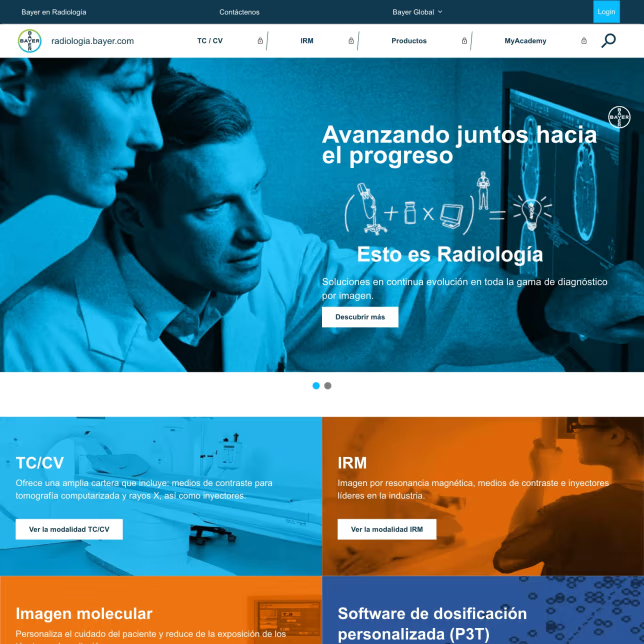
An advanced healthcare digital platform for LATAM was required to facilitate collaboration among radiology HCPs, distribute company knowledge, refine treatment methods, and streamline workflows. The solution needed secure medical website role-based access restrictions based on user role (HCP / non-HCP) and geographic region.
The platform enhanced collaboration, streamlined workflows, and empowered radiology professionals with advanced tools to gain insights and optimize patient care.
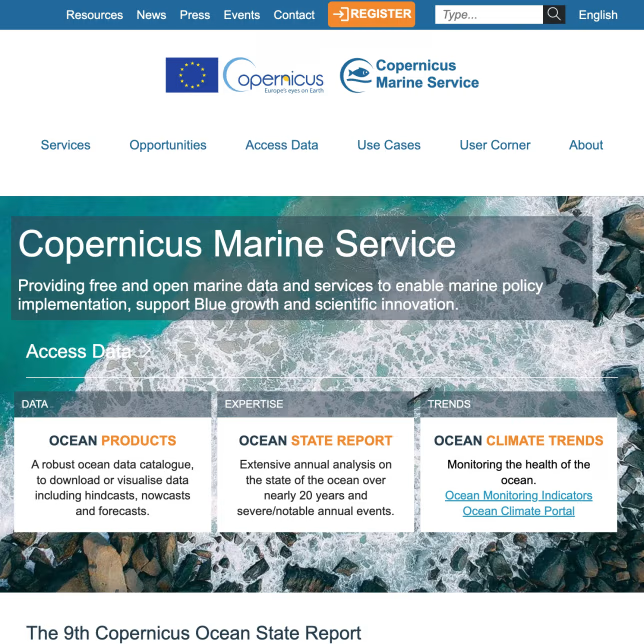
The existing marine data portal relied on three unaligned WordPress installations and embedded PHP code, creating inefficiencies and risks in content management and usability.
The new Drupal DXP streamlined content operations and improved accessibility, offering scientists and businesses a more efficient gateway to marine data services.
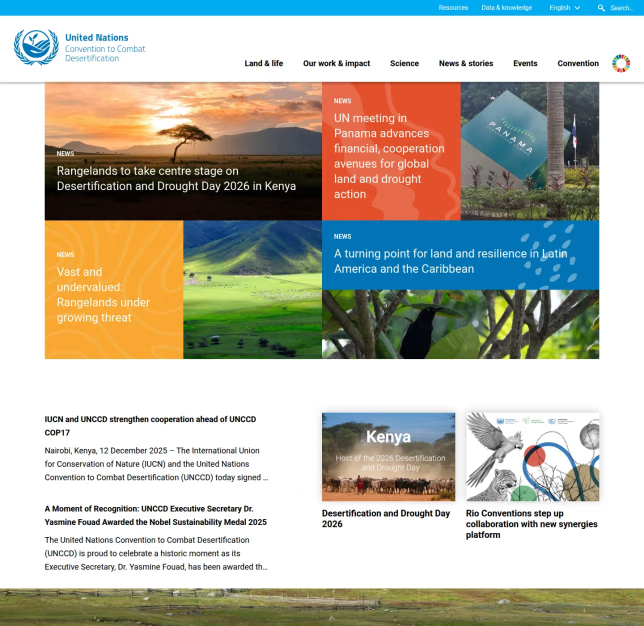
UNCCD operated four separate websites (two WordPress, two Drupal), leading to inconsistencies in design, content management, and user experience. A unified, scalable solution was needed to support a large-scale CMS migration project and improve efficiency and usability.
The modernization effort resulted in a cohesive, user-friendly, and scalable website, improving content management efficiency and long-term digital sustainability.
With Drupal 7 reaching end-of-life, Veolia needed a Drupal 7 to Drupal 10 enterprise migration for its Acquia Site Factory multisite platform—preserving region-specific content and multilingual capabilities across more than 200 sites.
The platform was modernized into a stable, scalable multisite foundation with improved performance, maintainability, and long-term upgrade readiness.
Oleksiy (PathToProject) and I worked together on a Digital Transformation project for Bayer LATAM Radiología. Oly was the Drupal developer, and I was the business lead. His professionalism, technical expertise, and ability to deliver functional improvements were some of the key attributes he brought to the project.
I also want to highlight his collaboration and flexibility—throughout the entire journey, Oleksiy exceeded my expectations.
It’s great when you can partner with vendors you trust, and who go the extra mile.

Axel Gleizerman Copello
Building in the MedTech Space | Antler
Oleksiy (PathToProject) is demanding and responsive. Comfortable with an Agile approach and strong technical skills, I appreciate the way he challenges stories and features to clarify specifications before and during sprints.

Olivier Ritlewski
Ingénieur Logiciel chez EPAM Systems
As Dev Team Lead on my project for 10 months, Oleksiy (PathToProject) demonstrated excellent technical skills and the ability to handle complex Drupal projects. His full-stack expertise is highly valuable.

Laurent Poinsignon
Domain Delivery Manager Web at TotalEnergies
These articles expand on the operational and governance decisions that shape a reliable Drupal platform. They cover recovery planning, configuration control, cache behavior, and multi-tenant risk so you can connect high availability design to real delivery and incident-response practices.
We can review your current Drupal topology, identify single points of failure, and produce a practical HA reference architecture with validated failover steps and operational ownership.