Discovery and Scope
Confirm platform boundaries, stakeholders, and decision-making authority. Collect existing documentation, constraints, and program drivers, then define the assessment approach and required access to repositories and environments.
Drupal platform strategy defines how Drupal will be used, governed, and evolved as an enterprise web platform. It connects business goals to technical decisions such as multi-site topology, content model boundaries, integration patterns, hosting and security posture, and the operating model required to deliver changes safely.
Organizations typically need this capability when Drupal has grown beyond a single website into a portfolio of products, brands, or regions. Without an explicit strategy, teams make local optimizations that accumulate into inconsistent architecture, duplicated functionality, and unclear ownership. A strategy provides a shared target state, a decision framework, and a sequenced roadmap that can be executed by multiple teams.
The outcome is a platform plan that is implementable: it clarifies what to standardize versus what to allow to vary, how governance will work in practice, and how to prioritize investment across reliability, security, performance, and developer productivity while keeping delivery moving.
As Drupal estates expand across brands, regions, and product lines, teams often evolve sites independently. Content models diverge, integration approaches vary, and shared modules become tightly coupled to one implementation. Over time, the platform stops behaving like a platform and becomes a collection of related but incompatible builds.
This drift creates architectural friction. Platform teams struggle to define what is “standard” versus “local,” and product teams cannot predict the effort or risk of changes. Security and compliance controls are applied inconsistently, upgrade paths become uncertain, and performance issues are addressed reactively rather than through a coherent capacity and caching strategy. Integration landscapes (SSO, search, DAM, analytics) become brittle because ownership and interface contracts are unclear.
Operationally, delivery slows as teams re-solve the same problems, environments differ, and release processes are not aligned. Budgeting becomes difficult because work is not tied to a roadmap with explicit trade-offs. The result is higher maintenance overhead, increased deployment risk, and a platform that is harder to modernize when Drupal versions, hosting models, or organizational needs change.
Confirm platform goals, constraints, and decision owners across product, engineering, security, and operations. Establish the scope of the Drupal estate, success criteria, and the planning horizon for the roadmap.
Inventory sites, modules, themes, integrations, hosting, and release practices. Identify duplication, coupling, upgrade blockers, and operational risks using architecture review, repository analysis, and interviews.
Translate findings into platform capabilities (content, experience delivery, integration, security, operations, developer enablement). Define maturity levels and gaps to create a shared baseline for prioritization.
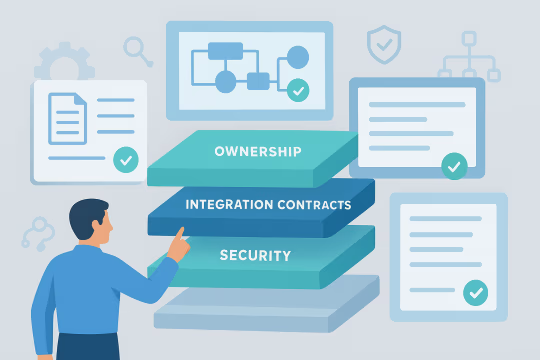
Define target-state patterns for multi-site topology, content boundaries, integration contracts, identity, caching, and environment strategy. Document key decisions and constraints to guide implementation teams consistently.
Design practical governance: standards, exception handling, decision records, and review cadences. Clarify ownership for shared modules, integrations, and platform services, including security and compliance responsibilities.
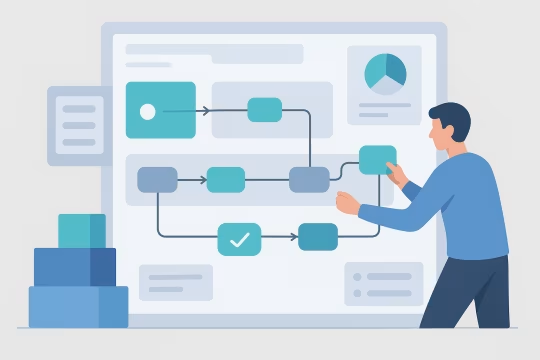
Create a sequenced plan with dependencies, milestones, and incremental deliverables. Balance foundational work (upgrades, CI/CD, observability) with product-facing initiatives to maintain delivery throughput.
Define how teams collaborate: intake, prioritization, release management, and support. Establish documentation structures, contribution workflows, and measures that track platform health over time.
This service establishes the technical and organizational foundations required to run Drupal as an enterprise platform. It focuses on making architecture decisions explicit, defining reusable patterns, and setting governance that can be executed by multiple teams. The work connects platform capabilities to a roadmap with clear sequencing and trade-offs, enabling predictable upgrades, safer integrations, and consistent delivery across a Drupal portfolio.
Engagements are structured to produce actionable architecture decisions and a roadmap that teams can execute. Outputs are designed for reuse across programs, with clear ownership and governance so the strategy remains operational rather than purely conceptual.
Confirm platform boundaries, stakeholders, and decision-making authority. Collect existing documentation, constraints, and program drivers, then define the assessment approach and required access to repositories and environments.
Review current Drupal implementations, integrations, hosting, and delivery practices. Identify systemic risks, duplication, and constraints affecting upgrades, security posture, and delivery throughput.
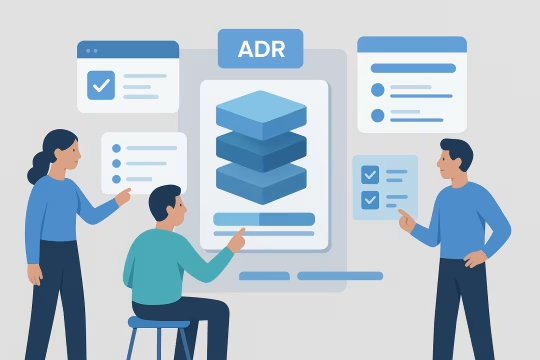
Run structured workshops to define target-state patterns and key trade-offs. Capture decisions as ADRs and validate them against constraints such as compliance, performance, and organizational structure.
Define standards, review processes, and exception handling that fit the organization’s delivery cadence. Establish ownership for shared modules, integration contracts, and platform services, including security responsibilities.
Create a sequenced roadmap with dependencies, milestones, and incremental deliverables. Provide prioritization logic and options for different investment levels or timelines.
Translate strategy into execution-ready artifacts: reference architectures, backlog epics, and acceptance criteria for foundational work. Align delivery teams on how to apply patterns and how governance will be enforced.
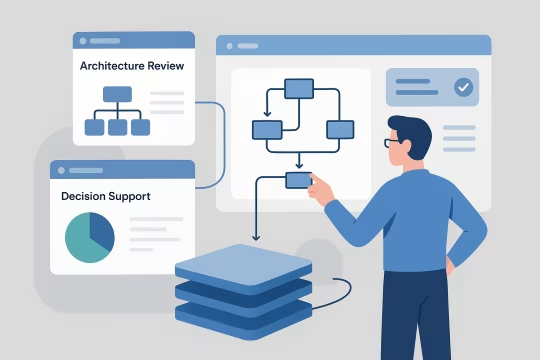
Support early execution through architecture reviews, decision support, and roadmap adjustments. Establish feedback loops using platform health metrics so the strategy evolves with real operational data.
A well-defined Drupal platform strategy reduces uncertainty and makes platform investment measurable. It improves delivery predictability by aligning architecture, governance, and operating model, while keeping modernization work sequenced to avoid disrupting product delivery.
Shared patterns and clear standards reduce rework across teams and sites. Roadmap sequencing clarifies dependencies so delivery plans are more predictable across a multi-site portfolio.
Explicit lifecycle and upgrade planning reduces emergency work caused by unsupported components. Governance clarifies controls for security, compliance, and release management across environments.
Decision records and reference patterns prevent teams from diverging unintentionally. Exceptions are handled transparently, preserving autonomy while maintaining platform coherence.
A defined upgrade path and deprecation policy reduces uncertainty around major Drupal changes. Teams can plan remediation work incrementally rather than as disruptive, high-risk projects.
Capability mapping links platform work to measurable gaps and outcomes. Leadership can choose trade-offs explicitly between feature delivery, risk reduction, and platform sustainability.
Operating model design clarifies who owns shared modules, integrations, and platform services. This reduces bottlenecks, improves support responsiveness, and prevents “orphaned” critical components.
Standardized integration contracts reduce brittle point-to-point dependencies. Clear ownership and versioning practices improve stability when upstream systems change.
Adjacent capabilities that extend Drupal strategy into architecture, delivery operations, and platform evolution.
Enterprise Digital Experience Platforms Engineering
Target architecture and operating model definition
Refactor Drupal architecture for upgradeable delivery
Comprehensive Technical Assessment for Enterprise Drupal Platforms
Designing Scalable Digital Foundations
Structured content models and editorial operating design
Common questions from enterprise teams planning or resetting a Drupal platform strategy, including architecture, operations, governance, integration, and engagement model details.
A Drupal platform strategy should make a small set of high-impact decisions explicit and durable, so teams can implement consistently without re-litigating fundamentals. Typically this includes: multi-site topology (single codebase vs multiple, shared distributions, tenancy boundaries), content model boundaries (what is shared vs local), and the target integration approach (API contracts, eventing where relevant, and ownership). It should also define environment and deployment architecture (how many environments, promotion rules, configuration management approach), performance patterns (caching layers, CDN strategy, invalidation rules, search architecture), and identity/security posture (SSO patterns, authorization boundaries, secrets management, audit requirements). Finally, it should clarify extensibility rules: what belongs in custom modules, what is acceptable contrib usage, how to manage patches, and how to handle exceptions. The goal is not to over-prescribe implementation details, but to provide a reference architecture and decision framework that reduces drift and makes upgrades and integrations predictable across the estate.
Multi-site strategy starts with understanding why sites are grouped: shared brand experience, shared content, shared integrations, shared compliance controls, or shared delivery teams. We then evaluate coupling and variation: which capabilities must be standardized (identity, security controls, analytics baselines) and which must remain flexible (regional content, campaign pages, local integrations). From there, we define a topology that fits the organization’s operating model. Options range from a single codebase with feature flags and strict governance, to a shared distribution with controlled extension points, to multiple codebases with shared platform services. The right choice depends on release independence needs, risk tolerance, and how much variation is expected. We also address practical mechanics: configuration management, module ownership, shared component libraries/themes, and how upgrades will be coordinated. A good multi-site strategy includes explicit exception handling so teams can deviate safely without fragmenting the platform over time.
Running Drupal as a platform requires an operating model that separates product delivery from platform stewardship while keeping them aligned. In practice, this means defining platform ownership (who maintains shared modules, distributions, CI/CD templates, hosting baselines), product ownership (who owns site-specific features and content models), and shared responsibilities (security, incident response, release coordination). We typically define intake and prioritization mechanisms for platform work, including how product teams request changes to shared capabilities and how those requests are evaluated. Release management is also key: whether releases are centralized, federated with guardrails, or fully independent with compliance checks. Operationally, you need consistent environments, observability standards, and support boundaries (what is “platform support” vs “product support”). The model should include documentation and decision records as operational artifacts, not one-off deliverables. The objective is to reduce bottlenecks while maintaining platform coherence and risk controls.
Platform strategy sets the constraints and standards that CI/CD and release management must implement. For example, if the strategy requires consistent security controls and predictable upgrades across a portfolio, CI/CD needs standardized pipelines, automated checks, and a clear promotion model between environments. We define environment strategy (number of environments, data handling rules, configuration promotion, and rollback expectations) and align it with the operating model. A centralized release train may fit tightly coupled multi-site estates, while a federated model with shared pipeline templates and policy-as-code can support more independent teams. The strategy should also specify what “done” means operationally: automated testing expectations, deployment frequency targets, observability baselines, and incident response integration. This ensures CI/CD is not implemented as a tool choice, but as an operational capability that enforces the platform’s architectural decisions and governance in day-to-day delivery.
Integration strategy begins with mapping systems of record and systems of engagement: identity providers, CRM, DAM/PIM, search, analytics, marketing automation, and internal APIs. We then define integration contracts: data ownership, API boundaries, authentication/authorization, error handling, and versioning expectations. For Drupal, we typically standardize a small set of integration patterns: REST/GraphQL consumption where appropriate, webhook/event patterns for content distribution, and batch interfaces for large data synchronization. We also define how integration code is owned and deployed: embedded in Drupal, implemented as separate services, or managed via an API gateway. A key part is operationalizing integrations: monitoring, retry behavior, rate limiting, and incident ownership. The goal is to reduce brittle point-to-point dependencies and ensure integrations remain stable as upstream systems evolve, without forcing every product team to invent its own approach.
For headless or hybrid scenarios, the strategy must define where Drupal sits in the experience architecture: content hub, page renderer, or both. We clarify which channels are in scope (web, mobile, kiosks, partner portals) and define content modeling rules that support reuse without over-coupling. We then define API strategy: which APIs are exposed, how they are secured, and how they are versioned. For hybrid builds, we also define boundaries between Drupal-rendered pages and frontend applications, including routing, caching, and shared design system usage. Operationally, headless introduces additional concerns: coordinating releases across Drupal and frontend apps, contract testing for APIs, and observability across multiple runtimes. The strategy should include governance for API changes and a roadmap that sequences foundational work (content model stabilization, integration contracts, pipeline alignment) before scaling to additional channels.
Good governance is lightweight, enforceable, and aligned to how teams actually deliver. It typically includes: clear standards (coding, security, module usage, configuration management), a decision record mechanism (ADRs), and a defined exception process with time-bounded approvals. It also clarifies ownership: who approves changes to shared modules, who owns integration contracts, and who is accountable for platform-level non-functional requirements such as performance and availability. Governance should be supported by automation where possible, for example CI checks for coding standards, dependency policies, and security scanning. Importantly, governance must include cadence: regular architecture reviews focused on decisions and risks, not status reporting. The objective is to prevent platform drift and unmanaged technical debt without creating a centralized bottleneck. When governance is working, teams can move quickly because constraints and approval paths are known and consistent.
We start by separating “must be consistent” from “can vary safely.” Must-be-consistent areas usually include security controls, identity patterns, integration contracts, baseline observability, and upgrade/lifecycle policies. Areas that can vary often include content structures for local needs, page composition approaches, and feature-specific modules, provided they meet compatibility and support rules. We then design governance as a set of guardrails rather than gatekeeping. Guardrails include reference implementations, reusable templates, and automated checks in CI/CD. Where human review is required, we keep it focused on architectural decisions and risk, with clear SLAs and an exception process. Finally, we define contribution workflows so product teams can improve shared capabilities rather than forking them. Autonomy is preserved by enabling independent releases within agreed constraints, and by making standards easy to adopt through tooling and documentation rather than policy documents alone.
The most common risk is platform drift: teams make reasonable local decisions that accumulate into incompatible architectures, duplicated modules, and inconsistent integration approaches. This increases maintenance cost and makes upgrades unpredictable because there is no shared baseline or lifecycle plan. A second risk is operational fragility. Without defined environment strategy, release management, and observability standards, incidents are harder to diagnose and fixes are harder to deploy safely. Security and compliance controls may be applied unevenly, creating audit exposure and emergency remediation work. A third risk is investment inefficiency. Platform work competes with product work without a capability-based prioritization model, so foundational improvements are delayed until they become urgent. When modernization is finally required (major Drupal upgrades, hosting changes, new channel delivery), the organization faces a larger, riskier program than necessary. A strategy reduces these risks by making decisions explicit and sequencing work incrementally.
Risk reduction starts with assessment and segmentation: not every site needs the same approach at the same time. We identify upgrade blockers, high-risk integrations, and sites with heavy customization, then define migration waves based on dependency and business criticality. We also define a target architecture and “minimum viable platform baseline” that can be adopted incrementally: standardized CI/CD checks, dependency policies, environment parity, and observability. This baseline reduces the chance of regressions as changes scale across the estate. For execution, we favor iterative modernization: upgrade paths that keep releases flowing, parallel run where necessary, and clear rollback strategies. Governance is used to prevent new drift during the program, and decision records capture trade-offs so teams understand why constraints exist. The goal is to avoid a single high-risk cutover by sequencing work into manageable increments with measurable risk burn-down.
You should expect artifacts that are directly usable by delivery teams and leadership. Common outputs include: a current-state assessment summary, a capability map with maturity and gaps, and a target-state reference architecture covering multi-site topology, integration patterns, environment strategy, and security posture. We also produce a governance model: standards, decision record templates, exception handling, ownership mapping, and review cadences. For execution, the key deliverable is a sequenced roadmap (often 6–18 months) with dependencies, milestones, and recommended work packages that can be translated into epics and backlogs. Where helpful, we add implementation accelerators such as reference repository structures, CI/CD policy recommendations, and platform KPIs (upgrade compliance, incident metrics, lead time, dependency health). The emphasis is on clarity and operability: artifacts should reduce ambiguity, support budgeting, and guide consistent engineering decisions across teams.
Duration depends on estate size, stakeholder availability, and how much documentation already exists. A focused strategy for a small-to-medium portfolio might take 3–6 weeks, while a large multi-site estate with complex integrations and multiple delivery teams often takes 6–12 weeks. We usually structure the work in phases so you get usable outputs early: initial discovery and assessment, target architecture and governance design, then roadmap sequencing and operating model alignment. This allows decisions to be validated as we go rather than waiting for a single final document. If the organization is already mid-program (e.g., upgrade or replatform), we can run an accelerated engagement that prioritizes decision-making and sequencing to unblock delivery, then deepen governance and capability mapping in parallel. The key is to align the timeline with decision deadlines and upcoming release milestones.
Collaboration typically begins with a short alignment phase to confirm scope, stakeholders, and decision authority. We agree which parts of the Drupal estate are in scope (sites, shared services, integrations), the planning horizon for the roadmap, and the primary constraints (compliance, hosting mandates, delivery model). Next, we run a structured discovery: interviews with platform, product, security, and operations stakeholders; review of existing architecture and operational documentation; and targeted technical assessment of repositories, environments, and integration touchpoints where access is available. We then validate initial findings in a workshop to ensure we are solving the right problems. From there, we move into decision-making workshops to define target architecture and governance, capturing outcomes as decision records. We finish by translating decisions into a sequenced roadmap with dependencies and ownership. Throughout, we keep outputs execution-ready so internal teams can start implementing foundational changes before the engagement ends.
Let’s assess your Drupal estate, define target architecture and governance, and produce a roadmap your teams can execute with predictable risk and ownership.