 [01]
[01]Discovery and Mapping
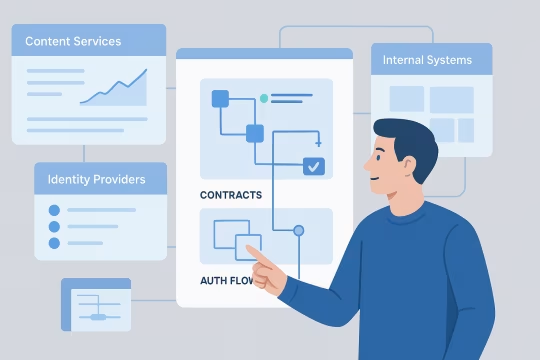
Run workshops to map systems, consumers, and critical journeys. Document current contracts, auth flows, and operational constraints, and identify high-risk dependencies and ownership gaps.
Headless ecosystems depend on integrations: content services, frontend applications, identity providers, search, commerce, and internal systems must exchange data through stable interfaces. Headless integration services focus on designing those interfaces, implementing the integration layer, and ensuring the resulting system remains reliable as teams and products scale. This often includes headless CMS API integration across GraphQL and REST, plus consistent routing and policy enforcement at the gateway.
Organizations typically need this capability when multiple channels consume the same content and data, when backends are decomposed into services, or when platform ownership is distributed across teams. Without explicit integration architecture, API contracts drift, authentication becomes inconsistent, and changes in one system cascade into outages or rework.
A well-designed integration layer supports scalable platform architecture by separating concerns: clear API boundaries, versioning strategies, consistent authN/authZ (including OAuth 2.0 headless security patterns), and observability across service calls. It enables independent deployment of services while maintaining predictable behavior for consumers, which is essential for long-term maintainability in composable and multi-team environments.
Core Focus
Best Fit For
Key Outcomes
Technology Ecosystem
Delivery Scope



As headless platforms grow, integrations often emerge incrementally: teams add endpoints, introduce new consumers, and connect additional systems under delivery pressure. Over time, the platform accumulates inconsistent API shapes, duplicated transformations, and undocumented dependencies between services, frontends, and third-party systems.
This fragmentation creates architectural stress. API contracts change without coordinated versioning, GraphQL schemas become tightly coupled to backend implementations, and authentication patterns vary by service. Integration logic spreads across clients, middleware, and edge layers, making it difficult to reason about data ownership, caching behavior, and failure modes. Engineering teams spend increasing time debugging cross-system issues rather than delivering product capabilities.
Operationally, the platform becomes sensitive to small changes: a backend deployment can break multiple consumers, retries amplify downstream load, and partial outages propagate across channels. Without consistent observability and error handling standards, incident response relies on tribal knowledge. The result is slower delivery, higher maintenance overhead, and increased risk when evolving the ecosystem.
Map current and target systems, consumers, and data flows. Identify ownership boundaries, critical paths, latency constraints, and failure domains. Capture existing API contracts, authentication methods, and operational pain points to establish an integration baseline.
Define API and schema contracts with clear resource models, naming conventions, and compatibility rules. Establish versioning and deprecation policies, error models, and pagination/filtering standards so consumers can evolve independently with predictable behavior.
Design authentication and authorization flows using OAuth patterns appropriate to the ecosystem (service-to-service, user-delegated, machine credentials). Define token lifetimes, scopes, secret management, and gateway enforcement points aligned with enterprise security requirements.
Select integration patterns such as BFF, API gateway routing, GraphQL federation/aggregation, or dedicated orchestration services. Define caching, rate limiting, idempotency, and resilience mechanisms to control load and isolate failures across dependencies.
Implement integration services, adapters, and schema layers with consistent validation and transformation logic. Add contract tests and schema checks to prevent breaking changes, and ensure backward compatibility where required by consumer lifecycles.
Validate integrations with automated tests across contracts, auth flows, and error scenarios. Include performance and resilience checks such as timeouts, retries, circuit breakers, and degraded-mode behavior to confirm predictable outcomes under stress.
Instrument end-to-end tracing, structured logging, and metrics across gateways and services. Define SLOs for critical integration paths, dashboards for latency and error rates, and alerting that supports fast triage across teams.
Establish ownership, review workflows, and release processes for contract changes. Maintain integration documentation, deprecation schedules, and compatibility matrices, and run periodic architecture reviews to keep the ecosystem coherent as services and channels expand.
Headless integrations require more than connecting endpoints; they require stable contracts, consistent security, and predictable runtime behavior across many consumers. This service focuses on headless CMS GraphQL and REST API integration patterns that support independent evolution of services and channels. Capabilities include API and schema governance, OAuth 2. 0 security for headless integrations, resilience patterns, and observability that makes cross-system behavior measurable. The result is an integration layer that can scale with product growth while remaining maintainable for platform teams.
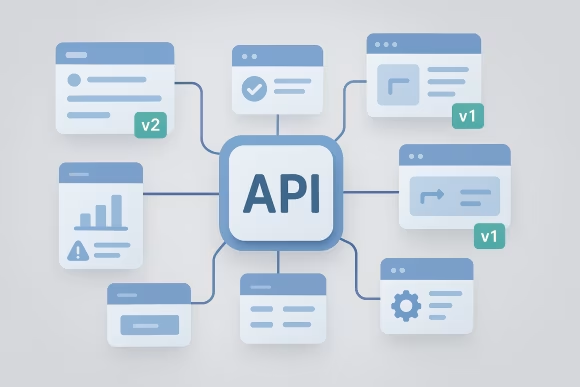
Define resource models, request/response shapes, and compatibility rules that remain stable as backends evolve. This includes versioning strategies, deprecation policies, and standardized error models so consumers can upgrade on their own timelines without frequent breaking changes.
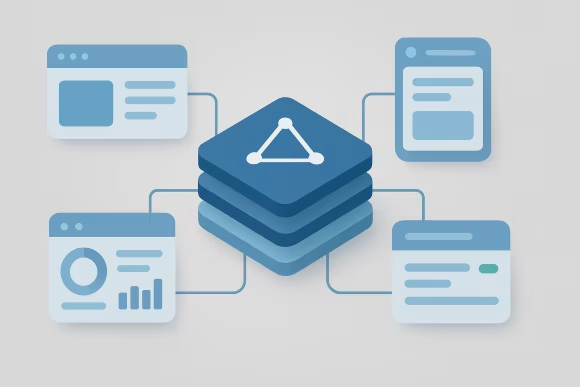
Design GraphQL schemas that reflect domain boundaries rather than backend implementation details. Implement aggregation, federation, or BFF patterns to control coupling, enforce authorization at the right layer, and provide consistent query behavior across channels.
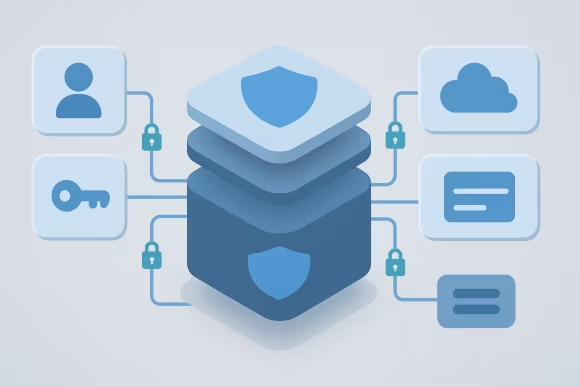
Implement OAuth-based authentication and authorization flows for user and service contexts. Define scopes, token exchange, and gateway enforcement, and integrate with enterprise identity providers while keeping service-to-service communication secure and auditable.

Build integration services that translate between systems, normalize data, and orchestrate multi-step workflows. Encapsulate vendor-specific APIs and legacy interfaces behind stable adapters to reduce ripple effects when upstream systems change.
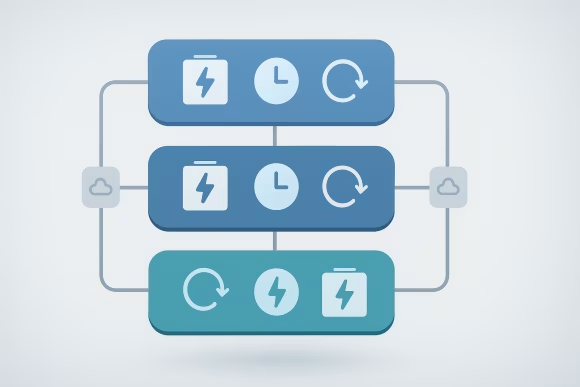
Apply timeouts, retries with backoff, circuit breakers, and idempotency to prevent cascading failures. Define fallback behavior and partial-response strategies where appropriate, and ensure integrations degrade predictably under dependency outages.
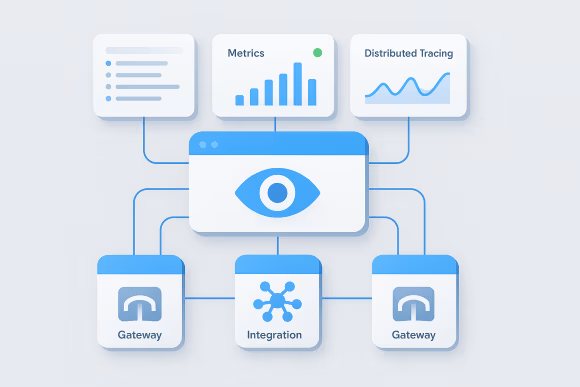
Instrument distributed tracing, structured logs, and metrics across gateways and integration services. Correlate requests across systems, track contract-level error rates, and expose latency breakdowns to support incident response and capacity planning.
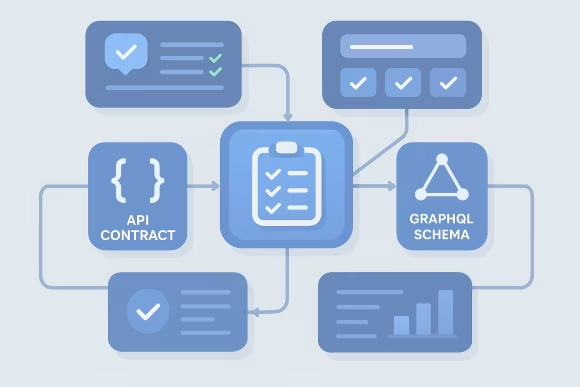
Automate validation of API contracts and GraphQL schemas through consumer-driven tests, schema checks, and compatibility gates. Detect breaking changes early in CI/CD and enforce standards for error handling, pagination, and authorization behavior.
Delivery follows a clear engineering sequence from discovery and integration mapping through contract-first design, implementation, and hardening. We align GraphQL/REST interface decisions, OAuth 2. 0 security for headless integrations, and testing/observability early so the integration layer can be operated and evolved safely over time.
[01]Run workshops to map systems, consumers, and critical journeys. Document current contracts, auth flows, and operational constraints, and identify high-risk dependencies and ownership gaps.
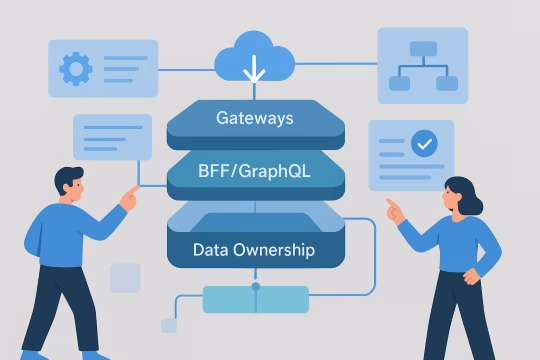 [02]
[02]Define integration patterns and boundaries, including gateway responsibilities, BFF/GraphQL placement, and data ownership. Produce contract standards, versioning rules, and a migration path from current interfaces.
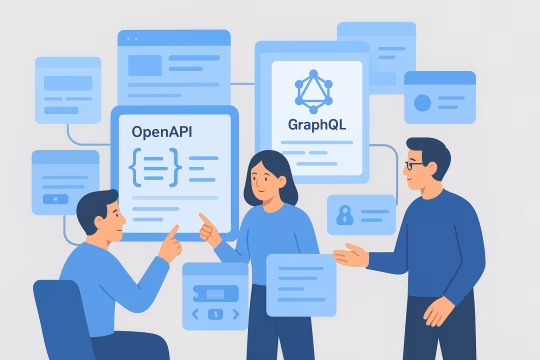 [03]
[03]Draft OpenAPI and/or GraphQL schemas with error models, pagination, and authorization rules. Review contracts with consumer teams and establish compatibility and deprecation policies.
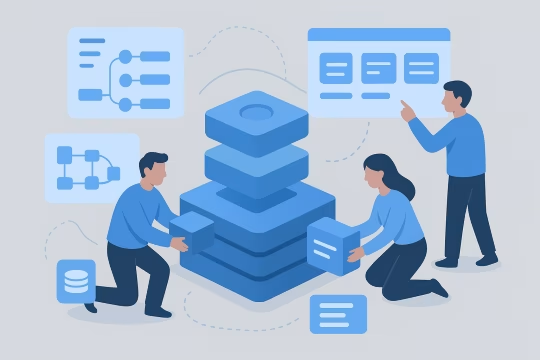 [04]
[04]Build integration services, adapters, and schema layers in small increments. Prioritize critical paths first, then expand coverage while keeping contracts stable and changes reviewable.
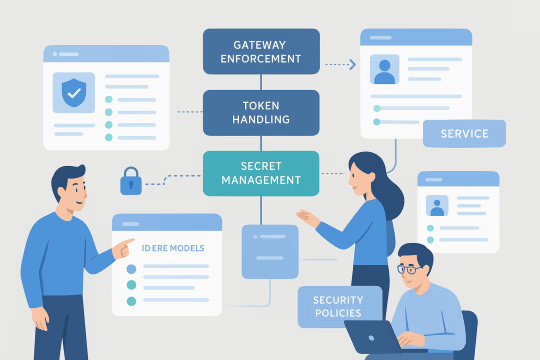 [05]
[05]Implement OAuth flows, scope models, and token handling aligned with enterprise identity requirements. Add gateway enforcement, secret management integration, and audit-friendly logging.
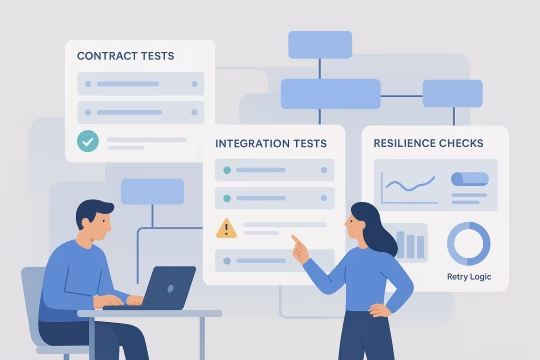 [06]
[06]Add contract tests, integration tests, and resilience checks for timeouts and retries. Validate performance characteristics and ensure predictable degraded behavior under dependency failures.
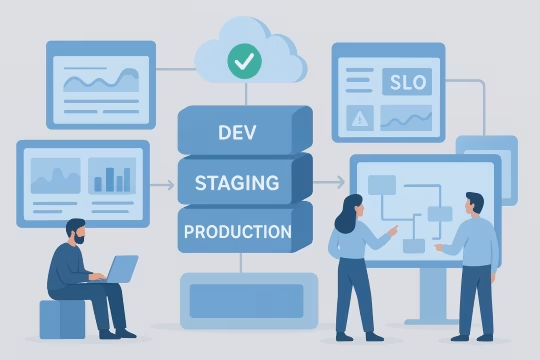 [07]
[07]Deploy with instrumentation for tracing, metrics, and structured logs. Establish dashboards and alerts for critical integration paths and define initial SLOs with platform stakeholders.
 [08]
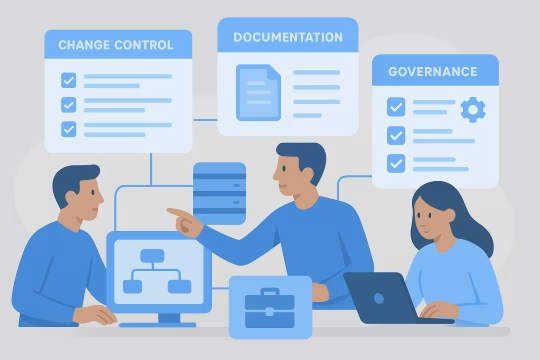
[08]Set up change control for contracts and schemas, documentation, and ownership models. Provide runbooks and operational guidance, and plan a backlog for continuous improvement and platform evolution.
Headless integration services reduce delivery friction between teams while improving platform reliability. By stabilizing contracts, standardizing OAuth 2. 0 security, and making cross-system behavior observable, organizations can evolve headless CMS API integration across GraphQL and REST with fewer incidents and less rework.
Contract-first design and compatibility rules reduce unexpected consumer failures. Versioning and deprecation policies make change predictable across multiple teams and release trains.
Resilience patterns and failure isolation limit cascading outages when dependencies degrade. Standardized error handling and timeouts improve incident containment and recovery.
Clear integration boundaries reduce coordination overhead between backend, frontend, and platform teams. Teams can ship independently while relying on stable interfaces and shared standards.
Unified OAuth patterns and gateway enforcement reduce gaps created by ad hoc implementations. Scope modeling and audit-friendly telemetry support enterprise security and compliance requirements.
End-to-end tracing and metrics make integration paths measurable and debuggable. Faster root-cause analysis reduces time spent diagnosing multi-system issues.
Centralized adapters and normalized transformations prevent duplication across clients. Integration logic becomes easier to update when vendors, schemas, or internal systems change.
Well-structured APIs and schema layers support multiple channels without custom per-client workarounds. This improves consistency across web, mobile, and partner integrations as the ecosystem grows.
Adjacent capabilities that extend headless integration architecture into API design, platform operations, and frontend delivery patterns.
Enterprise API design for scalable, secure foundations
API-first platform design with clear domain boundaries
Composable DXP content architecture and API-first platform design
API-first enterprise headless CMS platform architecture for content delivery
Structured schemas for an API-first content strategy
Contract-first headless API development for enterprise delivery
Enterprise GraphQL schema design and governance
Headless architecture roadmap and target architecture definition
Common questions about architecture, operations, governance, and engagement for headless integration work.
We start from consumer needs and platform constraints rather than technology preference. REST is often the right default for stable resource-oriented interfaces, caching, and broad tooling support. GraphQL can be effective when consumers need flexible query shapes across multiple domains, but it requires strong schema governance and careful control of coupling to backend services. A BFF (Backend for Frontend) is frequently the practical middle ground in headless ecosystems: it keeps consumer-specific composition close to the channel while preserving stable domain APIs behind it. We evaluate factors such as number of consumers, latency budgets, caching strategy, authorization model, and team ownership. The outcome is typically a layered approach: domain REST APIs for core capabilities, optional GraphQL aggregation where it adds clear value, and BFFs for channel-specific orchestration and performance tuning. We also consider operational maturity: if schema evolution, query cost controls, and observability are not in place, GraphQL can increase risk. The architecture recommendation includes governance and runtime controls, not just interface style.
A good integration boundary is defined by ownership and change cadence. It exposes a contract that is stable for consumers, hides vendor or legacy specifics, and makes data ownership explicit. In composable platforms, boundaries often align to domains (content, identity, catalog, search) rather than to systems (CMS, CRM, commerce) because systems can change while domains remain. Practically, this means: consistent resource models, explicit versioning and deprecation, and a clear separation between domain APIs and orchestration. Orchestration belongs in a layer that can change quickly (BFF or integration service) without forcing changes in core systems. We also define non-functional boundaries: latency targets, caching rules, rate limits, and failure behavior. We document dependencies and provide a compatibility matrix so teams understand what can change independently. The goal is to enable parallel delivery while preventing hidden coupling that turns every release into a coordination exercise.
We design for predictable failure. First, we classify dependencies by criticality and define timeouts and retry policies per dependency, avoiding unbounded retries that amplify load. We implement circuit breakers where repeated failures should quickly short-circuit calls, and we use idempotency keys for operations that may be retried. Second, we define degraded-mode behavior. For read paths, that can include cached responses, partial responses with explicit error fields, or fallback data sources. For write paths, we may use asynchronous patterns, queues, or outbox approaches depending on consistency requirements. Third, we make reliability observable. We instrument tracing across gateway and services, track dependency-level error rates and latency, and set SLOs for critical integration journeys. This allows teams to detect regressions early and to respond with clear runbooks. Reliability is treated as an architectural property with measurable controls, not as an afterthought.
At minimum, integration services should emit structured logs with correlation identifiers, distributed traces that span gateway-to-service-to-dependency calls, and metrics for request rate, latency, error rate, and saturation. We also recommend dependency-specific metrics (per upstream system) so you can see which integration partner is driving failures or latency. For APIs, we track contract-level indicators: status code distributions, validation failures, auth failures, and payload size. For GraphQL, we add query-level metrics, resolver timings, and query cost controls to prevent expensive queries from degrading the platform. Operationally, we define dashboards around critical journeys (for example, content delivery to a key channel) and alerts aligned to SLOs rather than raw infrastructure signals. The goal is fast triage: identify whether the issue is in the gateway, integration layer, identity provider, or an upstream system, and quantify customer impact quickly.
We design a consistent OAuth model across the ecosystem: which flows are used for which clients, how tokens are issued and validated, and where authorization decisions are enforced. For user-facing channels, that often means Authorization Code with PKCE, with access tokens scoped to the minimum required permissions. For service-to-service communication, we typically use client credentials or token exchange patterns depending on the identity provider and trust boundaries. We define scope conventions that map to domain capabilities, not to individual endpoints, and we document how services interpret scopes. Enforcement is usually centralized at the gateway for coarse-grained checks and repeated in services for fine-grained authorization where needed. We also address operational details: token lifetimes, refresh strategies, key rotation, secret management, and audit logging. The result is an identity integration that is secure, consistent for developers, and maintainable as services and consumers grow.
We start by mapping the domain interactions: what data is authored in the CMS, what data is owned by commerce or PIM, and what needs to be composed for delivery. We then choose integration patterns per interaction: synchronous APIs for real-time queries, asynchronous events for propagation of changes, and caching strategies for high-traffic read paths. For delivery, we often implement a composition layer (BFF or GraphQL aggregation) that joins content with product and availability data while keeping ownership boundaries intact. For indexing, we design pipelines that transform and enrich content and product data into search-friendly documents, with clear reindex triggers and backfill procedures. We also define consistency expectations: which fields must be strongly consistent and which can be eventually consistent. This prevents over-engineering while keeping customer-facing experiences predictable and debuggable.
Governance is implemented as lightweight controls embedded in delivery workflows. We define contract standards (naming, error models, pagination, auth requirements) and enforce them with automated checks in CI/CD. For REST, that includes OpenAPI validation and compatibility checks. For GraphQL, it includes schema diffing, breaking-change detection, and query cost controls. We establish an ownership model: who owns each contract, who approves changes, and how consumers are notified. Deprecation policies include timelines, migration guidance, and a way to measure remaining usage (for example, via gateway analytics or field-level GraphQL usage). We also recommend a regular review cadence for high-impact interfaces and a shared backlog for cross-cutting improvements. The goal is to keep teams autonomous while preventing contract drift that creates operational risk and slows platform evolution.
Maintainable integrations require documentation that supports both build-time and run-time needs. At build-time, teams need authoritative contracts (OpenAPI specs, GraphQL schemas), examples of common flows, and clear rules for versioning, deprecation, and error handling. At run-time, operations teams need dependency maps, dashboards, alert definitions, and runbooks for common failure modes. We also document ownership and escalation paths: which team owns which service, how to request changes, and what SLAs exist between internal providers and consumers. For identity, we document OAuth flows, scope definitions, and token validation rules. The key is keeping documentation close to the source of truth. We prefer docs generated from contracts and code where possible, with a small set of curated architectural decision records that explain why key patterns were chosen. This reduces drift and supports onboarding.
The most common risks are contract instability, hidden coupling, and inconsistent security. Contract instability happens when APIs are treated as implementation details rather than products; consumers break frequently and teams resort to workarounds. Hidden coupling appears when GraphQL schemas or BFFs mirror backend structures too closely, making backend refactors expensive and risky. Security risk often comes from inconsistent OAuth implementations, unclear scope models, and authorization checks scattered across clients. Operational risk follows when observability is insufficient: teams cannot trace requests across systems, and incidents become prolonged investigations. We mitigate these risks by establishing contract-first practices, explicit ownership boundaries, standardized auth patterns, and automated compatibility checks. We also design resilience and observability from the start, because integration failures are inevitable in distributed systems. The program is managed as an evolving platform capability, not a one-time project.
We reduce lock-in by isolating vendor-specific behavior behind stable, domain-oriented interfaces. Instead of exposing a CMS or commerce vendor API directly to channels, we implement adapters that translate vendor models into your domain contract. This allows you to change vendors or run parallel systems without rewriting every consumer. We also avoid embedding vendor assumptions into GraphQL schemas and client contracts. Where possible, we keep schemas aligned to business concepts and use composition layers to map to underlying systems. For identity, we standardize on OAuth concepts and avoid proprietary extensions unless required. Finally, we treat contracts and data models as long-lived assets: versioning, deprecation, and documentation are maintained independently of vendors. This approach does not eliminate migration effort, but it prevents the ecosystem from becoming tightly coupled to a single provider’s API surface and operational characteristics.
Deliverables depend on scope, but we typically produce a clear integration architecture package plus working increments of the integration layer. Architecture outputs include system and dependency maps, target integration patterns (gateway, BFF, GraphQL aggregation, adapters), contract standards, versioning and deprecation policies, and an identity integration design for OAuth flows and scopes. Implementation deliverables commonly include one or more integration services or adapters, updated API contracts (OpenAPI and/or GraphQL schemas), automated contract and integration tests, and observability instrumentation with dashboards and alerts for critical paths. We also provide operational runbooks and a governance workflow for future changes. Where migrations are involved, we deliver a phased plan with compatibility strategies so consumers can transition without coordinated “big bang” releases. The goal is to leave you with both functioning integrations and the controls needed to evolve them safely over time.
We integrate into your existing engineering system rather than replacing it. Early in the engagement we review your standards for API design, security, CI/CD, observability, and incident management. We then align our contract conventions, testing approach, and deployment practices to your toolchain and governance requirements. We typically work in a mixed model: architecture and contract design is done collaboratively with platform and consumer teams, while implementation is delivered in small increments that can be reviewed and merged into your repositories. We prioritize knowledge transfer through pairing, design reviews, and shared runbooks. If standards are missing or inconsistent, we propose minimal, enforceable baselines and automate them in CI/CD (linting, schema checks, compatibility gates). The aim is to increase consistency without creating heavy process overhead for teams shipping product work.
Collaboration usually begins with a short discovery focused on integration reality rather than assumptions. We start by identifying the highest-value journeys (for example, content delivery to a key channel, authenticated personalization, or CMS-to-search indexing) and mapping the systems and teams involved. We review existing API contracts, GraphQL schemas, gateway configuration, and OAuth flows, along with incident history and known bottlenecks. From that, we produce a prioritized integration backlog and a target architecture outline: recommended patterns (BFF, gateway policies, aggregation), contract standards, and immediate risk controls (timeouts, retries, tracing). We agree on ownership boundaries and how changes will be reviewed and released. The first implementation increment is typically a thin vertical slice that proves the approach end-to-end: contract definition, security enforcement, integration logic, tests, and observability. This creates a working reference that internal teams can extend while we iterate on the broader integration roadmap.
These case studies showcase practical implementations of headless CMS architectures, API contract design, and integration layers that align closely with headless integration services. They highlight real-world delivery of scalable, secure, and reliable content and data exchange platforms using GraphQL, REST APIs, OAuth 2. 0, and orchestration patterns essential for multi-channel and multi-team ecosystems.
Users were abandoning the website before fully engaging with content due to slow loading times and an overall poor performance experience.
The updated platform significantly improved speed and usability, resulting in higher user engagement, longer session durations, and increased content exploration.
Arvesta required a modern, scalable headless CMS for enterprise corporate marketing—supporting rapid updates, structured content operations, and consistent UI delivery across multiple teams and repositories.
The platform enabled faster delivery of marketing updates, improved UI consistency across pages, and strengthened editorial operations through structured content models and reusable components.
UNCCD operated four separate websites (two WordPress, two Drupal), leading to inconsistencies in design, content management, and user experience. A unified, scalable solution was needed to support a large-scale CMS migration project and improve efficiency and usability.
The modernization effort resulted in a cohesive, user-friendly, and scalable website, improving content management efficiency and long-term digital sustainability.
It was my pleasure working with Oleksiy (PathToProject) on a new Drupal website. He is a true full-stack developer—the ideal mix of DevOps expertise, deep front-end knowledge, and the structured thinking of a senior back-end developer.
He is well-organized and never lets anything slip. Oleksiy understands what needs to be done before being asked and can manage a project independently with minimal involvement from clients, product managers, or business analysts.
One of the best consultants I’ve worked with so far.

Andrei Melis
Technical Lead at Eau de Web
Oleksiy (PathToProject) worked with me on a specific project over a period of three months. He took full ownership of the project and successfully led it to completion with minimal initial information.
His technical skills are unquestionably top-tier, and working with him was a pleasure. I would gladly collaborate with Oleksiy again at any opportunity.

Nikolaj Stockholm Nielsen
Strategic Hands-On CTO | E-Commerce Growth
Oleksiy (PathToProject) has been a valuable developer resource over the past six months for us at LSHTM. This included coming on board to revive and complete a stalled Drupal upgrade project, as well as carrying out work to improve our site accessibility and functionality.
I have found Oleksiy to be very knowledgeable and skilful and would happily work with him again in the future.

Ali Kazemi
Web & Digital Manager at London School of Hygiene & Tropical Medicine
These articles dig into the governance and implementation concerns that shape reliable headless integrations at scale. They cover API change control, GraphQL boundaries, security, and downstream dependency management so you can evaluate the service with a clearer view of the operational tradeoffs.
Let’s review your current integration landscape, define stable API and identity boundaries, and prioritize the next implementation increment with clear operational controls.