In enterprise WordPress programs, shared themes usually begin with the right intent. A central team establishes a common design system, reusable templates, and a base implementation that multiple brands can adopt. Early delivery can look efficient: shared code moves quickly, brand launches accelerate, and governance appears manageable.
The trouble starts later.
As new market requirements arrive, local teams often need to move faster than the platform model can comfortably support. A campaign requires a slightly different hero layout. One brand needs a special navigation treatment. Another wants a custom archive page that does not fit the shared component library. If the fastest path is a template override or a child theme exception, those decisions accumulate. Over time, the platform still looks shared on paper, but operationally it becomes fragmented.
That is the real challenge of WordPress theme override governance. It is not about preventing all customization. It is about making sure customization happens in ways that preserve maintainability, release confidence, and the ability to upgrade the platform without discovering dozens of hidden dependencies.
Why shared themes drift even when the architecture started clean
Most shared-theme programs do not fail because the original architecture was careless. They drift because the operating model allows local delivery pressure to outrun architectural decision-making.
A few patterns commonly drive that drift:
- shared themes are treated as a starting point rather than a product with clear ownership
- component gaps are resolved with local template copies instead of upstream enhancement
- variation rules are implied rather than explicitly documented
- release review focuses on functionality, not on the long-term cost of extension choices
- brand stakeholders are allowed to request visual or structural exceptions without a mechanism to classify their impact
In practice, this means the platform team may still believe it owns a standard, while delivery teams experience the standard as optional whenever deadlines tighten.
The technical symptoms often appear gradually. A child theme copies parent templates instead of extending behavior through stable hooks or component inputs. Shared modules become harder to change because nobody knows which brands depend on old markup. Styling conventions diverge. Template hierarchy becomes unpredictable. Eventually, a routine parent theme update becomes risky because the platform can no longer distinguish intended extension points from accidental forks.
This is why governance belongs in the architecture discussion. Upgradeability is not only a code quality issue. It is the result of decisions about ownership, review, and what kinds of variation the platform is designed to absorb.
The override surfaces that create the most long-term risk
Not every customization creates the same level of risk. Some changes are isolated and reversible. Others quietly create coupling that makes future maintenance much harder.
The highest-risk override surfaces typically include:
- full template copies of parent theme files into child themes
- brand-specific markup changes inside shared templates
- component duplication where a brand forks an existing component rather than extending it
- special-case conditional logic embedded in common rendering paths
- CSS overrides that compensate for structural differences rather than expressing tokenized visual variation
- unreviewed plugin-template customization that behaves like theme logic but sits outside theme governance
The reason these surfaces matter is not that they are always wrong. It is that they change the cost profile of the platform.
A full template copy may solve an immediate need, but it also creates a shadow version of the parent capability. If the parent template later improves accessibility, performance, or editorial flexibility, that improvement may never reach the copied child version. Multiply that across brands and the platform team is no longer maintaining one system. It is maintaining several partial forks hidden behind a shared-theme label.
Similarly, brand-specific markup changes can look harmless when viewed in isolation. But once the same base component renders differently in five brands for five different historical reasons, testing becomes more expensive. Documentation becomes less trustworthy. Refactoring becomes politically difficult because each exception has a stakeholder attached to it.
Good governance starts by recognizing which override types are merely cosmetic and which ones alter the platform's structural behavior.
Child themes vs configuration vs reusable components
A useful governance model distinguishes between three very different mechanisms for variation: child themes, configuration, and reusable components. Many platforms get into trouble because these are treated as interchangeable.
Child themes should be the last-resort mechanism for structural extension, not the default place where brand differences live. They are powerful, but that power comes with a maintenance burden. A child theme can override parent templates, introduce alternative logic, and reshape rendering behavior. That makes it suitable for carefully reviewed exceptions, but dangerous as an everyday customization tool.
Configuration is a better home for predictable variation. If brands need approved differences in logo usage, spacing density, color tokens, card styles, promotional banner behavior, or optional layout regions, those differences should ideally be expressed as configuration inputs rather than copied templates. Configuration turns variation into something the platform can reason about, document, test, and support over time.
Reusable components sit between those two extremes. When a brand requirement is not merely presentational but also not unique enough to justify a permanent child-theme fork, the right answer is often to extend the shared component model. Instead of creating a one-off carousel template for a single brand, the platform team might enhance the carousel component to support approved variants through explicit props, slots, or block settings.
A practical decision rule looks like this:
- if the need is recurring and predictable, prefer configuration
- if the need is structural and likely reusable, evolve the shared component
- if the need is genuinely exceptional and time-bound, consider a governed child-theme override
This distinction matters because it changes how the platform scales. Configuration scales operationally. Shared components scale architecturally. Child-theme overrides scale poorly unless tightly controlled.
How to classify acceptable brand variation
The hardest part of shared theme governance is rarely saying no to customization. It is defining what a legitimate difference looks like.
Without a classification model, every brand request becomes an emotional debate. One team sees a small commercial need. Another sees an architectural precedent. Governance improves when acceptable variation is categorized before requests arrive.
A simple classification model can include four levels:
-
Token-level variation
Colors, typography choices, spacing scales, icon sets, and other design-system values. These should almost always be governed through configuration or theme variables. -
Component-level variation
Approved changes to component presentation or behavior, such as card formats, hero treatments, or navigation options. These should be handled through reusable shared components with explicit variants. -
Template-composition variation
Differences in how approved components are assembled on a page type. These may be valid, but should still rely on shared building blocks rather than bespoke markup forks. -
Structural or business-rule variation
Changes that affect rendering logic, content model assumptions, or workflow behavior. These deserve the highest review threshold because they are the most likely to damage upgradeability.
This classification gives teams a common language. It lets a platform lead ask a more useful question than, "Can this brand have a custom page template?" The better question is, "What category of variation is this, and what is the lowest-risk extension mechanism that can support it?"
It also helps expose false exceptions. Many requests that arrive as structural needs are really symptoms of missing component capability or poor upstream planning. Once that becomes visible, teams can solve the underlying product gap instead of institutionalizing another override.
Review workflows, ownership boundaries, and release discipline
Even a sensible architecture will drift if the review process is weak. Governance works when the platform has explicit ownership boundaries and a release model that treats shared theme changes as productized assets.
A few practices tend to make the biggest difference.
Define who owns the base theme as a product.
Someone must be accountable for its standards, roadmap, and extension model. If ownership is diffuse, local exceptions will steadily become the real architecture.
Require architectural review for specific override types.
Not every brand-level styling change needs escalation. But template copies, new rendering branches, duplicated components, and plugin-template alterations usually should. The goal is not bureaucracy for its own sake. It is early visibility into changes that can create long-lived maintenance cost.
Publish approved extension points.
If teams do not know where and how variation is intended to happen, they will create their own methods. Documented extension points can include configurable component variants, template hooks, block patterns, and styling tokens.
Make upstream contribution easier than local forking.
This is one of the most important operating model decisions. If contributing an enhancement to the shared theme takes weeks of coordination, teams will bypass it. If the platform provides a clear intake and review path for broadly useful improvements, reuse becomes more attractive.
Track override inventory as a platform health indicator.
Many enterprises track defects and delivery velocity but not architectural divergence. A lightweight inventory of child theme overrides, copied templates, local components, and conditional branches can reveal where upgrade risk is concentrating.
Test shared assets across representative brand scenarios.
Release discipline matters because one of the first casualties of override sprawl is confidence. A shared theme should be validated against the range of supported brand patterns, not only against the default implementation. That does not require exhaustive automation for every edge case, but it does require the platform team to understand the supported variation matrix.
Together, these practices shift governance from reactive policing to a clearer contract between the platform and brand teams.
Recovery patterns for platforms already deep in override debt
Many enterprise teams are not starting from a clean slate. They are inheriting estates where the shared theme exists, but dozens of local exceptions already define the day-to-day reality. In that situation, governance must begin with recovery, not perfection.
A practical recovery approach usually happens in phases.
1. Build an override map.
Before changing standards, identify where divergence actually exists. Review child themes, template copies, custom components, styling layers, and ad hoc conditional logic. The point is not to produce academic documentation. It is to understand which overrides are active, which are redundant, and which ones block upgrades.
2. Group overrides by intent, not by file.
Several different code changes may represent the same unmet platform need. For example, three brands may each have their own promotional header implementation because the base theme never offered a flexible shared version. Grouping by intent helps reveal consolidation opportunities.
3. Separate strategic variation from historical accident.
Some exceptions support genuine business differentiation. Others persist only because they were the fastest solution at the time. Those two categories should not be treated the same. Historical accidents are the best candidates for retirement or upstream replacement.
4. Stabilize the highest-risk surfaces first.
Do not try to refactor every override at once. Start with the areas that most directly affect upgradeability: copied parent templates, duplicated shared components, and brittle conditional rendering paths. Reducing risk in those areas usually improves confidence for broader cleanup.
5. Introduce a target extension model before enforcing it.
Teams cannot stop using overrides if no workable alternative exists. Define the preferred mechanisms for token variation, component variation, and structural exceptions. Then use that model to guide new work while gradually paying down older divergence.
6. Treat remediation as platform modernization, not just code cleanup.
Override debt is often a symptom of a platform that lacks clear product ownership, modern component patterns, or sustainable release practices. Recovery may involve revisiting how frontend engineering is organized, how shared assets are versioned, and how design and engineering collaborate on reusable patterns.
For organizations modernizing enterprise WordPress estates, this is often the turning point. What first looks like a theme maintenance issue is really a platform capability issue. Once teams recognize that, they can connect governance to broader efforts around digital experience architecture, frontend standardization, and scalable delivery practices.
A number of WordPress multisite architecture programs run into exactly this pattern, where shared theme intent exists but local delivery pressure gradually turns exceptions into the de facto platform model.
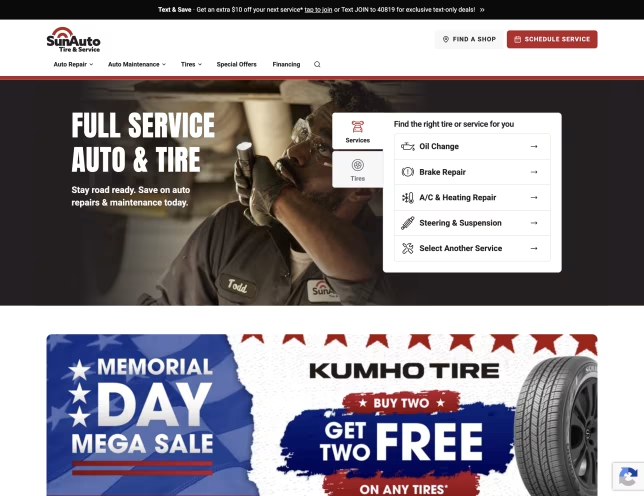
That dynamic is also visible in projects like SunAuto, where modernization work focused on maintainability, governance, reusable architecture, and reducing the long-term cost of fragmented implementation choices.
Governance should protect variation, not suppress it
A multi-brand platform does not succeed by making every brand identical. It succeeds by making the right kinds of variation easy and the wrong kinds expensive.
That is the purpose of WordPress theme override governance. It helps teams preserve the benefits of a shared theme without pretending that local needs will disappear. It creates a disciplined way to decide whether a requirement belongs in configuration, in a reusable component, or in a tightly governed exception path.
When that discipline is missing, local customizations quietly redefine the platform. Upgrades slow down. Testing costs rise. Shared assets stop feeling shared. Eventually, the organization is left supporting a fragmented estate under the illusion of standardization.
When the discipline is present, the opposite becomes possible. Brands still get room to differentiate, but the platform remains legible, supportable, and adaptable. That is what makes a shared theme strategy durable: not the absence of overrides, but the presence of clear architectural rules about when they are justified, how they are implemented, and how they are brought back under control over time.
Tags: WordPress, WordPress theme override governance, Enterprise architecture, Multi-brand platforms, Frontend engineering, Platform governance