Enterprise teams often begin with a sensible goal: make access easier, centralize identity, and reduce fragmented login experiences. In practice, though, SSO can quickly expand from a focused access pattern into a platform-wide assumption. Once that happens, the Drupal platform is no longer just consuming identity. It starts inheriting complexity from every upstream directory, claim model, business exception, and support process.
That is usually where problems begin.
Check your Drupal integration boundariesRun a quick Drupal Platform Health CheckIn enterprise experience platforms, not every user journey needs the same identity treatment. A public marketing site, a gated resource center, a partner portal, and an editorial administration interface may all sit on the same Drupal estate, yet each has different risk, governance, and operational needs. Treating all of them as one SSO problem can create unnecessary coupling and make future changes harder.
A better approach is to define the boundary of identity integration deliberately. That means deciding where SSO adds real value, where lighter-weight access models are more appropriate, and where Drupal should remain decoupled from upstream systems.
Why SSO becomes over-scoped in enterprise Drupal programs
SSO is often framed as an unqualified improvement. For some use cases, it is. It can reduce friction for known users, align with enterprise identity standards, and simplify onboarding into protected experiences. But enterprise programs often over-scope SSO for organizational reasons rather than architectural ones.
Common drivers include:
- a security or infrastructure team standardizing on a corporate identity provider
- a desire to eliminate multiple login paths without separating user populations
- pressure to reuse one identity pattern across public sites, partner spaces, and internal tools
- assumptions that SSO automatically improves authorization consistency
- platform consolidation programs that treat identity as a shared service without defining service boundaries
The risk is not that SSO is wrong. The risk is that the scope expands faster than the platform design.
For example, a public Drupal platform may only need identity for a small library of gated assets. If the team instead binds the full platform experience to enterprise SSO, anonymous browsing, content caching, regional content variation, and campaign landing pages may all become indirectly constrained by login assumptions. That can affect performance strategy, support workflows, analytics interpretation, and even editor behavior.
In multi-site Drupal estates, over-scoping is even more common. One business unit may need federation with a workforce identity provider. Another may need external user registration. A third may serve mostly anonymous visitors. Pushing all of those into one identity model typically creates exceptions layered on top of exceptions.
The right question is not, "Can Drupal support SSO?" It usually can. The more important question is, "Which experiences, users, and control points actually benefit from identity integration, and which should remain intentionally separate?"
Distinguishing authentication, authorization, and profile sync
One reason enterprise Drupal SSO discussions drift is that multiple problems are collapsed into one term.
SSO is primarily about authentication: confirming who the user is through an external identity provider, often using SAML or OIDC. That is not the same thing as authorization, which determines what the authenticated user can access inside Drupal. It is also not the same as profile synchronization, which deals with user attributes such as region, organization, program membership, or account status.
These concerns should be designed separately.
Authentication decisions typically cover:
- which identity provider or providers Drupal trusts
- which users are expected to sign in through federation
- how login initiation works
- whether local Drupal accounts are allowed for some populations
Authorization decisions typically cover:
- which roles or permissions Drupal grants
- whether access is based on claims, Drupal-managed roles, external groups, or a combination
- how access changes are applied and reviewed over time
- what happens when upstream identity data is incomplete or delayed
Profile sync decisions typically cover:
- which attributes are copied into Drupal user records
- which system is considered authoritative for those attributes
- how frequently updates occur
- whether profile fields are needed for personalization, routing, or reporting
When teams merge these into a single integration stream, the result is usually fragile. A claim intended only to prefill a profile field may become a hidden authorization dependency. A directory group meant for workforce management may end up driving content entitlements. A login integration may quietly become the only provisioning mechanism for privileged Drupal access.
A strong Drupal identity integration model keeps these layers explicit. Drupal can authenticate with an external IdP, while still handling some authorization internally. Or it can accept external role signals for a narrowly defined protected area, while editorial roles remain governed through a separate administrative process.
That separation is often what keeps the platform manageable.

See where identity integrations add risk
Assess SSO scope, role mapping, and session dependencies across your Drupal platform.
- Audit integration boundaries
- Spot role mapping drift
- Review session dependencies
Public, semi-public, and restricted experiences in one platform
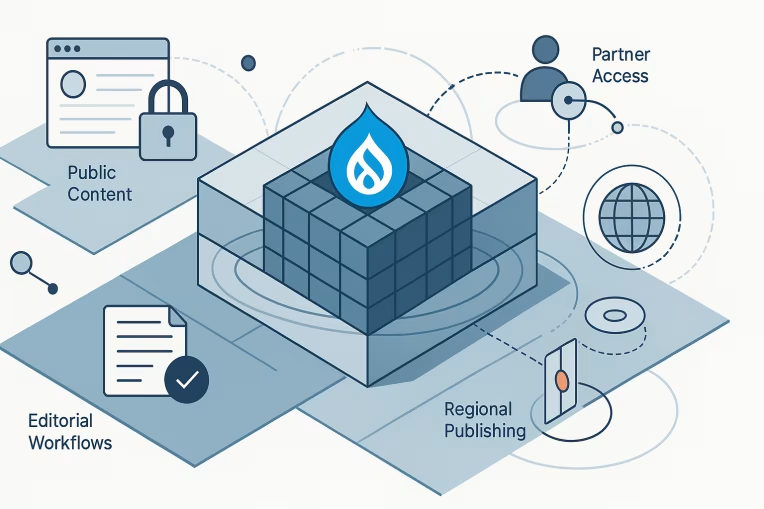
Enterprise Drupal platforms rarely serve only one audience. More often, they combine several experience types in the same implementation or across a related multi-site estate:
- fully public content intended for search and broad discoverability
- semi-public experiences such as gated downloads, event registrations, or preference-based content access
- restricted areas for partners, members, distributors, or clients
- operational interfaces for editors, translators, regional publishers, and administrators
These are not all the same identity problem.
Public content usually benefits from remaining anonymous-first. That preserves discoverability, reduces friction, and keeps performance and caching strategies straightforward. Introducing SSO expectations into public journeys can create unnecessary dependencies on third-party availability, cookie behavior, domain coordination, and logout semantics.
Semi-public experiences often justify a narrower pattern. For example, a resource center may ask users to authenticate before accessing selected materials, while the broader site remains public. In that model, gated content Drupal architecture should not require the entire platform to behave like a portal. The login boundary can sit around specific routes, content types, or applications rather than the whole site.
Restricted experiences, such as partner areas or client-only resources, are where enterprise SSO is often most valuable. Even then, the design should still clarify:
- whether Drupal is the system enforcing access or only reflecting external entitlements
- whether all users come from one identity provider or multiple federated sources
- whether user lifecycle events are handled upstream or need Drupal-side controls
- whether the restricted experience shares a session model with public content or operates as a separate subdomain or application zone
This is especially important in sectors such as healthcare, education, or large multi-brand organizations, where one platform may need both public communication and controlled access patterns. The more those experience types are blended without clear boundaries, the more likely identity assumptions will leak into unrelated parts of the platform.
A practical design principle is to assign identity models to experience zones, not just to websites. A single Drupal platform may reasonably support:
- anonymous access for public publishing
- self-service or lightweight registration for some marketing workflows
- federated SSO for partner or member sections
- separately managed privileged accounts for editors and administrators
That is not inconsistency. It is scoped architecture.
Role mapping and entitlement drift across identity providers
Role mapping is often where enterprise Drupal SSO becomes operationally expensive.
At first, external role claims seem attractive. If the identity provider already knows a user's department, partner type, region, or group membership, why not pass those claims into Drupal and derive access from them? In limited scenarios, that can work well.
The challenge is that upstream groups are not usually designed around Drupal content governance. They are designed around enterprise org structures, HR systems, partner management processes, or application access categories. Over time, those upstream models change for reasons that have nothing to do with Drupal.
That creates entitlement drift.
Entitlement drift can appear in several ways:
- group names change and Drupal mappings fall out of date
- a broad identity group is reused for multiple systems with different access expectations
- temporary business exceptions become permanent access logic
- users inherit access through nested or indirect membership that is not obvious to Drupal administrators
- claims are issued inconsistently across identity providers in B2B or multi-tenant scenarios
- revocation timing differs from the platform's expectation of when access should change
This is why Drupal role mapping should be treated as an architectural control, not a convenience feature.
A few practical patterns can reduce drift:
- Map only a small number of stable external claims into Drupal roles.
- Avoid one-to-one mirroring of every upstream directory group.
- Use Drupal roles for platform-level permission bundles, not as a raw copy of enterprise identity taxonomy.
- Keep content entitlements conceptually separate from administrative permissions.
- Define what happens when claims are missing, ambiguous, or delayed.
- Review access mappings as part of platform governance, not just during implementation.
In many cases, the best model is hybrid. The identity provider confirms the user and may send a small set of stable assertions. Drupal then applies local rules to determine specific access outcomes. That gives the platform enough flexibility to evolve without rebuilding identity dependencies every time an upstream team changes its directory structure.
This is also where Drupal authorization architecture matters more than protocol choice. SAML and OIDC can both participate in well-designed integrations. Neither solves poor authorization boundaries on its own.
Session design, logout behavior, and cross-domain realities
Enterprise teams sometimes assume that once SSO is enabled, session behavior becomes seamless by default. It rarely does.
A Drupal platform may participate in federated login and still need deliberate decisions about:
- session lifetime inside Drupal
- when Drupal trusts an existing IdP session
- how forced reauthentication is triggered for sensitive areas
- whether logout should terminate only the Drupal session or also attempt upstream logout
- how behavior changes across multiple domains, subdomains, or applications
These decisions become especially important when public and restricted experiences coexist.
For example, if a public content domain and a gated partner area share branding but operate on different subdomains, users may reasonably expect continuity. Technically, however, cookie scope, browser constraints, reverse proxies, and identity-provider behavior can limit how seamless that experience really is. Designing around idealized cross-domain session behavior often leads to brittle implementations and support issues.
Logout is another common source of confusion. There is often no single "correct" logout experience across enterprise systems. Ending the Drupal session is straightforward. Ending the upstream IdP session across a user's broader environment may be undesirable, inconsistent, or disruptive. The right outcome depends on context.
Rather than promising perfect single logout, teams should define explicit expectations:
- what "sign out" means in this Drupal experience
- whether other enterprise applications are expected to remain signed in
- how session expiration affects return visits to gated content
- how support teams should troubleshoot perceived login loops or logout failures
This may seem operational rather than architectural, but it is part of scope discipline. If the platform cannot support a clean enterprise-wide session model across every experience zone, that is a signal to narrow the SSO boundary instead of overextending it.
Editorial and administrative access as a separate control problem
One of the most useful boundary decisions in enterprise Drupal is to separate customer- or partner-facing identity from editorial and administrative access.
These populations have different risk profiles, support models, and lifecycle patterns.
Editors and administrators typically need:
- stronger governance over privileged permissions
- more deliberate onboarding and offboarding controls
- compatibility with internal workforce identity systems
- clearer auditability around role assignment and approval workflows
- access to non-public content operations that should not inherit external-user logic
External users in a gated resource center or partner experience usually need something else entirely: stable access to specific materials, account continuity, and limited permission scope.
Problems arise when the same enterprise Drupal SSO design is forced to serve both populations without distinction. An external-claims model that works adequately for gated assets can be a poor fit for administrative permissions. Likewise, an editorial login pattern tied tightly to internal workforce identity may be unsuitable for external audiences who are not represented in the same directory.
From a governance standpoint, these should often be treated as separate control domains, even when they share the same Drupal platform.
That can mean:
- different identity providers for different user populations
- separate authentication entry points
- separate role models and provisioning workflows
- stricter manual approval for elevated Drupal roles
- isolated admin paths or domains with distinct session expectations
The point is not to create fragmentation. The point is to avoid accidental coupling between public-facing experience delivery and privileged operational access.
A decision framework for scoping Drupal SSO correctly
If a team wants to define the right Drupal SSO architecture boundary, it helps to work through a structured set of decisions.
1. Define user populations clearly
List the real user groups, not just the systems involved.
Typical groups might include:
- anonymous visitors
- known marketing contacts
- customers or clients
- partners or distributors
- members or subscribers
- internal editors
- site administrators
- regional publishers or translators
If these groups have different lifecycle owners, support channels, or permission needs, they probably should not all share the same identity treatment.
2. Map experience zones to those populations
Identify which parts of the platform are:
- fully public
- selectively gated
- fully restricted
- operational or administrative
This helps determine where SSO is useful and where it is unnecessary. It also prevents the entire Drupal estate from being designed around the most restrictive use case.
3. Separate authentication from authorization decisions
For each zone, answer separately:
- How will users authenticate?
- Who determines what they can access?
- Which attributes need to exist in Drupal?
This prevents a login integration from becoming a hidden authorization model.
4. Minimize external claim dependencies
Only consume upstream claims that are stable, meaningful, and actually needed. If a claim changes frequently or is difficult for business owners to explain, it is a poor foundation for long-term access design.
5. Plan for exceptions before they arrive
Exceptions are common in enterprise platforms. A temporary partner category, a regional publishing override, a migration-period access rule, or a manually managed account type can all disrupt an otherwise neat identity model.
If the design cannot absorb exceptions without reworking the whole platform, the SSO boundary is probably too broad.
6. Design support and governance flows
A workable identity pattern is not only about successful login. It also needs clear operational ownership for:
- failed access cases
- provisioning disputes
- role change requests
- entitlement reviews
- incident triage between Drupal and identity teams
Support overhead is one of the clearest signals of over-scoped identity integration. When teams cannot quickly tell whether a problem belongs to Drupal, the IdP, directory data, or content permissions, resolution slows and confidence drops.
7. Keep protocol choices in perspective
SAML and OIDC are both common in enterprise environments. The better choice usually depends on surrounding ecosystem constraints, existing standards, application patterns, and implementation maturity. A protocol decision should support the platform boundary, not substitute for it.
Teams often spend too much time debating protocol preference and too little time defining role ownership, session expectations, and failure modes.
What good boundaries look like in practice
A well-scoped identity model for Drupal often has a few recognizable characteristics:
- Public publishing remains public and is not dependent on enterprise login.
- Gated content is protected at clearly defined boundaries rather than across the entire site.
- External claims are limited to a manageable set of access inputs.
- Drupal permissions are not a direct mirror of every upstream directory structure.
- Editorial and administrative access are governed separately from external audience access.
- Session behavior is explained in practical terms, especially across domains and logout flows.
- Ownership is clear when access issues occur.
This kind of architecture may appear less ambitious than a fully unified identity vision. In reality, it is usually more durable. It gives enterprise teams enough integration to support business goals without making the Drupal platform dependent on every identity decision made elsewhere in the organization.
The most effective SSO designs are rarely the broadest ones. They are the ones with the clearest boundaries.
For enterprise Drupal platforms, that means treating identity as a scoped architecture decision tied to audience, access model, and governance responsibilities. When teams do that well, SSO becomes a useful capability inside the platform rather than a blanket assumption that complicates everything around it.
Projects such as Copernicus Marine Service show how SSO integration can sit alongside broader platform consolidation and governance work, rather than defining the entire architecture by default. In the same way, Drupal Experience Platform Strategy work is often where teams clarify which experience zones should federate, which should stay anonymous-first, and how those boundaries remain operable over time.
Drupal integrations
Validate your Drupal identity integration model
Use the Health Check to uncover over-scoped SSO, fragile authorization patterns, and cross-domain session risks before they spread across the platform.
Tags: Drupal, Drupal SSO architecture, enterprise Drupal SSO, Drupal identity integration, Drupal role mapping, Drupal authorization architecture, gated content Drupal, Enterprise CMS