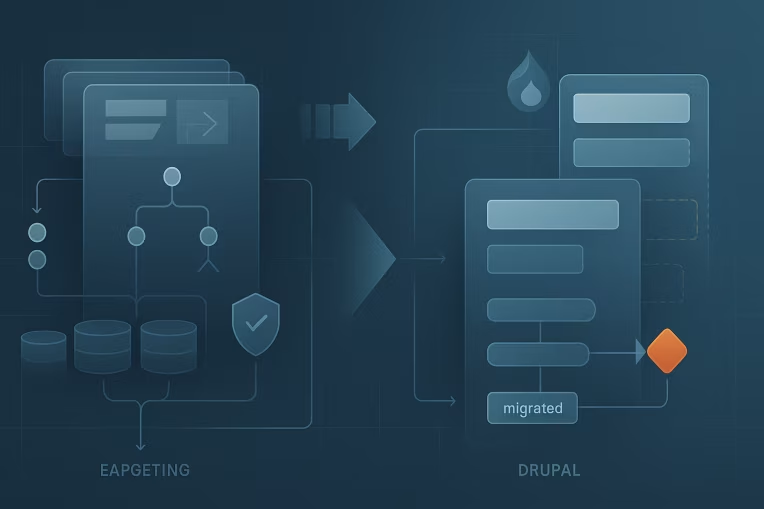
A Drupal migration can look well-scoped on paper and still fail to account for one of the most operationally sensitive parts of the current platform: personalization.
In many AEM environments, personalization logic is not captured cleanly in the content model or component inventory. It lives across audience definitions, ContextHub stores, rule conditions, page-level targeting, authoring exceptions, inherited templates, analytics assumptions, and publishing workflows. Some of it represents genuine business value. Some of it is implementation residue from an earlier phase of the platform. Much of it sits somewhere in between.
That is why an AEM personalization audit before Drupal migration should be treated as a discovery workstream, not a late-stage feature checklist. The goal is not to reproduce every legacy behavior one-for-one. The goal is to understand what the organization actually needs, what the current implementation is truly doing, and which target architecture is most appropriate for each behavior.
A good audit produces three outcomes:
- a realistic inventory of personalization and delivery logic in AEM
- a decision framework for rebuild, replacement, or retirement
- better estimation for dependencies, testing, governance, and rollout
Why personalization logic is often missing from migration scope
Personalization tends to be under-scoped because it is distributed rather than centralized.
A content model can be documented. A template library can be counted. Components can be mapped. Personalization usually cuts across all of those things. A page may render one experience for one audience, suppress a block for another, expose a regional variation based on context, and trigger authoring or preview expectations that are not obvious from markup alone.
In practice, teams often discover that:
- audience rules were configured directly in authoring interfaces and never documented elsewhere
- ContextHub stores pull from session, profile, geolocation, campaign, or custom data sources that are owned by different teams
- page-level exceptions override otherwise standard rendering behavior
- preview workflows depend on assumptions about simulated context that are easy to miss in migration planning
- published output is affected by targeting logic that is not visible in a standard content export
This becomes especially risky in enterprise programs because multiple groups may each assume another team owns the logic. Marketing may believe platform engineering has a definitive rule set. Engineering may assume campaign operations owns it. Privacy, analytics, and regional publishing teams may each influence behavior without owning the implementation end to end.
When that logic is not discovered early, the Drupal program inherits ambiguity in the areas that most affect estimation and launch risk.
What to inventory in AEM: audiences, rules, context stores, triggers, page-level exceptions
The most useful audit starts with inventory, but not just a raw export of configurations. It should identify behavior, ownership, dependency, and business purpose.
At minimum, review the following areas.
1. Audience and segment definitions
Document each audience or segment that influences content delivery.
For each one, capture:
- business name and plain-language description
- where it is used
- entry criteria or rule logic
- data needed to evaluate the audience
- known owner or stakeholder
- whether the audience affects content, layout, CTA selection, messaging, or access
- whether it is still actively used
Do not assume audience names reflect current reality. Many long-lived AEM implementations carry segments created for campaigns or experiments that no longer matter but still appear in configuration.
2. Personalization rules and decision logic
Inventory rules at the level of behavior, not only implementation artifacts.
Useful questions include:
- What content changes when the rule is met?
- Is the rule additive, suppressive, or mutually exclusive?
- Does it run globally, at template level, component level, or page level?
- Is rule evaluation deterministic and stable, or dependent on volatile client-side context?
- Does the rule affect first paint, hydration, or post-load content swaps?
This matters because the migration target may implement equivalent business outcomes in very different ways. A server-side targeted page variant, a client-side experience swap, and a CMS editorial decision tree are not interchangeable from a performance, preview, and governance standpoint.
3. ContextHub stores and data sources
A ContextHub audit should identify what data is being used, where it comes from, and how reliable it is.
Typical inputs can include:
- browser or device context
- session state
- geographic hints
- profile attributes
- campaign parameters
- authenticated user information
- custom JavaScript-fed values
- analytics or marketing platform data
For each store or data source, record:
- source system
- data classification or sensitivity
- runtime dependency
- client-side versus server-side availability
- fallback behavior when data is missing
- whether consent is required before use
- regional restrictions or policy exceptions
This is where migration planning often intersects with privacy architecture. A personalization behavior that appears simple in AEM may depend on data that cannot be used in the same way on the new stack without revised consent handling or regional controls.
4. Triggers, timing, and rendering sequence
Two targeting rules may look identical functionally but behave very differently operationally.
One may resolve at request time. Another may resolve after page load based on JavaScript context. Another may wait on third-party signals. These differences affect:
- cache strategy
- perceived page stability
- analytics interpretation
- preview fidelity
- test design
If you do not capture timing and rendering sequence, you can underestimate the effort required to replicate user-visible behavior even when the business logic seems straightforward.
5. Page-level exceptions and localized overrides
Enterprise AEM environments often contain exceptions that are invisible in platform-level summaries.
Examples include:
- specific pages with custom audience suppression
- market-specific variations that bypass standard targeting rules
- landing pages built for campaign workflows outside the normal template system
- manually maintained exceptions for legal, regulated, or regional content
These exceptions are important because they reveal where personalization has become a workaround for content governance or publishing constraints. That distinction matters when deciding whether Drupal should reproduce the same pattern.
Distinguishing true business requirements from legacy DXP habit
Not every personalization rule is a business requirement. Some are simply artifacts of how the legacy platform evolved.
A useful audit does more than ask, "What exists?" It asks, "Why does this exist, and what value does it still provide?"
A practical way to evaluate each rule is to classify it into one of four groups:
- Business-critical: directly supports revenue, compliance, customer access, or required regional delivery
- Operationally important: improves authoring or campaign execution but is not customer-critical in every journey
- Useful but optional: beneficial when available, but not essential to launch or platform integrity
- Legacy residue: still configured, but no longer tied to a validated business need
To make that classification credible, involve more than one perspective. Platform owners may know technical dependencies. Marketing teams may know current use. Legal or privacy teams may identify constraints. Regional publishing teams may reveal that a global rule is actually a local exception.
Look for warning signs that a rule is legacy habit rather than a current requirement:
- nobody can identify an accountable owner
- there is no clear KPI or operational purpose
- the rule exists on only a small number of pages with inconsistent patterns
- the audience logic relies on data that is incomplete, stale, or poorly governed
- authors avoid using the feature because preview is unreliable or workflows are confusing
- the rule was introduced for a campaign or organizational structure that no longer exists
This step is where migration scope becomes more strategic. If a behavior is not valuable enough to defend, it should not automatically become a requirement for Drupal.
Mapping options: Drupal-native patterns, CDP-driven activation, frontend-only decisions, retirement
Once the current-state audit is complete, the next step is not "How do we port this?" The better question is "What is the right target pattern for the business outcome?"
There are usually four broad options.
1. Rebuild using Drupal-native patterns
Some behaviors belong in the CMS because they are editorially governed and closely tied to content structure.
Examples can include:
- audience-aware content blocks controlled by editors
- region or market variants aligned to content governance models
- role-based or state-based messaging that depends on structured content rules
- scheduled or workflow-driven experience changes
Choose a Drupal-native implementation when the organization needs strong author visibility, governed publishing controls, and predictable preview behavior tied to CMS-managed content.
But be careful not to force Drupal to impersonate every aspect of legacy DXP behavior. If the legacy implementation relied on volatile runtime data or external decisioning, a purely CMS-native rebuild may create complexity without delivering the right operational model.
2. Replace with CDP- or decisioning-driven activation
Some personalization is less about content management and more about audience activation or cross-channel decisioning.
In those cases, the better target may be a separate decisioning layer or customer data platform, with Drupal serving the content and presentation layer rather than owning all targeting logic.
This pattern can make sense when:
- audience definitions need to be shared across channels
- identity or profile logic comes from systems beyond the CMS
- business teams want centralized governance for activation logic
- the website is only one endpoint in a larger personalization ecosystem
The key planning point is to keep vendor assumptions high level during discovery unless the target architecture is already decided. The audit should identify which behaviors require external decisioning capabilities, not prematurely lock them to a specific product feature set.
3. Shift to frontend-only decisions
Some behaviors may be best handled in the frontend, especially when the logic is lightweight, ephemeral, and not essential to authoritative content governance.
Examples can include:
- simple client-side suppression based on local state
- lightweight message variation tied to device or referrer hints
- UI changes that do not alter the underlying canonical content
This approach can reduce CMS complexity, but it introduces tradeoffs around consistency, SEO exposure, performance, accessibility, and preview. It is usually a better fit for presentational variations than for content decisions with regulatory, localization, or analytics significance.
4. Retire the behavior entirely
Retirement is a valid migration outcome.
If a rule has no clear owner, weak evidence of value, heavy dependency cost, or governance problems that outweigh its benefit, decommissioning it may be the most responsible choice. Many migration programs create avoidable complexity by preserving low-value behavior out of caution.
Retirement should still be explicit. Document what is being removed, why, who approved it, and whether any monitoring is needed after launch in case the impact proves larger than expected.
Risks to preview, governance, consent, and regional publishing
Teams often treat personalization as a rendering issue, but migration risk usually shows up in operational boundaries.
Preview expectations
Authors and marketers often expect to preview targeted experiences with confidence. If the legacy system allowed simulated audience states or context overrides, that expectation may need to be recreated or consciously redefined.
Without a clear preview model, teams can end up with:
- uncertainty about what will publish
- more manual QA cycles
- over-reliance on production validation
- tension between editorial and engineering teams during launch windows
A target solution does not have to mimic legacy preview exactly, but it should make supported preview paths explicit.
Governance boundaries
Personalization can blur ownership between CMS, analytics, marketing operations, frontend, and platform teams. During migration, define who controls:
- audience definitions n- targeting rules
- content variants
- approval workflows
- exception handling
- post-launch troubleshooting
If governance is vague, the new implementation can become harder to operate than the old one, even if the technology is more modern.
Consent and privacy
Audience targeting often depends on user context and profile attributes. That means the audit should identify where consent affects runtime behavior.
Important questions include:
- Is the data required for personalization considered personal or sensitive?
- Can the rule run before consent, after consent, or only in certain regions?
- What is the fallback experience when data use is restricted?
- Do authors understand when a targeted experience may not render for all users?
A migration is a good moment to remove rules that depend on poorly governed data usage or assumptions that no longer align with privacy policy.
Regional publishing and legal exceptions
Global platforms frequently mix targeting with localization and regulatory delivery. A region-specific banner, access rule, or message variant may appear to be personalization when it is really a publishing governance requirement.
That distinction matters because compliance-related behavior usually deserves stronger controls, clearer auditability, and more deterministic delivery than campaign-level personalization.
Estimation inputs: rebuild complexity, dependency owners, testing surface
A strong audit improves estimation because it shifts the conversation from feature labels to delivery complexity.
For each personalization behavior, estimate against these dimensions:
- Decision complexity: how many conditions, data points, and exceptions drive the outcome
- Dependency complexity: how many systems or teams must provide data, approval, or support
- Rendering complexity: server-side, client-side, hybrid, or asynchronous implementation needs
- Editorial complexity: how much author training, workflow design, and preview support is required
- Governance complexity: whether privacy, legal, analytics, or regional controls apply
- Testing complexity: how many audience states, pages, devices, and publishing contexts must be validated
This creates a better basis for phasing.
For example:
- high-value, low-complexity rules may be good candidates for initial rebuild
- high-value, high-complexity rules may require architectural decisions before implementation begins
- low-value, high-complexity rules are often strong retirement candidates
Also identify dependency owners early. A targeting feature may look like a CMS task until discovery reveals that identity, consent, analytics, CDN behavior, and regional operations all affect delivery.
Validation plan for cutover and post-launch behavior
Personalization migration should not rely on generic page QA alone. It needs a validation model based on behavior.
A practical plan usually includes the following layers.
Behavior mapping
For each retained rule, define:
- intended user state or audience
- expected content or experience outcome
- fallback outcome when context is unavailable
- authoritative source for expected behavior
This becomes the basis for test cases and stakeholder signoff.
Preview and author validation
Before cutover, confirm that editors and business owners can validate the experiences they are responsible for. If preview behavior differs from the old system, train for that difference explicitly.
Environment and data validation
If targeting depends on identity, cookies, regional routing, campaign parameters, or profile data, test those dependencies in environments that resemble production as closely as practical. Personalization frequently fails not because the rule is wrong, but because a dependency behaves differently outside production.
Fallback and degraded-state testing
Do not test only ideal conditions. Validate what happens when:
- consent is absent
- profile data is incomplete
- a third-party dependency is delayed or unavailable
- a user moves between regions or devices
- cache behavior changes the timing of resolution
Fallback behavior is often more important to launch stability than perfect parity.
Post-launch monitoring
Define what signals will indicate whether retained behaviors are functioning as intended. That may include operational monitoring, analytics review, content owner checks, or support workflows for regional or campaign teams.
A decision matrix for rebuild vs replace vs retire
A simple decision matrix helps teams move from discovery to action without forcing false precision.
Use these questions for each item in the audit:
- Is there a current, validated business requirement?
- Is there a clear accountable owner?
- What data is required, and is its use governed and supportable?
- Does the behavior belong in the CMS, in an external decisioning layer, in the frontend, or nowhere?
- What is the expected preview and authoring model?
- What happens when data or consent is unavailable?
- What is the testing surface and operational burden?
- Is the behavior critical at launch, or can it be phased?
From there, assign one of four outcomes:
- Rebuild when the requirement is clear, valuable, governed, and appropriately owned by the target CMS experience model
- Replace when the business outcome matters but another layer is a better architectural fit than Drupal itself
- Retire when value is low, ownership is unclear, or governance risk is too high
- Defer when the requirement is real but should be phased after core migration stabilization
The most effective migrations treat this as an architecture and operating model exercise, not just a configuration extraction task.
AEM personalization can hide meaningful business logic, but it can also hide years of accumulated exceptions and habits. Auditing it before a Drupal migration gives teams a more honest view of scope and a better foundation for delivery decisions. Instead of asking how to reproduce the past exactly, the better question is which behaviors deserve a place in the future platform, under what governance, and in which layer of the stack.
That shift usually leads to better estimates, cleaner architecture, and a more supportable Drupal platform after launch. Teams planning a broader AEM to Drupal migration often find that this workstream is what turns a nominal content move into a realistic delivery plan, especially when governance-ready publishing workflows and multi-team operating boundaries are part of the target state.
Tags: Drupal, AEM migration, Personalization, ContextHub, Enterprise CMS, Migration planning, DXP assessment