
 [01]
[01]Discovery and Inventory
Run workshops and technical audits to capture AEM structures, content volumes, and integration dependencies. Produce a migration inventory and risk register that informs sequencing, resourcing, and cutover constraints.
Drupal migration readiness
Use a Drupal health check to surface content model gaps, integration dependencies, governance issues, and upgrade readiness before migration scope hardens.
Built for teams moving from AEM to Drupal with complex content, redirects, and integration parity requirements.
No login required. Takes 2–3 minutes.
AEM to Drupal migration services support enterprise CMS replatforming from AEM by moving content, information architecture, templates, and integrations from Adobe Experience Manager to Drupal while preserving operational continuity. The work typically includes content model migration AEM to Drupal (content types, fields, taxonomies), automated content migration pipelines for extraction and transformation, URL and redirect strategy, and rebuilding presentation and authoring workflows in Drupal.
Organizations pursue Adobe Experience Manager to Drupal replatforming when AEM operating costs, deployment constraints, or architectural direction no longer align with platform goals, or when they need a more composable architecture around Drupal and APIs. The migration must account for content quality, localization, permissions, and downstream dependencies such as search, analytics, and identity.
A successful migration treats content as structured data, not pages. By defining target content types, field semantics, and integration contracts early, teams can automate repeatable migrations, validate results, and support phased cutovers. This approach enables Drupal to become a maintainable platform foundation for multi-site growth, governance, and ongoing evolution.
Core Focus
Best Fit For
Key Outcomes
Technology Ecosystem
Platform Integrations
As AEM implementations grow over time, content structures often drift from the original model. Pages embed presentation logic, components vary by site, and authoring conventions become inconsistent across teams. Integrations accumulate through point-to-point connections, and operational knowledge becomes concentrated in a small group of specialists.
When organizations need to evolve the platform, these conditions create friction. Content cannot be reliably extracted without custom rules, and the target platform cannot be designed cleanly because the source model is ambiguous. Engineering teams spend time reverse-engineering templates, reconciling field semantics, and handling edge cases such as embedded assets, references, and localization. Without a disciplined approach, migrations become manual, non-repeatable, and difficult to validate.
Operationally, the risk shows up as extended parallel-run periods, unpredictable cutovers, broken URLs, incomplete redirects, and integration regressions (search, analytics, identity, forms). The result is slower delivery, higher maintenance overhead, and reduced confidence in platform changes because each release can reintroduce migration defects or content inconsistencies.
Inventory AEM sites, templates, components, content types, and integrations. Identify content volumes, languages, permissions, and authoring workflows. Establish migration constraints such as cutover windows, compliance requirements, and parallel-run expectations.
Define Drupal content types, fields, taxonomies, media strategy, and reference patterns. Map AEM structures to Drupal semantics, including localization and workflow states. Document canonical URL rules and redirect requirements to preserve SEO and routing behavior.
Design extraction, transformation, and load (ETL) flows using Drupal migration tooling and APIs. Specify idempotent runs, incremental migration strategy, and error handling. Establish environments and data handling policies for secure processing.
Build migration pipelines for content, media, and relationships, including normalization and deduplication. Implement mapping rules, reference resolution, and asset processing. Produce repeatable runs that can be executed across environments with consistent outputs.
Recreate or refactor integration contracts in Drupal, including REST API endpoints, inbound webhooks, and downstream consumers. Validate authentication, caching behavior, and data formats. Align integration monitoring and operational runbooks for the new platform.
Run automated validation for counts, checksums, and field-level completeness, plus spot checks for editorial correctness. Test redirects, canonical tags, and structured metadata. Execute performance and cache validation to confirm expected runtime behavior.
Plan phased or big-bang cutover with content freeze rules, final delta migration, and rollback options. Coordinate DNS, CDN, and caching changes. Verify production readiness with smoke tests and post-cutover monitoring.
Stabilize the platform with defect triage, content cleanup backlog, and operational tuning. Establish governance for content modeling, component usage, and release management. Define ongoing migration patterns for future acquisitions or site onboarding.
This service treats Adobe Experience Manager to Drupal migration as a repeatable, testable engineering system rather than a one-off data move. It establishes a target content model in Drupal, implements automated content migration pipelines for content and media, and preserves routing and CMS integration parity through contract-focused validation. The result supports phased delivery, controlled cutover, and maintainable content structures and integration contracts for Drupal 10 migration from AEM and beyond.

Define a target Drupal content architecture that reflects business semantics rather than legacy page structures. Map AEM templates, components, and properties to Drupal content types, fields, taxonomies, and entity references. This creates consistent structures for search, personalization, and API delivery while reducing future drift in authoring conventions.
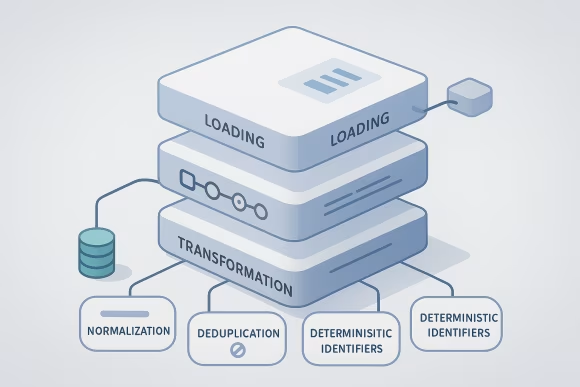
Implement repeatable extraction and transformation flows that can be run multiple times across environments. Pipelines handle normalization, deduplication, and deterministic identifiers so reruns do not create duplicates. This supports iterative development, parallel validation, and final delta migrations during cutover.
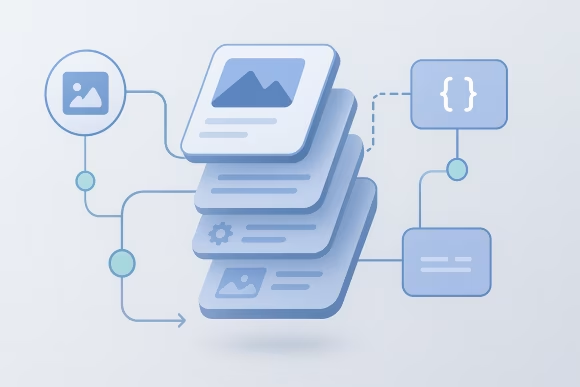
Migrate images, documents, and related metadata into Drupal’s media model with consistent naming, alt text, and usage references. Handle renditions and asset relationships where applicable, and ensure that embedded references are resolved. This reduces broken content and supports governance for future asset lifecycle management.
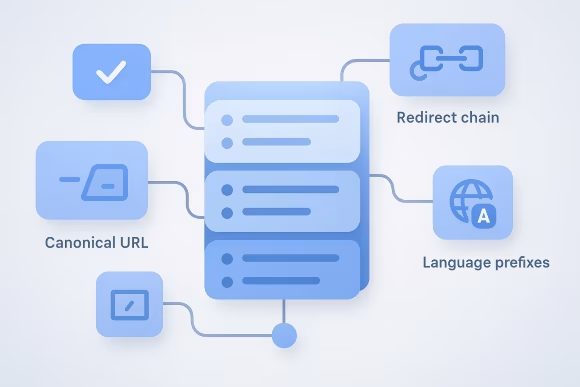
Preserve URL structures where feasible and implement redirect rules where changes are required. Validate canonical URLs, redirect chains, and edge cases such as trailing slashes, language prefixes, and legacy patterns. This protects routing stability and reduces the risk of SEO regressions during replatforming.
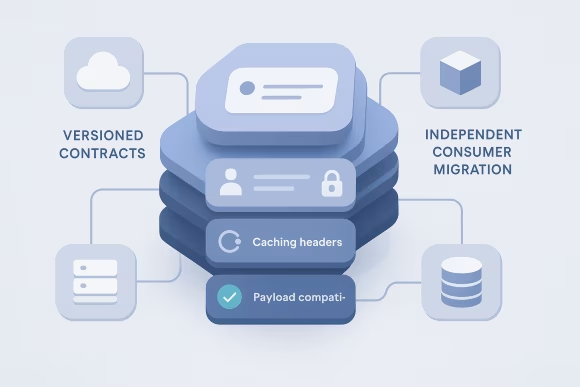
Rebuild or refactor integration points so downstream systems continue to function after the platform switch. This includes REST API endpoints, authentication flows, caching headers, and payload compatibility. Where appropriate, introduce versioned contracts to allow consumers to migrate independently of the CMS cutover.

Create automated checks for completeness and correctness, including record counts, field-level assertions, and relationship integrity. Combine automated validation with targeted editorial review workflows for high-risk content. This provides measurable confidence in migration outcomes and reduces late-stage surprises.
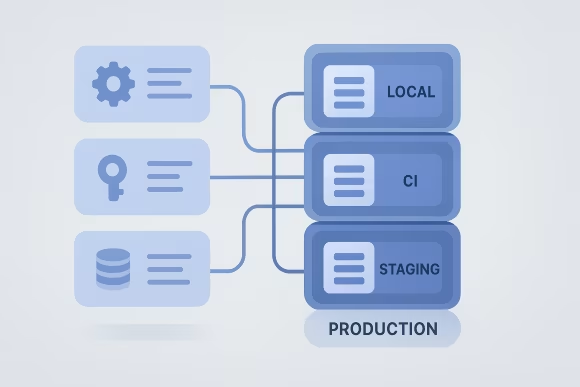
Standardize local and CI environments using containerized tooling to run migrations consistently. Align configuration, secrets handling, and data access patterns across dev, staging, and production. This reduces environment-specific failures and supports predictable execution during final cutover windows.
Identify the issues that create rework during AEM to Drupal migration, then prioritize the Drupal changes that improve architecture, governance, and cutover readiness.
Delivery is structured to reduce migration risk through repeatable runs, measurable validation, and controlled cutover planning. Teams typically iterate through model design and pipeline implementation while running migration rehearsals in parallel with Drupal build and integration work.
[01]Run workshops and technical audits to capture AEM structures, content volumes, and integration dependencies. Produce a migration inventory and risk register that informs sequencing, resourcing, and cutover constraints.
 [02]
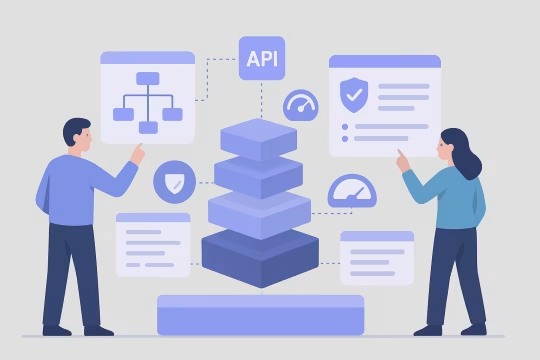
[02]Design the Drupal content model, media strategy, and routing rules. Define integration contracts and non-functional requirements such as caching, security, and performance targets.
 [03]
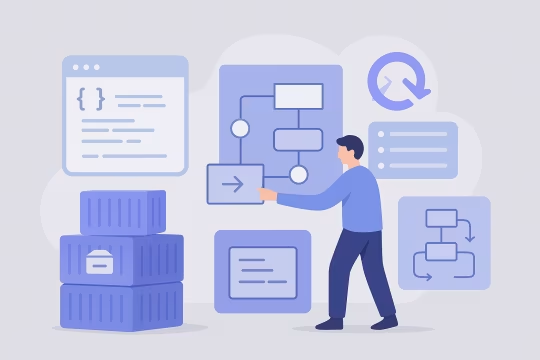
[03]Implement migration pipelines and mapping logic, including transformation rules and reference resolution. Establish repeatable execution in containerized environments and CI where appropriate.
 [04]
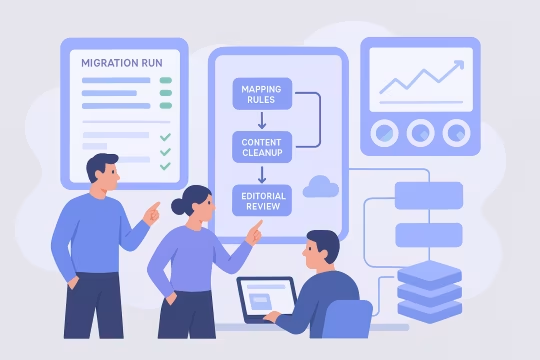
[04]Execute migrations repeatedly to validate completeness, performance, and edge cases. Use rehearsal outputs to refine mapping rules, content cleanup requirements, and editorial review processes.
 [05]
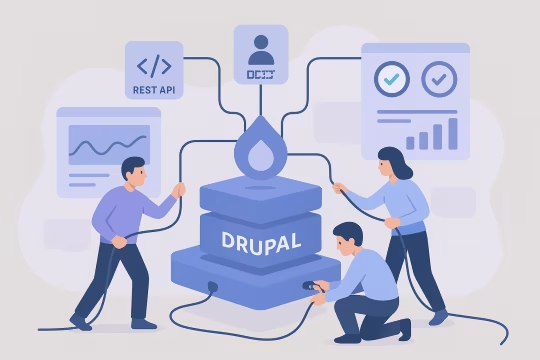
[05]Validate that downstream systems continue to work with Drupal, including REST APIs, identity, search, and analytics. Confirm caching behavior and operational monitoring for the new runtime.
 [06]
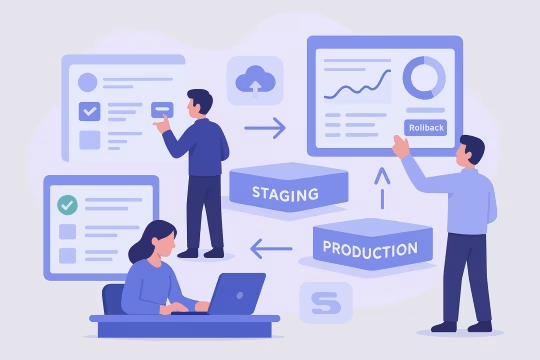
[06]Perform final delta migration, apply redirects, and coordinate CDN and DNS changes. Execute smoke tests and production verification steps, with rollback options defined for critical failure scenarios.
 [07]
[07]Triage post-launch issues, finalize documentation, and transfer runbooks to operations teams. Establish governance for content modeling changes and ongoing platform evolution.
AEM to Drupal migration reduces platform constraints while maintaining continuity for users, editors, and integrated systems. The impact comes from lowering operational risk during change, improving maintainability of content structures, and enabling faster iteration after the replatforming event.
Repeatable migration runs and measurable validation reduce uncertainty during launch. Cutover plans include delta migration and rollback considerations, lowering the likelihood of extended downtime or emergency fixes.
Automated pipelines replace manual copy/paste and ad-hoc scripts. Engineering time shifts from repetitive tasks to resolving genuine edge cases and improving content quality.
A clear Drupal content model reduces drift and makes future changes easier to reason about. Teams can evolve content types and workflows without reintroducing legacy inconsistencies.
Explicit integration contracts and parity testing reduce regressions in identity, search, analytics, and downstream consumers. Versioning strategies can decouple consumer migration from CMS cutover timing.
Once content and integrations are stabilized, teams can ship features without being blocked by legacy CMS constraints. A consistent model supports reusable components and predictable development patterns.
Containerized environments and documented runbooks improve repeatability across dev, staging, and production. Monitoring and performance validation reduce surprises after launch.
URL mapping, redirect validation, and canonical rules reduce traffic loss during replatforming. Teams can measure and correct issues quickly using structured verification outputs.
Before roadmap commitment
A Drupal health check helps your team validate architecture decisions, governance controls, integration readiness, and upgrade considerations before committing to migration timelines.
Adjacent capabilities that commonly support replatforming programs, including Drupal platform build-out, API integration work, and headless or composable architecture patterns.
Drupal content migration engineering for data, content, and platform change
Enterprise Drupal upgrade strategy for upgradeable delivery
Enterprise CMS modernization services for legacy Drupal estates
Drupal Major Version Upgrades: Drupal 8/9/10 to 11/12
Enterprise Drupal Technical Assessment & Drupal Health Check
Custom modules, extensions, and feature engineering
Decoupled Drupal + Next.js migration for modern frontend delivery
Drupal API development services for secure integration layers
Drupal event tracking architecture, identity, and audience sync engineering
Common questions about migrating from AEM to Drupal, covering architecture, operations, integrations, governance, risk management, and engagement structure.
We start by separating business semantics from AEM presentation structures. AEM templates and components often encode layout decisions, while the underlying content meaning is spread across properties, nested components, and authoring conventions. We inventory representative page types, extract field candidates, and identify shared concepts (people, locations, programs, news, landing pages, etc.). In Drupal, we model these concepts as content types, paragraphs or structured components where appropriate, taxonomies for controlled vocabularies, and entity references for relationships. We also define media handling (images, documents, renditions), localization strategy (per-entity translation, language fallbacks), and workflow states. The output is a mapping specification: source fields to target fields, transformation rules, required/optional constraints, and relationship resolution rules. We validate the model early by running small migration samples and checking editorial usability, API outputs, and downstream needs such as search indexing. This keeps the target architecture stable while still allowing iterative refinement before full-scale migration runs.
It depends on content volume, integration complexity, and organizational tolerance for parallel operations. A phased approach is often preferable when you have multiple sites, distinct business units, or high-risk integrations. You can migrate and launch in slices (by site, language, or content domain), reducing the blast radius and allowing teams to learn from early waves. A single cutover can be viable when the platform is relatively bounded, the URL space is manageable, and you can enforce a content freeze window. In that case, the key is to run multiple rehearsals, measure migration duration, and ensure the final delta migration is predictable. Architecturally, phased migrations require careful routing and integration planning: shared services (search, identity, analytics) must support both platforms temporarily, and canonical URL ownership must be explicit to avoid duplicate indexing. We typically recommend deciding the cutover model early because it affects content modeling, redirect strategy, and how you design migration pipelines for incremental runs versus one-time loads.
At minimum you need a development environment for pipeline implementation, a staging environment that mirrors production configuration, and a production environment for final execution. For enterprise programs, we also recommend a dedicated migration rehearsal environment to run full-scale loads without disrupting feature testing. Repeatability comes from environment parity: consistent Drupal configuration, consistent versions of migration tooling, and controlled access to AEM exports or APIs. Containerized setups (for example using Docker) help ensure the same pipeline behaves the same way across developer machines and CI runners. Operationally, you also need a data handling approach: where exports are stored, how credentials are managed, how PII is treated, and how logs are retained. We implement idempotent migrations so reruns do not create duplicates, and we produce execution reports (counts, failures, skipped items) that can be compared across runs. This makes it possible to rehearse cutover steps and estimate final migration time with much higher confidence.
During migration, performance is primarily about throughput and stability of the pipeline. We batch operations, control concurrency, and design migrations to be resumable so failures don’t require restarting from scratch. We also separate content and media loads when needed, because asset processing can dominate runtime. After migration, performance shifts to runtime behavior: page rendering, API response times, and cache effectiveness. We validate caching headers, CDN behavior, and Drupal cache configuration, and we ensure that migrated content does not create pathological rendering patterns (for example deeply nested structures or excessive entity loads). If Redis is part of the stack, we confirm it is used appropriately for cache bins and that eviction behavior aligns with traffic patterns. We also validate that search indexing and background jobs do not overload the platform immediately after launch. The goal is to avoid a situation where the migration “succeeds” but the platform becomes operationally unstable due to cache misses, heavy rebuilds, or inefficient content structures.
We start by classifying integrations into categories: content consumption (APIs used by frontends), authoring workflow integrations, identity and access, analytics/tagging, search/indexing, and operational tooling. For each integration we identify the contract: endpoints, payload shapes, authentication, caching, and SLAs. If consumers depend on AEM-specific APIs, we decide whether to provide equivalent Drupal endpoints, introduce a compatibility layer, or refactor consumers to a new contract. In enterprise environments, versioned APIs are often the safest path: Drupal exposes v2 endpoints while legacy consumers continue using v1 until they are migrated. We validate integration parity with contract tests and environment-based verification. This includes checking headers and caching behavior, not just payload correctness. Where possible, we decouple integrations from the CMS by introducing an API gateway or integration service, reducing the likelihood that a future CMS change forces another broad integration rewrite.
For search, continuity depends on preserving content semantics and ensuring the indexing pipeline receives equivalent or improved signals. We map fields used for indexing (titles, summaries, body, taxonomy tags, language, access rules) and validate that Drupal outputs the required structured data. We also plan reindexing timing and verify that access-controlled content is handled correctly. For analytics, we focus on preserving measurement integrity: page paths, canonical URLs, redirect behavior, and tagging consistency. If the organization uses a tag manager, we validate that data layer events and key attributes remain stable. If tagging is embedded, we migrate the implementation to Drupal templates or frontend code and confirm consent and privacy behavior. We run pre- and post-cutover checks: redirect chain audits, sampling of high-traffic URLs, and comparison of key analytics dimensions. The objective is not to keep every implementation detail identical, but to avoid breaking reporting continuity and to ensure that the new platform produces reliable, comparable data from day one.
Model drift usually happens when teams add fields and structures opportunistically without shared standards. In Drupal, we mitigate this by establishing governance around content types, taxonomies, and reusable structured components. That includes naming conventions, field semantics documentation, and a review process for model changes. We also recommend separating concerns: use content types for domain concepts, use structured components for composable content blocks, and avoid encoding layout decisions into content fields unless there is a clear product requirement. Where multiple sites share a platform, we define which parts of the model are global versus site-specific. Operationally, governance is supported by tooling: configuration management, code review for configuration changes, and automated checks in CI to detect unexpected configuration drift. Over time, this reduces the risk that the platform becomes difficult to evolve because content structures diverge across teams, making migrations, integrations, and frontend rendering increasingly complex.
We treat workflows and permissions as first-class migration requirements, not post-launch configuration. We begin by mapping roles, groups, and approval steps in AEM to Drupal roles and workflow states. For multi-site or multi-team environments, we also define content ownership boundaries and how shared content is governed. In Drupal, we implement workflows using appropriate tooling and configuration, ensuring that states (draft, review, approved, published, archived) align with operational needs. We also validate that permissions cover both content and media, including who can create, edit, translate, and publish. During migration, we decide what to do with historical workflow state. In many cases, the target is to migrate published content as published and keep drafts in a controlled backlog, because migrating every historical state can add complexity without clear value. The key is to ensure that editors can operate effectively on day one and that governance prevents accidental publication or unauthorized changes.
The primary SEO risks are URL changes, redirect errors, duplicate content, and loss of metadata signals. URL changes can cause ranking drops if redirects are incomplete, incorrect, or create chains. Duplicate content can occur during phased migrations if both platforms serve similar pages without clear canonical ownership. Mitigation starts with a URL inventory and a mapping strategy: preserve URLs where feasible, define deterministic new URL rules where not, and implement 301 redirects with validation. We also validate canonical tags, hreflang for multilingual sites, robots directives, and structured metadata outputs. We run automated audits before and after cutover: sampling high-traffic pages, checking status codes, detecting redirect loops, and verifying that sitemap outputs are correct. For phased migrations, we define which platform is authoritative for each URL segment and ensure non-authoritative pages are redirected or noindexed as appropriate. The goal is to make routing behavior predictable and measurable, so SEO impact is controlled rather than discovered after launch.
Most AEM estates contain content inconsistencies: missing metadata, embedded formatting, broken references, and outdated assets. We handle this by classifying issues into three groups: fix in source, fix in transformation, or fix in target after migration. If the issue is systemic and affects many items (for example inconsistent date formats or taxonomy values), we typically fix it in transformation rules so the pipeline produces normalized outputs. If the issue is localized but critical (for example legal disclaimers or key landing pages), we may fix it in source to preserve editorial intent and reduce exceptions. We also produce reconciliation reports: items skipped, items with validation warnings, and items requiring manual review. This creates a content cleanup backlog that can be prioritized by business impact. The aim is to avoid blocking the entire migration on perfect content while still ensuring that high-risk content is correct and that the platform does not inherit avoidable structural debt.
On the client side, successful migrations usually involve a platform owner (or product owner) to make scope decisions, an enterprise or platform architect to align target architecture and integrations, and engineering leads to coordinate implementation and environments. Editorial leadership is also important to validate content semantics, workflows, and acceptance criteria. For larger estates, you often need representatives per site or business unit to confirm edge cases and local requirements, plus operations/SRE stakeholders to align on deployment, caching, monitoring, and cutover procedures. Security and compliance stakeholders may be required for data handling, access control, and audit requirements. We define responsibilities early: who approves the target content model, who owns URL decisions, who signs off on integration parity, and who controls the cutover window. Clear ownership reduces late-stage churn where technical work is complete but decisions about redirects, workflows, or content exceptions remain unresolved.
Timelines vary based on content volume, number of sites and languages, integration complexity, and the amount of redesign or information architecture change included. A migration that keeps URL structures and limits template changes can move faster than one that combines replatforming with a full redesign and content restructuring. From an engineering perspective, the critical path is usually: target model decisions, pipeline implementation, and rehearsal runs with validation. Rehearsals are not optional for enterprise cutovers; they are how you estimate duration, identify edge cases, and confirm that the process is repeatable. A practical way to estimate is to run a pilot: migrate a representative subset (one site or one content domain), measure throughput, and extrapolate while accounting for complexity multipliers (media-heavy content, localization, complex references). We also plan for stabilization after launch. The goal is a schedule that reflects operational reality, not just development effort.
Yes, and it is often a key architectural reason to move. If you plan to use Drupal as a content hub for multiple channels, we design the content model and API layer accordingly. That includes defining stable entity identifiers, consistent field semantics, and predictable relationships so consumers can render content without relying on CMS-specific presentation logic. We also define API contracts: REST endpoints, caching strategy, authentication, and versioning. In some cases, it is beneficial to introduce an API gateway or a BFF (backend-for-frontend) layer to tailor responses to specific applications while keeping Drupal’s core model clean. The migration approach changes slightly for headless: you prioritize structured content completeness and API validation over page-level parity. You also need to plan how routing and redirects are handled if the frontend is decoupled. The key is to decide early whether the target is traditional Drupal rendering, headless, or a hybrid, because it affects content modeling and integration design.
We treat identity as an integration contract with clear requirements: authentication protocols, user provisioning, role mapping, session behavior, and audit needs. We document how AEM currently integrates (for example SAML/OIDC flows, group-to-role mapping, and any custom authorization logic) and then design the Drupal equivalent. In Drupal, we implement the chosen protocol and validate edge cases such as multi-domain cookies, admin access separation, and step-up authentication requirements. We also ensure that authorization decisions are explicit: which roles can access which content, and how that interacts with caching and search indexing. During cutover, identity changes can be high risk because they affect editors and administrators immediately. We therefore test in a production-like staging environment with representative user accounts and groups, and we include identity verification steps in the cutover runbook. The objective is to avoid a situation where the platform launches but teams cannot log in or cannot perform critical publishing operations.
URL decisions sit at the intersection of product, SEO, and platform architecture, so ownership must be explicit. We typically recommend a joint ownership model: product or digital leadership defines user-facing URL intent, SEO stakeholders define continuity requirements, and platform engineering implements deterministic rules and validation. Redirect governance should be treated as a managed artifact, not an ad-hoc spreadsheet that changes late in the project. We maintain a canonical URL inventory, mapping rules, and exception lists with version control where possible. We also define acceptance criteria: no redirect chains beyond a defined limit, no loops, and coverage for high-traffic and high-value pages. After launch, redirect governance continues. Teams need a process for adding new redirects, retiring old ones, and monitoring 404s. Without governance, redirect rules accumulate inconsistently, which can degrade performance and create maintenance overhead. A clear owner and a controlled change process keep routing stable as the platform evolves.
Collaboration usually begins with a short discovery phase focused on establishing scope and constraints. We request access to a representative AEM environment (or exports), existing architecture documentation, and a list of key integrations and stakeholders. We then run workshops to inventory content domains, templates/components, languages, workflows, and operational requirements such as cutover windows and compliance constraints. From that, we produce a migration plan that includes: a target content model outline, a proposed cutover strategy (phased or single), an integration parity plan, and a validation approach with measurable acceptance criteria. We also identify unknowns and propose a pilot migration to reduce risk and improve estimation. The next step is typically a pilot implementation: migrate a bounded subset end-to-end, validate outputs with editorial and technical stakeholders, and refine mapping rules and pipeline design. This creates a shared baseline for delivery sequencing, resourcing, and timelines before committing to full-scale migration execution.
These case studies showcase successful Drupal migrations and platform modernizations that align closely with AEM to Drupal migration services. They highlight structured content model transformations, automated migration pipelines, integration parity, and governance frameworks that ensure scalable, maintainable Drupal platforms. The selected work demonstrates measurable outcomes in enterprise CMS replatforming, content governance, and multi-site delivery architectures.
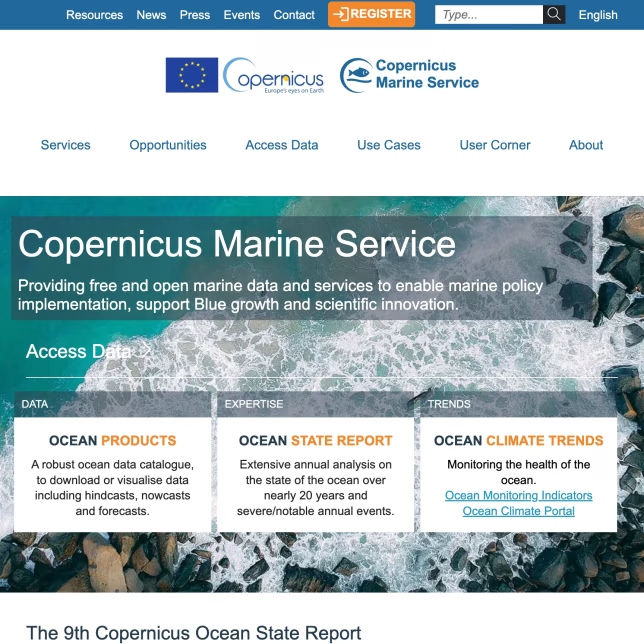
The existing marine data portal relied on three unaligned WordPress installations and embedded PHP code, creating inefficiencies and risks in content management and usability.
The new Drupal DXP streamlined content operations and improved accessibility, offering scientists and businesses a more efficient gateway to marine data services.
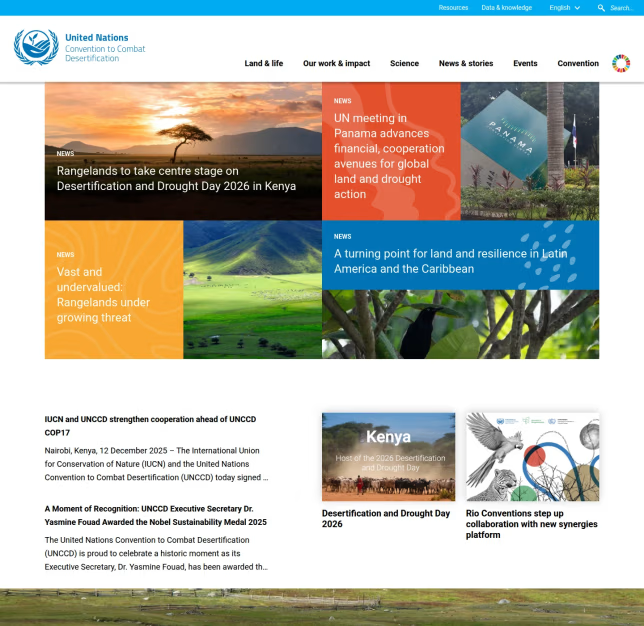
UNCCD operated four separate websites (two WordPress, two Drupal), leading to inconsistencies in design, content management, and user experience. A unified, scalable solution was needed to support a large-scale CMS migration project and improve efficiency and usability.
The modernization effort resulted in a cohesive, user-friendly, and scalable website, improving content management efficiency and long-term digital sustainability.
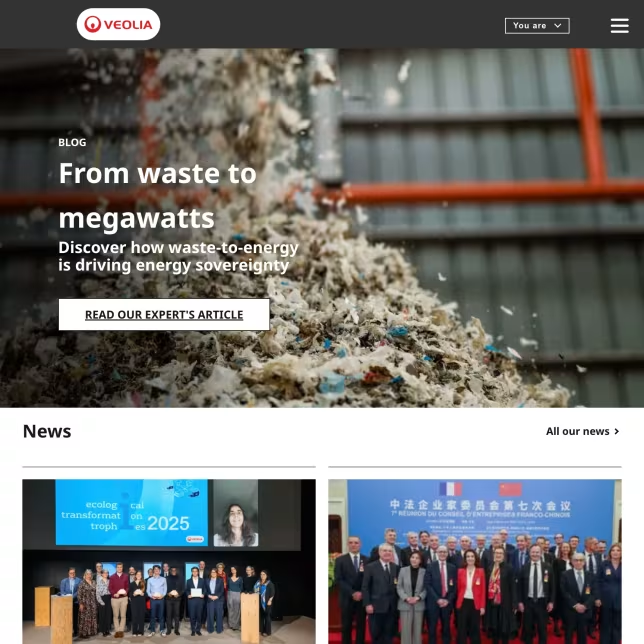
With Drupal 7 reaching end-of-life, Veolia needed a Drupal 7 to Drupal 10 enterprise migration for its Acquia Site Factory multisite platform—preserving region-specific content and multilingual capabilities across more than 200 sites.
The platform was modernized into a stable, scalable multisite foundation with improved performance, maintainability, and long-term upgrade readiness.
It was my pleasure working with Oleksiy (PathToProject) on a new Drupal website. He is a true full-stack developer—the ideal mix of DevOps expertise, deep front-end knowledge, and the structured thinking of a senior back-end developer.
He is well-organized and never lets anything slip. Oleksiy understands what needs to be done before being asked and can manage a project independently with minimal involvement from clients, product managers, or business analysts.
One of the best consultants I’ve worked with so far.

Andrei Melis
Technical Lead at Eau de Web
Oleksiy (PathToProject) and I worked together on a Digital Transformation project for Bayer LATAM Radiología. Oly was the Drupal developer, and I was the business lead. His professionalism, technical expertise, and ability to deliver functional improvements were some of the key attributes he brought to the project.
I also want to highlight his collaboration and flexibility—throughout the entire journey, Oleksiy exceeded my expectations.
It’s great when you can partner with vendors you trust, and who go the extra mile.

Axel Gleizerman Copello
Building in the MedTech Space | Antler
Oleksiy (PathToProject) is demanding and responsive. Comfortable with an Agile approach and strong technical skills, I appreciate the way he challenges stories and features to clarify specifications before and during sprints.

Olivier Ritlewski
Ingénieur Logiciel chez EPAM Systems
These articles dig into the AEM behaviors that most often shape migration scope, from content and asset modeling to workflow, permissions, localization, and delivery dependencies. They are useful background for teams planning a structured move from AEM to Drupal and want to understand what must be rebuilt, replaced, or retired before cutover.
Let’s review your AEM estate, define the target Drupal content model, and design a repeatable migration and cutover plan with measurable validation.