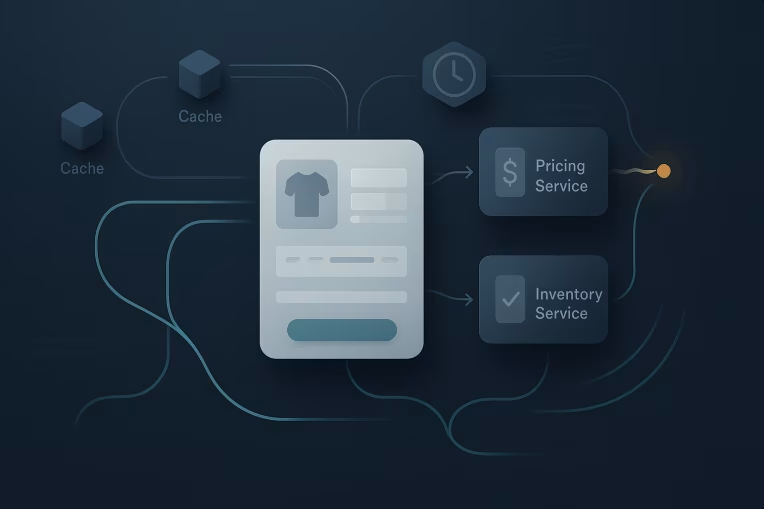
In composable commerce, the storefront often looks modern long before it becomes resilient. Teams decouple the experience layer, add specialized services for pricing, promotions, inventory, search, and checkout, and then discover that the customer journey now depends on many runtime decisions finishing on time.
That tradeoff is manageable when fallback behavior is designed up front. It becomes expensive when the first real discussion about degradation happens during an outage.
A product detail page does not need every dependency to behave perfectly in order to remain useful. But it does need clear rules for what can be cached, what can be shown as stale, what must block action, and who decides those rules. Without that discipline, headless commerce resilience is mostly accidental.
This is where fallback architecture matters. The goal is not perfect continuity under every failure mode. The goal is to preserve the most valuable user actions, communicate uncertainty honestly, and prevent upstream instability from turning into total page failure.
Why composable commerce fails at dependency boundaries
Composable stacks usually fail at boundaries rather than at the rendering layer itself. The frontend may be healthy, edge delivery may be healthy, and CMS content may be available, while the page still becomes functionally broken because one or two commerce services exceed latency budgets.
Common examples include:
- the pricing service returns after the page render budget has already expired
- the inventory API responds inconsistently across regions or channels
- promotion eligibility depends on rules engines with variable execution time
- the cart or checkout API is available, but product availability validation is not
- edge-cached page shells remain fast while personalized or transactional fragments become unstable
These failures are hard because they are not always binary. A service may be partially available, slow only for certain product types, or accurate for one warehouse model but not another. That ambiguity often leads teams to implement one of two bad patterns:
- Hard dependency everywhere: the page waits for every upstream result before rendering critical actions
- Optimistic guessing everywhere: the page renders actionable states without enough confidence in the underlying data
Neither works well at scale. The first destroys availability. The second creates trust and operational issues.
A better approach is to define dependency behavior explicitly by journey. For example, a landing page may tolerate stale merchandising data. A product detail page may tolerate slightly stale price display in some contexts but not an add-to-cart promise that depends on current stock validation. A checkout step may require stricter guarantees than browse or discovery pages.
That is the core of commerce integration architecture under degradation: not every data source deserves the same runtime treatment.
Classifying critical vs optional commerce data on the page
A practical fallback strategy starts with classifying data by business consequence, not by implementation ownership.
Many teams categorize dependencies only by service name: pricing, inventory, promotions, recommendations, ratings. That is too coarse. The same service can provide both critical and optional data depending on where the user is in the journey.
A more useful model is to classify page data into four groups:
-
Essential to render the page
Content without which the page is not meaningful, such as product name, primary image, base description, and core merchandising context. -
Essential to take the next commercial action
Data required before the user can make a reliable decision or submit a transaction, such as buyability status, validated price, channel-specific availability, or shipping restriction flags. -
Important but deferrable
Information that improves decision quality but does not need to block initial render, such as low-stock messaging, estimated delivery ranges, related products, or promotional banners. -
Optional and removable
Enhancements that can disappear cleanly during degradation, such as recommendation carousels, social proof widgets, personalization modules, or secondary enrichment.
Once this classification exists, the frontend can stop treating the page as a single all-or-nothing request chain.
For enterprise product detail pages, that often leads to a layered design:
- render the durable page shell and CMS-controlled product content immediately
- request dynamic commerce data in parallel rather than serially
- gate only the actions that truly require fresh validation
- suppress non-essential enrichments when upstream latency grows
- preserve explanatory messaging when certainty is limited
This is also where teams should separate display accuracy from transactional accuracy. A displayed price can sometimes be slightly stale if the final price is revalidated before cart or checkout. Inventory messaging can sometimes be approximate on browse surfaces, but add-to-cart availability usually needs stronger guarantees.
Those decisions are business and legal decisions as much as technical ones. Engineers should not improvise them during implementation.
Timeout budgets, stale data windows, and safe cache policies
Most degraded experiences are not caused by failure alone. They are caused by missing rules for how long the experience layer should wait and what it may safely do when fresh data does not arrive.
Three controls matter most: timeout budgets, stale data windows, and cache policies.
Timeout budgets
Every upstream dependency should have a clear latency budget aligned to the page's performance target.
For example, if a product detail page needs to become meaningfully interactive within a fixed user experience target, the pricing API cannot consume most of that budget by itself. The orchestrating layer needs explicit thresholds such as:
- time allowed before rendering without the dependency
- time allowed before replacing a placeholder with fallback messaging
- time allowed before suppressing a module entirely
- time allowed before logging a degraded-state event
A pricing API timeout strategy should account for both technical and journey consequences. Waiting an extra few hundred milliseconds might be acceptable if the result enables a reliable buy action. Waiting much longer may only delay the inevitable fallback and make the page feel broken.
In practice, this often means setting different budgets per surface:
- shorter budgets for list pages and landing pages
- moderate budgets for product detail page display data
- stricter validation budgets for add-to-cart and checkout steps
Stale data windows
If no stale tolerance exists, every real-time dependency becomes a hard dependency.
The better question is not whether data can become stale. It is how stale each class of data may be before it becomes misleading or operationally unsafe.
Typical examples:
- merchandising badges may tolerate a longer stale window than inventory counts
- general stock status may tolerate more staleness than warehouse-specific pickup availability
- base price display may have a different tolerance than time-limited promotional price eligibility
- delivery estimates may need their own freshness rules because they combine stock, location, and carrier data
A stale window should be defined in business language first:
- What customer action could this influence?
- What is the risk if the value is slightly outdated?
- Is the value revalidated later in the journey?
- Does regulation, contract, or channel policy impose stricter rules?
Only then should the implementation pick technical mechanisms such as edge cache TTL, stale-while-revalidate behavior, origin cache keys, or client-side storage rules.
Safe cache policies
Edge caching for commerce is useful, but only when the cached artifact is intentionally scoped.
Teams often make one of two mistakes:
- they avoid caching dynamic commerce data entirely, forcing every request to depend on origin-time service health
- they cache dynamic data too broadly, leaking context or serving misleading information across channels, markets, or customer states
Safe cache policies usually require separating data into cacheable layers:
- Highly durable layer: page shell, layout, content blocks, imagery, non-sensitive product narrative
- Moderately dynamic layer: general price display, broad availability label, merchandising treatments with bounded staleness
- Highly dynamic or context-sensitive layer: customer-specific pricing, exact stock, promotions with narrow eligibility, fulfillment-specific delivery promises
The architecture can then choose different delivery paths for each layer:
- edge render or static generation for durable content
- API composition with stale fallback for moderately dynamic data
- just-in-time validation for transaction-critical data
That combination is often more resilient than trying to make every field real-time on every request.
UX fallback patterns for pricing, stock, promotions, and checkout dependencies
A degraded experience is still a designed experience. If the UI does not explain what is happening, customers infer the worst: the site is broken, the price is unreliable, or the product is unavailable.
Fallback design should therefore specify both system behavior and user-visible behavior.
Pricing fallback patterns
When pricing is delayed or unavailable, common options include:
- show the last known valid displayed price with clear revalidation at cart
- replace price with a neutral state such as "Price currently updating"
- hide promotional breakdowns while preserving the ability to browse product information
- disable add-to-cart until current price validation succeeds
Which option is appropriate depends on the commercial model. If price volatility is low and revalidation happens before commitment, a bounded stale display may be acceptable. If promotions are highly conditional or contractually sensitive, neutral messaging may be safer.
What should usually be avoided is presenting a normal, actionable purchase state when the platform cannot support the promise behind it.
Inventory fallback patterns
Inventory API failure handling requires even more care because stock is often distributed, location-dependent, and contested by concurrent demand.
Useful fallback patterns include:
- degrade exact counts into broader states such as "Availability currently being confirmed"
- show general online availability while suppressing store-level pickup promises
- allow add-to-cart but perform stronger validation before checkout progression
- block immediate purchase actions when no reliable stock signal exists
The key is to avoid false precision. If the inventory model is uncertain, the UI should become less specific, not pretend certainty.
Promotions and eligibility fallback patterns
Promotions are frequently implemented through rules engines, campaign services, or customer-context evaluation. They can be valuable, but they should rarely be allowed to take down the page.
A sensible pattern is:
- render the core product experience without promotional dependency
- attach promotion messaging asynchronously
- suppress complex offer combinations under latency or failure
- revalidate discount logic in cart and checkout where the commercial commitment occurs
This avoids turning promotional enrichment into a hard prerequisite for browse usability.
Checkout and downstream dependency patterns
Some dependencies cannot be safely softened. Payment authorization, tax calculation in certain contexts, and order submission validation often require stricter correctness than browse-stage interactions.
Even here, fallback design still matters. The objective becomes controlled interruption rather than silent failure.
Good patterns include:
- preserving cart contents when downstream services fail
- showing explicit retry states with context, not generic errors
- distinguishing temporary service issues from true validation errors
- keeping the user's progress and form input intact wherever possible
In other words, degraded experience design is not only about staying up. It is also about failing in a way that protects trust and reduces abandonment.
Observability and incident ownership across frontend and commerce services
Fallback architecture is incomplete without operational visibility. If teams cannot see when the experience has entered degraded mode, they cannot manage the business impact.
At minimum, observability should answer these questions:
- Which upstream dependencies are timing out, failing, or exceeding budget?
- Which user journeys are entering fallback state most often?
- What percentage of requests are served with stale data?
- Which modules are suppressed or disabled during incidents?
- Are customers unable to complete revenue-critical actions, or only seeing reduced enrichment?
That requires instrumentation across several layers:
- frontend events for placeholders, disabled states, module suppression, and user retries
- edge and server logs for cache hits, stale serves, and origin timeout behavior
- API orchestration metrics for dependency timing, circuit breaking, and fallback path selection
- service-level telemetry for pricing, inventory, promotion, and checkout health
Ownership is just as important as telemetry. In many enterprise environments, nobody fully owns degraded user experience because responsibilities are fragmented:
- frontend owns rendering
- platform teams own edge behavior
- commerce teams own pricing or inventory services
- product teams own the journey
- operations teams own incident coordination
When degradation occurs, these boundaries can slow decisions. One team sees elevated latency, another sees a healthy error rate, and a third sees falling conversion with no clear root cause.
A stronger model defines ownership in advance:
- who sets timeout budgets
- who approves stale data windows
- who decides which actions remain enabled under uncertainty
- who can activate incident modes or feature suppression
- who reviews fallback behavior after incidents
This governance matters because resilience is not just a code path. It is an operating model.
When fallback complexity signals a deeper architecture problem
Fallback logic is valuable, but it can also become a warning sign.
If teams need dozens of special-case rules just to keep the product detail page functional, the architecture may be over-fragmented. A storefront that requires too many synchronous upstream calls may be carrying domain boundaries that make sense on an org chart but not in a runtime path.
Warning signs include:
- the same page depends on many thin services with overlapping data responsibilities
- orchestration logic becomes more complex than the business logic it supports
- stale and fresh variants of the same data are difficult to reconcile consistently
- one service's output is needed only because another service lacks a usable aggregate view
- incident handling depends on manual toggles that teams do not trust
At that point, the right answer may not be more fallback branches. It may be architectural simplification.
Possible responses include:
- consolidating read models for page-serving use cases
- precomputing selected commerce views for edge delivery
- moving non-critical enrichment off the critical render path
- introducing clearer separation between browse-time and transaction-time validation
- redefining service contracts around journey needs rather than internal domains
This does not mean abandoning composability. It means using composability with runtime discipline. Modular systems still need deliberate aggregation patterns where customer experience depends on coordinated outcomes.
Practical recommendations for enterprise teams
For teams improving headless commerce resilience, a pragmatic sequence often works better than a large redesign.
-
Map the runtime dependency chain for priority journeys
Start with product detail, category listing, cart, and checkout entry. Document which services are required, which are optional, and where current waiting happens. -
Classify each data element by consequence of staleness or absence
Do not stop at service-level labels. Define what each field means for customer action and business risk. -
Set explicit timeout and fallback rules
Decide what happens when pricing, inventory, or promotions do not arrive on time. Make the behavior deterministic. -
Separate cacheable read concerns from transactional validation
Use edge and origin caching where bounded staleness is acceptable, but preserve stronger revalidation where commitments are made. -
Design degraded UI states intentionally
Review loading, stale, unavailable, and retry states with product, engineering, and commercial stakeholders together. -
Instrument degraded mode as a first-class condition
Track when the platform serves stale data, suppresses modules, disables actions, or shifts to fallback copy. -
Review incidents for architecture signals, not just immediate fixes
Repeated fallback activation may indicate a deeper contract, orchestration, or service-boundary problem.
Conclusion
Composable commerce gives teams flexibility, but it also increases the number of runtime dependencies that can weaken a customer journey. When pricing or inventory APIs degrade, the question is not whether the storefront can continue in some form. The better question is whether it can continue in a way that is useful, honest, and operationally controlled.
Strong composable commerce fallback architecture defines what the experience may show, how long it may wait, when it may serve stale data, and where transactional certainty must be restored. It aligns frontend rendering, API orchestration, edge caching, and governance so degradation becomes a managed state rather than an improvised crisis.
No fallback model removes all risk. Different products, channels, and operating constraints require different tolerances. But teams that classify dependencies clearly and design degraded modes deliberately are usually better positioned to protect both performance and trust when upstream services behave unpredictably.
Tags: composable commerce fallback architecture, headless commerce resilience, pricing API timeout strategy, inventory API failure handling, degraded experience design, commerce integration architecture, edge caching for commerce, frontend architecture