 [01]
[01]Discovery and Mapping
Workshops to map systems, commerce domains, and current integration paths. Identify sources of truth, failure modes, and performance constraints. Produce a prioritized integration backlog tied to critical journeys.
Commerce integrations connect a headless experience layer to commerce capabilities such as catalog, pricing, promotions, checkout, payments, inventory, and order management. In composable environments these capabilities are often distributed across multiple SaaS products and internal services, which makes composable commerce architecture and enterprise commerce platform integration a primary determinant of platform reliability.
Organizations need this capability when they must deliver consistent transactional behavior across web, mobile, and partner channels while maintaining the freedom to evolve vendors and services independently. Without clear contracts, versioning, and operational controls, commerce flows become brittle: small upstream changes can break checkout, pricing accuracy, or order status propagation.
This service focuses on designing and implementing integration boundaries, API contracts, checkout and order orchestration patterns, and runtime safeguards. The result is a platform integration layer that supports scalable delivery, predictable change management, and measurable operational behavior across critical commerce journeys, including GraphQL commerce API integration where it fits the experience boundary.
Core Focus
Best Fit For
Key Outcomes
Technology Ecosystem
Delivery Scope




As commerce platforms evolve toward composable architectures, transactional journeys span multiple systems: storefront, commerce engine, payment providers, tax, fraud, ERP, OMS, and fulfillment. Teams often integrate these systems incrementally, resulting in inconsistent API contracts, duplicated mapping logic, and unclear ownership of domain boundaries such as pricing, inventory availability, and order state.
Over time, integration logic becomes tightly coupled to vendor-specific behaviors and undocumented assumptions. Checkout and order flows are especially sensitive: latency spikes, partial failures, and asynchronous updates can create mismatched totals, missing confirmations, or orders that cannot be reconciled. Engineering teams spend disproportionate effort diagnosing cross-system issues because logs, correlation IDs, and error semantics are not standardized across services.
Operationally, release cycles slow down as every change requires coordinated testing across multiple vendors and environments. Incident response becomes reactive, with limited ability to isolate failures, apply fallbacks, or roll back safely. The platform accumulates integration debt that blocks channel expansion, vendor changes, and performance improvements.
Map commerce domains and system responsibilities across catalog, pricing, checkout, payments, inventory, and orders. Identify source-of-truth rules, data ownership, and critical user journeys. Capture non-functional requirements such as latency budgets, availability targets, and compliance constraints.
Define API contracts and schemas for key capabilities, including request/response shapes, error models, and idempotency rules. Establish versioning strategy and compatibility expectations. Align contracts with domain language to reduce mapping ambiguity across teams and vendors.
Select integration patterns per flow: synchronous APIs, asynchronous events, webhooks, or orchestration services. Design boundaries for BFFs, gateways, and shared libraries. Specify resilience mechanisms such as retries, circuit breakers, and compensating actions for distributed transactions.
Build integration services, adapters, and mapping layers for commerce providers and internal systems. Implement authentication, rate-limit handling, pagination, and batching strategies. Ensure deterministic behavior for pricing and checkout calculations across channels, including GraphQL commerce API integration at the experience boundary when appropriate.
Create automated tests for critical commerce paths, including contract tests, integration tests, and sandbox-based checkout simulations. Validate edge cases such as partial fulfillment, refunds, and inventory contention. Add synthetic monitoring for high-risk endpoints and events.
Instrument services with structured logs, metrics, traces, and correlation IDs across systems. Define runbooks, alert thresholds, and incident triage workflows. Implement feature flags and safe rollout strategies for integration changes.
Plan migration and cutover steps to avoid order loss and pricing inconsistencies. Use parallel runs, shadow traffic, and controlled ramp-ups where feasible. Validate reconciliation between OMS/ERP and commerce engine during transition windows.
Establish integration governance: contract review, schema change management, and deprecation policies. Maintain reference implementations and documentation for consumers. Iterate based on production telemetry, vendor roadmap changes, and new channel requirements.
Headless commerce integration services provide the technical foundation to connect commerce capabilities across a composable commerce architecture without coupling channels to vendor specifics. The focus is on explicit contracts, predictable checkout and order orchestration, and operational controls that make transactional flows observable and change-safe. Capabilities cover GraphQL commerce API integration at the experience boundary, synchronous and asynchronous integration patterns, resilience for partial failures, and consistent domain modeling across catalog, pricing, and the order lifecycle.
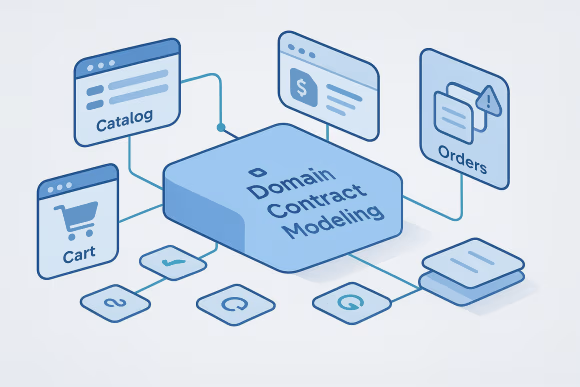
Define domain-aligned schemas for catalog, pricing, cart, checkout, and orders, with consistent naming and semantics across systems. Contracts include error models, idempotency keys, and pagination rules to support safe retries and predictable client behavior. Versioning and compatibility guidelines reduce breaking changes as vendors and services evolve.
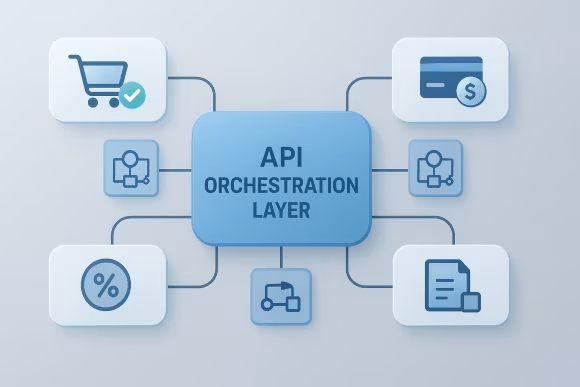
Implement orchestration services that coordinate multi-step commerce workflows such as checkout authorization, payment capture, tax calculation, and order creation. Orchestration isolates channel clients from cross-system sequencing and failure handling. Where needed, compensating actions and state machines are used to manage distributed transaction behavior.
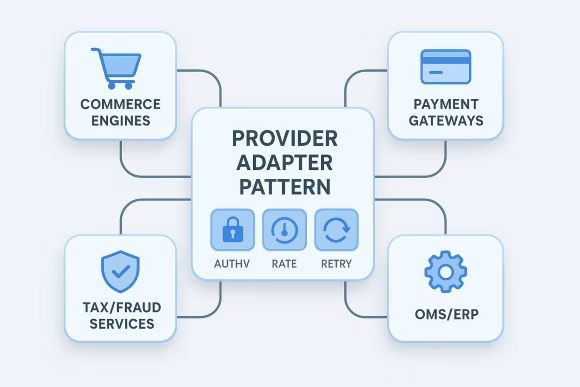
Build adapters for commerce engines, payment gateways, tax/fraud services, and OMS/ERP endpoints that normalize vendor-specific models into platform contracts. Adapters encapsulate authentication, rate limits, retries, and vendor quirks. This reduces coupling and enables vendor substitution with controlled blast radius.
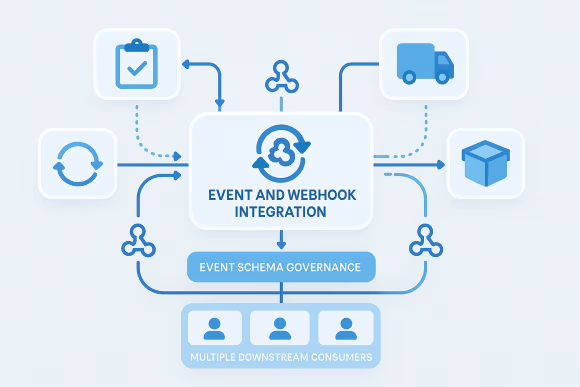
Design event-driven flows for order status updates, fulfillment, refunds, and inventory changes using webhooks and message streams. Implement deduplication, ordering strategies, and idempotent consumers to handle at-least-once delivery. Event schemas are governed to support multiple downstream consumers without tight coupling.
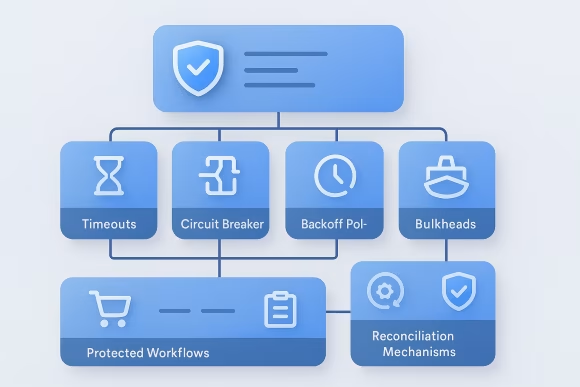
Apply timeouts, circuit breakers, backoff policies, and bulkheads to protect checkout and order flows from upstream instability. Implement reconciliation mechanisms for eventual consistency, including periodic sync jobs and audit trails. Define fallback behaviors for degraded dependencies while preserving transactional integrity.
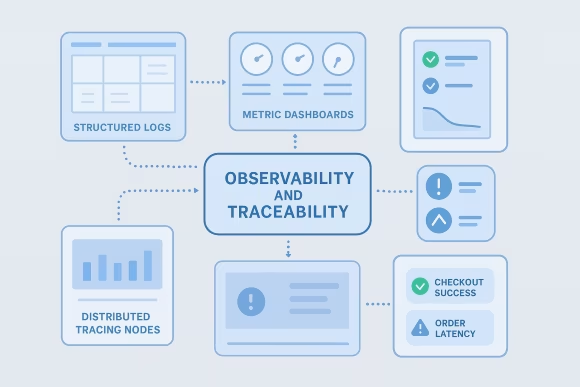
Instrument integrations with structured logs, metrics, and distributed tracing, including correlation IDs propagated across services and vendors. Standardize error classification to distinguish client issues, upstream failures, and data inconsistencies. Dashboards and alerts focus on commerce SLOs such as checkout success rate and order propagation latency.
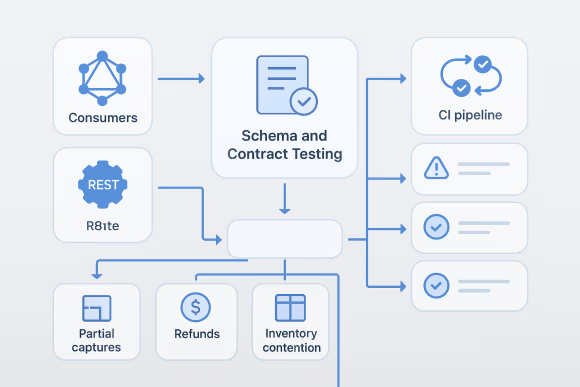
Introduce contract tests for GraphQL schemas and REST endpoints, plus consumer-driven tests where multiple clients depend on the same capability. Validate backward compatibility and deprecation behavior in CI. Test suites cover edge cases like partial captures, refunds, and inventory contention to reduce production regressions.
Engagements follow a clear engineering sequence from discovery and domain mapping through contract definition, implementation, verification, and operational readiness. Work is organized around critical commerce journeys (especially checkout and order orchestration) and delivered incrementally so integrations can be rolled out safely across channels and vendors.
[01]Workshops to map systems, commerce domains, and current integration paths. Identify sources of truth, failure modes, and performance constraints. Produce a prioritized integration backlog tied to critical journeys.
 [02]
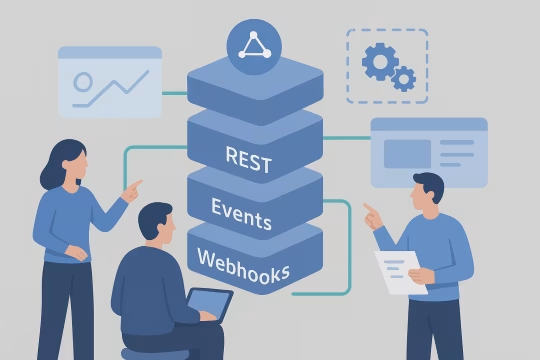
[02]Define integration boundaries, contracts, and orchestration patterns for each domain. Decide where GraphQL, REST, events, and webhooks are appropriate. Document non-functional requirements and operational responsibilities.
 [03]
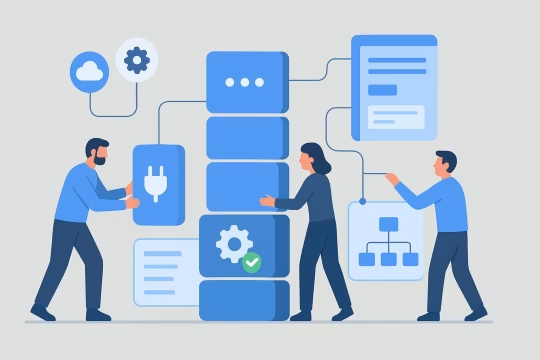
[03]Implement adapters and orchestration services in thin vertical slices. Start with the highest-risk flows such as checkout and order creation. Keep changes deployable independently to support staged rollout.
 [04]
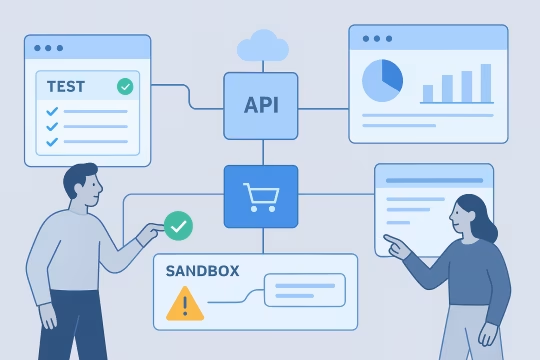
[04]Add contract tests, integration tests, and sandbox simulations for commerce providers. Validate idempotency, error handling, and edge cases like refunds and partial fulfillment. Establish regression coverage for critical paths.
 [05]
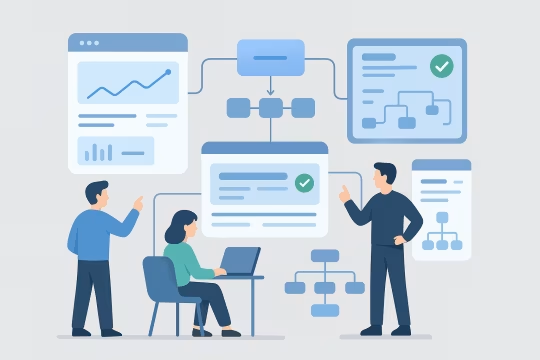
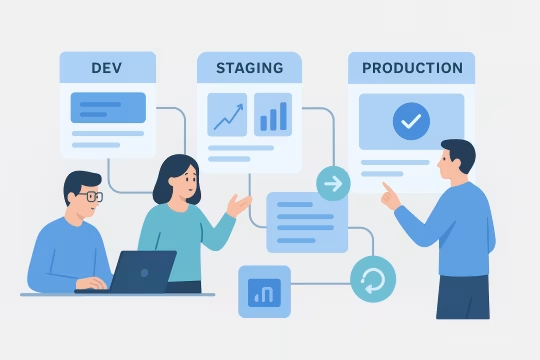
[05]Implement tracing, metrics, and structured logging with correlation across systems. Define alerts, dashboards, and runbooks aligned to commerce SLOs. Prepare incident workflows and escalation paths with platform teams.
 [06]
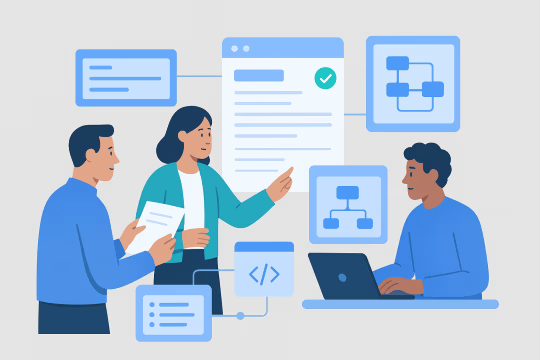
[06]Plan migration steps including parallel runs, shadow traffic, and controlled ramp-ups. Validate reconciliation of orders and financial events during cutover. Provide rollback strategies and post-release monitoring windows.
 [07]
[07]Establish contract governance, schema review, and deprecation policies. Deliver documentation and reference implementations for consumers. Transfer operational knowledge through pairing and runbook walkthroughs.
Commerce integrations affect revenue-critical journeys and operational cost. The impact is realized through fewer checkout regressions, faster change adoption across vendors, and improved ability to diagnose and resolve cross-system issues with measurable platform controls—supporting multi-channel commerce delivery integration without increasing integration debt.
Reduced failure rates through consistent error handling, idempotency, and resilience controls. Clear orchestration boundaries limit the blast radius of upstream outages. Monitoring focuses on checkout success and latency to detect issues early.
Channel teams consume stable contracts rather than vendor-specific APIs. New storefronts and partner channels reuse the same integration layer. This reduces duplicated mapping logic and shortens delivery cycles for new experiences.
Adapter patterns and governed schemas reduce one-off fixes and brittle coupling. Changes are localized to provider adapters or contracts with controlled versioning. Engineering effort shifts from reactive debugging to planned evolution.
Normalized domain contracts separate platform behavior from provider implementations. Vendor changes become integration projects with bounded scope rather than full-channel rewrites. This supports procurement flexibility and roadmap alignment.
End-to-end traceability and standardized error semantics speed up triage across systems. Runbooks and dashboards provide actionable signals for common failure modes. Teams can isolate issues to specific dependencies and workflows.
Reconciliation mechanisms and event processing patterns reduce mismatches across OMS/ERP, commerce engine, and storefront. Audit trails support investigation of pricing, tax, and fulfillment discrepancies. Event schemas enable reliable downstream consumption.
Contract testing and deprecation policies reduce regressions during iterative releases. Incremental rollout strategies allow controlled exposure of new integrations. Governance creates predictable change management across multiple teams.
These related services are natural extensions of enterprise commerce platform integration work—covering adjacent API platform architecture, composable platform design, headless integration patterns, and the observability and delivery practices needed to operate a change-safe integration layer.
Enterprise API design for scalable, secure foundations
API-first platform design with clear domain boundaries
Composable DXP content architecture and API-first platform design
API-first enterprise headless CMS platform architecture for content delivery
Structured schemas for an API-first content strategy
Enterprise content migration with API-first content delivery
Decoupled Drupal + Next.js migration for modern frontend delivery
Headless CMS migration with API-first content delivery
Headless CMS API integration, contracts, and integration layer engineering
Enterprise GraphQL schema design and governance
Contract-first headless API development for enterprise delivery
Metrics, traces, and alerts across APIs
Common questions about architecture, operations, integration patterns, governance, risk management, and how engagements are structured for enterprise commerce platforms.
We start by classifying workflows by coupling, criticality, and failure semantics. Checkout and order creation usually benefit from orchestration because sequencing, retries, and compensating actions must be explicit and observable. An orchestration service can enforce idempotency, manage state transitions, and provide a single place to implement timeouts, circuit breakers, and audit trails. Choreography is often appropriate for downstream lifecycle events such as fulfillment updates, refunds, or inventory adjustments, where multiple consumers react to events independently. In those cases we focus on well-defined event schemas, deduplication, and consumer idempotency. In practice many platforms use a hybrid: orchestrate revenue-critical synchronous steps, then publish events for asynchronous propagation. The decision is validated against latency budgets, availability targets, and the operational ability to trace a transaction across services and vendors.
GraphQL is most effective at the experience boundary, typically as a BFF (backend-for-frontend) or API composition layer that aggregates multiple domain services into a channel-optimized schema. We avoid using GraphQL as an internal “universal transport” if it obscures ownership or makes operational debugging harder. A common pattern is: domain services expose stable REST or event interfaces, while the BFF exposes GraphQL tailored to web/mobile needs. This keeps domain contracts explicit and testable, while allowing the experience layer to evolve its query shapes without forcing changes across all upstream systems. We also define schema governance: naming conventions, deprecation rules, query cost controls, and error semantics. For commerce, we pay special attention to caching, N+1 query risks, and how pricing and availability are resolved to avoid inconsistent totals during checkout.
We standardize telemetry at the integration boundary: correlation IDs propagated through headers and events, structured logs with consistent fields, and distributed traces that link storefront requests to downstream provider calls. Metrics are aligned to commerce SLOs such as checkout success rate, payment authorization latency, order creation latency, and webhook processing lag. For vendor APIs, we capture dependency-specific metrics: rate-limit responses, timeout rates, retry counts, and error category distributions. We also implement synthetic monitoring for critical endpoints and workflows to detect issues before they impact users. Operational readiness includes dashboards, alert thresholds, and runbooks that map symptoms to likely causes and remediation steps. The goal is to reduce mean time to isolate failures, especially when the root cause sits outside your infrastructure in a third-party service.
Idempotency is foundational: every step that can be retried must be safe to repeat without duplicating charges or orders. We implement idempotency keys, deduplication stores where needed, and deterministic request construction so retries behave predictably. We then apply resilience controls: timeouts tuned to user experience constraints, circuit breakers to prevent cascading failures, and backoff strategies that respect vendor rate limits. For multi-step flows, we define compensating actions (for example, voiding an authorization if order creation fails) and explicit state machines to track progress. Finally, we plan for partial failure and eventual consistency. That includes reconciliation jobs, audit trails, and clear user-facing states (pending, confirmed, failed) so the platform can recover without manual intervention or data loss.
We start by defining a source-of-truth model for each domain: where product data originates, how pricing is calculated, and which system owns promotion rules. We then design contracts that make those responsibilities explicit, including currency handling, rounding rules, tax inclusion, and validity windows. For performance and consistency, we often separate read models from transactional calculations. Catalog and base pricing can be cached and synchronized, while checkout totals are computed through a controlled pricing service or commerce engine call with deterministic inputs. We also ensure that the same pricing logic is used across channels by centralizing calculation or enforcing shared contracts. Testing focuses on edge cases: stacked promotions, customer-specific pricing, inventory constraints, and concurrent cart updates. Observability tracks discrepancies between displayed and charged totals to detect drift early.
We implement a payment abstraction that normalizes provider capabilities into a consistent contract: authorization, capture, void, refund, and settlement status. Provider adapters encapsulate tokenization, 3DS flows, webhooks, and provider-specific error codes while exposing standardized outcomes to the platform. Because payment flows are sensitive to retries, we design idempotent operations and store transaction references with clear state transitions. Webhook processing is treated as an event ingestion problem: signature validation, deduplication, ordering considerations, and replay handling. We also align the payment model with order orchestration so that financial events and order states remain consistent. Reconciliation processes compare provider settlement data with OMS/ERP records to detect and resolve mismatches without manual firefighting.
Governance starts with explicit ownership: each contract has a responsible team and a documented change process. We define versioning rules (semantic or date-based), compatibility expectations, and deprecation timelines. For GraphQL, we use schema directives and tooling to track field usage and enforce deprecation policies. We also introduce automated checks in CI: contract tests, schema diff validation, and consumer-driven tests where multiple clients depend on the same API. Changes that affect critical flows require review against non-functional requirements such as latency budgets and error semantics. For vendor dependencies, we track provider API versions and roadmap changes, and we isolate vendor-specific behavior behind adapters. This allows the platform to evolve contracts deliberately rather than reacting to upstream changes under incident pressure.
Maintainability depends on documentation that supports both build and operate phases. We document domain boundaries and source-of-truth rules, including which system owns pricing, inventory, and order state. For each contract we provide schemas, example payloads, error taxonomy, idempotency behavior, and versioning/deprecation notes. Operational documentation includes runbooks for common incidents (payment webhook delays, order propagation failures, rate limiting), dashboards with interpretation guidance, and escalation paths for vendor support. We also document data mappings and transformation rules so changes can be assessed for downstream impact. Finally, we keep architecture decision records for key choices such as orchestration vs events, caching strategy, and reconciliation approach. This reduces knowledge loss and helps new teams evolve the platform without reintroducing brittle coupling.
We reduce checkout risk by combining contract discipline, automated verification, and controlled rollout. Contract tests validate backward compatibility and enforce error semantics. Integration tests simulate end-to-end checkout in provider sandboxes, including failure scenarios like timeouts, declined payments, and partial captures. For deployment, we use feature flags, canary releases, and traffic ramp-ups. Where feasible, we run changes in parallel (shadow traffic or dual-write patterns) to compare outcomes before switching fully. We also define rollback strategies that account for in-flight transactions and asynchronous webhooks. Operationally, we monitor leading indicators such as authorization failure rates, cart-to-checkout conversion, and order creation latency. Alerts are tuned to detect regressions quickly while avoiding noise, enabling rapid containment before revenue impact grows.
We treat consistency as a design constraint rather than an afterthought. First we define authoritative ownership for order state, fulfillment status, and financial events. Then we design integration flows that preserve traceability: stable identifiers, correlation IDs, and an audit trail of state transitions. Because many integrations are eventually consistent, we implement reconciliation processes. These can include periodic sync jobs, event replay mechanisms, and discrepancy reports that compare OMS/ERP records with commerce engine and payment provider data. Reconciliation is paired with remediation workflows, ranging from automated retries to controlled manual interventions. We also design for idempotent updates and deduplication to handle webhook retries and at-least-once event delivery. The objective is to ensure that transient failures do not create permanent divergence or require ad-hoc scripts to repair production data.
In the first phase we aim to make the integration landscape explicit and reduce uncertainty around critical flows. Deliverables typically include a system and domain map, a prioritized list of commerce journeys (for example, checkout, order creation, refunds), and a target integration architecture with defined boundaries. We also produce initial contracts for the highest-value domains, including schema definitions, error models, and versioning rules. If implementation starts early, we deliver a thin vertical slice such as a checkout orchestration path or a provider adapter with observability and basic tests. Operational foundations are introduced from the start: correlation IDs, logging conventions, and dashboards for key dependencies. This ensures that as integration work expands, the platform remains diagnosable and changes can be validated with measurable signals rather than assumptions.
Collaboration usually begins with a short discovery to align on scope, constraints, and the most risk-bearing commerce journeys. We request access to existing API documentation, integration codebases, vendor contracts, and production telemetry (logs/metrics/traces) where available. We also identify key stakeholders across commerce, platform, and operations. We then run structured workshops to map domains and ownership, document current-state flows, and surface failure modes and performance constraints. From this, we propose a target architecture and an incremental delivery plan that sequences work around critical paths such as checkout, payments, and order propagation. The engagement is set up with clear working agreements: contract review cadence, definition of done (including tests and observability), and an integration governance model. Implementation typically proceeds in vertical slices with regular demos against real provider sandboxes and measurable operational acceptance criteria.
These case studies showcase practical implementations of commerce platform integration, focusing on API orchestration, contract governance, and scalable delivery models. They highlight real-world examples of integrating commerce APIs, managing order lifecycles, and ensuring operational controls in complex, multi-vendor environments. Reviewing these examples provides insight into effective strategies for composable commerce architecture and resilient integration patterns.
With Drupal 7 reaching end-of-life, Veolia needed a Drupal 7 to Drupal 10 enterprise migration for its Acquia Site Factory multisite platform—preserving region-specific content and multilingual capabilities across more than 200 sites.
The platform was modernized into a stable, scalable multisite foundation with improved performance, maintainability, and long-term upgrade readiness.
Oleksiy (PathToProject) worked with me on a specific project over a period of three months. He took full ownership of the project and successfully led it to completion with minimal initial information.
His technical skills are unquestionably top-tier, and working with him was a pleasure. I would gladly collaborate with Oleksiy again at any opportunity.

Nikolaj Stockholm Nielsen
Strategic Hands-On CTO | E-Commerce Growth
Oleksiy (PathToProject) has been a valuable developer resource over the past six months for us at LSHTM. This included coming on board to revive and complete a stalled Drupal upgrade project, as well as carrying out work to improve our site accessibility and functionality.
I have found Oleksiy to be very knowledgeable and skilful and would happily work with him again in the future.

Ali Kazemi
Web & Digital Manager at London School of Hygiene & Tropical Medicine
As Dev Team Lead on my project for 10 months, Oleksiy (PathToProject) demonstrated excellent technical skills and the ability to handle complex Drupal projects. His full-stack expertise is highly valuable.

Laurent Poinsignon
Domain Delivery Manager Web at TotalEnergies
These articles expand on the governance, orchestration, and resilience concerns that shape reliable commerce integrations. They cover API contract management, GraphQL and BFF boundaries, and fallback patterns for pricing and inventory flows when upstream services degrade.
Let’s review your commerce journeys, integration boundaries, and operational telemetry to identify the highest-risk flows and define an incremental plan for contracts, orchestration, and observability.