Discovery and Baseline
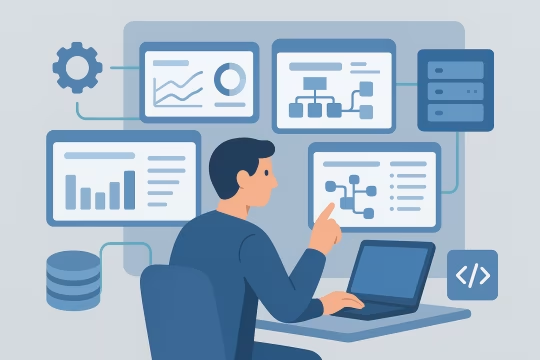
Establish the current-state baseline across codebase, content model, integrations, hosting, and release process. Identify upgrade blockers, operational pain points, and critical journeys that must remain stable during change.
Drupal legacy system modernization is the structured evolution of aging CMS platforms into a maintainable, secure, and extensible Drupal-based architecture. It typically combines content model refactoring, integration redesign, and incremental migration patterns so critical publishing operations continue while the platform is improved.
Organizations need this capability when legacy CMS implementations constrain delivery: brittle templates, tightly coupled integrations, unclear ownership boundaries, and upgrade paths that are operationally risky. Modernization focuses on establishing a target architecture (often API-first), defining migration increments, and introducing engineering controls such as automated testing and deployment pipelines.
The result is a platform that supports scalable architecture: clear domain boundaries, reusable integration patterns, and a Drupal foundation that can evolve through minor releases rather than disruptive rewrites. Where appropriate, modernization can also introduce decoupled delivery layers (for example Next.js/React) while keeping Drupal as the governed content and integration hub.
As digital platforms grow, legacy CMS implementations often accumulate tightly coupled templates, ad-hoc integrations, and inconsistent content structures. Teams compensate with manual publishing workarounds, duplicated content types, and one-off patches that keep the platform running but make change increasingly expensive. Upgrades become avoided events, and the platform drifts further from supported versions and secure operating baselines.
These conditions create architectural friction. Integration points are frequently undocumented, data contracts are implicit, and business logic leaks into themes or custom modules without clear boundaries. Engineering teams struggle to introduce new channels, redesign experiences, or standardize delivery patterns because every change risks regressions across unrelated areas. The platform becomes difficult to test, difficult to deploy predictably, and difficult to operate under enterprise governance expectations.
Operationally, the organization experiences slower delivery, higher incident risk during releases, and increasing dependency on a small set of individuals who understand the legacy behavior. Security and compliance work expands because patching and dependency management are constrained by the platform’s age and coupling, while product teams face longer lead times for even modest experience changes.
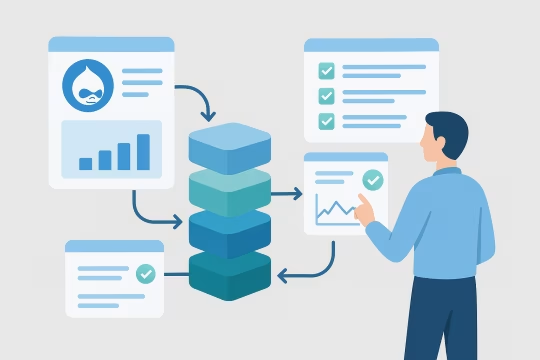
Review the current CMS estate, hosting model, integrations, and release process. Identify upgrade blockers, coupling hotspots, and operational constraints. Establish measurable modernization goals aligned to platform reliability and delivery cadence.
Define the future-state Drupal architecture, including content domains, integration patterns, and delivery model (coupled or decoupled). Produce an incremental roadmap with clear boundaries, migration increments, and de-risking milestones.
Normalize content types, fields, taxonomies, and editorial workflows to reduce duplication and improve governance. Introduce versioned content contracts where APIs are required, and document ownership and lifecycle rules.
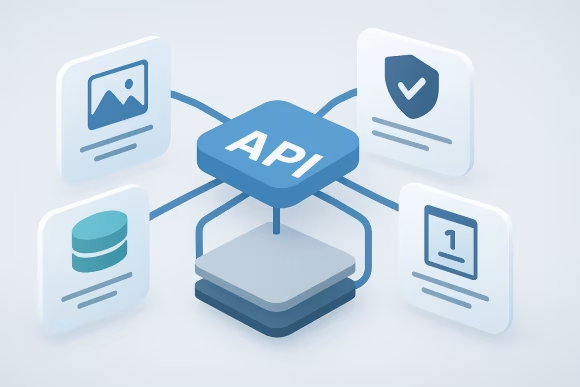
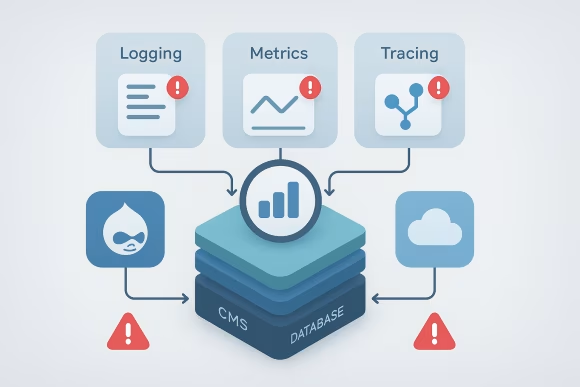
Refactor legacy point-to-point integrations into explicit APIs and event-driven or queued workflows where appropriate. Establish stable interfaces, error handling, and observability so downstream systems can evolve independently.
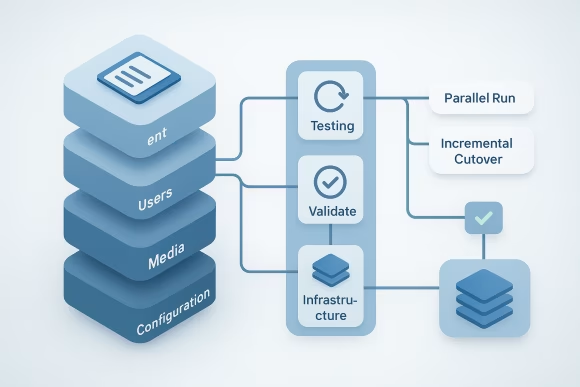
Migrate content, users, and configuration in controlled slices using repeatable migration tooling. Run parallel operations when needed, validate data quality, and maintain backward compatibility for critical publishing and delivery paths.
Introduce automated regression coverage for key journeys, migrations, and integrations. Add performance and security checks to the pipeline, and define acceptance criteria that can be executed repeatedly across releases.
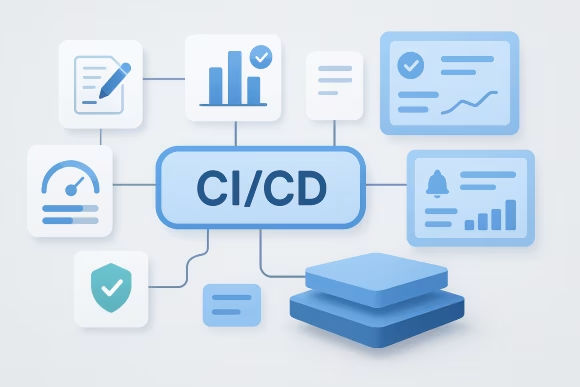
Standardize build and deployment workflows, environment parity, and rollback strategies. Improve configuration management, secrets handling, and dependency updates to support predictable releases and patching.
Establish architectural decision records, coding standards, and upgrade policies. Define ownership for modules, integrations, and content domains, and set a cadence for continuous modernization without large rewrites.
This service strengthens Drupal platforms by making legacy behavior explicit, refactoring coupling into clear boundaries, and introducing repeatable engineering controls. The focus is on architecture that can evolve: versioned interfaces, governed content models, and predictable deployment workflows. Modernization work is structured to reduce risk through incremental migration and testable changes, enabling ongoing delivery while the platform is improved.
Modernization is delivered as a sequence of controlled increments that reduce coupling and operational risk while maintaining publishing continuity. Each increment is designed to be testable, deployable, and reversible, with clear acceptance criteria and measurable platform improvements.
Establish the current-state baseline across codebase, content model, integrations, hosting, and release process. Identify upgrade blockers, operational pain points, and critical journeys that must remain stable during change.
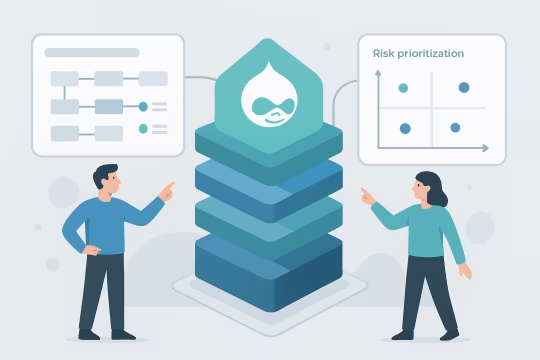
Define the target Drupal architecture and the migration strategy, including boundaries, interfaces, and sequencing. Produce a roadmap that prioritizes risk reduction and enables parallel delivery of product work where possible.
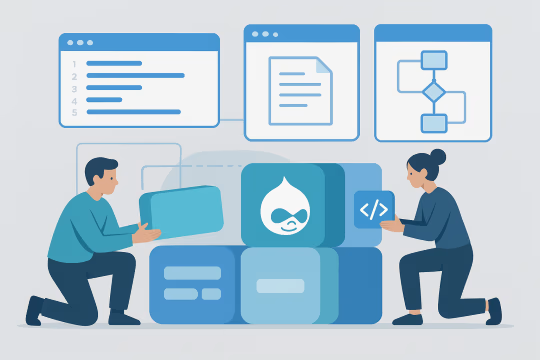
Refactor the most constraining legacy areas first: content model inconsistencies, custom module boundaries, and theme coupling. Introduce coding standards, documentation, and initial automation to support repeatable change.
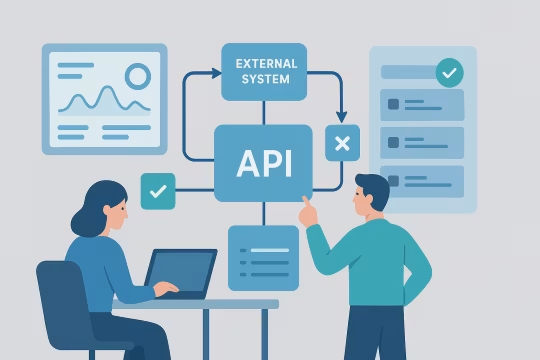
Rebuild or wrap integrations behind explicit APIs and stable contracts. Add error handling, retries, and observability so integration failures are diagnosable and do not cascade into editorial or delivery outages.
Execute migrations in slices with repeatable tooling and validation. Support dual-running and staged cutovers when needed, and ensure data quality checks are automated and auditable across environments.
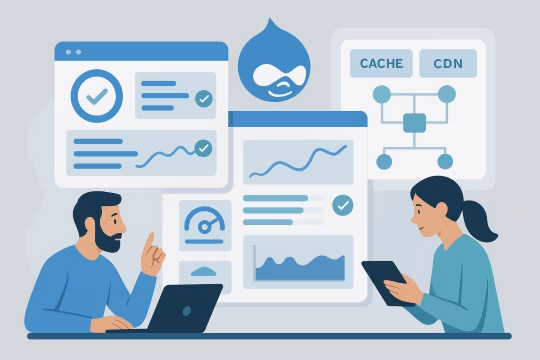
Implement automated regression coverage for critical paths and migration verification. Validate performance characteristics under realistic load and ensure caching, invalidation, and CDN behavior match the delivery model.
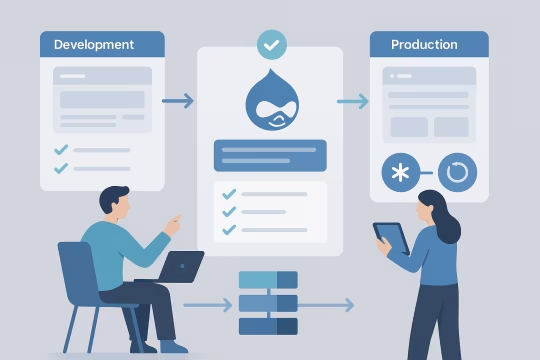
Deploy increments through standardized pipelines with environment parity and rollback plans. Coordinate cutovers with content operations, define freeze windows only when necessary, and document post-release verification steps.
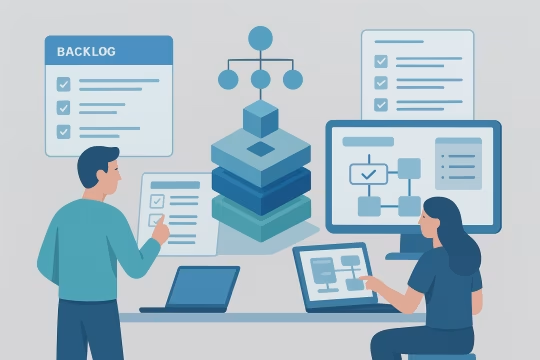
Transition to a sustainable operating model: upgrade cadence, dependency management, and governance for content and integrations. Maintain a backlog for ongoing modernization so the platform continues to improve without large rewrites.
Modernization reduces the cost and risk of change by turning legacy behavior into explicit architecture, interfaces, and automated controls. The impact is realized through faster delivery cycles, safer upgrades, and improved operational stability while maintaining continuity for content operations.
Clear boundaries and stable interfaces reduce the blast radius of changes. Teams can ship experience updates and integration changes with less coordination overhead and fewer regressions across unrelated areas.
Incremental migration and automated regression checks reduce uncertainty during deployments. Predictable rollback and verification steps improve confidence for both engineering and content operations.
Refactoring coupling hotspots and normalizing content models removes recurring workarounds. The platform becomes easier to extend without accumulating additional bespoke behavior.
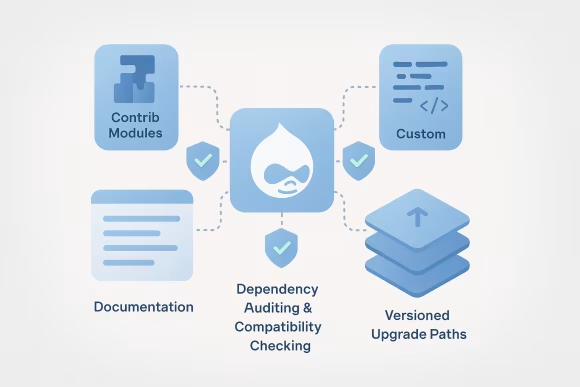
A defined dependency and upgrade strategy turns major upgrades into planned engineering work. This supports security patching and reduces the likelihood of running unsupported components.
API-first contracts, retries, and observability reduce integration fragility. Failures become diagnosable and contained, improving platform stability for downstream systems and channels.
A modern Drupal architecture supports multi-site and multi-channel patterns with clearer governance. This enables platform evolution without repeated replatforming cycles.
Standardized tooling, tests, and deployment workflows reduce time spent on manual verification and environment drift. Engineers can focus on product work rather than firefighting legacy behavior.
Metrics and logging around critical workflows improve incident response and capacity planning. Platform health becomes measurable, supporting better prioritization and governance decisions.
Adjacent capabilities that commonly extend Drupal modernization programs across architecture, operations, and delivery.
Refactor Drupal architecture for upgradeable delivery
Content, data, and platform migration engineering
Secure, Structured Upgrade to Drupal 11/12
Custom modules, extensions, and feature engineering
Upgrade from Drupal 8/9/10 to 11/12 with Confidence
Major upgrades with dependency and code remediation
Common questions from enterprise teams planning Drupal-based modernization of legacy CMS estates, including architecture, operations, integration, governance, risk, and engagement.
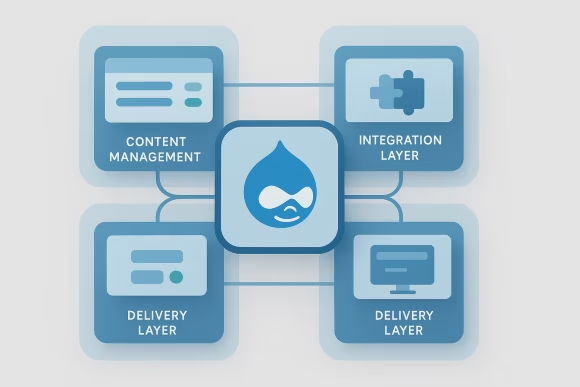
We start by documenting the current-state architecture as it actually operates: content domains, rendering paths, integration points, deployment topology, and operational constraints. From there we define a future-state Drupal architecture that makes responsibilities explicit across three areas: content management (Drupal), integration (APIs/events/queues), and delivery (coupled theming or decoupled frontends). A target architecture includes decisions on content modeling strategy, module boundaries, configuration management, caching and invalidation, authentication/authorization, and how environments support preview and editorial workflows. We also define interface contracts for integrations (versioning, error handling, SLAs) so downstream systems can evolve independently. The output is not only diagrams; it is a set of architectural decision records and a roadmap of increments. Each increment is designed to be deployable and testable, with a clear definition of “done” and measurable reduction of coupling or operational risk. This keeps the architecture practical and aligned to delivery realities.
Decoupling makes sense when the delivery layer needs independent release cadence, advanced frontend performance patterns, or a unified experience across multiple backends. It is also common when legacy theming is the primary constraint and cannot be safely evolved without repeated regressions. However, decoupling introduces architectural responsibilities that must be planned: routing ownership, preview and draft content workflows, cache invalidation, authentication flows, and operational monitoring across multiple runtimes. During modernization we typically validate decoupling with a thin vertical slice: one or two content domains delivered through an API contract, with preview and publishing behavior proven end-to-end. If the organization’s primary issues are content model inconsistency, upgrade blockers, or fragile integrations, we often prioritize stabilizing Drupal and the integration layer first. Decoupling can then be introduced incrementally, ensuring Drupal remains the governed source of content and integration rules rather than becoming a passive database behind an uncontrolled frontend.
We treat publishing continuity as a non-functional requirement and design the roadmap around it. Practically, that means identifying critical editorial journeys (create, review, schedule, publish, rollback), the roles involved, and the integrations that must remain stable (search indexing, DAM, personalization, analytics). We then plan increments that keep these flows operational while underlying architecture is improved. Common techniques include parallel run for specific content domains, staged cutovers by site or section, and backward-compatible API contracts. We also implement repeatable migration tooling so content moves are not one-time scripts but versioned processes with validation and reconciliation. Operationally, we coordinate release windows with content teams only when necessary, and we automate verification steps so editors are not asked to manually test large surface areas. The goal is to reduce change anxiety by making each increment small, observable, and reversible.
Modernization usually includes standardizing environments and deployment workflows, improving configuration management, and introducing observability. On Drupal platforms this often means tightening the build pipeline, ensuring environment parity (dev/test/stage/prod), and defining a clear strategy for configuration synchronization and secrets handling. We also add operational controls around the areas that cause the most incidents in legacy estates: cache invalidation behavior, background processing (queues/cron), media handling, and integration error handling. Logging and metrics are structured so failures are actionable (for example, distinguishing editorial validation errors from downstream API outages). Finally, we establish an upgrade and dependency cadence. Instead of deferring updates until they become projects, we make updates routine with compatibility checks and automated regression coverage. This reduces security exposure and keeps the platform within supported boundaries.
We inventory integrations by purpose and criticality: identity, search, DAM, CRM/CDP, analytics, payments, and internal APIs. For each integration we document the current contract (often implicit), failure modes, and operational ownership. Modernization then focuses on making contracts explicit and stable. In practice this means introducing API gateways or dedicated integration modules/services, defining versioning and authentication, and implementing resilience patterns such as retries, circuit breakers, and queued processing where synchronous coupling is risky. We also add observability so integration failures can be detected and diagnosed quickly. Where legacy integrations are tightly coupled to templates or database access, we replace them with API-first patterns and staged cutovers. Downstream consumers are migrated incrementally, and we validate behavior with contract tests and end-to-end checks so integration changes do not become hidden regressions during platform upgrades.
Often yes, but it depends on how downstream systems consume content and events today. If consumers rely on unstable HTML structures, direct database reads, or undocumented endpoints, we typically need an intermediate compatibility layer during migration. The goal is to avoid forcing a “big bang” change across multiple teams. A common approach is to introduce stable APIs that replicate the required outputs while the legacy consumption method is phased out. For example, we can provide JSON:API or GraphQL endpoints with explicit schemas, while maintaining existing feeds for a limited period. We define deprecation timelines and monitor usage so the organization can retire legacy paths safely. The key is governance: we need clear ownership of contracts and a plan for versioning. Modernization should reduce long-term coupling, not preserve it indefinitely. We therefore treat compatibility as a transitional capability with measurable exit criteria.
Maintainability comes from explicit decisions and enforced standards. We typically establish architectural decision records (ADRs) for key topics such as content modeling conventions, module boundaries, API versioning, caching strategy, and frontend integration patterns. These decisions are then reflected in code review checklists and automated checks. On the Drupal side, governance includes ownership of custom modules, a policy for contrib module adoption, and a dependency update cadence. For content operations, governance includes rules for when to create new content types versus extending existing ones, taxonomy management, and workflow changes. We also recommend defining platform SLOs for critical functions (publishing latency, API response times, error rates) and ensuring observability supports those measures. Governance is not a committee; it is a lightweight operating model that makes platform evolution predictable across teams and vendors.
We start by identifying shared domains versus local variations. Shared domains (for example, product, location, policy content) benefit from standardized schemas and reusable components, while local domains can remain flexible within defined constraints. We document these boundaries and align them to ownership: who can change what, and how changes are reviewed. Technically, we use configuration management and structured deployment workflows so content model changes are versioned and promoted safely. For API-exposed models, we add versioning and compatibility rules so downstream consumers are not broken by field renames or structural changes. Operationally, we introduce a change process for content model evolution: proposal, impact assessment (editorial, API, search, analytics), implementation, and validation. This is especially important in multi-site estates where a seemingly small change can have wide impact across templates, integrations, and reporting.
The most common risks are hidden coupling, data quality issues, and underestimating operational dependencies. Hidden coupling appears when templates, custom code, and integrations rely on undocumented behavior. We mitigate this through discovery, dependency mapping, and by introducing automated regression checks around critical journeys before making large refactors. Data risk is common in legacy estates: inconsistent field usage, duplicated content types, and media sprawl. We mitigate this by treating migrations as repeatable pipelines with validation, reconciliation, and clear acceptance criteria. We also run sample migrations early to surface edge cases. Operational risk includes release instability and editorial disruption. We mitigate this with incremental cutovers, environment parity, rollback plans, and observability. The guiding principle is to make each modernization increment small enough to be reversible and measurable, rather than relying on a single high-stakes launch.
Security is handled as part of the modernization architecture and delivery workflow. We establish a supported baseline for Drupal core and dependencies, define patching and update cadence, and ensure environments and secrets management meet enterprise requirements. Where legacy code blocks upgrades, we prioritize removing or isolating those blockers early. We also review authentication and authorization flows, especially when introducing APIs or decoupled frontends. This includes token handling, session strategy, and least-privilege access for integrations and editorial roles. Logging and audit requirements are validated so compliance needs are met without relying on manual processes. In delivery, we add automated checks where feasible: dependency scanning, static analysis, and security-focused test cases for critical endpoints. The objective is to reduce the security burden over time by making upgrades routine and by eliminating legacy patterns that create persistent exposure.
We typically structure the engagement in phases with clear decision points. An initial discovery and architecture phase establishes the baseline, target architecture, and a prioritized roadmap. From there, implementation proceeds in increments that each deliver a measurable improvement: a refactored content domain, a stabilized integration, an upgrade step, or a migrated site section. We work with enterprise delivery constraints by defining interfaces between teams: who owns content operations, who owns integrations, and who owns infrastructure. We also align on acceptance criteria and release governance so increments can be deployed predictably. Resourcing is usually a blended model: platform architects and senior engineers drive architecture and critical refactors, while product teams continue feature delivery within the new constraints. This avoids pausing business delivery while modernization progresses and helps internal teams adopt the new operating model.
We avoid single-number estimates before discovery because legacy estates vary widely in coupling, content complexity, and integration dependencies. Instead, we produce an estimate range after a short baseline assessment that measures the main cost drivers: number of content domains and variations, migration volume and data quality, integration count and criticality, and the degree of upgrade blockage. We then convert the roadmap into increments with scoped outcomes and acceptance criteria. Each increment can be estimated more reliably because it targets a bounded slice of the platform. This also allows the organization to stop, pivot, or accelerate based on what is learned. For enterprise governance, we provide a delivery plan that includes risk assumptions, dependencies on internal teams, and operational constraints such as release windows. The goal is transparency: what drives cost, what reduces risk, and what can be deferred without compromising the target architecture.
Collaboration typically begins with a short discovery engagement focused on establishing a shared architectural baseline and a practical roadmap. We start with stakeholder interviews across architecture, engineering, content operations, and security to understand constraints and priorities. In parallel, we review the codebase, content model, hosting/deployment setup, and integration landscape. We then run a structured workshop to align on the target architecture and the modernization strategy: what will be refactored versus replaced, what must remain stable for publishing continuity, and what the first incremental cutover should be. The outcome is a set of documented decisions (ADRs), a prioritized backlog of increments, and a definition of success metrics (for example upgradeability, release cadence, incident reduction). If the organization is ready, we proceed directly into a first implementation increment designed to validate the approach end-to-end: one content domain, one integration contract, automated checks, and a deployable release. This creates a repeatable pattern for subsequent increments.
Let’s assess your legacy CMS constraints, define a Drupal target architecture, and plan incremental modernization steps that reduce risk while keeping publishing operations stable.