Enterprise teams usually do not struggle to generate translated copy. They struggle to decide whether that copy is safe to publish, where it needs review, and how quality signals should move through the delivery stack.
That distinction matters. In a multi-region content platform, translation quality is not just a linguistic issue. It affects content integrity, customer trust, brand consistency, and release reliability across websites, apps, campaign pages, product content, and support experiences.
AI can reduce turnaround time for localization. It can help teams pre-translate large content volumes, reduce repetitive manual work, and accelerate updates across markets. But AI-assisted translation becomes risky when organizations treat output as inherently publish-ready. Once weak translations enter a CMS unchecked, they often spread into downstream channels, search experiences, and region-specific customer journeys.
For that reason, enterprise localization QA should be designed as a governance layer across systems, workflows, and release decisions. The goal is not to eliminate human review everywhere. The goal is to apply human attention where risk is highest and automate controls where confidence is sufficient.
Why AI translation quality fails after the pilot
AI translation programs often look successful in early tests because pilots usually operate under controlled conditions:
- limited content types
- simplified approval paths
- a narrow terminology set
- close manual oversight
- low publication pressure
Problems emerge when the process scales.
A real enterprise environment introduces complexity that pilots rarely capture. Structured content fields may carry different context from long-form page copy. Product content may need precise terminology and attribute consistency. Campaign pages may rely on brand voice and regional nuance. Regulated or high-sensitivity copy may require formal review before publication.
When teams move too quickly from pilot to production, several failure patterns appear.
First, confidence signals are missing or too vague. If the system cannot distinguish strong output from questionable output, every translation either gets manually reviewed or gets published with too much trust. Both outcomes create operational problems.
Second, content context is fragmented. A translation engine may process isolated fields without understanding page hierarchy, product taxonomy, legal qualifiers, or audience intent. This is especially common in headless and composable architectures where content is stored in modular fragments.
Third, terminology drift accumulates. Without governed glossaries and approved language patterns, repeated translation of similar phrases can produce inconsistent customer-facing experiences across regions.
Fourth, publish workflows remain binary. Many teams only support two states: translated or not translated. That is not enough. Mature workflows often need statuses such as machine-translated, awaiting linguistic review, brand-reviewed, approved for publish, or blocked pending source update.
Fifth, frontend fallback behavior masks quality issues. A page may appear complete because untranslated or low-confidence fields quietly fall back to a default language. That may protect availability, but it can also hide localization debt until it becomes visible in production.
These failures are not signs that AI translation is inherently unusable. They usually indicate that the organization implemented generation faster than governance.
The difference between language generation and publish-ready localization
A useful way to frame the problem is to separate translation output from publish readiness.
Translation output answers a narrow question: Did the system generate target-language text?
Publish readiness answers a broader set of questions:
- Is the meaning preserved?
- Is required terminology correct?
- Does the content match the right market and variant?
- Has the content passed the right review path for its risk level?
- Do downstream channels know whether the translation is approved?
- If approval is missing, what fallback behavior should occur?
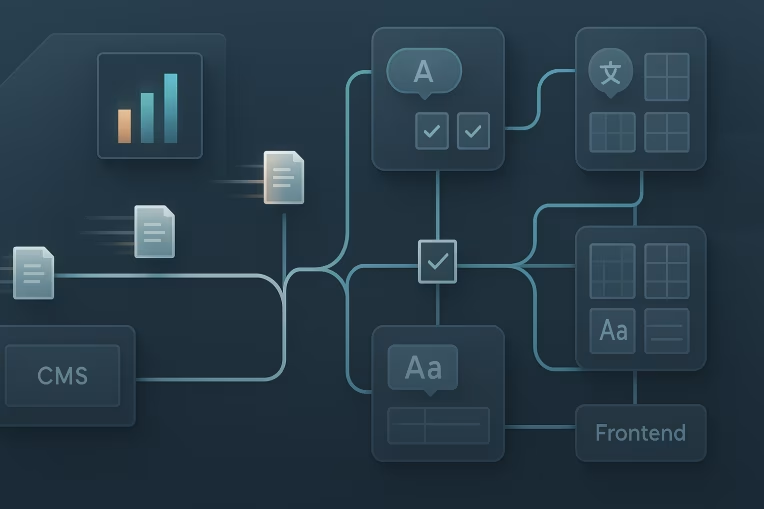
That distinction is especially important in enterprise digital platforms because publication is rarely tied to one tool. The CMS may manage authoring and lifecycle states. The TMS may orchestrate translation jobs and linguistic review. Workflow automation may route exceptions. The frontend may decide whether to render translated content, fallback content, or nothing at all.
Without a shared model of publish readiness, each system makes its own assumptions. That creates inconsistency. A TMS may mark an item complete because translation is returned. The CMS may assume complete means ready. The frontend may render it automatically. Meanwhile, localization stakeholders may still consider that content unreviewed.
A better model treats publish readiness as an explicit operational state supported by metadata. For example, content items or fields can carry attributes such as:
- source version reference
- target locale
- translation method
- confidence band
- terminology compliance result
- review status
- risk classification
- fallback eligibility
- approved-for-publish flag
Once those signals exist, teams can define rules instead of relying on assumptions.
Guardrail design: confidence thresholds, terminology, fallback, and escalation
The most effective AI translation review workflow does not try to review everything equally. It classifies content and routes it according to risk, confidence, and business impact.
A practical governance model usually starts with four control areas.
1. Confidence thresholds
Confidence thresholds help decide what happens next after translation is generated. The exact scoring method will vary by tooling, so the important step is not chasing a universal number. It is defining how your organization interprets confidence bands.
A simple model might look like this:
- High confidence: eligible for streamlined review or selective sampling, depending on content class
- Medium confidence: requires editorial or linguistic review before publish
- Low confidence: blocked from publish and routed for escalation
The threshold should not be global across all content. Product specifications, campaign headlines, help articles, and regulated statements do not carry the same risk. A high-confidence product feature bullet may still need less scrutiny than a medium-confidence promotional claim on a regional landing page.
Confidence should also be combined with source-side change magnitude. A small punctuation correction in source content does not need the same QA path as a rewritten paragraph, new feature launch, or updated disclaimer.
2. Terminology governance
Terminology matters because consistency is one of the first things customers notice when localization quality declines.
Enterprise teams should maintain approved terminology for:
- product names
- feature labels
- navigation terms
- legal or policy phrases
- market-specific vocabulary
- phrases that should not be translated
These controls are especially important in structured content environments where the same term appears across components, templates, search indexes, and product catalogs.
Terminology governance does not have to mean perfect linguistic centralization. It means defining a source of truth and ensuring translation workflows can check output against it. If a term fails compliance, the content should not quietly proceed as if it passed.
3. Fallback rules
Fallback is necessary in multi-region publishing, but unmanaged fallback creates hidden quality risk.
For example, suppose a regional product page launches with:
- translated body copy n- untranslated feature comparison labels
- outdated support text
- fallback to the default language for a pricing disclaimer
Technically, the page renders. Operationally, the experience may be incomplete or misleading.
A better approach is to define fallback eligibility by content type and field criticality. Teams can ask:
- Which fields may safely fallback to a source language temporarily?
- Which fields must never fallback because they affect compliance, pricing, conversion, or trust?
- When fallback occurs, should the page still publish, partially render, or stay blocked?
This is a core part of multilingual content governance. Availability and quality should be balanced intentionally, not left to default frontend behavior.
4. Escalation paths
Low-confidence or failed-rule content should trigger clear next steps.
Escalation paths often include:
- routing to a language specialist or in-market reviewer
- requesting source-content clarification from the author
- flagging prohibited terminology or ambiguous phrasing
- delaying publication for a specific locale while other locales proceed
- temporarily using approved fallback content until review is complete
The key is to make escalation operationally normal rather than an exception that people handle manually over email or chat. If escalation is not built into workflow automation, teams either ignore problems or slow the whole pipeline down.
Where QA belongs across CMS, TMS, workflow automation, and frontend delivery
One of the most common mistakes in headless localization quality control is assuming that one platform should own all QA responsibilities. In practice, quality governance works best when responsibilities are distributed clearly.
CMS responsibilities
The CMS is usually the right place to manage content structure, source ownership, workflow states, and publish controls.
Typical CMS responsibilities include:
- storing content model fields and locale variants
- marking content by risk class or business criticality
- tracking source version changes that invalidate previous translations
- enforcing workflow states such as draft, review, approved, or blocked
- preventing publication when required approval signals are missing
In a mature setup, the CMS should not just store translated text. It should store enough metadata to determine whether each locale version is publishable.
TMS responsibilities
The TMS is often best positioned to coordinate translation jobs, linguistic assets, review tasks, and terminology checks.
Typical TMS responsibilities include:
- orchestrating translation requests and returns
- applying translation memory or equivalent reuse logic where applicable
- enforcing glossary and term-base validation
- assigning reviewer queues by language, market, or content type
- returning QA signals to upstream systems
What matters most is that TMS completion status should not be treated as a standalone publish signal unless the workflow explicitly defines it that way.
Workflow automation responsibilities
Integration and workflow layers connect system states into operational decisions.
Typical automation responsibilities include:
- routing jobs based on locale, confidence, and risk class
- triggering review tasks when thresholds fail
- updating CMS metadata from TMS outcomes
- notifying stakeholders when source changes invalidate live translations
- holding or releasing deployable content packages based on readiness rules
This layer is often where governance either becomes scalable or falls apart. If teams rely on manual interpretation between systems, quality controls become inconsistent under deadline pressure.
Frontend delivery responsibilities
The frontend should not decide translation quality, but it must honor quality rules.
Typical frontend responsibilities include:
- reading locale availability and readiness states
- applying approved fallback behavior by field or page type
- preventing accidental rendering of blocked content
- surfacing missing-translation conditions to monitoring systems when appropriate
- supporting regional rollout strategies without exposing unfinished variants
This is especially important in composable stacks where delivery systems assemble experiences from multiple APIs. If one service returns unapproved localized content and another falls back to source content, the customer experience can become incoherent unless readiness logic is standardized.
Release patterns for high-risk and low-risk content classes
Not every content type needs the same release model. A useful governance framework segments content into classes and assigns the lightest safe control set to each.
Here is a practical way to think about it.
Low-risk content
Examples can include routine support articles, lower-impact descriptive content, or frequently updated operational copy where minor variation carries limited business risk.
For low-risk content, teams can often use:
- AI-assisted pre-translation
- threshold-based selective review
- terminology validation
- sampling-based QA after publication or before wider rollout
- controlled source-language fallback where appropriate
The benefit is speed. The guardrail is that low-risk classification must be intentional, not assumed because the content volume is high.
Medium-risk content
Examples can include product overview pages, key navigation labels, or evergreen marketing content with broad visibility.
For medium-risk content, teams often need:
- AI-generated draft translation
- mandatory review for medium- and low-confidence output
- glossary compliance checks
- version-aware approval states in the CMS
- publish only after locale-specific readiness is confirmed
This class usually represents the largest operational volume in enterprise platforms, so efficient triage matters.
High-risk content
Examples can include pricing-related copy, promotional claims, sensitive customer communications, contractual language, or other content where errors can create outsized commercial or trust impact.
For high-risk content, teams should typically require:
- stricter approval workflow
- explicit reviewer assignment
- blocked publication for missing approvals
- no silent fallback for critical fields
- traceable audit of source changes and approval decisions
This does not mean AI has no role. AI may still accelerate draft creation or comparison workflows. It means automation should stop short of autonomous publication.
Staged regional release
Another effective pattern is staged rollout by locale group.
For example, a team may:
- publish approved locales first,
- hold regions with unresolved QA issues,
- use approved fallback rules for non-critical elements,
- release remaining locales after targeted review.
This prevents one problematic locale from blocking an entire global launch while still preserving content quality standards.
Metrics that show whether AI localization is actually reducing operational risk
If the only KPI is translation throughput, teams may scale faster while publishing more hidden defects. Good governance requires metrics that reflect both efficiency and control.
Useful measures often include:
Review distribution
Track how much content falls into high-, medium-, and low-confidence bands, and how much review effort each band consumes. If nearly everything still requires manual review, the workflow may not be achieving useful automation.
Publish-block rate by content class
Measure how often content is prevented from publishing because thresholds, terminology checks, or approval requirements fail. Some block rate is healthy. Zero may indicate that controls are too weak or not enforced.
Terminology compliance trends
Watch repeated term failures by locale, content type, or authoring source. These patterns can reveal weaknesses in glossary governance, source clarity, or structured content reuse.
Source-change invalidation rate
Measure how often live translations become stale after source updates. This is particularly important for modular content architectures where one source change can affect many downstream pages.
Fallback exposure
Track where and how often fallback language is rendered in live experiences. This is one of the clearest ways to detect silent quality degradation in multilingual delivery.
Time to publish-ready status
Do not just measure time to translated status. Measure time until the content is actually approved for release in each target locale. That is the metric business stakeholders usually care about.
Rework and exception volume
Count how often translated content is sent back for clarification, linguistic correction, or source rewrite. Rising exception volume can indicate that the upstream authoring process is creating ambiguity AI cannot reliably resolve.
The purpose of these metrics is not surveillance for its own sake. It is to help teams decide whether governance is calibrated correctly. If review burdens remain too high, controls may be too broad. If defects still leak into production, controls may be too permissive or too disconnected from publish logic.
A practical implementation sequence
Organizations that want to improve publish readiness for translated content do not need to redesign everything at once. A phased rollout is usually more sustainable.
A pragmatic sequence often looks like this:
- Classify content by risk and business impact. Start by separating low-, medium-, and high-risk content families.
- Define publish-readiness metadata. Make approval, confidence, terminology, and fallback status explicit across systems.
- Set review thresholds by content class. Avoid one universal workflow for every asset.
- Connect CMS and TMS states. Ensure translation completion is not confused with approval.
- Implement field-level fallback rules. Treat critical fields differently from non-critical ones.
- Route exceptions through structured review queues. Escalation should be systematic, not ad hoc.
- Instrument release and quality metrics. Measure readiness, fallback exposure, and rework, not just output volume.
- Refine with live operational feedback. Thresholds and routing rules should improve over time as teams learn where errors actually occur.
This sequence keeps the focus on operating model design rather than tool hype.
Conclusion
AI-assisted localization can absolutely improve speed across enterprise digital platforms. But speed becomes expensive when weak translations are allowed to masquerade as completed work.
That is why AI translation QA governance should be treated as a publishing and platform discipline. The strongest programs do not depend on perfect model behavior. They depend on clear thresholds, governed terminology, explicit publish-readiness states, reliable fallback rules, and review paths that match content risk.
When those controls are built into CMS workflows, TMS processes, automation layers, and frontend delivery, teams gain a more useful outcome than raw translation volume: they gain a multilingual operating model that scales with less uncertainty.
In practice, that is the difference between experimenting with AI in localization and running it responsibly in production.
Tags: AI translation QA governance, Enterprise localization QA, Content operations, Multilingual content governance, Headless CMS, Localization workflow, Frontend delivery, Digital experience architecture