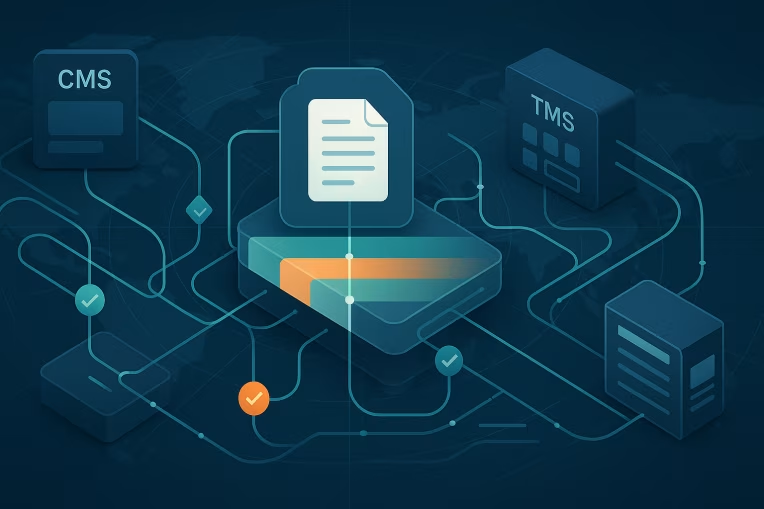
Headless localization is often sold as a clean separation of concerns: the CMS manages content, the TMS manages translation, and frontend applications render the right experience for each market. In practice, that separation can expose operational gaps that were previously hidden inside a more coupled publishing workflow.
A multi-region program usually involves more than translating strings. It involves content model design, editorial timing, API behavior, cache invalidation, preview expectations, release coordination, and the decision rules that determine whether a locale is actually ready to go live. If those rules are not defined explicitly, each team fills the gaps with its own assumptions.
That is where launches start to drift. Editors believe a page is translated because fields were sent to the TMS. Frontend teams assume fallback content is acceptable because a locale route resolves. Release owners think a market is ready because no blockers are visible in the CMS. Meanwhile, the customer experience can still be incomplete, stale, or inconsistent.
For enterprise digital platforms, the solution is not simply “improve localization.” The more useful approach is to define workflow contracts across the systems and teams involved. Those contracts should make status, ownership, transitions, exceptions, and recovery paths visible. They should also be neutral enough to work across Drupal, WordPress, and modern headless CMS architecture ecosystems.
Why localization breaks after headless adoption
Headless architecture does not automatically make localization better or worse. What it often does is move implicit workflow behavior into places where it must now be designed deliberately.
In a coupled CMS, editorial users may have depended on built-in previews, publishing states, locale relationships, and rendering logic that made content readiness easier to infer. In a headless model, those concerns are split across multiple services and applications. That can improve flexibility, but it also creates more integration points where ambiguity can grow.
Common failure patterns include:
- content is marked ready in the CMS before translated variants are actually complete
- the TMS reports job completion, but content synchronization back into the CMS is delayed or partial
- frontend applications fall back to a default locale without making that state visible to editors or release owners
- previews work for the source language but not for in-progress localized content
- release coordination happens by spreadsheet because no system owns market readiness end to end
- retry behavior for failed translation events is undefined, so stale content persists silently
These issues are rarely just technical defects. They usually indicate that the delivery model lacks shared definitions for what each state means and who is responsible at each point.
That is why localization workflow governance matters. The goal is not to add bureaucracy. The goal is to make sure operational reality is represented clearly enough that systems can support it and teams can trust it.
The contract between CMS, TMS, and frontend delivery
A useful translation workflow contract answers three questions:
- What is the source of truth for each kind of state?
- What event or condition moves content from one state to another?
- What happens when the expected event does not arrive?
In many enterprise programs, the CMS is the source of truth for content structure, editorial intent, and publish controls. The TMS is the source of truth for translation job execution. The frontend is the source of truth for runtime delivery behavior, including locale routing, fallback rendering, and cache freshness. Problems begin when one system is treated as authoritative for a state it cannot actually guarantee.
For example, a TMS may accurately report that a translation job is complete. That does not necessarily mean the localized page is publishable. It may still fail validation, be missing non-translatable assets, require legal review, or depend on related content that has not been localized yet.
Similarly, a frontend route resolving successfully does not mean a market experience is complete. The application may be rendering default-language fallback content in key regions of the page. That can be acceptable in some scenarios and unacceptable in others.
A practical contract usually defines boundaries like these:
- CMS owns content models, locale relationships, editorial workflow states, required fields, and publish approval status
- TMS owns translation job status, assignment, linguistic progress, and delivery acknowledgments
- Frontend owns runtime locale behavior, fallback implementation, visibility of degraded states, and cache refresh behavior
- Release management or market operations owns cross-system readiness decisions for launch
This separation is especially important in multi-brand and multi-region content operations. A single page can have different requirements by market. One locale may tolerate product-description fallback temporarily, while another may require complete legal and regulatory localization before publication. Without documented contracts, teams tend to assume one global rule where the business actually needs different readiness criteria.
Modeling locale status, translation state, and publish readiness
One of the most common design mistakes is using a single status to represent several different meanings.
Teams often overload labels such as translated, ready, or published. Those terms sound efficient, but they collapse multiple workflow dimensions into one ambiguous field. In enterprise implementations, it is usually better to model at least three separate concerns:
- Locale status: does this content item have a locale variant, and what is its lifecycle in the CMS?
- Translation state: what is the status of the translation process itself?
- Publish readiness: can this locale be released to end users under current rules?
That separation matters because these states do not always move together.
A locale can exist in the CMS but still be awaiting translation. A translation can be completed but blocked for editorial review. A locale can be approved editorially but not publishable because a required component remains in fallback. A page can even be technically published while still below market readiness standards if governance is weak.
A simple enterprise-ready model may look like this:
Locale status in the CMS
- not created
- created from source
- in editorial preparation
- ready for translation
- localized draft
- approved for publish
- published
Translation state from the TMS or integration layer
- not requested
- queued
- in progress
- delivered
- delivery failed
- requires retranslation
- canceled
Publish readiness state for release management
- not assessed
- blocked
- conditionally ready
- ready
- released
The exact names can vary. The key is that each state should have a clear owner and explicit entry criteria.
For example, delivered should mean that translated content has been returned from the TMS and successfully stored where downstream systems can use it. It should not mean that all business validation is complete. Likewise, ready should be reserved for content that meets agreed launch criteria, not merely content that exists in a locale.
This approach also helps reporting. Instead of asking vague questions such as “Which locales are done?”, teams can ask better operational questions:
- Which locale variants are missing required fields?
- Which translation jobs were delivered but not reconciled into the CMS?
- Which pages are technically publishable but blocked by market governance?
- Which markets are live with fallback still in use?
That level of visibility is what makes translation status modeling useful rather than decorative.
Fallback rules versus true translation completion
Locale fallback is one of the most misunderstood parts of headless CMS localization.
Fallback is a delivery behavior, not a translation status. It can be helpful when used deliberately. It can also hide quality and readiness problems when treated as proof that localization is complete.
In multi-region platforms, fallback often exists at several levels:
- page-level fallback to a default locale when a localized page is missing
- field-level fallback when only some content fields are translated
- component-level fallback where reusable content blocks remain in the source language
- taxonomies, labels, or UI copy falling back independently of editorial content
Each fallback level has different business implications. A product teaser falling back temporarily may be acceptable. Regulatory text, pricing language, or campaign copy may not be.
That is why teams should define fallback policy as part of the workflow contract rather than burying it in frontend logic.
Useful policy questions include:
- Which content types can fall back at all?
- Which fields may fall back, and for how long?
- Should fallback be allowed in preview but blocked in production?
- Must pages with fallback be labeled internally as degraded?
- Who approves temporary fallback for launch-critical markets?
- How is fallback usage reported after release?
A strong rule for enterprise teams is this: fallback should never be used as the sole indicator that a locale is launch-ready.
Instead, publish readiness rules should explicitly account for fallback. For example:
readymay require no fallback in mandatory fieldsconditionally readymay allow fallback in non-critical promotional modulesblockedmay apply when fallback appears in legal, transactional, or regulated content
This helps avoid a common operational trap in headless translation workflow design: the frontend behaves gracefully, so stakeholders assume the workflow is healthy. Graceful degradation is useful for users. It is not a substitute for governance.
Webhooks, retries, and reconciliation for translation events
Many localization programs fail not because the workflow design is wrong, but because the event handling is too optimistic.
TMS integration architecture often relies on asynchronous events: content is submitted, translation jobs progress, callbacks or webhooks report status changes, and localized content is pushed or pulled back into the CMS. That model is workable, but only if teams treat event delivery as unreliable by default.
In enterprise environments, webhook delays, duplicate events, missed callbacks, temporary API failures, and out-of-order updates are normal conditions. A resilient contract plans for them.
A practical integration design should include:
- idempotent processing so duplicate events do not corrupt content state
- retry policies for transient delivery failures
- dead-letter or exception handling for events that repeatedly fail
- reconciliation jobs that compare expected versus actual state on a schedule
- audit trails showing when content was submitted, translated, received, validated, and published
- alerts for stuck states, not just hard failures
Reconciliation is especially important. A webhook-first design can seem sufficient during initial implementation, but large-scale multi-region programs usually need scheduled checks to identify drift. Examples include:
- translation marked complete in the TMS but localized content not updated in the CMS
- localized content stored in the CMS but frontend caches not refreshed
- source content changed after translation submission, making returned translations stale
- content published before all dependent localized components reached the required state
This is where an integration layer or orchestration service can add real value. It does not need to be heavy. But it should provide consistent mapping between source content IDs, locale variants, translation jobs, and delivery outcomes. That is often easier to govern than placing all workflow logic inside either the CMS or the frontend.
For teams working across Drupal, WordPress, and headless CMS ecosystems, the principle stays the same: do not assume connector success means workflow success. Measure the full path from editorial intent to localized runtime delivery. On larger composable platform architecture programs, that usually means defining event contracts and ownership boundaries explicitly rather than leaving them implicit in connectors.
Governance patterns for market teams, editors, and release owners
Technology alone cannot solve translation reliability. Governance determines whether the workflow contract actually reflects the organization.
In many enterprise platforms, different roles care about different thresholds:
- editors care whether content can be worked on, reviewed, and previewed
- localization leads care whether translation requests, exceptions, and vendor coordination are visible
- market teams care whether localized content matches local launch needs
- frontend teams care whether APIs, cache behavior, and fallback logic are predictable
- release owners care whether a market can go live without hidden degradation
A good governance model turns those perspectives into explicit decision rights.
Common patterns that work well include:
1. Separate editorial approval from market release approval
Editorial teams can approve the quality and structure of localized content, but release ownership may still sit with a market lead or platform release manager. This helps when business readiness depends on more than translation alone.
2. Define required versus optional localization scope by content type
Not every content object needs the same treatment. A campaign page, support article, and legal notice usually have different localization requirements. Documenting this reduces conflict at launch time.
3. Make exception handling visible
Temporary fallback, delayed locales, and manual overrides should be recorded, time-bound, and reviewable. Hidden exceptions are what turn operational workarounds into recurring platform risk.
4. Agree on source-change policy
When source content changes after translation has started, what happens? Teams need a rule for whether the locale is invalidated, partially updated, or allowed to proceed. Without that rule, stale locales accumulate quietly.
5. Use readiness dashboards tied to actual contract states
Dashboards should not only report translation completion percentages. They should show blocked items, unresolved fallbacks, failed deliveries, stale source dependencies, and launch-critical gaps by market.
These governance choices are central to content platform architecture, not peripheral process documentation. They shape how content models are designed, how integrations are built, and how frontend teams expose status to internal users.
A readiness checklist for multi-region rollout
When preparing a new market launch or stabilizing an existing localization program, teams can use a simple readiness checklist to test whether the workflow contract is actually usable.
Content model and status design
- Are locale lifecycle states distinct from translation job states?
- Are required fields and validation rules defined by content type and market where necessary?
- Is publish readiness modeled separately from simple content existence?
Fallback governance
- Are fallback rules documented at page, field, and component levels?
- Do teams know which fallback cases are acceptable, conditional, or blocked?
- Can internal users see when fallback is being used in preview or production?
TMS integration architecture
- Are submission, delivery, and status events idempotent?
- Are retry and exception paths defined for failed or delayed callbacks?
- Is there scheduled reconciliation between CMS, TMS, and delivery layers?
Editorial and operational workflow
- Do editors know when a locale is truly ready versus merely translated?
- Is there a policy for source updates after translation submission?
- Are temporary overrides and launch exceptions documented and reviewable?
Frontend delivery
- Does the frontend distinguish unavailable locale content from fallback content?
- Are caches refreshed reliably after localized updates?
- Can preview environments represent localized and partially localized states accurately?
Release governance
- Is there a named owner for market go-live decisions?
- Are readiness dashboards based on contract states rather than informal reporting?
- Are market-specific launch requirements explicit?
If several of these questions cannot be answered clearly, the underlying issue is usually not tooling alone. It is that the organization has not yet defined the operational contract that the tooling is expected to enforce.
Bringing the workflow contract into platform design
For enterprise teams, translation workflow should be treated as a product of architecture and operating model together.
That means the contract should influence:
- content model structure and locale relationships
- integration patterns between CMS, TMS, and other services
- frontend handling of missing, partial, and stale localized content
- internal observability, dashboards, and audit trails
- release management processes across markets and brands
This is also where headless content modeling and headless integrations need to be designed with delivery realities in mind. A platform that is flexible in principle can still be fragile in operation if status ownership, reconciliation, and failure recovery were never formalized.
The most mature teams do not ask only whether translations can move between systems. They ask whether every participant in the workflow can answer the same questions consistently:
- What state is this locale in?
- Who owns the next action?
- Can this market publish safely?
- If not, what is blocking it?
- If an event fails, how will we know and recover?
When those answers are explicit, localization becomes much more predictable. Editors gain clarity. market teams gain confidence. Frontend delivery becomes easier to reason about. Release owners can make decisions based on shared evidence rather than assumptions.
Headless localization programs do not become reliable just because the CMS, TMS, and frontend are connected. They become reliable when the workflow contract between them is designed, implemented, and governed with the same discipline as the platform itself.
Tags: Headless, Localization, CMS Architecture, TMS Integration, Enterprise Platforms, Frontend Engineering