 [01]
[01]Discovery
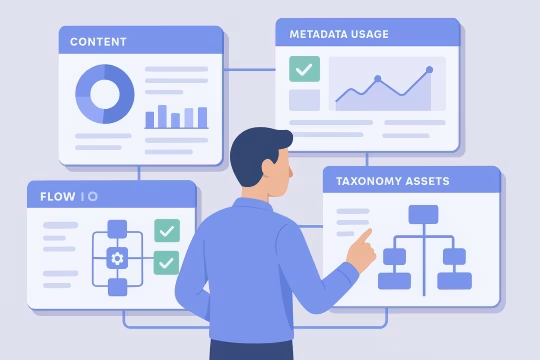
We assess content domains, metadata usage, taxonomy assets, and platform dependencies across the current ecosystem. This creates a shared view of classification problems, operational constraints, and implementation priorities.
AI-assisted taxonomy and content classification helps organizations structure large content estates in a way that supports findability, governance, reuse, and operational consistency. It combines taxonomy design, metadata modeling, classification logic, and workflow integration so content can be tagged and organized with greater accuracy and lower manual effort.
As enterprise platforms grow across multiple teams, channels, and repositories, content structures often diverge. Labels become inconsistent, metadata quality declines, and search relevance suffers. AI can support classification at scale, but only when it is applied within a well-defined taxonomy model, clear governance rules, and platform-aware content architecture.
This capability focuses on aligning taxonomy systems with real content models, editorial processes, and downstream search or personalization requirements. The result is a more reliable metadata foundation for CMS and DXP platforms, improved interoperability across systems, and a practical operating model for maintaining classification quality over time.
Core Focus
Best Fit For
Key Outcomes
Technology Ecosystem
Delivery Scope




As enterprise content platforms expand, taxonomy structures often evolve unevenly across teams, channels, and systems. Different business units create local labels, overlapping categories, and inconsistent metadata rules. Content types may be modeled without a clear relationship to taxonomy, while search platforms and downstream applications depend on structured classification that is incomplete or unreliable.
This fragmentation creates architectural and operational problems. Search relevance declines because metadata is sparse, inconsistent, or semantically ambiguous. Content reuse becomes difficult because teams cannot reliably identify related assets or apply shared categorization logic. Editorial workflows slow down as manual tagging requirements increase, and governance stakeholders struggle to maintain standards across distributed publishing environments. AI models introduced without a controlled taxonomy foundation can amplify inconsistency rather than reduce it.
Over time, the platform accumulates hidden complexity. Reporting becomes less trustworthy, personalization inputs degrade, and migration or integration work becomes more expensive because classification logic is embedded in disconnected processes. Engineering teams are then forced to compensate with custom rules, exceptions, and remediation scripts, increasing maintenance overhead and reducing confidence in the content architecture.
Review content types, metadata usage, publishing workflows, and downstream dependencies across CMS, DXP, and search systems. This establishes the current classification landscape, identifies inconsistencies, and defines the scope for taxonomy alignment.
Evaluate existing taxonomies, vocabularies, labels, hierarchies, and governance rules. The goal is to identify duplication, ambiguity, structural gaps, and areas where taxonomy design does not match actual content or business use cases.
Define the target taxonomy structure, metadata schema, classification logic, and confidence thresholds for AI-assisted tagging. This stage aligns content architecture with search, governance, and operational requirements.
Map classification processes into editorial and operational workflows, including review states, exception handling, and human validation. Integration points are defined for CMS interfaces, search pipelines, and governance checkpoints.
Configure prompts, rules, model inputs, and decision boundaries for classification tasks using available content signals. The implementation is designed to support repeatability, auditability, and controlled automation rather than opaque tagging behavior.
Test classification accuracy, metadata consistency, and taxonomy fit against representative content sets. Validation includes edge cases, ambiguous content, and governance review criteria to improve reliability before wider rollout.
Deploy the classification model and supporting workflows into production processes with monitoring and fallback paths. Teams receive clear operating guidance for manual review, taxonomy updates, and issue escalation.
Establish ongoing processes for taxonomy maintenance, model tuning, content audits, and change management. This ensures the classification system remains aligned with platform growth, editorial change, and new content domains.
This service establishes the technical foundation required to classify enterprise content consistently across complex platform ecosystems. It combines taxonomy design, metadata architecture, AI-assisted decisioning, and workflow integration so classification becomes an operational capability rather than an isolated experiment. The emphasis is on governed automation, structured content alignment, and maintainable implementation patterns that support search, analytics, and long-term platform evolution.
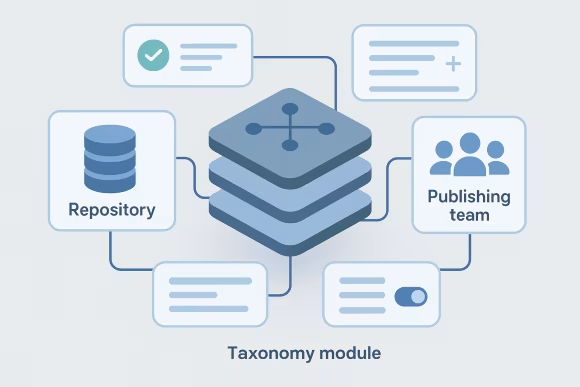
Design hierarchical and faceted taxonomy structures that reflect real content domains, user needs, and operational ownership. The architecture supports controlled vocabularies, semantic consistency, and extensibility across multiple repositories and publishing teams.
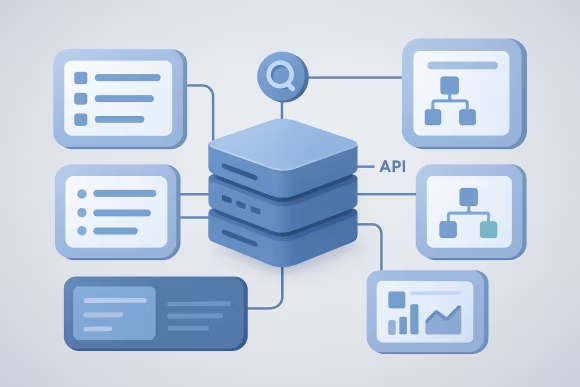
Define metadata fields, relationships, validation rules, and classification targets that align with content models and downstream platform requirements. This creates a structured foundation for search indexing, analytics, governance, and content reuse.
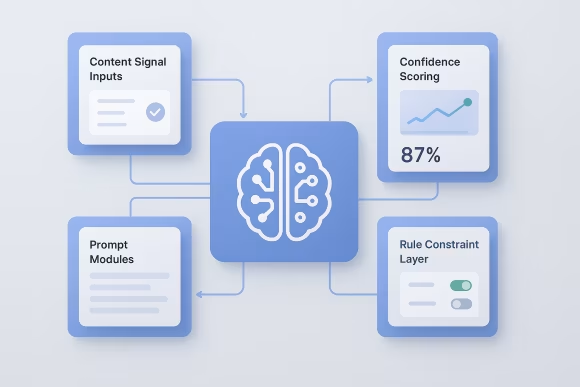
Implement AI-assisted classification patterns that use content signals, prompts, confidence scoring, and rule constraints to assign taxonomy terms. The logic is designed for transparency and reviewability, reducing the risk of uncontrolled or inconsistent tagging behavior.
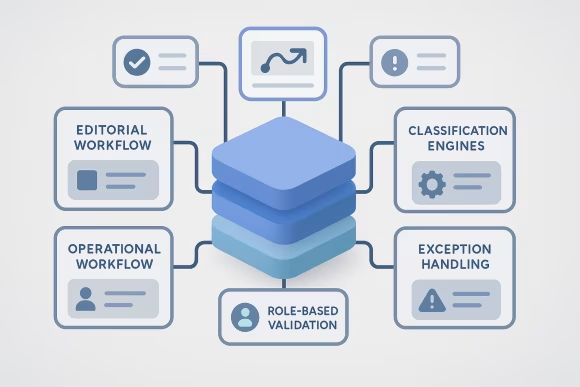
Embed classification into editorial and operational workflows so metadata assignment happens at the right stage of content creation or maintenance. This includes review paths, exception handling, and role-based validation across content operations.
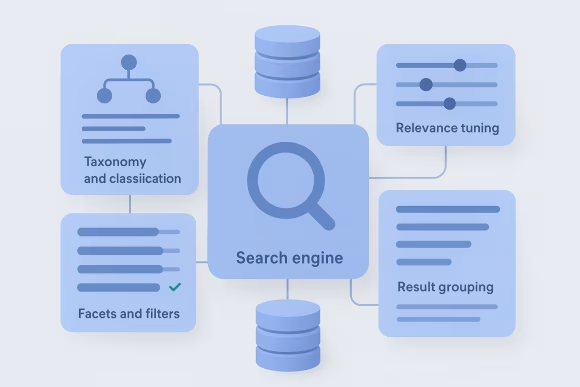
Connect taxonomy and classification outputs to search platform requirements such as facets, filters, relevance tuning, and result grouping. This ensures metadata structures are usable in retrieval systems rather than existing only as editorial abstractions.
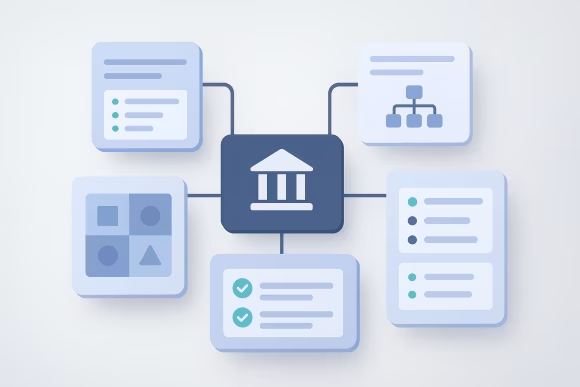
Introduce ownership models, change processes, audit mechanisms, and policy rules that keep taxonomy and classification systems stable over time. Governance controls help teams manage growth without allowing local exceptions to erode platform consistency.

Establish measurement approaches for classification accuracy, metadata completeness, drift detection, and exception rates. Monitoring provides the operational feedback needed to refine taxonomy structures, AI behavior, and workflow design.

Support classification across CMS, DXP, search, and data systems through shared metadata definitions and integration-aware implementation. This reduces duplication and enables taxonomy-driven behavior across multiple enterprise applications.
Delivery is structured around taxonomy analysis, metadata design, workflow integration, and controlled AI implementation. The model is designed to fit enterprise content operations where governance, auditability, and cross-platform consistency are required alongside practical automation.
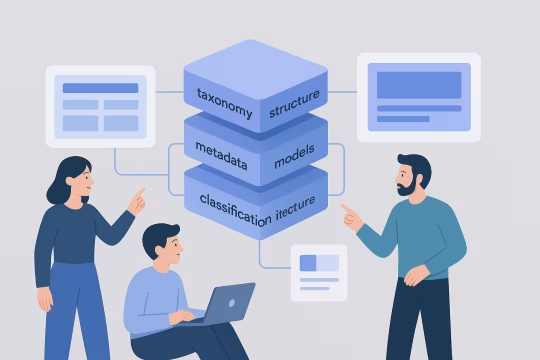
[01]We assess content domains, metadata usage, taxonomy assets, and platform dependencies across the current ecosystem. This creates a shared view of classification problems, operational constraints, and implementation priorities.
 [02]
[02]We define the target taxonomy structure, metadata model, and classification architecture needed to support search, governance, and content operations. Decisions are documented so they can be maintained across teams and systems.
 [03]
[03]We build a controlled prototype using representative content sets, AI classification logic, and review workflows. This validates taxonomy fit, confidence thresholds, and operational feasibility before broader rollout.
 [04]
[04]We configure classification workflows, metadata mappings, and platform integration points within the CMS, DXP, or search ecosystem. The implementation is designed to support repeatable operation and clear ownership.
 [05]
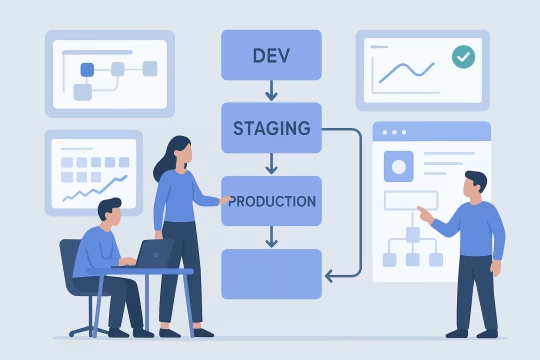
[05]We test classification accuracy, metadata consistency, exception handling, and workflow behavior using real content scenarios. Results are used to refine prompts, rules, and governance controls before production adoption.
 [06]
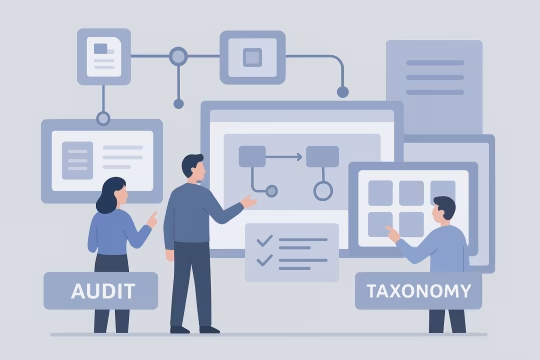
[06]We introduce the capability into live publishing and maintenance processes with monitoring, fallback paths, and operational guidance. Rollout can be phased by content domain, repository, or business unit.
 [07]
[07]We establish taxonomy ownership, change control, audit practices, and review responsibilities for long-term maintenance. Governance ensures the classification model remains aligned with evolving content and platform needs.
 [08]
[08]We support iterative refinement through quality monitoring, taxonomy updates, and model tuning based on observed content behavior. This helps maintain metadata quality as the platform and organization change over time.
A well-implemented taxonomy and classification capability improves the operational quality of enterprise content platforms. It reduces metadata inconsistency, strengthens search and reuse, and creates a more governable foundation for content-driven digital products.
Consistent classification improves how content is indexed, filtered, and retrieved across search and navigation experiences. Teams and users can locate relevant content with less manual effort and fewer structural workarounds.
AI-assisted tagging reduces the volume of repetitive manual classification work required from editorial teams. Human effort can then focus on review, exceptions, and governance rather than routine metadata entry.
Shared taxonomy structures and controlled workflows create clearer ownership and more reliable policy enforcement. This reduces the drift that often appears when multiple teams publish content independently.
Search platforms perform more effectively when metadata is complete, consistent, and aligned with taxonomy logic. This supports more relevant results, stronger faceting, and improved content discovery patterns.
A common classification model helps unify content behavior across CMS, DXP, search, and downstream systems. This decreases duplication and limits the need for custom reconciliation logic between platforms.
When content is classified consistently, teams can identify related assets and repurpose material across channels more reliably. This supports structured content strategies and reduces unnecessary duplication.
Governed AI implementation reduces the risk of uncontrolled tagging behavior, inconsistent metadata, and opaque automation decisions. Auditability and review paths make the system safer to operate in enterprise environments.
Classification processes become more sustainable as content volume grows across teams and repositories. The platform can support expansion without relying entirely on manual tagging or ad hoc metadata practices.
This service often connects with adjacent architecture, data, search, and content modeling capabilities across enterprise platform ecosystems.
Governed AI workflows for metadata quality
Structured remediation for large content estates
Structured content transformation for enterprise platforms
Structured migration workflows with LLM-assisted transformation
Governed automation across content and operations
Search API design and indexing pipelines
Structured schemas for an API-first content strategy
Composable DXP content architecture and API-first platform design
Unified customer profile architecture and insight-ready datasets
Scalable enterprise audience segmentation models and cohort definition frameworks
Stewardship, standards, and CDP data policy and controls
CDP event pipeline architecture and identity foundations
Common questions about taxonomy architecture, AI-assisted classification, governance, integration, and delivery for enterprise content platforms.
Taxonomy architecture and content modeling are closely related, but they solve different structural problems. Content modeling defines the shape of content objects: content types, fields, relationships, validation rules, and editorial structures. Taxonomy architecture defines the classification system applied across those objects: categories, controlled vocabularies, hierarchies, facets, synonyms, and governance rules for metadata assignment. In practice, the two must work together. A content model may include fields such as topic, audience, region, product line, or content purpose, but the taxonomy determines what values are allowed, how those values relate to each other, and how they should be maintained over time. If content models are designed without taxonomy alignment, metadata fields often become inconsistent, redundant, or too loosely governed to support search and reuse. For enterprise platforms, the distinction matters because taxonomy usually spans multiple content types, repositories, and teams, while content models may vary by application or publishing domain. A strong implementation aligns both layers so structured content can be classified consistently, indexed effectively, and governed across the wider platform ecosystem.
A sound architecture starts with a well-defined taxonomy, explicit metadata targets, and clear workflow boundaries before any AI model is introduced. The classification layer should not operate as an isolated black box. Instead, it should sit within a structured pipeline that includes content inputs, prompt or rule configuration, confidence scoring, validation logic, exception handling, and audit trails. The architecture also needs to account for where classification happens. In some environments, tagging occurs during content authoring inside the CMS. In others, it happens in downstream indexing pipelines, enrichment services, or governance review processes. The right design depends on editorial workflows, platform constraints, and how metadata is consumed by search, personalization, analytics, or compliance systems. For enterprise use, the most important architectural qualities are traceability, maintainability, and interoperability. Teams need to understand why a term was assigned, how the model can be tuned, and how taxonomy changes propagate across systems. Without those controls, AI classification may appear effective in isolated tests but become difficult to govern or trust at scale.
Ongoing maintenance is essential because taxonomy and classification systems reflect changing products, services, audiences, and organizational language. Even if the initial implementation is strong, metadata quality will degrade if there is no process for reviewing new terms, retiring obsolete labels, handling exceptions, and monitoring classification drift. Operationally, maintenance usually includes periodic taxonomy reviews, sample-based quality audits, updates to prompts or rules, and governance checkpoints for major content or platform changes. Teams also need a process for managing edge cases where content does not fit existing structures cleanly. In enterprise settings, this often involves collaboration between taxonomy owners, content strategists, search specialists, and platform teams. The level of effort depends on content volume, publishing decentralization, and the number of systems involved. A mature operating model does not require constant intervention, but it does require ownership and routine review. The goal is to make classification sustainable through clear governance and measurable quality controls rather than relying on one-time implementation work.
The impact depends on where classification is introduced and how much editorial control is required. In many cases, AI-assisted classification reduces repetitive tagging work by pre-populating metadata suggestions during authoring or content review. Editors then validate, adjust, or reject those suggestions based on confidence thresholds and governance rules. This can improve efficiency, but only if workflow design is handled carefully. If AI outputs are inserted without review logic, teams may lose trust in metadata quality. If every suggestion requires heavy manual correction, the process may add friction rather than remove it. The workflow therefore needs clear decision points, role responsibilities, and escalation paths for ambiguous content. For larger organizations, the most effective model usually combines automation with controlled oversight. Routine classification can be accelerated, while sensitive or high-impact metadata remains subject to human review. This approach supports operational scale without weakening governance. It also helps editorial teams understand classification behavior as part of normal publishing operations rather than as a separate technical process.
Search integration is one of the main reasons organizations invest in taxonomy and classification. Search platforms depend on structured metadata to support filtering, faceting, ranking, result grouping, and query interpretation. If taxonomy terms are inconsistent or classification is incomplete, search quality suffers even when the indexing technology itself is sound. Integration typically involves mapping taxonomy fields to search index schemas, defining how hierarchical or faceted terms should be stored, and ensuring classification outputs are available at indexing time. In some cases, synonyms, preferred labels, and related-term relationships are also passed into search configuration to improve retrieval behavior. The design must account for how metadata is generated, validated, and refreshed as content changes. A strong integration does more than expose tags to the index. It aligns taxonomy structure with actual search use cases, such as navigation filters, audience segmentation, or content type prioritization. This requires coordination between taxonomy design, content architecture, and search engineering. When done properly, classification becomes a functional part of search relevance rather than a disconnected metadata exercise.
Yes, but the integration pattern should be chosen based on editorial processes, platform constraints, and governance requirements. In some CMS and DXP environments, AI-assisted classification can be embedded directly into authoring interfaces so editors receive metadata suggestions while creating or updating content. In other cases, classification is better handled in background services, enrichment pipelines, or review queues. Direct integration is useful when metadata quality depends on timely editorial action and when the platform supports workflow customization. However, it also introduces questions about user experience, permissions, validation, and exception handling. Editors need to understand whether metadata is mandatory, suggested, or automatically applied, and governance teams need visibility into how those decisions are made. For enterprise implementations, the integration should preserve auditability and avoid tightly coupling classification logic to a single interface if the same metadata is needed elsewhere. A flexible architecture often combines CMS workflow integration with reusable classification services so the organization can support multiple channels, repositories, and downstream consumers without duplicating logic.
Enterprise taxonomy governance requires clear ownership, change control, and quality accountability. At minimum, organizations need named owners for taxonomy domains, a process for proposing and approving changes, and documented rules for how terms are created, updated, deprecated, and mapped across systems. Without this structure, local exceptions accumulate and classification quality declines quickly. Governance also needs to cover operational behavior, not just taxonomy design. That includes who reviews low-confidence AI classifications, how exceptions are handled, how quality is measured, and how changes are communicated to editorial, search, and platform teams. In distributed organizations, governance often works best as a federated model with central standards and domain-level stewardship. The right model should be proportionate to platform complexity. It does not need to be bureaucratic, but it does need to be explicit. Taxonomy and classification affect search, analytics, content reuse, and compliance, so unmanaged change can have broad downstream impact. A practical governance model creates enough control to maintain consistency while still allowing the taxonomy to evolve with the business.
Auditability starts with making classification decisions observable. That means recording which model, prompt, rule set, or workflow state contributed to a metadata assignment, along with confidence levels and any subsequent human overrides. Without this information, teams cannot reliably investigate errors, tune the system, or demonstrate control over metadata decisions. Policy control is achieved by constraining where automation applies and defining when human review is required. For example, some taxonomy fields may be safe for automatic suggestion, while others may require mandatory approval because they affect compliance, legal interpretation, or customer-facing experiences. Confidence thresholds, exception routing, and role-based permissions help enforce those boundaries. In enterprise environments, governance and engineering need to work together. The technical implementation should support logging, versioning, and review states, while governance defines acceptable use, ownership, and escalation paths. This combination allows AI to be used productively without weakening accountability. The goal is not to eliminate automation risk entirely, but to make it visible, manageable, and consistent with platform policy.
The main risk is that automation scales inconsistency instead of solving it. If taxonomy terms are ambiguous, overlapping, or poorly governed, AI models will still produce classifications, but those outputs may reinforce structural problems already present in the platform. This can create a false sense of progress while making metadata quality harder to correct later. Other risks include low trust from editorial teams, degraded search relevance, and increased maintenance overhead. When classifications are not aligned with content models or downstream use cases, engineering teams often end up building compensating logic in search indexes, reporting pipelines, or custom validation scripts. That increases complexity and reduces transparency. There is also a governance risk. If the organization cannot explain why content was classified a certain way, or if taxonomy changes are not managed systematically, the platform becomes harder to audit and evolve. AI should be introduced as part of a structured metadata architecture, not as a shortcut around unresolved taxonomy design. A strong foundation is what makes automation useful, measurable, and maintainable over time.
Reducing lock-in starts with separating taxonomy and metadata architecture from any single AI provider. The taxonomy model, field definitions, governance rules, and workflow logic should remain platform-owned assets. AI models can support classification, but they should not become the only place where classification logic exists or the only way metadata can be generated. A practical approach is to design classification services with clear interfaces, configurable prompts or rules, and measurable outputs that can be tested independently of a specific vendor. This makes it easier to compare models, switch providers, or introduce hybrid approaches over time. It also helps teams retain control over quality thresholds, review logic, and operational reporting. Organizations should also avoid embedding provider-specific assumptions too deeply into editorial workflows or downstream integrations. If a model changes behavior, pricing, or availability, the platform should still be able to operate through fallback rules, manual review, or alternative services. The objective is not to avoid external AI tools, but to ensure the classification capability remains portable, governable, and resilient.
Scope is usually defined by a combination of content domain, platform boundaries, and operational goals. Some engagements focus on a single repository or business unit, such as improving metadata quality for a specific CMS implementation. Others address broader platform concerns, such as aligning taxonomy across multiple systems that feed search, analytics, or personalization services. A useful scoping process identifies the content types involved, the taxonomy assets already in place, the systems that consume metadata, and the workflows where classification decisions occur. It also clarifies whether the engagement includes taxonomy redesign, AI-assisted tagging, search integration, governance design, or all of these together. Without this level of definition, projects can become too abstract or too broad to implement effectively. In enterprise settings, scope is often phased. Teams may begin with assessment and architecture, then move into a pilot for one content domain before scaling to additional repositories or workflows. This allows the organization to validate taxonomy fit, operational impact, and governance requirements before committing to wider rollout.
Successful implementation usually requires collaboration across content, governance, search, and platform functions. Content strategists and taxonomy owners help define classification structures and editorial meaning. CMS or DXP leads provide workflow and platform context. Search teams ensure metadata supports retrieval, faceting, and relevance needs. Governance stakeholders define policy, ownership, and review requirements. Depending on the environment, data teams, product owners, and engineering leads may also be involved. Their role is often to align classification with downstream analytics, integration patterns, or broader platform architecture. The exact mix varies, but the work is rarely effective when owned by only one discipline because taxonomy and classification affect multiple operational layers at once. The collaboration model should be explicit from the start. Teams need to know who makes structural decisions, who validates content behavior, and who owns long-term maintenance. Clear roles reduce delays and prevent the common problem of taxonomy being treated as a side task without operational accountability.
Collaboration usually begins with a focused assessment of the current content and metadata landscape. This includes reviewing existing taxonomies, content models, classification practices, search dependencies, and governance constraints. The purpose is to establish a shared understanding of where inconsistency, manual effort, or platform fragmentation is creating operational problems. From there, a working scope is defined around a specific content domain, platform area, or use case such as search improvement, metadata governance, or AI-assisted tagging. Stakeholders are identified across content, platform, search, and governance teams, and the engagement is structured around practical decisions: what taxonomy needs to be aligned, where classification should happen, how quality will be measured, and what level of automation is appropriate. In many cases, the first formal step is an architecture and discovery phase followed by a limited prototype or pilot. That approach allows teams to test taxonomy fit, workflow integration, and AI behavior using real content before scaling further. It creates a controlled starting point and helps define a realistic roadmap for broader implementation.
These case studies show how structured content models, governance rules, and search-aligned information architecture were implemented across Drupal and headless CMS environments. They are especially relevant for AI taxonomy and content classification because they demonstrate the delivery foundations needed for scalable metadata quality, editorial consistency, and better content findability. Together, they provide concrete proof of taxonomy-aligned architecture, workflow design, and discovery improvements in real enterprise content ecosystems.
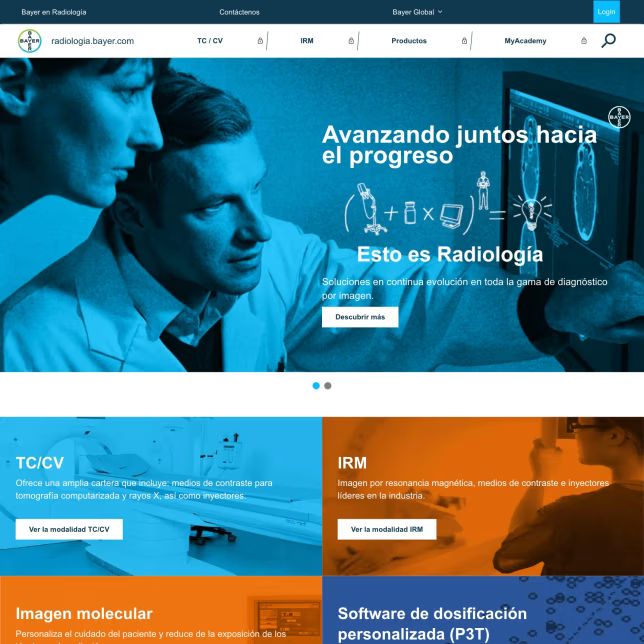
An advanced healthcare digital platform for LATAM was required to facilitate collaboration among radiology HCPs, distribute company knowledge, refine treatment methods, and streamline workflows. The solution needed secure medical website role-based access restrictions based on user role (HCP / non-HCP) and geographic region.
The platform enhanced collaboration, streamlined workflows, and empowered radiology professionals with advanced tools to gain insights and optimize patient care.
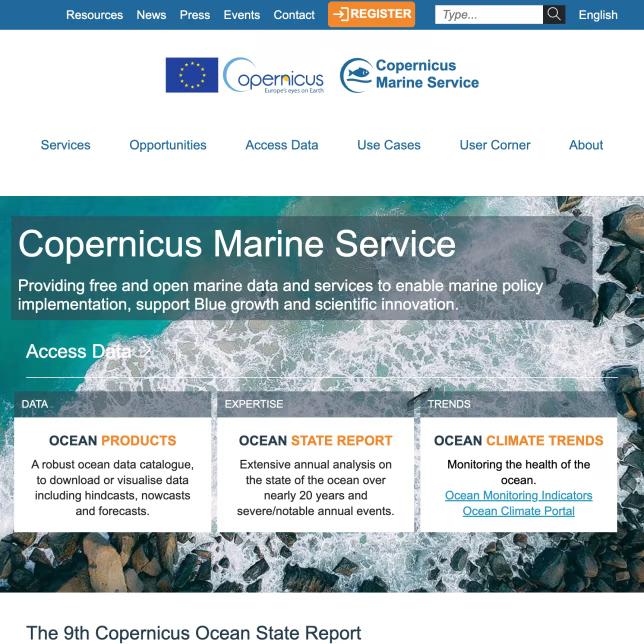
The existing marine data portal relied on three unaligned WordPress installations and embedded PHP code, creating inefficiencies and risks in content management and usability.
The new Drupal DXP streamlined content operations and improved accessibility, offering scientists and businesses a more efficient gateway to marine data services.
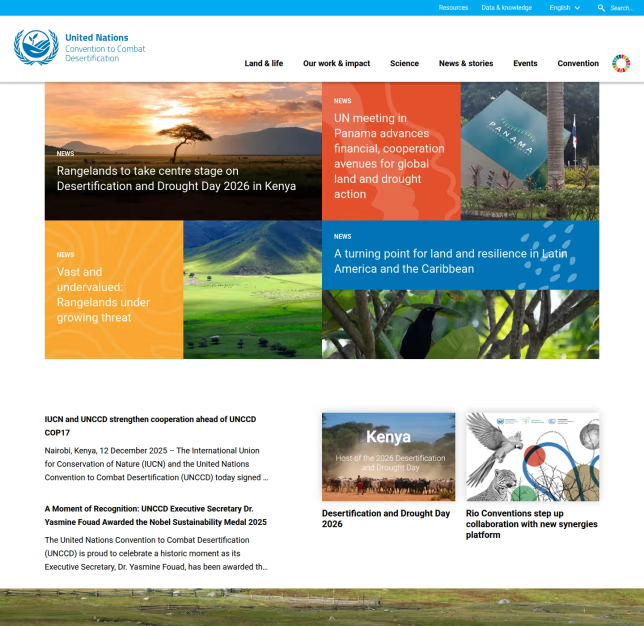
UNCCD operated four separate websites (two WordPress, two Drupal), leading to inconsistencies in design, content management, and user experience. A unified, scalable solution was needed to support a large-scale CMS migration project and improve efficiency and usability.
The modernization effort resulted in a cohesive, user-friendly, and scalable website, improving content management efficiency and long-term digital sustainability.
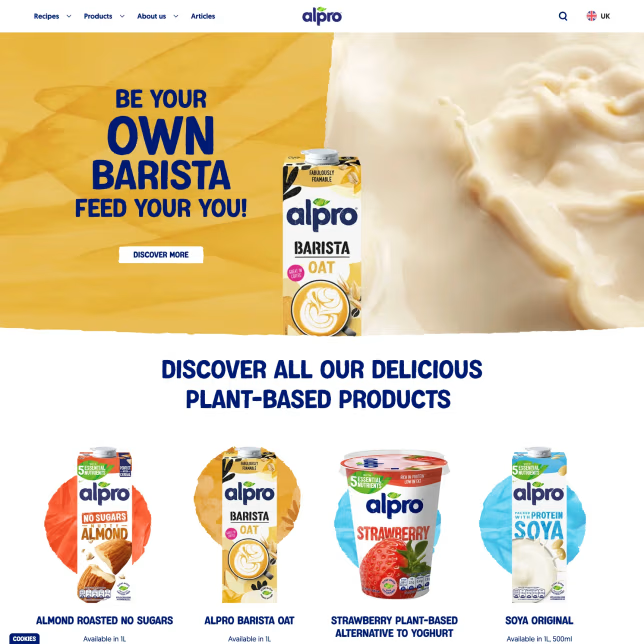
Users were abandoning the website before fully engaging with content due to slow loading times and an overall poor performance experience.
The updated platform significantly improved speed and usability, resulting in higher user engagement, longer session durations, and increased content exploration.
Arvesta required a modern, scalable headless CMS for enterprise corporate marketing—supporting rapid updates, structured content operations, and consistent UI delivery across multiple teams and repositories.
The platform enabled faster delivery of marketing updates, improved UI consistency across pages, and strengthened editorial operations through structured content models and reusable components.
Oleksiy (PathToProject) and I worked together on a Digital Transformation project for Bayer LATAM Radiología. Oly was the Drupal developer, and I was the business lead. His professionalism, technical expertise, and ability to deliver functional improvements were some of the key attributes he brought to the project.
I also want to highlight his collaboration and flexibility—throughout the entire journey, Oleksiy exceeded my expectations.
It’s great when you can partner with vendors you trust, and who go the extra mile.

Axel Gleizerman Copello
Building in the MedTech Space | Antler
Oly (PathToProject), as we could call him, was working with us for 9 months and started up our Drupal and Akeneo integration with great passion.
His experience, skills and knowledge were very productive for the project. A real Drupal guru, breathing PHP and writing code as if it were poetry!

Tom Rogie
DevOps at X2O Badkamers (aka chef-van-t-containerpark)
It was my pleasure working with Oleksiy (PathToProject) on a new Drupal website. He is a true full-stack developer—the ideal mix of DevOps expertise, deep front-end knowledge, and the structured thinking of a senior back-end developer.
He is well-organized and never lets anything slip. Oleksiy understands what needs to be done before being asked and can manage a project independently with minimal involvement from clients, product managers, or business analysts.
One of the best consultants I’ve worked with so far.

Andrei Melis
Technical Lead at Eau de Web
These articles explore the governance, modeling, and search-alignment decisions that make AI-assisted classification work in real content platforms. They add practical context on taxonomy drift, metadata consistency, and the operational changes needed to keep classification reliable over time.
Let’s review your content structures, metadata quality, and workflow constraints to define a governed approach to AI-assisted classification.