 [01]
[01]Discovery and Audit
Assess Drupal content structures, theming, integrations, and operational constraints. Produce a dependency map and migration backlog with sequencing that minimizes disruption to editorial and release processes.
Drupal-to-headless migration services help teams move from tightly coupled Drupal rendering to a headless Drupal architecture migration with API-first content delivery and an independent frontend application (often Next.js). The goal is to preserve editorial workflows and governance while enabling faster frontend iteration, multi-channel delivery, and clearer separation of concerns across teams.
Organizations typically need this capability when Drupal themes and page-building patterns constrain performance, release cadence, or integration requirements. As platforms grow, the coupling between content, presentation, and deployment pipelines increases coordination overhead and makes modernization risky.
A well-executed migration establishes a stable content model, a versioned API surface (often GraphQL), and a frontend delivery layer such as Next.js. It also defines cutover strategy, coexistence patterns, and operational ownership so the platform can evolve incrementally without destabilizing production or disrupting content operations.
Core Focus
Best Fit For
Key Outcomes
Technology Ecosystem
Delivery Scope
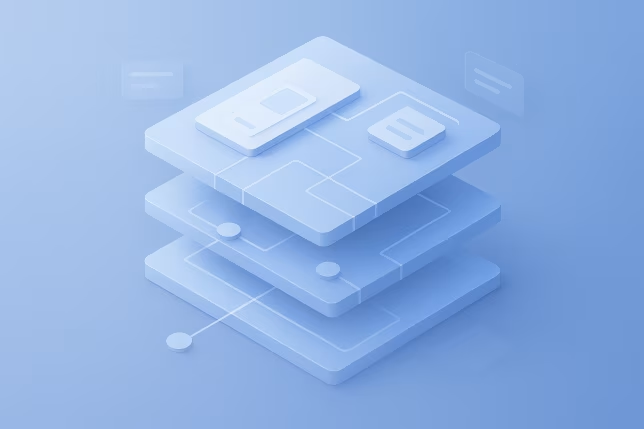


As Drupal platforms mature, rendering, routing, and content concerns often become intertwined with theme logic, contributed modules, and environment-specific deployment practices. Over time, teams accumulate page templates, custom preprocess layers, and ad-hoc integrations that make even small UI changes require full CMS releases. This coupling becomes more visible when organizations introduce new channels, performance targets, or product teams that need autonomy.
Engineering teams then face architectural constraints: frontend modernization is blocked by backend release cycles, caching strategies are inconsistent across pages, and integration patterns vary between modules. Content modeling may reflect historical page structures rather than reusable domain concepts, which makes API exposure difficult and increases the cost of change. Testing and observability also become fragmented because failures can originate from theme code, CMS configuration, or integration endpoints without clear boundaries.
Operationally, the platform becomes harder to evolve safely. Release windows expand, rollback strategies are limited, and parallel work streams collide in the same deployment unit. The result is slower delivery, higher regression risk, and a growing gap between the desired digital experience architecture and what the platform can reliably support.
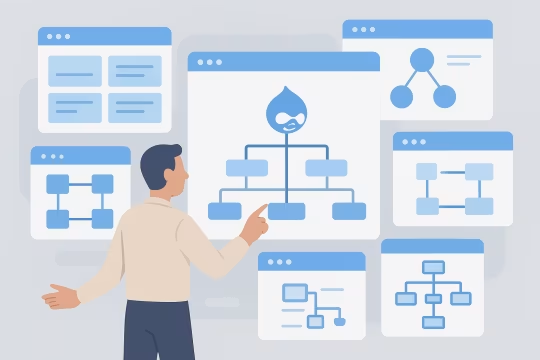
Review the current Drupal estate, including content types, editorial workflows, theming, integrations, and deployment topology. Identify coupling points, performance constraints, and channel requirements to define migration scope and sequencing.
Define the headless reference architecture: API boundaries, rendering approach (SSR/SSG/ISR), caching layers, authentication, and integration patterns. Establish non-functional requirements such as latency, availability, and operational ownership.
Normalize content structures into reusable domain models and define relationships, localization, and media handling. Align the model with API consumption patterns and editorial governance to avoid recreating page-template coupling in a new form.
Design a versioned GraphQL schema, resolver strategy, and access controls. Implement query patterns, pagination, and error handling, and define conventions for deprecations and backward compatibility.
Implement the frontend application with routing, rendering strategy, component composition, and data-fetching patterns. Establish caching and revalidation behavior, preview flows, and environment configuration aligned to release independence.
Plan incremental migration using coexistence patterns such as route-by-route cutover, proxying, or hybrid rendering. Define URL strategy, redirects, canonical handling, and content freeze windows where required.
Implement automated tests for API contracts, content rendering, and critical user journeys. Add logging, tracing, and metrics across Drupal, API, and frontend layers to support incident response and performance tuning.
Define API governance, schema change management, and operational runbooks. Establish ownership boundaries, release processes, and a backlog for iterative improvements after the initial migration milestone.
This service focuses on the technical foundations required to evolve a Drupal platform into a decoupled architecture without losing operational control. It emphasizes stable content modeling, explicit API contracts, and frontend delivery patterns that support independent releases. The work includes coexistence strategies for incremental cutover, reliability engineering across layers, and governance mechanisms for long-term maintainability as teams and channels scale.
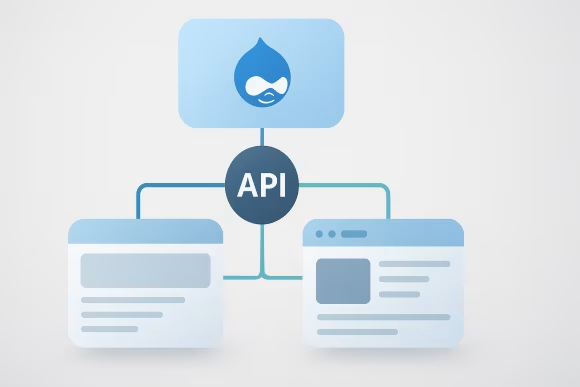
Define clear separation between content management, API delivery, and frontend rendering. Establish boundaries for responsibilities, deployment units, and failure domains so that changes in presentation do not require CMS releases and backend changes do not destabilize the UI layer.
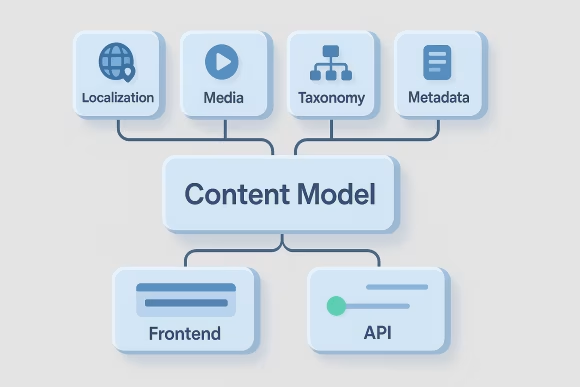
Refactor Drupal content types and relationships into reusable domain concepts optimized for API consumption. Address localization, media, taxonomy, and structured metadata so multiple frontends can consume consistent content without duplicating transformation logic across applications.
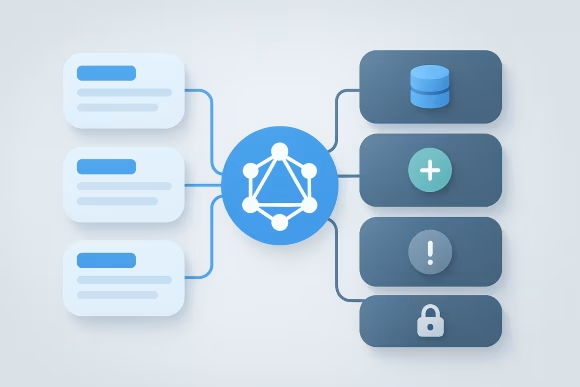
Design and implement a GraphQL schema that reflects domain models, supports efficient query patterns, and enforces access control. Include conventions for pagination, error handling, and schema evolution so clients can adopt changes predictably over time.
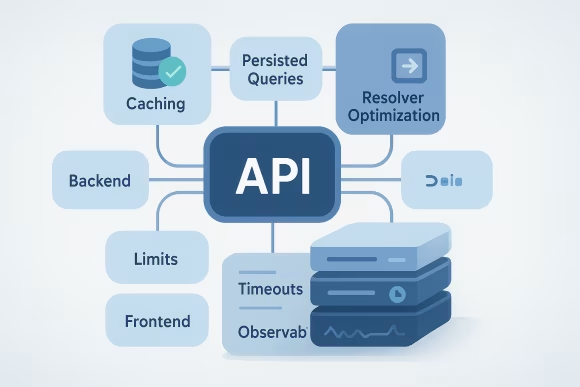
Implement caching, persisted queries where appropriate, and resolver optimization to control latency and backend load. Define limits, timeouts, and observability signals so API behavior remains stable under peak traffic and complex content graphs.
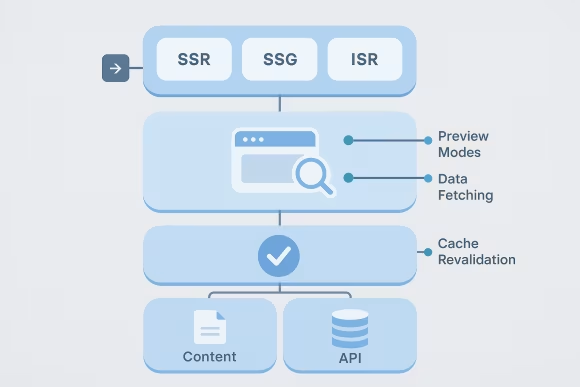
Implement SSR/SSG/ISR strategies aligned to content freshness, traffic profiles, and operational constraints. Establish routing, data fetching, preview modes, and cache revalidation so editorial changes propagate predictably without overloading origin systems.
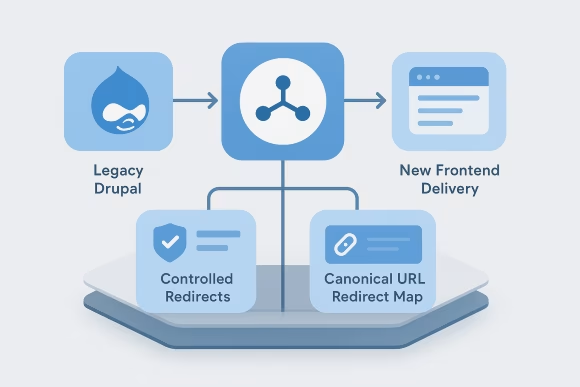
Enable route-by-route or feature-by-feature migration using proxies, hybrid routing, and controlled redirects. Maintain SEO integrity with canonical URLs, redirect maps, and structured metadata continuity while progressively moving traffic to the new delivery layer.
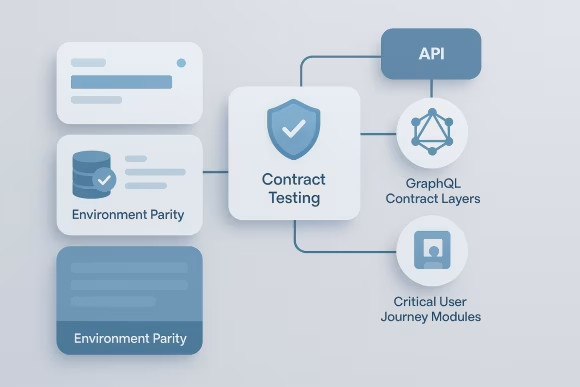
Add automated checks for GraphQL contracts, content rendering invariants, and critical user journeys. Use test data strategies and environment parity to detect breaking changes early, especially during coexistence when two delivery paths are active.
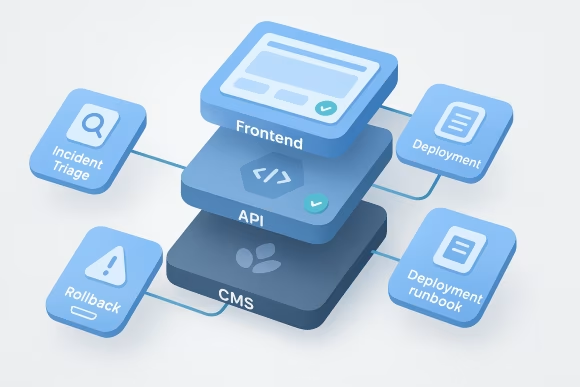
Define operational responsibilities across CMS, API, and frontend layers, including incident triage paths and rollback options. Provide runbooks for deployments, cache invalidation, schema changes, and content issues to reduce operational ambiguity post-migration.
Engagements follow an engineering sequence from discovery and architecture decisions through implementation, coexistence, and controlled cutover. The delivery model is designed to reduce migration risk while establishing API-first content delivery (including GraphQL where appropriate) and a decoupled frontend such as Next. js, with clear operational ownership for long-term evolution.
[01]Assess Drupal content structures, theming, integrations, and operational constraints. Produce a dependency map and migration backlog with sequencing that minimizes disruption to editorial and release processes.
 [02]
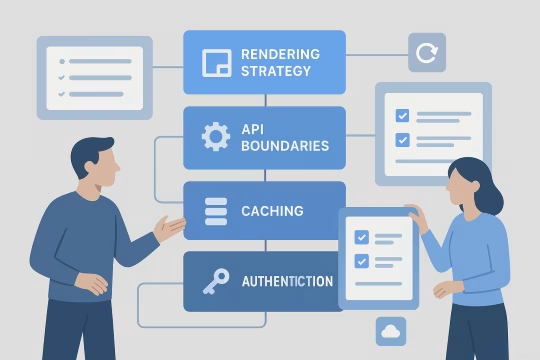
[02]Define target-state architecture and record key decisions as ADRs, including rendering strategy, API boundaries, caching, and authentication. Establish acceptance criteria for performance, reliability, and maintainability.
 [03]
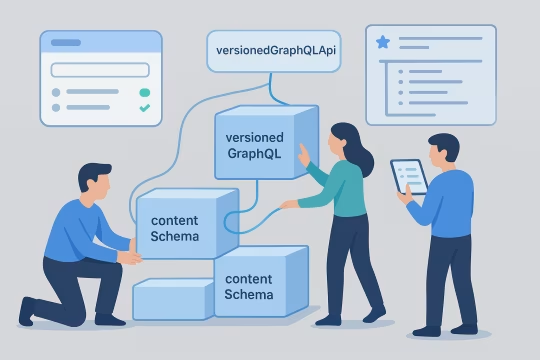
[03]Refactor content models and implement the GraphQL layer with versioning and access controls. Validate query patterns against real content scenarios and define conventions for schema evolution and deprecation.
 [04]
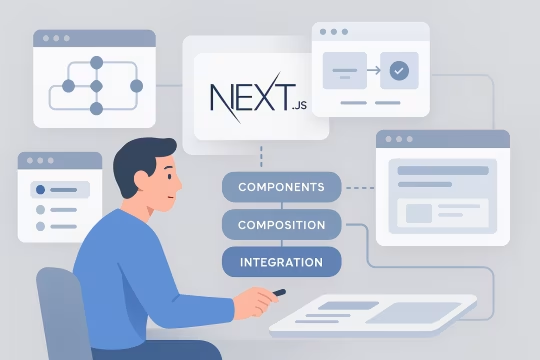
[04]Build the Next.js application foundation, including routing, data fetching, rendering mode selection, and preview workflows. Establish component composition and integration patterns that support independent frontend releases.
 [05]
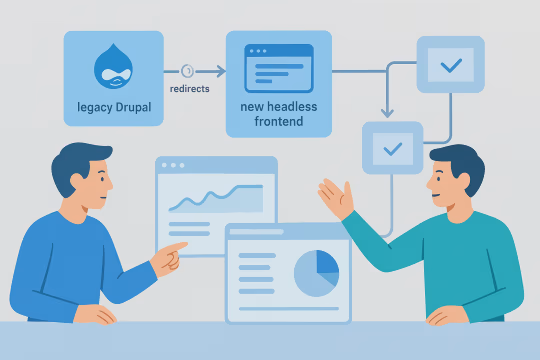
[05]Implement coexistence patterns such as proxy routing, hybrid delivery, and incremental redirects. Coordinate data consistency, caching behavior, and monitoring across both legacy and new delivery paths.
 [06]
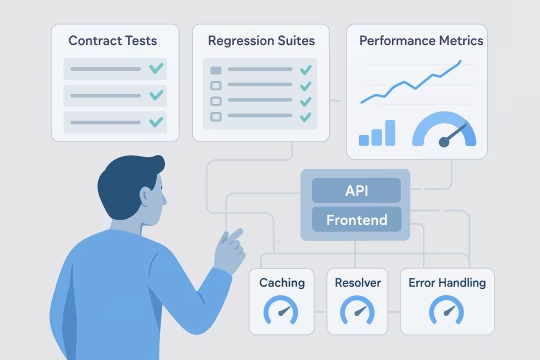
[06]Add contract tests, regression suites, and performance checks across API and frontend layers. Tune caching, resolver performance, and error handling based on observed behavior in staging and production-like environments.
 [07]
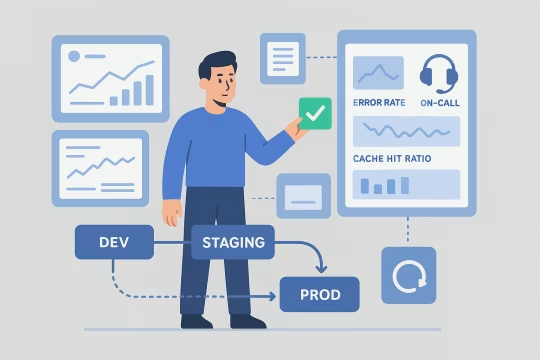
[07]Execute a controlled cutover with rollback options, runbooks, and on-call support. Monitor KPIs such as error rates, latency, cache hit ratios, and editorial throughput, then address stabilization backlog items.
 [08]
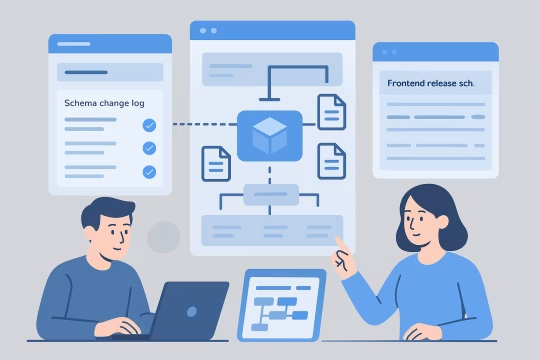
[08]Operate a governance cadence for schema changes, frontend releases, and platform improvements. Maintain a roadmap for further decoupling, channel expansion, and technical debt reduction based on platform telemetry.
A Drupal-to-headless migration primarily improves platform changeability and operational control. By separating concerns and introducing explicit API contracts, organizations can reduce coordination overhead, modernize the frontend safely, and scale delivery across teams and channels without expanding the CMS deployment blast radius.
Frontend teams can ship changes without waiting for CMS deployment windows. Backend changes can be scheduled and validated against API contracts, reducing cross-team coordination and release contention.
Smaller, decoupled deployment units reduce the blast radius of changes. Clear rollback paths for frontend and API layers improve incident response and lower the likelihood of platform-wide regressions.
Rendering strategies and caching can be tuned independently of CMS constraints. This enables predictable latency management through CDN behavior, revalidation policies, and API performance optimization.
A stable content API supports web, mobile, and other channels without duplicating content logic. Teams can introduce new experiences while keeping a single governed content model and permission structure.
Explicit boundaries reduce the accumulation of theme-driven coupling and ad-hoc integrations. Over time, this decreases the cost of upgrades, refactors, and onboarding across platform components.
Versioned schemas, deprecation policies, and ADRs make platform evolution auditable. This supports enterprise change management and reduces uncertainty when multiple product teams depend on shared content APIs.
Tracing and metrics across CMS, API, and frontend make failures easier to localize. Teams can correlate content changes, API behavior, and rendering outcomes to resolve issues faster.
Decoupling supports clearer ownership boundaries between content operations, API engineering, and frontend delivery. This enables parallel development and reduces the coordination tax as the organization scales.
Adjacent capabilities that commonly extend Drupal-to-headless migration work, including API engineering, frontend delivery, and platform operations for decoupled architectures.
Enterprise content migration with API-first content delivery
API-first enterprise headless CMS platform architecture for content delivery
Structured schemas for an API-first content strategy
Contract-first headless API development for enterprise delivery
Headless CMS API integration, contracts, and integration layer engineering
Enterprise API design for scalable, secure foundations
Enterprise GraphQL schema design and governance
Headless architecture roadmap and target architecture definition
Reduce latency across rendering and APIs
Common architecture, operations, integration, governance, risk, and engagement questions for Drupal-to-headless migrations in enterprise environments.
Most enterprise migrations converge on a three-layer model: Drupal as the content and workflow system, an API layer (often GraphQL) as the contract boundary, and a separate frontend application (for example Next.js) responsible for routing and rendering. Within that model, the main architectural choices are how the API is exposed (direct from Drupal vs a dedicated gateway), how rendering is performed (SSR, SSG, ISR, or mixed), and where caching is enforced (CDN, application cache, API cache). A practical target architecture also defines identity and authorization flows (editorial permissions vs end-user auth), preview and draft content access, and failure domains. For example, you may want the frontend to degrade gracefully when a non-critical API field fails, rather than failing the entire page. We typically document these decisions as architecture decision records (ADRs) and validate them with a thin vertical slice: one content type, one route, one query pattern, and end-to-end observability. That reduces the risk of choosing a rendering or caching approach that does not fit your content update frequency or traffic profile.
The decision is driven by content freshness requirements, traffic patterns, and operational constraints. SSG works well for content that changes infrequently and benefits from maximum cacheability, but it can create long build times for large estates. SSR provides per-request freshness and can simplify personalization, but it increases origin load and makes caching strategy more complex. ISR is often a middle ground: pages are served statically and revalidated on a schedule or on-demand, which can align well with editorial publishing workflows. For Drupal-backed content, we usually map content types and routes to rendering modes. High-traffic evergreen pages often use SSG/ISR with CDN caching. Frequently updated pages may use ISR with on-demand revalidation triggered by publish events. Authenticated or highly personalized experiences may require SSR or a separate application layer. We validate the choice with measurable criteria: time-to-first-byte, cache hit ratio, build duration, and failure behavior during API degradation. The goal is a predictable operational model, not a single rendering mode everywhere.
Operationally, you move from one primary runtime (Drupal rendering pages) to multiple runtimes: Drupal for content operations, an API surface for content delivery, and a frontend runtime for rendering and routing. This increases the number of deployable units, but it also reduces coupling and allows more targeted rollbacks. You should expect changes in monitoring and incident response. Instead of diagnosing “the site is slow” within a single stack, teams need cross-layer observability: API latency, resolver error rates, frontend rendering errors, cache behavior, and CMS health. Runbooks should define how to triage issues by layer and how to mitigate quickly (for example, disabling a problematic query field, adjusting cache TTLs, or rolling back a frontend release). Release management also changes. Frontend releases can become more frequent, while API and CMS changes may require stronger contract discipline. We recommend establishing environment parity, automated smoke tests, and a clear ownership model so operational responsibilities remain unambiguous.
We treat caching as a multi-layer strategy with explicit responsibilities. The CDN typically handles edge caching for rendered pages and static assets. The Next.js layer may cache rendered output depending on SSR/ISR choices. The GraphQL layer may cache query results or rely on upstream caching in Drupal, depending on resolver design and content volatility. Invalidation is where many migrations fail operationally. We define which events trigger revalidation (publish, unpublish, taxonomy changes, media updates) and how those events propagate. Common patterns include webhook-driven on-demand revalidation for ISR, selective CDN purge for critical routes, and conservative TTLs for volatile content. We also design queries to be cache-friendly: stable query shapes, predictable pagination, and avoiding highly variable parameters that destroy cache hit rates. Finally, we instrument cache headers and cache hit metrics so teams can see whether the strategy is working and adjust without guesswork.
Integrations need to be re-evaluated based on whether they are content-side, experience-side, or user-side. Content-side integrations (taxonomy sync, DAM, translation workflows) often remain in Drupal with minimal change, though API exposure may require additional fields or normalized models. Experience-side integrations (search UI, recommendations, analytics tagging) typically move into the frontend application because they are presentation and interaction concerns. Forms and authenticated flows require careful design. If Drupal previously handled form rendering and submission, you may replace that with frontend-rendered forms that submit to dedicated endpoints, or keep Drupal as a form backend via APIs. SSO and identity often become shared concerns: Drupal needs editorial authentication, while the frontend may need end-user authentication via OIDC/OAuth. We create an integration inventory and classify each integration by ownership, runtime, and data flow. Then we define migration steps and acceptance tests so integrations do not regress during coexistence and cutover.
With Drupal, GraphQL typically exposes content entities, relationships, and media through a schema that reflects your domain model. The key engineering work is in schema design and resolver behavior: ensuring consistent field naming, predictable nullability, and efficient resolution of nested relationships. Query complexity must be managed to protect Drupal and the API runtime. We commonly implement depth and complexity limits, timeouts, and rate limits, and we monitor slow queries. Resolver optimization is critical: batching, caching, and avoiding N+1 patterns when traversing entity references. Where appropriate, we introduce persisted queries or a query registry so the frontend uses known query shapes that are easier to cache and secure. We also treat the schema as a product interface. Versioning and deprecation policies matter because multiple frontend teams and channels may depend on it. Contract tests help ensure schema changes do not break clients during ongoing evolution.
We recommend governance at three levels: process, tooling, and ownership. Process includes defining who can change the schema, how changes are proposed, and what constitutes a breaking change. Tooling includes schema diff checks in CI, contract tests against a set of approved queries, and automated documentation generation so consumers can see changes quickly. On the ownership side, we establish an API steward role (or a small group) responsible for consistency and deprecation policy. Deprecations should have explicit timelines and migration guidance. For high-dependency fields, we often introduce additive changes first, run both fields in parallel, and remove only after consumers have migrated. In practice, this looks like: ADRs for major schema decisions, pull-request checks for schema diffs, a changelog for releases, and a regular cadence where frontend and platform teams review upcoming changes. The goal is predictable evolution rather than freezing the schema.
Editorial continuity is usually the highest non-technical risk. We start by mapping current workflows: roles and permissions, draft and moderation states, preview requirements, scheduling, and content dependencies (for example, landing pages composed of referenced components). Then we ensure the headless delivery layer can support those workflows without forcing editors into workarounds. Preview is a common gap. We design preview URLs and authentication so editors can see draft content rendered by the Next.js application, not just in Drupal. We also ensure that content relationships and component composition remain manageable in Drupal, often by refactoring content models to be more structured and less template-driven. Governance includes defining content model ownership, change approval for new fields, and validation rules to prevent incomplete content from breaking the frontend. Where necessary, we add content linting, required fields, and publishing checks. The objective is to keep editorial throughput stable while the delivery architecture changes underneath.
The most common risks are: underestimating content model complexity, choosing a rendering strategy that does not match content volatility, and losing SEO or URL integrity during cutover. Another frequent risk is operational ambiguity—teams are unsure whether an issue belongs to Drupal, the API layer, or the frontend, which slows incident response. Mitigation starts with discovery that is specific: content inventory, route inventory, integration mapping, and performance baselines. We then implement a vertical slice early to validate the end-to-end path (content edit → publish → API → frontend render → cache behavior → monitoring). That slice exposes hidden constraints such as preview requirements, resolver performance, or build times. For SEO, we plan canonical URLs, redirect maps, metadata parity, and structured data continuity. For operations, we define ownership boundaries, runbooks, and observability before cutover. Finally, we favor incremental coexistence over “big bang” migrations so risk is contained to a subset of routes at any time.
We treat SEO as an engineering constraint with explicit acceptance criteria. First, we inventory existing routes, templates, and metadata sources in Drupal, including canonical tags, hreflang, structured data, and redirect rules. Then we define a URL strategy for the headless frontend: which routes move first, how legacy routes are handled, and where redirects are enforced (CDN, proxy, or application). During coexistence, we ensure there is a single canonical URL for each piece of content. If both Drupal-rendered and Next.js-rendered versions exist temporarily, we use routing rules and canonical tags to prevent duplication. We also validate parity for critical metadata fields and ensure robots directives and sitemap generation remain correct. Testing includes automated link checks, redirect validation, and sampling of key templates for metadata parity. After cutover, we monitor crawl errors, redirect chains, and performance metrics. The goal is controlled change with measurable signals, not relying on search engines to “figure it out.”
A typical engagement blends platform and product delivery skills. On the platform side, you usually need a Drupal engineer who understands content modeling and workflows, an API engineer focused on GraphQL schema and performance, and a frontend engineer experienced with Next.js rendering and caching. For enterprise environments, an architect role is important to align identity, networking, and operational requirements. We also recommend involving content operations early: an editorial representative who can validate workflow continuity, preview behavior, and content governance. If you have a dedicated operations or SRE function, they should participate in observability, runbooks, and deployment design to avoid late-stage operational surprises. The team composition can be adjusted based on scope. For example, if the frontend already exists, the focus may shift to API and content model refactoring. If the API layer is fixed, the work may focus on cutover strategy, caching, and testing. Clear ownership boundaries are more important than headcount.
Collaboration usually starts with a short discovery phase designed to produce decisions and a migration plan, not just documentation. We begin with stakeholder interviews across architecture, platform engineering, frontend, and content operations to capture constraints: release cadence, compliance requirements, traffic patterns, and channel roadmap. Next, we run a structured audit: content type and workflow inventory, route and template inventory, integration mapping, and current performance and operational baselines. From that, we propose a target architecture and a cutover strategy (incremental coexistence vs larger milestones), along with a prioritized backlog and measurable acceptance criteria. We typically validate the plan with a vertical slice implemented in your environments: one representative content type, one route, GraphQL queries, Next.js rendering, caching behavior, preview flow, and monitoring. That slice becomes the reference implementation and reduces uncertainty before scaling the migration across the broader platform.
These case studies showcase successful implementations of headless architectures, API-first content delivery, and frontend modernization using technologies like Drupal, GraphQL, and Next. js. They highlight content model refactoring, incremental migration strategies, and scalable multi-channel publishing that align closely with the Drupal to Headless Migration service. The selected work provides concrete examples of delivering decoupled Drupal platforms with improved editorial workflows, performance, and operational stability.
UNCCD operated four separate websites (two WordPress, two Drupal), leading to inconsistencies in design, content management, and user experience. A unified, scalable solution was needed to support a large-scale CMS migration project and improve efficiency and usability.
The modernization effort resulted in a cohesive, user-friendly, and scalable website, improving content management efficiency and long-term digital sustainability.
Users were abandoning the website before fully engaging with content due to slow loading times and an overall poor performance experience.
The updated platform significantly improved speed and usability, resulting in higher user engagement, longer session durations, and increased content exploration.
Organogenesis faced operational challenges managing multiple brand websites on outdated platforms, resulting in fragmented workflows, high maintenance costs, and limited scalability across a multi-brand digital presence.
The transformation reduced time-to-deliver marketing updates by 20–25%, improved Lighthouse scores to ~90+, and delivered a scalable multi-brand foundation for long-term growth.
It was my pleasure working with Oleksiy (PathToProject) on a new Drupal website. He is a true full-stack developer—the ideal mix of DevOps expertise, deep front-end knowledge, and the structured thinking of a senior back-end developer.
He is well-organized and never lets anything slip. Oleksiy understands what needs to be done before being asked and can manage a project independently with minimal involvement from clients, product managers, or business analysts.
One of the best consultants I’ve worked with so far.

Andrei Melis
Technical Lead at Eau de Web
Oleksiy (PathToProject) worked with me on a specific project over a period of three months. He took full ownership of the project and successfully led it to completion with minimal initial information.
His technical skills are unquestionably top-tier, and working with him was a pleasure. I would gladly collaborate with Oleksiy again at any opportunity.

Nikolaj Stockholm Nielsen
Strategic Hands-On CTO | E-Commerce Growth
Working closely with Oleksiy (PathToProject), I have been extremely impressed by his skill level, commitment and ability to identify and resolve complex bugs quickly.
Oleksiy works well in a team and is also able to handle tasks independently when required. It’s been a real pleasure to work with Oleksiy — as a senior PM/BA I have always felt in safe hands, and I recommend him as reliable and highly skilled in Drupal development.

Carla Toomer
Senior Project Manager | Programme Management | Business Analysis | Complex Transformation Delivery
These articles cover the governance and delivery concerns that shape a successful Drupal-to-headless move. They add practical guidance on API control, content model change management, cutover planning, and Next. js implementation decisions that affect migration risk and long-term operability.
Share your current Drupal architecture, channel goals, and constraints. We will map migration options, validate a target architecture, and define an incremental plan with clear API contracts and operational ownership.