 [01]
[01]Discovery & Inventory
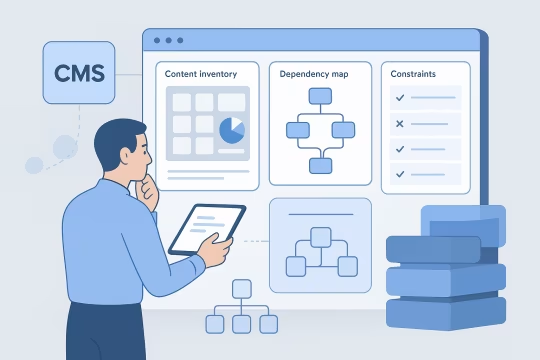
Run workshops and technical review to understand the legacy CMS, content types, and operational workflows. Produce a content inventory, dependency map, and constraints list covering SEO, compliance, and uptime.
CMS to headless migration is the engineering work required to move content, models, workflows, and delivery responsibilities from a coupled CMS to an API-first platform. For enterprise teams, this often takes the form of CMS to headless migration services that combine enterprise content migration, content model redesign, and API-first content delivery migration into a controlled program of work. It typically includes data transformation, migration automation, and integration of content delivery APIs into existing or new frontend applications.
Organizations need this capability when legacy CMS implementations constrain delivery speed, multi-channel publishing, or headless platform evolution. As content volume grows and teams add channels, coupled templates and ad-hoc fields create brittle dependencies between editorial operations and runtime delivery.
A well-structured migration supports scalable platform architecture by separating content governance from presentation, establishing stable content contracts, and enabling incremental cutover. The result is a platform that can evolve frontends independently, integrate with enterprise systems through APIs, and maintain predictable content quality through validation and governance.
Core Focus
Best Fit For
Key Outcomes
Technology Ecosystem
Platform Integrations
As digital platforms mature, legacy CMS implementations often accumulate template-driven content structures, inconsistent field usage, and hidden dependencies in themes, plugins, or custom modules. Content becomes shaped by page rendering constraints rather than by reusable domain models, making it difficult to support new channels, new frontends, or new product experiences without duplicating content or introducing fragile workarounds.
Engineering teams then face an architectural bottleneck: changes to content structures require coordinated releases across editorial tooling, rendering templates, and downstream integrations. Data quality issues surface when fields are overloaded, validation is inconsistent, and content relationships are implicit rather than modeled. Integrations with search, personalization, DAM, or analytics become tightly coupled to legacy endpoints and page markup, increasing the cost of change.
Operationally, migrations become risky because content parity is hard to verify, redirects and URL strategies are unclear, and cutovers require “big bang” releases. Teams spend time troubleshooting edge cases, reconciling content discrepancies, and managing parallel systems, which slows delivery and increases the probability of regressions during modernization.
Assess the current CMS, content inventory, editorial workflows, and downstream consumers. Identify coupling points such as templates, plugins, custom fields, and integration dependencies, and define migration constraints including uptime, SEO, and compliance requirements.
Define the headless reference architecture, including content delivery patterns (API gateway, BFF, caching), environments, and integration boundaries. Establish content contracts, versioning strategy, and how frontends will consume content during and after migration.
Design the target content model based on domain concepts rather than page templates. Specify relationships, localization, validation rules, and reusable components, and map legacy fields to target structures with clear transformation rules.
Build repeatable migration pipelines to extract, transform, and load content into the headless platform. Implement idempotent runs, incremental sync options, and detailed logging to support re-runs, audits, and controlled backfills.
Integrate content APIs with existing applications and services such as search, DAM, and identity. Implement caching and edge strategies, and validate that content delivery meets performance, security, and availability requirements.
Define parity criteria and automated checks for content completeness, relationships, media references, and localization. Run regression testing for critical journeys, validate schema constraints, and verify SEO signals such as metadata, canonicals, and structured data.
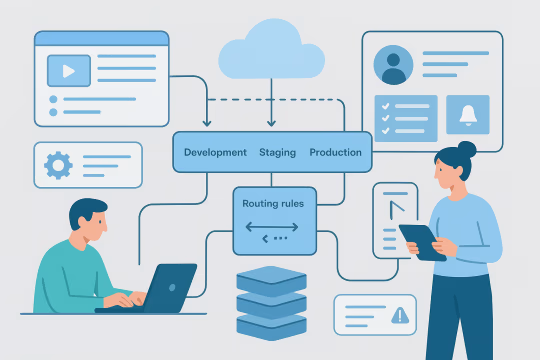
Execute a staged rollout using feature flags, routing rules, or channel-by-channel migration. Manage redirects, URL strategies, and content freeze windows as needed, and provide rollback procedures for high-risk transitions.
Establish ongoing governance for content model changes, API versioning, and editorial workflows. Document operational runbooks and handover procedures, and define a backlog for iterative improvements after the initial migration.
This service focuses on the engineering capabilities required to move from a coupled CMS to an API-first content platform without losing control of content quality, delivery performance, or operational stability. The work emphasizes explicit content contracts, repeatable migration pipelines, and integration patterns that support incremental cutover. The outcome is a maintainable content architecture that can evolve independently from frontend implementations while remaining compatible with enterprise governance and compliance needs.
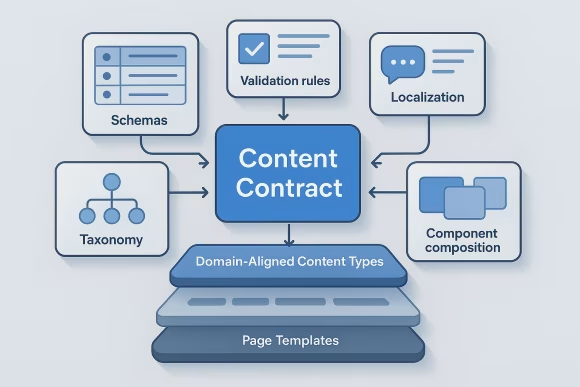
Define explicit schemas and reusable content types aligned to domain concepts, not page templates. Establish required fields, validation rules, and relationship constraints so downstream consumers can rely on stable structures. Include localization, taxonomy, and component composition patterns to support multi-site and multi-channel delivery.
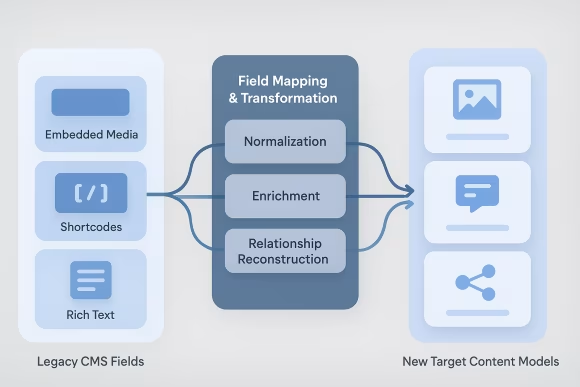
Create deterministic mappings from legacy fields to target models, including normalization, enrichment, and relationship reconstruction. Handle edge cases such as embedded media, shortcodes, rich text conversions, and legacy HTML cleanup. Maintain traceability from source identifiers to target entries for audit and support.
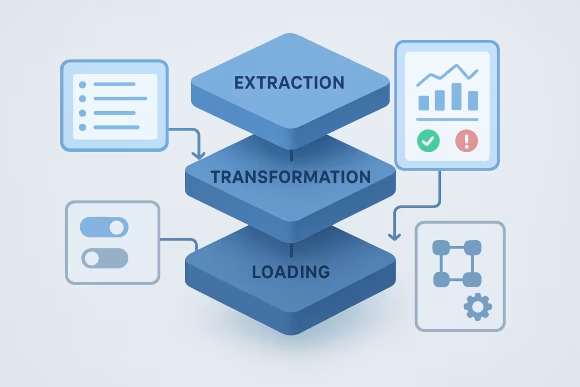
Implement scripted ETL pipelines with idempotent behavior, incremental runs, and environment-aware configuration. Provide structured logs, metrics, and error handling to support repeated test migrations and controlled production execution. Enable selective reprocessing for specific content types or segments without full reloads.
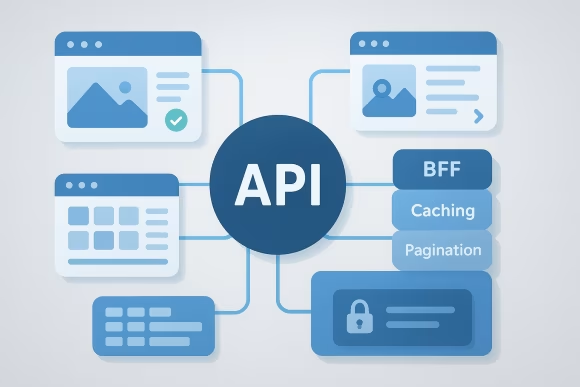
Integrate headless delivery APIs into frontends and services using consistent patterns such as BFF layers, caching, and pagination strategies. Define query conventions, filtering, and preview mechanisms to support editorial review. Ensure authentication and authorization align with enterprise security requirements.
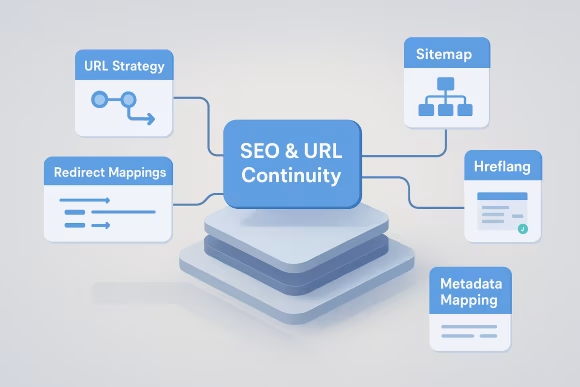
Preserve SEO-critical signals during migration by defining URL strategies, redirects, canonical rules, and metadata mappings. Validate structured data, hreflang, and sitemap generation where applicable. Coordinate content and routing changes to avoid indexation drift during phased cutovers.
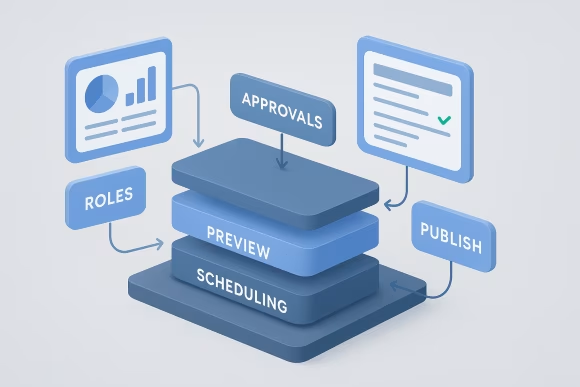
Recreate or redesign editorial workflows, roles, and approvals to match the headless operating model. Implement preview, scheduling, and publishing controls that support governance without reintroducing template coupling. Provide guidance on content operations, including model change requests and lifecycle management.
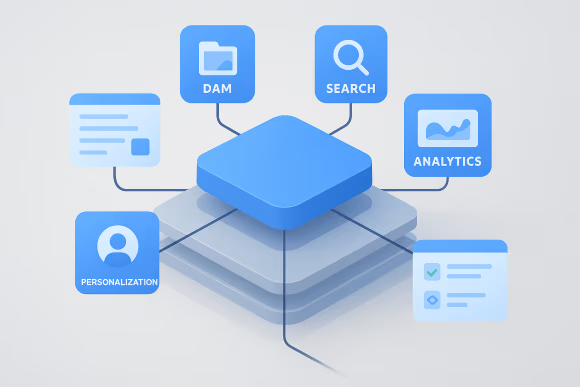
Decouple legacy integrations that rely on page markup or CMS-specific endpoints by moving toward API-based contracts. Rework connections to DAM, search, analytics, and personalization so they consume structured content and events. Document integration boundaries and versioning to reduce future migration friction.
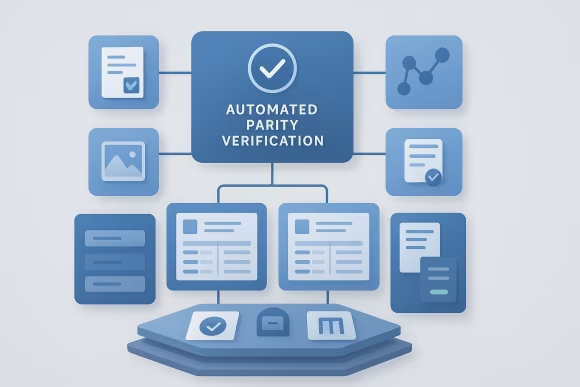
Establish automated checks for content completeness, relationship integrity, media references, and localization coverage. Compare source and target inventories, detect drift during parallel runs, and produce reports for editorial and engineering sign-off. Use parity criteria to control release gates and reduce regression risk.
Delivery follows an engineering sequence from discovery and inventory through content modeling, migration automation, API-first content delivery integration, and phased cutover planning. The approach supports parallel operation of legacy and headless systems while parity, SEO signals, and integration dependencies are validated through repeatable runs.
[01]Run workshops and technical review to understand the legacy CMS, content types, and operational workflows. Produce a content inventory, dependency map, and constraints list covering SEO, compliance, and uptime.
 [02]
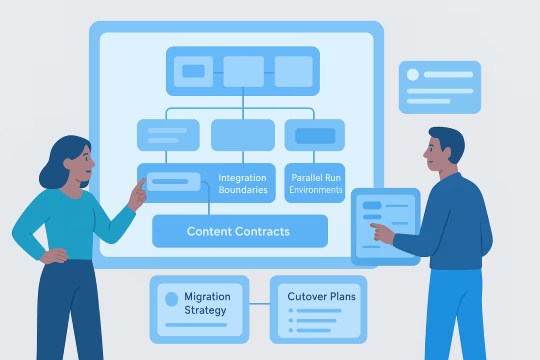
[02]Define target architecture, migration strategy, and cutover approach. Establish content contracts, integration boundaries, and a plan for parallel run, including environments and release coordination.
 [03]
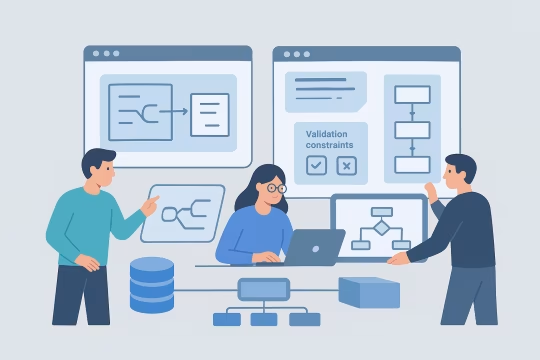
[03]Design the target content model and map legacy structures to new schemas. Specify transformation rules, validation constraints, and editorial workflow changes required for the headless operating model.
 [04]
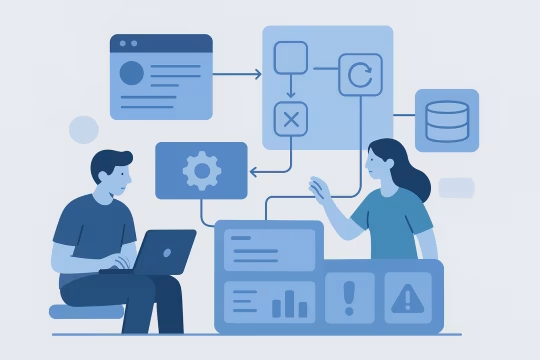
[04]Implement migration pipelines, transformation logic, and repeatable execution scripts. Add logging, metrics, and error handling to support multiple dry runs and controlled production execution.
 [05]
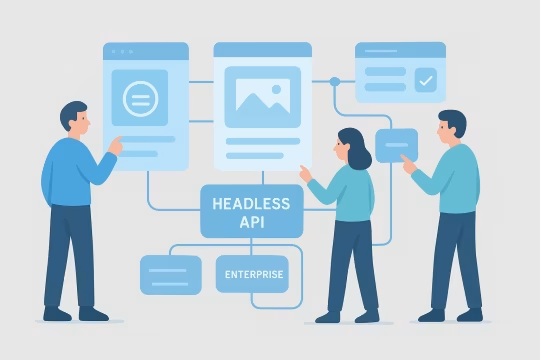
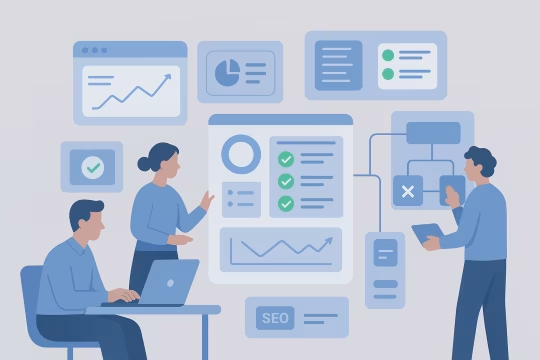
[05]Connect headless APIs to consuming applications and enterprise services. Implement preview, caching, and authentication patterns, and validate performance and access controls across environments.
 [06]
[06]Execute automated and manual parity checks against defined acceptance criteria. Validate SEO signals, redirects, and critical user journeys, and resolve discrepancies through iterative migration runs.
 [07]
[07]Perform phased cutover with routing rules, feature flags, or channel-by-channel migration. Monitor production behavior, handle rollback if needed, and stabilize operations with runbooks and on-call support.
 [08]
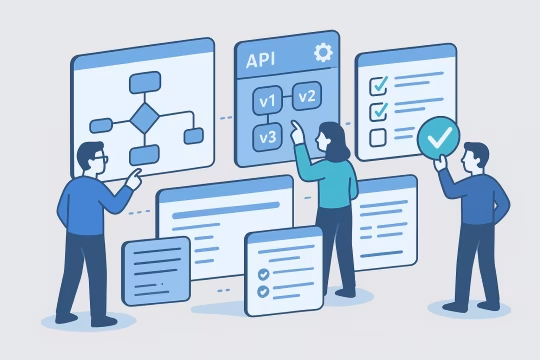
[08]Establish governance for schema changes, API versioning, and editorial operations. Create a prioritized backlog for post-migration improvements, performance tuning, and integration hardening.
A risk-managed CMS modernization program—delivered as a phased headless platform migration—reduces platform coupling and creates a foundation for independent evolution of content operations and digital experiences. The impact is realized through lower change cost, improved delivery predictability, and reduced operational risk during enterprise CMS to headless migration work.
Decoupled content delivery allows frontend teams to ship changes without coordinating template releases in the CMS. This reduces cross-team dependencies and shortens lead time for experience updates across channels.
Repeatable migration pipelines and parity criteria reduce uncertainty during cutover. Incremental runs and staged rollout make it possible to detect issues early and avoid high-impact “big bang” transitions.
Explicit content contracts and governance reduce schema drift and ad-hoc field usage over time. Teams can evolve models with controlled versioning and clearer ownership, lowering long-term maintenance overhead.
Structured content models support reuse across web, mobile, and downstream systems. This reduces duplication and enables consistent content behavior across channels without re-implementing CMS-specific rendering logic.
Moving integrations from markup scraping and CMS-specific endpoints to API contracts improves stability. Downstream systems become less sensitive to presentation changes, reducing incident rates and integration rework.
Phased cutover and defined acceptance gates improve coordination across engineering, content, and operations. Releases become more measurable, with clearer rollback paths and fewer late-stage surprises.
Validation rules, workflow controls, and auditability improve content quality and compliance. Editorial teams gain clearer guardrails while engineering teams reduce time spent fixing content-related production issues.
A headless platform provides a stable base for future initiatives such as design systems, personalization, and composable architectures. The migration establishes patterns that make subsequent platform evolution more predictable.
These related services extend CMS to headless migration services into adjacent architecture and implementation areas—content modeling, headless CMS architecture, API platform patterns, and integration work—so teams can evolve delivery and governance after the initial migration.
Enterprise API design for scalable, secure foundations
API-first platform design with clear domain boundaries
Composable DXP content architecture and API-first platform design
API-first enterprise headless CMS platform architecture for content delivery
Structured schemas for an API-first content strategy
Decoupled Drupal + Next.js migration for modern frontend delivery
Headless CMS migration with API-first content delivery
Decoupled WordPress CMS strategy for modern frontend delivery
Contract-first headless API development for enterprise delivery
Headless CMS API integration, contracts, and integration layer engineering
Enterprise GraphQL schema design and governance
Headless architecture roadmap and target architecture definition
Common questions from enterprise teams planning a CMS-to-headless migration, covering architecture, operations, integrations, governance, risk, and engagement.
We start by separating two concerns: content semantics (what the content means) and legacy implementation constraints (how the CMS stored and rendered it). For most enterprise platforms, migrating “as-is” preserves legacy coupling and limits the benefits of headless delivery, but a full redesign can increase scope and risk if done without clear parity criteria. We typically use a model-first approach with controlled scope: identify the highest-value domains (for example, articles, landing pages, product content) and design target schemas that are stable, reusable, and validated. We then map legacy fields into the new model with explicit transformation rules, including how to handle rich text, embedded media, and legacy HTML. When time or operational constraints are tight, we may apply a hybrid strategy: migrate a minimal compatible model for initial cutover, then iterate toward a cleaner domain model with versioning and governance. The decision is driven by channel requirements, editorial workflows, and how many downstream consumers depend on the current structures.
It depends on how many consumers you have, how heterogeneous they are, and what non-functional requirements apply (caching, auth, rate limits, and response shaping). Direct consumption from the headless CMS API can work for a single frontend with simple access patterns, but it often becomes limiting when multiple applications need different projections of the same content. A BFF (Backend for Frontend) or API gateway layer is useful when you need to aggregate content with other enterprise data, enforce consistent authorization, normalize query patterns, or implement caching and resiliency controls outside the CMS. It also provides a stable contract to frontends, reducing the impact of CMS vendor changes or schema evolution. During migration, a BFF can help with phased cutover by routing some requests to legacy sources and others to headless, while keeping frontend integration stable. We evaluate this early as part of target architecture and cutover planning, not as an afterthought.
Parallel run is managed through controlled boundaries: which content types are authoritative in which system, how updates are synchronized, and how consumers route requests. We define a source-of-truth matrix per content domain and a synchronization strategy (one-time migration, incremental sync, or event-driven updates) based on editorial needs and cutover windows. On the delivery side, routing can be handled via application logic, feature flags, or edge rules. For example, a subset of routes or page types can be served from headless while the rest remain on the legacy CMS. This requires a clear URL strategy, redirect plan, and consistent metadata handling to avoid SEO drift. Operationally, we add observability to migration pipelines and delivery APIs, and we define runbooks for re-running migrations, handling content drift, and responding to incidents. The goal is to make parallel operation predictable and time-bounded, not an indefinite dual-platform state.
We treat editorial continuity as a first-class requirement. That starts with understanding how content is created, reviewed, scheduled, localized, and published today, and which parts of that workflow must remain uninterrupted. We then design a transition plan that minimizes content freezes and clarifies where editors should work at each stage. Common patterns include migrating read-only content first, enabling preview in the headless platform early, and moving specific teams or content domains in waves. If incremental sync is required, we implement controlled synchronization with audit logs and conflict rules so editors do not lose changes. We also define acceptance criteria that editors can validate: content completeness, formatting expectations, media behavior, and localization coverage. Training and documentation are scoped to the new operating model, including how schema changes are requested and how content quality is enforced through validation rather than template constraints.
We map integrations based on the target content contract. For DAM, the key questions are asset ownership, transformation requirements (renditions, crops), and how references are stored and resolved. We ensure migrated content maintains stable asset identifiers and that delivery APIs expose the metadata needed by frontends and downstream systems. For search, we define indexing responsibilities: whether the headless CMS publishes events, whether an indexing service pulls content via APIs, and how incremental updates are handled. We also align taxonomy, localization, and access control with search requirements so results are consistent and compliant. During phased cutover, we often run dual indexing or a unified index that can ingest from both legacy and headless sources. The approach is chosen to avoid relevance regressions and to keep operational complexity manageable. Validation includes index completeness checks, query regression tests, and monitoring for indexing lag.
Analytics and SEO are frequently coupled to legacy templates and markup, so we explicitly inventory what exists today: tag manager containers, data layer conventions, event schemas, and SEO metadata sources. We then define how these will be produced in the new architecture, typically moving toward structured metadata fields and consistent rendering in the frontend layer. For SEO, we map and validate title tags, descriptions, canonical URLs, robots directives, hreflang, structured data, and sitemap generation. Redirect strategy is treated as part of the cutover plan, with testable rules and monitoring for 404s and unexpected status codes. For analytics, we ensure that page and event identifiers remain stable where needed, and we validate that key funnels and events continue to fire correctly after cutover. The goal is continuity of measurement and search visibility, with fewer hidden dependencies on CMS templates.
Headless platforms make schema changes easier to deploy, which increases the need for governance. We recommend treating the content model as an API: changes should be versioned, reviewed, and tested against consumers. Governance includes ownership (who can change schemas), change workflows (how requests are submitted and approved), and compatibility rules (what constitutes a breaking change). Practically, we implement a change process with clear artifacts: schema documentation, example payloads, consumer impact assessment, and rollout plans. For teams with multiple frontends, we often introduce a contract-testing approach or automated checks that validate key queries and payload shapes. We also define lifecycle policies for deprecated fields and content types, including timelines and migration steps. This prevents uncontrolled schema drift and reduces the risk that editorial convenience creates long-term integration debt.
We start by mapping current roles, groups, and permissions to the headless platform’s authorization model, including how it handles environments, spaces/projects, and content stages. Enterprise requirements often include separation of duties, auditability, and least-privilege access, which may not match legacy CMS patterns one-to-one. We define role templates aligned to editorial responsibilities (authors, reviewers, publishers, translators) and operational roles (admins, developers, auditors). Where compliance requires it, we ensure audit logs are enabled and retained appropriately, and we document how approvals and publishing actions are tracked. If the headless platform integrates with enterprise identity (SSO, SCIM), we plan that integration early to avoid manual user management during migration. We also validate that preview and delivery endpoints enforce the correct access controls, especially for embargoed or restricted content.
We reduce data-loss risk through repeatability, traceability, and validation. Migration pipelines are designed to be idempotent so they can be re-run safely, and every migrated item retains a reference to its source identifier. Transformation rules are deterministic and version-controlled, so changes to mappings are explicit and reviewable. Validation is multi-layered: inventory reconciliation (counts and coverage), schema validation (required fields and constraints), relationship integrity checks, and media reference verification. For rich text and embedded content, we add targeted checks to detect broken links, missing embeds, and formatting regressions. We also define rollback and recovery procedures: how to re-run a subset of content, how to handle failed items, and how to reconcile drift if editors continue updating legacy content during the transition. The goal is to make issues observable and correctable before they reach production consumers.
Cutover risk typically concentrates in three areas: routing and URL continuity, content parity, and integration dependencies. Routing issues can cause 404s, duplicate content, or incorrect canonicals. Parity issues can surface as missing content, broken relationships, or unexpected rendering behavior. Integration issues often appear in search indexing, analytics, authentication, or preview workflows. Mitigation starts with a phased cutover plan and explicit acceptance gates. We define redirect rules and test them at scale, validate SEO metadata and sitemaps, and monitor status codes and crawl signals during rollout. For parity, we use automated reconciliation reports and targeted regression tests for critical journeys. Operationally, we plan for a stabilization window with enhanced monitoring and clear rollback triggers. If a BFF or gateway is used, it can provide controlled routing and fallback behavior. The objective is a cutover that is measurable, reversible when needed, and coordinated across engineering and content operations.
Timelines vary with content volume, model complexity, and integration scope, but enterprise migrations usually benefit from an iterative plan rather than a single long build phase. Early weeks focus on discovery, inventory, and target architecture decisions, because these determine the migration strategy and cutover approach. Next, content modeling and mapping proceed in parallel with building migration pipelines. We typically run multiple dry migrations into non-production environments to validate transformations, editorial workflows, and parity criteria. Integration work (frontends, search, DAM, identity) is scheduled early enough to avoid late surprises but staged to align with cutover waves. Cutover is planned as a sequence of releases with defined gates and stabilization periods. The engagement should include time for governance setup, documentation, and handover. A realistic plan prioritizes critical domains first, then expands coverage while maintaining operational continuity.
Successful migrations require both engineering and content operations participation. On the engineering side, you typically need a platform architect or technical lead to align target architecture decisions, plus representatives from frontend, integration, and operations teams to validate delivery patterns, security, and deployment constraints. On the content side, you need content owners who can define what “correct” means: content semantics, required fields, taxonomy, localization rules, and editorial workflows. Editors or content operations leads are essential for validating parity and for shaping the operating model in the headless platform. We also recommend involving SEO and analytics stakeholders early, because URL strategy and measurement continuity are common sources of late-stage risk. Clear decision ownership and a regular review cadence help keep model changes, mappings, and cutover scope controlled as new findings emerge during migration runs.
Collaboration typically begins with a short discovery phase designed to make the migration plan testable. We start with stakeholder workshops and a technical review of the current CMS implementation, including content types, templates, customizations, and integrations. In parallel, we run a content inventory to quantify volume, localization, media usage, and structural inconsistencies. From that input, we produce a migration blueprint: target architecture options, a proposed content model direction, a mapping and transformation approach, and a cutover strategy (phased routes, domain-by-domain, or channel-by-channel). We also define parity criteria and the minimum observability needed to run repeatable migrations safely. The output is a prioritized plan with clear milestones: first dry migration, integration enablement, editorial workflow validation, and a staged cutover schedule. This gives both teams a shared baseline for scope, risk, and sequencing before committing to full implementation.
These case studies showcase successful implementations of headless CMS architectures, content model redesign, and migration automation pipelines. They highlight real-world delivery of API-first content platforms, scalable editorial workflows, and phased migration strategies that align closely with CMS to headless migration services. The selected work demonstrates measurable improvements in publishing continuity, multi-channel content delivery, and platform scalability.
Users were abandoning the website before fully engaging with content due to slow loading times and an overall poor performance experience.
The updated platform significantly improved speed and usability, resulting in higher user engagement, longer session durations, and increased content exploration.
Arvesta required a modern, scalable headless CMS for enterprise corporate marketing—supporting rapid updates, structured content operations, and consistent UI delivery across multiple teams and repositories.
The platform enabled faster delivery of marketing updates, improved UI consistency across pages, and strengthened editorial operations through structured content models and reusable components.
UNCCD operated four separate websites (two WordPress, two Drupal), leading to inconsistencies in design, content management, and user experience. A unified, scalable solution was needed to support a large-scale CMS migration project and improve efficiency and usability.
The modernization effort resulted in a cohesive, user-friendly, and scalable website, improving content management efficiency and long-term digital sustainability.
It was my pleasure working with Oleksiy (PathToProject) on a new Drupal website. He is a true full-stack developer—the ideal mix of DevOps expertise, deep front-end knowledge, and the structured thinking of a senior back-end developer.
He is well-organized and never lets anything slip. Oleksiy understands what needs to be done before being asked and can manage a project independently with minimal involvement from clients, product managers, or business analysts.
One of the best consultants I’ve worked with so far.

Andrei Melis
Technical Lead at Eau de Web
Oleksiy (PathToProject) has been a valuable developer resource over the past six months for us at LSHTM. This included coming on board to revive and complete a stalled Drupal upgrade project, as well as carrying out work to improve our site accessibility and functionality.
I have found Oleksiy to be very knowledgeable and skilful and would happily work with him again in the future.

Ali Kazemi
Web & Digital Manager at London School of Hygiene & Tropical Medicine
Oleksiy (PathToProject) was the Lead Developer on a number of client projects which I managed. He is highly skilled and incredibly hardworking. When assigning work to him, I could always rely on it being completed to a high quality and on time.
His technical expertise was valued across the team and he was often our 'go to' for technical challenges, which he loved to get stuck into. Oleksiy is proactive and engaged in a professional manner with our clients.
I have no hesitation in recommending him.

Daniela Graf
Senior Project Manager | Change Mgmt Practitioner | Process Improvement Geek
These articles expand on the architecture, governance, and delivery decisions that shape a successful move from a coupled CMS to a headless platform. They cover phased migration approaches, content modeling and contract design, and the operational controls needed to keep channels stable during cutover.
Let’s review your current CMS, content estate, and integration dependencies, then define a phased migration plan with measurable parity criteria and cutover controls.