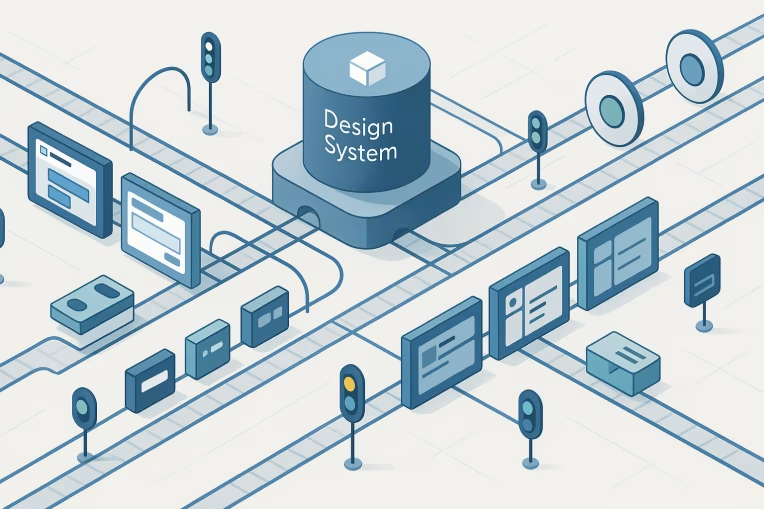
In enterprise environments, a design system is rarely just a set of components. It is a shared dependency that sits in the critical path of many teams, products, brands, and release calendars.
That is why design system release management matters. The bottleneck usually does not appear because teams cannot publish packages. It appears because too many delivery decisions are coupled to one central stream of change. A new button API, an accessibility fix, a token update, or a refactor in the component library can ripple across multiple applications with different priorities, testing capacity, and risk tolerance.
When every consuming team depends on one shared release rhythm, the design system can become both essential and obstructive. Central teams feel pressure to protect quality. Product teams feel blocked by upgrades they did not ask for. Platform leadership sees rising coordination cost.
The answer is not to weaken the design system. It is to treat release policy as part of the system's architecture.
Why shared component libraries become delivery bottlenecks
A shared UI package becomes a delivery bottleneck when the cost of coordination grows faster than the value of reuse.
That often happens for a few predictable reasons:
- All teams are expected to adopt every release on the same timeline.
- Breaking changes are technically versioned but operationally unsupported.
- Compatibility rules are unclear across applications, frameworks, and brand implementations.
- Urgent fixes are bundled into larger upgrades.
- The design system team measures package publication, but not upgrade friction.
- Product roadmap commitments are forced to wait for central release decisions.
The underlying issue is not that a component library is shared. The issue is that the organization has not defined release lanes that match real delivery conditions.
A team launching a new experience next month should not always consume the same release stream as a legacy app in maintenance mode. A regulated product with long test cycles may need a different support commitment than an internal tool. A branded white-label platform may need stricter compatibility expectations than a single-product interface.
Without those distinctions, the design system becomes a hidden scheduling authority over the whole portfolio.
Release train models: fast lane, stable lane, and long-support lane
A useful operating model is to offer more than one release path for the same shared component library.
A simple structure is:
- Fast lane for teams that want new capabilities quickly and can absorb frequent change.
- Stable lane for most production applications that want predictable updates on a defined cadence.
- Long-support lane for products with slower upgrade cycles, higher validation cost, or contractual support needs.
These lanes do not require completely separate codebases. They require policy.
For example, a design system team might publish frequently to the fast lane, promote selected releases to the stable lane after validation, and maintain a time-boxed long-support line for critical fixes only. The exact tooling can vary, but the important part is that consuming teams know what each lane means.
Each lane should define:
- expected release cadence
- level of change allowed
- support window
- backport policy
- upgrade expectations
- types of teams or applications that should use it
This creates a more honest contract between the platform team and consuming teams.
The fast lane supports experimentation, early adoption, and rapid iteration. The stable lane becomes the default operational choice. The long-support lane reduces pressure on teams that cannot safely absorb frequent updates.
The main tradeoff is maintenance overhead. More lanes create more release discipline, but they also require better triage and communication. That is why the number of lanes should stay small. The goal is not infinite flexibility. The goal is to avoid forcing one rhythm on every team.
Semantic versioning is not enough without adoption policy
Many organizations assume component library versioning solves release management. It helps, but it does not solve the operating model.
Semantic versioning tells teams something about the technical nature of change. It does not answer the practical questions that matter during delivery:
- How long is a version supported?
- Which versions are approved for production use?
- When are consuming teams expected to upgrade?
- Are teams allowed to skip intermediate versions?
- How are deprecations communicated and enforced?
- Which changes are eligible for backporting?
A version number is a signal, not a policy.
In enterprise design systems, adoption policy matters at least as much as release packaging. A minor version can still be expensive to adopt if it changes styling assumptions, testing outputs, accessibility behavior, layout defaults, or token mappings. Even non-breaking updates can create meaningful validation work across dozens of apps.
That is why release documentation should go beyond changelog categories. For each release, teams typically benefit from knowing:
- whether the release is fast-lane only or promoted to stable
- whether adoption is optional, recommended, or required
- whether any deprecated APIs have entered a countdown period
- whether there are visual regression implications
- whether teams using specific framework wrappers or theme layers need extra checks
This is where shared UI package governance becomes practical rather than abstract. It defines how versioning is translated into delivery expectations.
Compatibility expectations across apps, frameworks, and brands
In multi-team environments, compatibility is rarely one-dimensional.
A shared package may need to remain compatible across:
- multiple applications with different deployment schedules
- framework versions or rendering patterns
- brand themes and token sets
- internal wrapper libraries
- accessibility baselines
- browser support assumptions
If those expectations are implicit, release friction rises quickly.
A compatibility matrix can be useful here. It does not need to be complicated. It can simply document which design system versions are supported with which app baselines, theming models, and framework layers.
For example, a matrix might identify:
- the minimum supported application shell version
- supported framework adapter versions
- which token packages align with which component releases
- known limitations for specific brand implementations
- migration requirements for teams still on older wrappers
This matters because many design systems are not consumed directly. They are consumed through local abstractions, page builders, product shells, or brand-specific composition layers. When the central team only tests the base package in isolation, it can underestimate downstream integration risk.
A good compatibility policy therefore makes two things explicit:
- What the design system guarantees
- What consuming teams remain responsible for validating
That balance preserves autonomy without pretending the central team can certify every application context.
How to handle urgent fixes without forcing full upgrades
One of the clearest signs of poor frontend release lanes is when an urgent accessibility, security, or usability fix requires every team to absorb a broad package upgrade.
That pattern turns central quality improvements into delivery disruptions.
A better model separates urgent remediation from general feature movement. In practice, that can mean:
- backporting high-priority fixes to the stable or long-support lane
- issuing narrowly scoped patch releases for supported lines
- documenting whether the fix changes behavior, visuals, or only internal implementation
- defining emergency exception criteria in advance
Not every issue should be backported. That would create unsustainable maintenance cost. But critical fixes need a path that does not force teams into unrelated changes.
This is especially important in enterprise software, where application owners may need time for regression testing, approvals, or coordination across business units.
A useful policy is to classify urgent fixes by impact:
- Critical: backport to all supported lanes when feasible
- High: backport to stable lanes if risk is contained
- Standard: include in next scheduled release train
The exact labels matter less than the presence of a known rule set. Teams should not be negotiating the process from scratch during every incident.
Telemetry and support signals that should shape release policy
Many design system teams know what they publish but have limited visibility into what gets adopted, where breakage occurs, or how long upgrades sit unaddressed.
That makes release policy reactive.
Useful telemetry and support signals often include:
- adoption by version or release lane
- time between publication and production uptake
- most common support requests by component or release type
- frequency of rollback, patching, or local overrides
- number of apps on unsupported versions
- repeated accessibility or visual regression issues after upgrades
- exception requests tied to roadmap conflicts
This data helps the team answer practical questions.
Is the stable lane actually stable? Are deprecations realistic? Are product teams skipping releases because the upgrade path is too painful? Is one component family responsible for most support burden? Are long-support users accumulating faster than planned?
Telemetry should not be used only to push adoption harder. It should be used to improve the release model itself.
For example:
- slow adoption may indicate poor migration tooling, not poor team discipline
- repeated exceptions may signal that the cadence is mismatched to product delivery reality
- heavy patch demand may mean the stable lane is too broad or too infrequent
- widespread local overrides can reveal compatibility gaps between central assumptions and real app usage
A mature design system release management approach uses these signals to adjust policy, not just to report compliance.
Governance rituals for roadmap alignment, deprecation, and exceptions
Release policy works best when it is reinforced by lightweight, recurring governance rituals.
These rituals should reduce surprise, not create bureaucracy.
Common examples include:
- a recurring roadmap alignment meeting between the design system team and major consuming teams
- release readiness reviews for changes likely to affect many apps
- deprecation notices with published timelines and migration guidance
- exception review for teams that need to remain on older supported lines
- support-window reviews to decide when a lane should be extended or retired
The goal is to make coordination normal and visible.
Deprecation in particular needs operational clarity. It is not enough to mark an API as deprecated in documentation. Teams need to know:
- when the deprecated path stops receiving fixes
- when it becomes unsupported for new adoption
- when it will be removed from fast and stable lanes
- what migration path exists
- who is accountable for planning the upgrade
Exception handling also deserves a defined process. Some teams will have valid reasons to defer upgrades. The risk comes when exceptions are invisible and indefinite.
A practical exception model usually includes:
- a reason for the exception
- the version and lane affected
- the time limit
- the known risks accepted by the consuming team
- the next review date
This keeps autonomy intact while avoiding unmanaged fragmentation.
Warning signs that the design system is coupling too much of the portfolio
A shared design system should create leverage. When it creates excessive coupling, release pressure starts to show up in predictable ways.
Watch for signals such as:
- product launches delayed by design system release timing
- teams pinning old versions indefinitely because upgrades are too disruptive
- urgent fixes requiring unrelated visual or API changes
- central teams becoming the approval gate for routine product delivery
- local forks growing because official release paths do not fit delivery needs
- frequent disagreement over whether a release is "safe" for production
- no shared understanding of which versions are supported where
These are not just engineering inconveniences. They indicate that the platform contract is too vague or too centralized.
An enterprise design system should standardize interface building, accessibility patterns, and reusable UI behavior. It should not force every team into identical release behavior.
A practical operating model for shared UI packages
For organizations trying to improve multi-team frontend delivery, a practical model often starts with a small set of decisions:
- Define two or three release lanes with clear purpose.
- Publish support windows for each lane.
- Document compatibility expectations across applications, frameworks, and brand layers.
- Separate urgent fix handling from general feature upgrades.
- Set explicit adoption and deprecation policy, not just version numbers.
- Track adoption and support signals to refine the model.
- Create lightweight governance rituals for alignment and exceptions.
This framing keeps the design system team in a strong stewardship role without making it the bottleneck for every downstream roadmap.
The deeper point is that release management is part of design system architecture. It shapes how shared components behave socially and operationally across the organization, not only how they are packaged technically.
When release lanes, support commitments, and compatibility rules are defined well, central quality control and local delivery autonomy stop feeling like opposing goals. They become part of the same platform contract.
That is what allows enterprise design systems to scale: not just reusable components, but reusable expectations about how change moves through the portfolio.
Projects such as Arvesta and UNCCD show how shared component governance, multi-team delivery, and platform consistency become much more manageable when release expectations are treated as part of the operating model rather than left implicit.
Tags: Design Systems, design system release management, enterprise design systems, frontend architecture, platform governance, component libraries