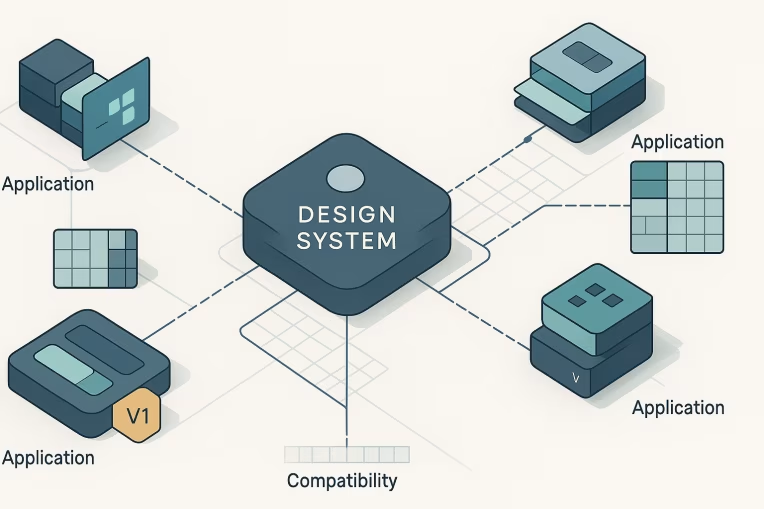
In enterprise software, a design system is rarely consumed by a single application with a single release cadence. It usually serves a portfolio: customer portals, internal tools, admin consoles, multi-brand websites, product shells, and sometimes embedded frontend surfaces owned by different teams.
That is where otherwise sensible platform decisions can become risky. A shared component library moves to a newer React version. A subset of applications can adopt it quickly. Others cannot because they are tied to a Next.js migration, a Node upgrade, a testing stack rewrite, or a broader roadmap freeze. The result is familiar: blocked releases, emergency compatibility patches, duplicate components, or local wrappers that quietly fork the system.
A design system compatibility matrix is a practical operating tool for this problem. It documents what combinations of framework versions, tooling assumptions, and package boundaries are intentionally supported, which ones are transitional, and which ones are no longer viable. More importantly, it helps teams make support decisions before incompatibilities show up in production.
This matters because multi-app frontend architecture is not only a technical challenge. It is a release management and governance challenge. When that distinction is ignored, design systems often become either too rigid to adopt broadly or too permissive to maintain safely.
Why shared UI breaks when app upgrade timelines diverge
Shared UI platforms usually break for predictable reasons, not surprising ones.
The first issue is assumption leakage. A component library may look framework-agnostic on the surface, but its implementation often carries hidden assumptions about:
- the minimum React features available
- whether server-side rendering behavior is stable across supported apps
- whether React Server Components are in play
- how routing works in the consuming framework
- what bundler or transpilation behavior the app relies on
- what styling pipeline is available at build and runtime
Those assumptions may be acceptable in a single-product environment. In a multi-product estate, they turn into compatibility risk.
The second issue is timeline divergence. One application may be ready to adopt the latest framework minor or major release because its team controls its dependencies and has strong automated coverage. Another may be locked behind a large migration program, compliance testing window, or vendor integration constraint. If the design system assumes synchronized adoption, the slowest consumer becomes a blocker or the fastest consumer becomes unsupported.
The third issue is package coupling. Many teams publish one library and treat it as the system. In practice, some parts of the system are stable across many consumers, while others are tightly coupled to framework behavior. When these concerns are released together, every change inherits the upgrade burden of the most framework-sensitive module.
This is why a component library compatibility policy cannot live only in package.json files. It needs explicit documentation and decision rights.
What a compatibility matrix should cover: React, Next.js, Node, Storybook, testing, styling, browser support
A useful matrix is more than a table of supported React versions. It should capture the technical surface area that can materially affect design system behavior across consumers.
At a minimum, a matrix should define support expectations for:
- React: supported major and minor ranges, including whether support is full, limited, or transitional
- Next.js: supported application framework ranges and any known SSR, routing, or RSC constraints
- Node: minimum and tested runtime versions for local development, CI, build pipelines, and package publishing
- Storybook or component workbench tooling: which versions are used for internal development and which consumer-facing assumptions exist
- Testing stack: expectations around Jest, Vitest, Testing Library, Playwright, Cypress, or snapshot tooling where package integration matters
- Styling approach: CSS modules, CSS-in-JS, utility pipelines, design token build outputs, runtime style injection assumptions, and side-effect declarations
- Browser support: baseline browser policy and whether polyfills are provided by the system or the consuming app
- Build tooling assumptions: ESM/CJS packaging, transpilation requirements, tree-shaking behavior, and sideEffects/package exports structure
- Rendering model: whether packages are safe for client-only apps, SSR apps, streaming SSR, or environments that mix client and server components
A simple compatibility matrix might include columns such as:
- package or package family
- supported React range
- supported Next.js range
- supported Node range
- rendering mode notes
- test coverage scope
- support tier
- deprecation date
- owner
The point is not to create documentation theater. The point is to make compatibility visible before consumer teams discover mismatches by trial and error.
For example, a base tokens package may support many consumers because it only ships platform-neutral outputs. A hooks package may support fewer versions because it depends on newer React patterns. A framework adapter package may support an even narrower set because it touches routing, SSR, or image/link abstractions.
That distinction is healthy. Not every package needs the same support horizon.
Defining support tiers and deprecation windows
One of the most useful parts of a React version support policy is the definition of support tiers.
Without tiers, teams tend to use binary language: supported or unsupported. That sounds simple but breaks down quickly in real platform environments. Some combinations are actively tested. Some are allowed but minimally maintained. Some are temporarily tolerated while a migration completes.
A practical model often includes tiers such as:
- Current: fully supported, actively tested in CI, default target for new development
- Supported: maintained and eligible for fixes, but not necessarily the primary development target
- Transitional: supported for a time-boxed period while consumer teams upgrade; fixes may be selective
- Deprecated: still documented but scheduled for end of support; only critical issues considered
- Unsupported: no validation, no compatibility commitment
The tier definitions should answer real operational questions:
- Will pull requests be blocked if a change breaks this combination?
- Will security or accessibility fixes be backported?
- Are new features expected to work here, or only defect fixes?
- How long does a team have after deprecation is announced?
- Who approves extensions if a consumer cannot upgrade in time?
Deprecation windows are especially important in enterprise environments. If the design system marks a framework combination as deprecated on the day a new version is released, that policy is usually disconnected from reality. Large programs often need a predictable window to plan, budget, test, and coordinate.
That does not mean support windows should be indefinite. It means they should be explicit. A design system team should be able to say, for example:
- new features target the current tier first
- the previous major framework combination remains supported for a defined period
- transitional support exists only with a named end date
- exceptions require funding or staffing agreement from affected programs
This is what turns frontend release management into a shared planning discipline rather than an escalation path.
Peer dependencies, adapters, and wrapper patterns
A compatibility matrix becomes far more effective when package design reinforces it.
Peer dependencies are one of the first signals of intent. If a package requires a consumer-provided version of React or Next.js-related runtime modules, the declared peer range should match the matrix. If the peer range is too narrow, teams are forced into unnecessary upgrades. If it is too broad, installation succeeds even when runtime behavior is unproven.
That is why peer dependency policy should be conservative and evidence-based. Expand ranges when packages are genuinely validated, not just because the code appears likely to work.
Adapters are another important pattern. Instead of embedding framework assumptions directly into core components, isolate them in dedicated packages. For example:
- a core UI package contains presentational components and interaction primitives
- a tokens package contains design tokens and theme artifacts
- a framework adapter package handles things like Link integration, image behavior, app shell hooks, or SSR-sensitive utilities
- optional testing helpers target specific consumer stacks
This structure helps avoid forcing every consumer into the same Next.js upgrade strategy. A team running a newer framework version may adopt the newest adapter package without requiring every application to upgrade the stable core package at the same time.
Wrapper patterns can also be useful, but they need discipline. Local wrappers are often the first response when compatibility is unclear. Sometimes they are appropriate, especially for app-specific business composition. But when wrappers become the default mechanism for handling design system incompatibility, they usually signal one of three deeper problems:
- the system package boundaries are wrong
- the support matrix is missing or ignored
- the framework-specific integration layer is under-designed
A good rule is that wrappers should express product customization, not compensate for undocumented platform gaps. If several consumer teams maintain similar wrappers around the same shared component, the design system team should treat that as architecture feedback.
Release lanes for core components versus framework-specific packages
A single release lane for all design system packages is attractive from an operational simplicity standpoint, but it can create unnecessary coupling.
In most enterprise design systems, not all packages change at the same rate or carry the same compatibility risk. Core design tokens, foundational components, linting rules, icons, accessibility utilities, and framework adapters each have different blast radii.
This is why release lanes are useful.
A practical release model might separate:
- Core lane: tokens, primitives, stable components with broad compatibility goals
- Framework lane: packages that integrate with Next.js, routing layers, SSR behavior, or RSC-sensitive concerns
- Tooling lane: Storybook configuration, testing helpers, codemods, ESLint rules, and local developer experience packages
- Experimental lane: pre-release packages for consumers willing to validate new framework capabilities earlier
This structure reduces pressure to make every package move in lockstep.
For example, a core button component may remain compatible across multiple app generations, while a framework integration package may need a faster cadence and a shorter support window. Keeping those release lanes separate makes the maintenance burden visible and prevents framework-specific changes from destabilizing broadly adopted packages.
The release notes should reflect this separation. Consumers need to know whether a version change affects:
- visual behavior
- API compatibility
- runtime assumptions
- minimum framework versions
- build or test tooling expectations
When those concerns are bundled together, upgrade risk becomes harder to estimate, and teams delay adoption longer than necessary.
CI validation across multiple consumer apps
A compatibility matrix is not credible unless it is backed by validation.
That does not mean every package must be tested against every possible combination. In large estates, the matrix can expand quickly. But the organization should deliberately choose how support claims are verified.
Common validation approaches include:
- package-level unit and integration tests against supported dependency ranges
- smoke-test applications representing key consumer archetypes
- monorepo workspaces that model multiple supported app stacks
- contract tests for framework adapters and SSR-sensitive utilities
- visual regression checks where styling pipelines or rendering modes differ
- canary releases tested in selected consumer applications before broad rollout
For monorepo consumers, validation can be closer to the design system source. For polyrepo consumers, the process often needs explicit integration apps or automated downstream verification pipelines.
A strong pattern is to maintain a small set of reference applications that represent the platform reality, not an idealized demo. For example:
- a legacy-but-supported React application
- a current-tier Next.js application using the preferred routing and rendering model
- a transitional application still on an older framework combination
- a consumer with alternate styling or test setup where that variation is common in the estate
These apps do not need full business functionality. They need enough realism to surface compatibility issues that isolated package tests miss. Teams working on React frontend architecture often use this kind of reference-app strategy to turn support claims into something testable.
CI policy should also map to support tiers. Current-tier combinations may block merges. Transitional tiers may run non-blocking or scheduled validation. Deprecated tiers may only run on release branches or scheduled checks until end of support.
This is one of the clearest ways to connect the matrix to engineering effort. If a combination is expensive to validate, that cost should influence whether the organization continues to support it.
Governance model: who approves support expansion and who pays the maintenance cost
Compatibility is never just a technical truth. It is a support commitment.
That is why enterprise design system governance needs to answer two questions clearly:
- Who can approve an expansion of the support matrix?
- Who carries the cost when support breadth increases?
In many organizations, those answers are fuzzy. A consumer team asks for support for an older framework version or a new rendering mode. The design system team informally agrees. Months later, the extra validation, bug triage, documentation, and backport work are absorbed without explicit planning.
That model does not scale.
A healthier governance approach often includes:
- a named design system or platform owner accountable for the matrix
- architecture review input for support expansions that affect package boundaries or runtime models
- consumer representation from major applications or product lines
- a documented exception process with time limits
- clear funding or staffing expectations for long-tail support requests
The maintenance cost question matters because support breadth has real consequences:
- more CI permutations
- more release note complexity
- slower package evolution
- more backport pressure
- more documentation overhead
- greater risk of hidden incompatibilities across app types
This does not mean the design system should always narrow support aggressively. In enterprise software, broad compatibility can be strategically valuable. But it should be treated as a portfolio investment, not an accidental obligation.
A good governance model makes tradeoffs explicit. If the business values slower-moving applications remaining on the shared system, the platform may choose longer transitional support windows. If speed of modernization is the priority, the platform may offer narrower windows and stronger migration tooling instead.
Either choice can be reasonable. Problems arise when the organization tries to promise both without acknowledging the cost.
Warning signs that the matrix is being ignored
Many organizations technically have a compatibility policy, but operational behavior suggests otherwise.
Watch for these signs:
- consumer teams ask design system maintainers whether a version combination is safe because the published answer is unclear or outdated
- peer dependency ranges are routinely widened without corresponding validation
- multiple applications maintain their own wrappers for the same shared components
- release notes describe breaking changes only in component terms, not framework or runtime terms
- CI covers only the latest app stack while older supported combinations fail during real upgrades
- deprecation dates pass without action, and unsupported consumers continue to receive informal fixes
- framework-specific logic keeps migrating into supposedly core packages
- the design system roadmap assumes synchronized upgrades that never happen in practice
When these symptoms appear, the issue is usually not documentation quality alone. It is a mismatch between platform ambition, package architecture, and governance.
A practical way to introduce a design system compatibility matrix
If your organization does not have a formal matrix today, start small and operational.
A pragmatic rollout often looks like this:
-
Inventory the real consumer landscape
List active applications, their React and Next.js versions, rendering models, Node versions, package managers, and notable styling or testing differences. -
Split package families by compatibility sensitivity
Separate stable core assets from framework-bound integration points. If everything is in one package, document that as a risk before restructuring. -
Define support tiers
Establish what current, supported, transitional, deprecated, and unsupported actually mean for engineering work. -
Publish the first matrix with known caveats
It does not need to be perfect. It does need to be explicit about what is verified, what is assumed, and what is nearing end of support. -
Align CI and release policy to the matrix
Validate current-tier combinations rigorously. Add representative reference apps or downstream smoke tests for important consumers. -
Create an exception and deprecation process
Make it possible to request longer support, but tie that request to ownership, timeline, and maintenance impact. -
Review quarterly or at major framework events
The matrix should evolve with the platform estate, not sit unchanged while teams improvise around it.
This approach keeps the matrix grounded in delivery realities rather than turning it into a static standards document. In practice, that often overlaps with broader design system architecture work, especially when package boundaries, tokens, and governance all need to be clarified together.
Conclusion
A design system does not become strategic merely because many applications consume it. It becomes strategic when it can support variation without descending into fragmentation.
That is the value of a design system compatibility matrix. It gives enterprise teams a shared language for framework support, package policy, release expectations, and deprecation timing. It helps platform teams avoid forcing upgrades that consumers cannot absorb. It helps product teams understand what is truly supported versus what only happens to install.
Most importantly, it acknowledges a basic truth of multi-app frontend architecture: different applications will move at different speeds. The goal is not to eliminate that divergence. The goal is to design for it intentionally, so shared UI remains a platform accelerator rather than a modernization bottleneck.
When compatibility policy, package boundaries, CI validation, and governance all reinforce each other, the design system can support a broad frontend estate without pretending every application lives on the same timeline. Large multi-site programs such as Organogenesis show why shared UI, release governance, and staged framework evolution need to be planned together rather than assumed to move in lockstep.
Tags: Design Systems, design system compatibility matrix, React, Next.js, multi-app frontend architecture, enterprise design system governance, frontend release management