Enterprise Drupal estates accumulate risk slowly.
A page that was accurate three years ago may now be misleading. A campaign microsite may still rank in search long after the owning team has moved on. A retired policy document may still be exposed through internal listings, APIs, or media references even after it has been taken off the main navigation. In many organizations, these issues are not caused by one bad decision. They are the result of having only two lifecycle choices: published or unpublished.
That binary model is rarely enough for enterprise content operations. Teams often need to distinguish between content that should remain public, content that should no longer be publicly accessible, content that must be retained for governance reasons, and content that should eventually be deleted under a controlled process.
In Drupal, that does not mean inventing a complicated workflow for its own sake. It means creating a practical operating model around states, metadata, access, discovery, and ownership so legacy content can be reduced safely and predictably.
Why publish or unpublish is not enough at enterprise scale
For small sites, unpublishing can look like a complete solution. The content is no longer visible to the public, so the problem appears solved.
In enterprise environments, that assumption often breaks down.
A content item can have multiple lives at once:
- it may be visible on the public website
- it may still exist in search indexes
- it may be referenced by landing pages or listings
- it may be exposed through feeds or APIs
- it may be needed for audit, records, or internal review
- it may still contain media assets reused elsewhere
When teams collapse all of those concerns into a single state change, they create operational ambiguity. Editors may use unpublish to mean "temporarily hidden." Compliance stakeholders may assume it means "retained but controlled." Technical teams may interpret it as "safe to remove from navigation but not from storage." Those meanings are not interchangeable.
The result is familiar: legacy content stays live because no one is confident enough to retire it, or it gets removed too quickly and breaks discovery, references, or downstream processes.
A stronger model starts by separating the decision types.
Retention, archival, and deletion are different decisions
One of the most important governance improvements is to stop treating retention, archival, and deletion as synonyms.
They answer different questions.
Retention asks whether the organization still needs to keep the content item or its record for business, policy, operational, or regulatory reasons.
Archival asks how the content should exist once it is no longer part of the active publishing estate. It may be preserved, restricted, hidden from public discovery, or made available only to specific roles.
Deletion asks whether the item can be removed from the platform entirely, including any associated references and operational dependencies.
That distinction matters because many high-risk mistakes happen when a team jumps from "this should not stay public" to "this should be deleted."
A safer enterprise pattern is usually:
- decide whether the content is still business-relevant or retention-relevant
- decide whether it should remain publicly accessible
- decide what form of archival state is needed
- check dependencies and discovery behavior
- delete only when policy and technical conditions are satisfied
This also improves internal decision-making. Content architects and platform owners can build lifecycle rules into editorial operations without pretending that every removal decision is a legal decision. At the same time, compliance stakeholders can define the conditions under which content must be preserved without having to manage the day-to-day cleanup process directly.
Common Drupal lifecycle states and what they should mean operationally
Drupal can support a more useful lifecycle model through moderation states, metadata, access controls, and editorial workflow conventions. The exact implementation will vary, but the governance logic should be explicit.
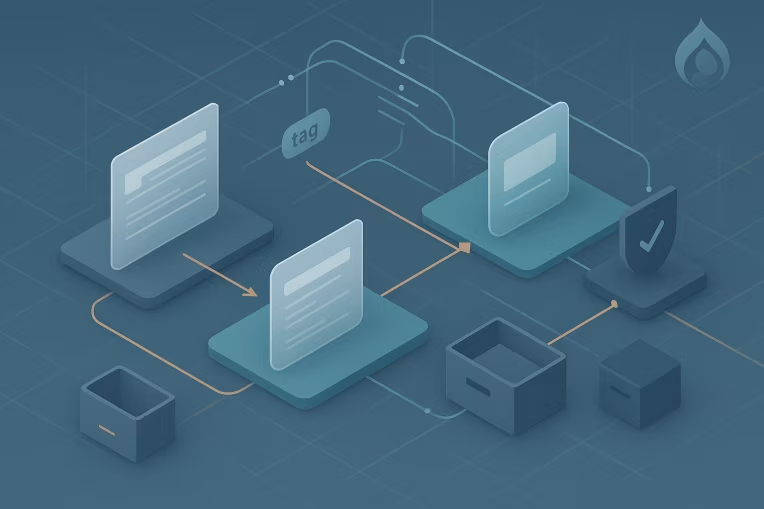
A practical enterprise lifecycle often includes states like these:
Draft
Content is being authored and is not available for public consumption.
Published
Content is live, indexed as intended, and treated as part of the current digital experience.
Review required
Content remains live for the moment but has reached a review threshold based on age, ownership change, policy change, or business relevance.
Archived
Content is no longer part of the active website experience. Public access may be removed or constrained. Internal users may still need to search for it, inspect it, or use it for historical reference.
Retained restricted
Content is being preserved for policy or records reasons but is not part of normal editorial operations. Access is limited to approved users or specific teams.
Pending deletion
Content has passed policy review and editorial review, and technical dependency checks are underway or complete.
Deleted
The content has been removed according to the organization’s approved process.
The state labels matter less than the operational meaning behind them. For each state, teams should define:
- who can move content into or out of the state
- whether the content is publicly accessible
- whether it appears in internal search
- whether it appears in editorial listings and reports
- whether it can be edited
- whether it is eligible for deletion
- what metadata must be captured
That metadata is often where governance becomes usable. For archived or retained content, common fields include:
- archival reason
- retention basis
- review date
- owning business unit
- content steward or approver
- replacement URL or successor content reference
- deletion eligibility date
Without metadata, archival becomes a content graveyard. With metadata, it becomes a managed operating state.
Search, SEO, redirects, and internal discovery after archival
Archival decisions are not complete until discovery behavior is defined.
This is where many cleanup programs create unintended damage. A team removes public access but forgets that search engines, internal search tools, XML sitemaps, site search indexes, or automated listings still treat the item as active.
A better approach is to evaluate discovery across multiple layers.
Public search and SEO
If archived content should no longer attract external traffic, teams should decide whether to:
- return a clear non-active response for the original URL when appropriate
- redirect to a valid successor page when there is a genuine replacement
- remove the item from sitemaps
- ensure meta and indexing behavior align with the archival decision
The key principle is not to use redirects as camouflage. Redirect only when the destination satisfies the original intent closely enough to avoid confusing users and search engines. If there is no legitimate successor, a redirect can create more noise than value.
Internal site search
Internal discovery is often more nuanced. Some archived content should disappear from everyday user-facing site search because it degrades relevance. Other content should remain visible to internal users, service staff, or authenticated roles for continuity and reference.
That means search retention should be designed intentionally rather than inherited accidentally from content status alone.
Useful questions include:
- Should archived content be excluded from public search results?
- Should authenticated staff still be able to find it?
- Should archived content appear only when filters are applied?
- Should search results visually label archived items so users understand their status?
Navigation and listings
Many content items remain discoverable not through search but through dynamic lists, taxonomy pages, related-content blocks, feeds, and manually curated components. Archival rules should cover these patterns explicitly.
If the item is archived but still appears in a department listing, a topical feed, or a "latest updates" block, the governance outcome is incomplete.
Editorial discoverability
There is also a difference between public visibility and editorial discoverability. Editors may need dedicated reports or views to find archived content, review aging content, and plan deletion windows. If the only way to find archived content is by direct URL or database lookup, the process will not scale.
Dependency checks: media, references, listings, APIs, and downstream consumers
Before content is archived or deleted, teams need to understand what else depends on it.
This is one of the biggest operational gaps in unmanaged Drupal estates. The page may look isolated in the authoring interface, but it can still drive user journeys, populate feeds, support applications, or carry shared media assets.
A dependency review should usually cover at least five areas.
1. Entity references and embedded content
Check whether the item is referenced by other nodes, paragraphs, blocks, or components. If a page is still featured on landing pages or campaign modules, archiving it without updating those references can create broken experiences or empty regions.
2. Media dependencies
The content item may contain images, documents, or videos that are also reused elsewhere. Removing or restricting the content does not always mean the associated media should be removed. Media governance should be reviewed separately from item-level lifecycle decisions.
3. Listings and taxonomy-driven discovery
Many Drupal experiences generate lists automatically based on tags, categories, dates, or relationships. An archived item may still surface unless those queries are designed to exclude the relevant lifecycle states.
4. APIs, feeds, and integrations
In enterprise environments, Drupal often supplies data to search platforms, mobile apps, partner tools, analytics workflows, or downstream repositories. If the item is available through JSON, GraphQL, RSS, or another export path, archival needs to be reflected there as well.
5. Redirect and URL dependencies
If a URL is widely linked internally or externally, the team should decide how that address behaves after archival. This is not only an SEO concern; it affects user trust, support operations, and documentation quality.
A mature process does not require exhaustive manual analysis for every item, but it does require proportional checks. High-risk, high-traffic, or highly referenced content should receive more rigorous review than low-impact content.
Governance model for policy, legal, editorial, and technical ownership
Content lifecycle governance fails when ownership is vague.
Editorial teams often know what is outdated, but not what must be retained. Legal or records stakeholders may define retention expectations, but not how those expectations should appear in workflow. Platform teams can implement states and permissions, but they should not be the default decision-makers for business relevance.
A workable governance model assigns clear roles.
Editorial or content operations owners typically define:
- review cadences
- content quality criteria
- archival triggers based on relevance or accuracy
- replacement content planning
- routine cleanup workflows
Policy, compliance, or records stakeholders typically define:
- retention categories
- preservation expectations
- restricted access requirements
- approval conditions for permanent deletion
Platform and engineering teams typically define:
- workflow implementation in Drupal
- permissions and access controls
- search and index behavior
- reporting, automation, and audit support
- dependency analysis patterns
Business owners typically define:
- whether content still serves an active purpose
- whether a successor asset exists
- whether an archived item must remain accessible to specific audiences
The important point is not to centralize every decision. It is to define decision rights clearly enough that the process can move.
In practice, many organizations benefit from a simple decision matrix that answers:
- who can archive content
- who can authorize restricted retention
- who must approve deletion
- what evidence is required at each stage
- how exceptions are documented
This is governance, not legal advice. The platform should support the policy model the organization adopts, but it should not pretend to replace policy judgment.
A phased recovery plan for estates with unmanaged legacy content
Many enterprise Drupal teams do not start with a clean lifecycle framework. They start with thousands of aging items, inconsistent editorial practices, unclear ownership, and long-forgotten sections of the site.
That does not mean the only option is a massive one-time cleanup. A phased recovery plan is usually more realistic.
Phase 1: Define the lifecycle model
Start by agreeing on a limited set of operational states and what they mean. Document public access rules, search behavior, metadata requirements, and deletion conditions.
Keep this model practical. If the organization cannot operate six archival variants consistently, define fewer states with clearer rules.
Phase 2: Identify high-risk content cohorts
Do not review everything equally at first. Prioritize content that is most likely to create risk or confusion, such as:
- very old public content with no recent review
- policy or guidance content with expiry implications
- campaign or event content that still attracts traffic
- duplicate or superseded documents
- content owned by defunct teams or unclear business units
This lets the program show value quickly while improving the underlying governance model.
Phase 3: Add metadata and reporting
Introduce the fields and views needed to govern content at scale. Teams need reporting on stale content, archived content, missing owners, pending deletion, and content awaiting review.
Good governance depends on visibility. If no dashboard or report can show which archived items are still publicly accessible, the process is not yet reliable.
Phase 4: Align search, listings, and integrations
Once lifecycle states exist, update the systems that consume them. Review Views, search indexes, feeds, API responses, and sitemap generation so archived content behaves consistently across channels. This kind of workflow and permissions alignment is usually part of broader Drupal governance architecture.
This is often where governance moves from theory into real platform behavior.
Phase 5: Pilot deletion with dependency checks
Choose a limited group of items that are good candidates for deletion and run the full dependency review. Document what was checked, what broke, what exceptions were needed, and what approval path worked.
That pilot is valuable because it turns deletion from an abstract fear into a managed procedure.
Phase 6: Connect lifecycle cleanup to migration readiness
If a platform redesign, replatforming effort, or major IA change is coming, content archival governance becomes even more important. Organizations that distinguish active, archived, retained, and deletable content migrate with far less noise.
Instead of carrying forward years of unmanaged legacy material, they can make deliberate decisions about what deserves investment in the next platform. That kind of phased cleanup is closely tied to Drupal legacy system modernization and can materially reduce migration risk.
Practical principles for enterprise Drupal content archival governance
If you need a concise operating standard, these principles are a strong starting point:
- do not treat unpublish as a complete retention strategy
- define archival as a managed state, not a vague holding area
- separate public visibility from internal discoverability
- require proportionate dependency checks before deletion
- capture ownership, rationale, and review metadata
- align lifecycle states with search, listings, APIs, and redirects
- give policy, editorial, business, and technical teams distinct responsibilities
These principles help reduce legacy content risk without turning content operations into bureaucracy.
Conclusion
Enterprise Drupal teams do not just manage content creation. They manage content exposure, discoverability, risk, and institutional memory over time.
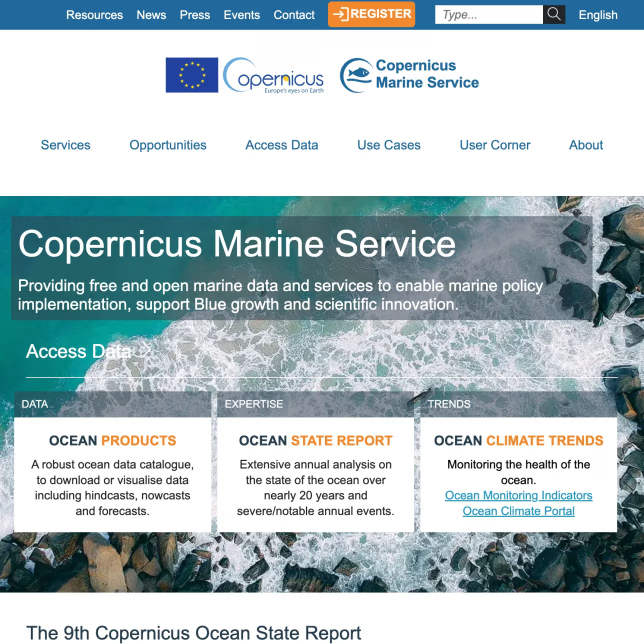
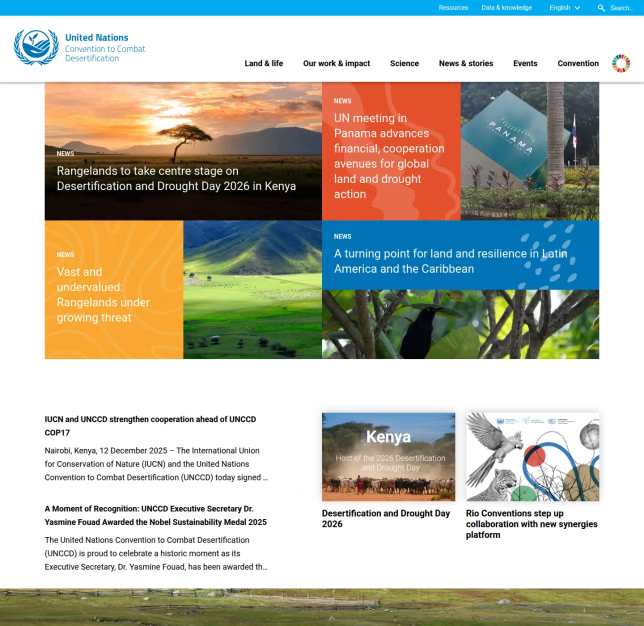
That is why Drupal content archival governance matters. A mature lifecycle model helps organizations retire outdated material, preserve what still needs to exist, improve search quality, and avoid breaking connected experiences. It also creates better conditions for platform modernization, migration planning, and ongoing editorial discipline, especially in large consolidated estates such as UNCCD or Copernicus Marine Service.
The goal is not to make every content decision complex. It is to make important decisions explicit.
When retention, archival, and deletion are governed separately—and when Drupal workflows, metadata, access controls, and discovery rules reflect that distinction—legacy cleanup becomes far more controlled, scalable, and defensible.
Tags: Drupal, Drupal content archival governance, Drupal content retention policy, Drupal archival workflow, legacy content governance, enterprise Drupal compliance