Drupal platforms often sit in the middle of a messy enterprise content landscape. A directory entry may originate in HR, profile details may be enriched in Drupal, event data may come from a scheduling system, and related research or product references may be synced from entirely different sources. On paper, this feels manageable: ingest data, map fields, publish pages.
In practice, platforms drift.
Without a clear model for canonical identity, the same real-world entity can appear multiple times in Drupal under slightly different records. One source creates a new node because a matching key is missing. Another update changes the title but not the identifier. Editorial teams patch one version manually while search indexes another. APIs expose inconsistent records. Reports stop lining up with what users see.
That is why Drupal canonical entity mapping is not a secondary integration concern. It is foundational platform design. If the platform does not know which record represents the entity, which system owns which fields, and how conflicts are resolved over time, reliability degrades across search, APIs, workflows, and trust.
Why multi-source Drupal platforms drift into duplicate record chaos
Duplicate record problems usually emerge from a set of reasonable local decisions rather than one obvious mistake.
A team may start with a simple import process for one source system. Later, a second source is added with overlapping data. Editorial users need flexibility, so some fields become manually editable. Search indexing is introduced, then a public API, then downstream feeds. Each addition is useful, but the identity model often stays implicit.
Common causes include:
- using source-specific record IDs as if they were universal identifiers
- matching on unstable fields such as title, email, or URL path
- allowing multiple imports to create records without shared deduplication rules
- failing to model whether Drupal is a publisher, an editor, or a true system of record for specific fields
- treating relationship mapping as a separate problem from entity identity
- ignoring delete and merge behavior until data quality has already degraded
In enterprise CMS environments, this problem is especially visible when Drupal aggregates:
- people or directory data
- event records
- product-like or catalog records
- partner, location, or office data
- research outputs or reference content
These domains all have one thing in common: records may look editorial, but they are actually composites assembled from several sources. If the platform does not explicitly define how those sources cooperate, duplicate records are the predictable result.
Canonical IDs, source-of-truth boundaries, and field-level precedence
A safer model starts by separating three concerns that teams often blend together.
1. Canonical identity
The platform needs a stable way to answer: what real-world entity does this Drupal record represent?
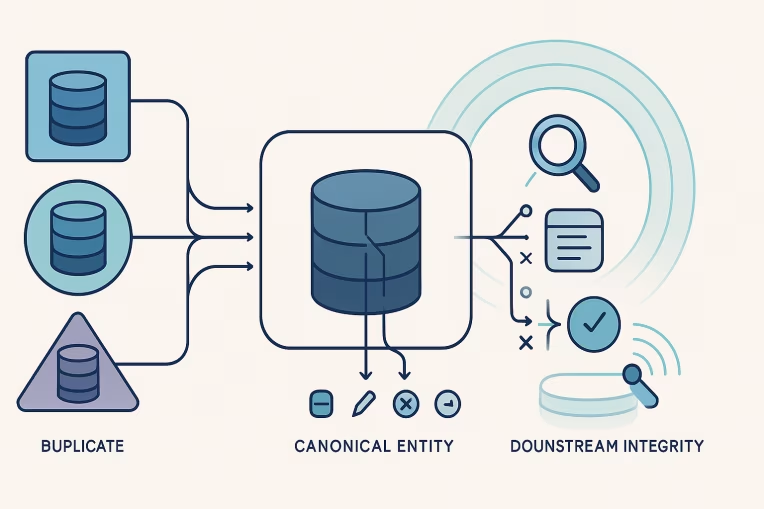
That usually means defining a canonical identity layer that is distinct from any one inbound source ID. In Drupal, this may be implemented through entity fields, mapping tables, or integration-ready schemas resolution logic, but the architectural requirement is the same:
- one canonical entity in Drupal
- zero or more source-system identifiers associated with it
- explicit rules for how new inbound records resolve to an existing entity or create a new one
If you only store one external ID directly on the node and assume it is sufficient, the model often breaks as soon as a second system references the same entity differently.
2. Source-of-truth boundaries
Once identity is defined, the next question is ownership.
For each field or field group, teams should decide whether the value is owned by:
- a single upstream system
- Drupal editorial users
- a computed enrichment process
- a precedence model across multiple sources
This is where many multi-source Drupal integrations fail. They define how data enters the platform, but not who is allowed to win when values differ.
For example:
- a person record's employee ID may always come from HR
- a public-facing biography may be editorially maintained in Drupal
- a profile photo may come from a media service unless manually overridden
- taxonomy relationships may be driven by a classification source but expanded by editorial curation
Those are not just implementation details. They are policy decisions that should be visible in the architecture.
3. Field-level precedence and override rules
Editorial flexibility is valuable, but unmanaged flexibility can undermine synchronization discipline.
If editors can change any synced field at any time, imports become nondeterministic. If imports always overwrite editorial changes, the CMS becomes frustrating and untrustworthy.
A practical model usually defines fields as one of the following:
- authoritative external: Drupal displays the field but does not own it
- editorial authoritative: Drupal owns the field, even if source systems provide candidate values
- default then override: external source populates the field initially, but editorial users can lock an override
- merged/computed: Drupal or an integration layer constructs the final value from multiple inputs
The key is not the specific categories. The key is that the rules are explicit, testable, and understandable to both engineering and editorial teams.
Common failure modes in search, APIs, editorial workflows, and reporting
When canonical mapping is weak, duplicate records do more than clutter the admin UI.
Search quality degrades first
Search indexes often expose duplication before internal teams fully notice it. Users may see two nearly identical results for the same person, event, or item. One may be stale. One may have broken relationships. One may rank higher simply because its content changed more recently.
Even when duplicates are not public, weak canonical mapping can still damage:
- facet counts
- relevance signals
- autocomplete suggestions
- landing page aggregations
- internal search confidence
In other words, Drupal search data quality depends heavily on entity identity quality upstream of indexing.
APIs become inconsistent
If an API consumer requests records by type, date, taxonomy, or relationship, duplicate entities can produce contradictory answers. One client may see the record with the latest editorial summary; another may see the version still connected to the old source identifier.
This creates hidden integration debt. Consumers start coding around platform inconsistency instead of trusting the contract.
Editorial trust erodes
Editorial users do not need to understand mapping tables to feel the impact of a poor model.
They experience symptoms such as:
- updating one record while another remains live
- not knowing which version is safe to edit
- seeing imported data revert manual changes unexpectedly
- discovering broken references after source updates
- spending time reporting data issues that the system should have prevented
Once editors stop trusting record lineage, platform governance becomes reactive rather than deliberate.
Reporting and analytics become misleading
Counts by entity type, publication state, taxonomy, geography, or owner can all become less reliable when duplicates inflate totals or split engagement across records. Reporting is especially vulnerable when downstream systems treat duplicate Drupal entities as distinct content objects.
Reconciliation patterns for creates, updates, deletes, and merges
A durable Drupal entity reconciliation approach should cover the entire lifecycle, not just initial import.
Create: resolve identity before creating content
The safest pattern is to make record creation conditional on identity resolution.
Before creating a Drupal entity, the integration should attempt to match against canonical keys and approved secondary identifiers. If no match is found, creation may proceed. If a probable match exists but confidence is low, the record should enter an exception path rather than creating a near-duplicate automatically.
Good create-time questions include:
- Which identifiers are considered unique and stable enough to match on?
- Which attributes may support secondary matching but never automatic creation decisions?
- What happens when a source sends a record with missing identifiers?
- Is there a quarantine or review state for unresolved imports?
Batch and event-driven integrations both need this discipline. Real-time delivery does not remove the need for identity checks.
Update: change only what the contract allows
Once a record is resolved to an existing Drupal entity, update logic should respect field ownership rules.
This typically means:
- updating authoritative external fields consistently
- preserving editorial overrides where policy allows
- tracking the source and timestamp of the last successful sync
- preventing partial updates from blanking fields unless the source is explicitly allowed to clear them
A common mistake is treating absent values and intentional deletes as the same thing. In many integrations, a missing field in a payload should mean "no change," not "erase the value in Drupal." That distinction should be part of the contract.
Delete: remove with caution
Deletes are one of the most dangerous areas in multi-source Drupal integration.
If a source record disappears, that does not always mean the Drupal entity should be deleted. The source may have changed scope, a feed may be incomplete, or another system may still rely on the entity.
Safer delete patterns include:
- soft-unpublishing until the absence is confirmed
- marking source associations inactive before deleting the canonical entity
- evaluating whether the entity still has active relationships or alternate source ownership
- routing high-risk deletions through review workflows
Delete logic should be based on entity lifecycle policy, not just transport events.
Merge: design it before you need it
Most platforms eventually need to merge duplicates. The problem is that many teams only consider merge behavior after duplicate records have already affected search and editorial operations.
A merge process should define:
- which entity remains as the canonical record
- how source identifiers are reattached
- how inbound relationships are reassigned
- how historical URLs or aliases are handled
- how search reindexing is triggered
- how audit history is preserved
This matters because duplicates are rarely isolated records. They are connected nodes in a graph of references, views, APIs, and indexes.
Governance for exceptions, ownership, and change control
Canonical mapping is partly technical, but it is also a governance discipline.
Without ownership, every exception becomes an ad hoc decision. One team changes matching logic. Another manually edits records. A third assumes search issues are indexing problems when they are actually identity problems.
A workable Drupal integration governance model usually defines:
- a named owner for entity identity rules
- documented source contracts for each integrated domain
- approval paths for adding new identifiers or changing precedence rules
- operational procedures for duplicate review and merge handling
- editorial guidance on which fields can be safely overridden
- release controls for schema or mapping changes that affect downstream consumers
This does not need to become heavy process. It needs to create shared clarity.
One practical artifact is a field ownership matrix for each entity type. For every important field, document:
- canonical field name in Drupal
- owning system or policy
- whether editors can override it
- whether overrides are permanent or temporary
- what happens on source nulls, deletes, or conflicts
That single document can prevent a great deal of confusion during implementation and ongoing operations.
Validation and observability signals that show mapping drift early
Teams often discover canonical mapping issues too late, after editors or users report visible defects. A better approach is to instrument the platform so drift becomes measurable.
Useful signals include:
- number of inbound records that fail identity resolution
- number of probable duplicates detected by matching heuristics
- percentage of records with multiple source IDs attached
- rate of editorial overrides on externally managed fields
- count of orphaned relationships after sync jobs
- search index documents without valid canonical references
- unexpected spikes in create events for historically stable entity types
- delete or unpublish actions triggered by incomplete source snapshots
You can also validate the model with targeted audits:
- sample entities from each source and confirm one canonical Drupal record exists per real-world object
- trace a record from source payload to Drupal entity to search index to API response
- compare public search results against internal entity counts for signs of duplication
- review the highest-edited synced records to determine whether source ownership rules are unrealistic
Observability matters because drift is often gradual. A platform can appear healthy while data quality is weakening underneath.
Architectural tradeoffs: editorial freedom versus synchronization discipline
There is no universal answer to how much editorial override flexibility a Drupal platform should allow. The right choice depends on platform purpose.
If Drupal is primarily a publishing surface for operational data, strict synchronization usually matters more than broad manual editing. If Drupal is a content enrichment layer built around externally sourced records, editorial control may need to be wider.
The mistake is not choosing one side or the other. The mistake is leaving the boundary undefined.
A few tradeoffs are worth making explicit:
- More editorial freedom can improve responsiveness, but it also increases divergence risk.
- Strong external authority can improve consistency, but it may slow content refinement.
- Aggressive auto-merge logic can reduce duplicates, but it can also create incorrect joins if identity confidence is weak.
- Conservative review workflows can improve quality, but they add operational overhead.
For most enterprise CMS environments, the best answer is a layered model: strict identity rules, explicit field ownership, limited override paths, and clear exception handling.
A practical operating model for Drupal canonical entity mapping
For teams trying to improve an existing platform, the work can often be phased.
Phase 1: make identity visible
Inventory which entity types are sourced from multiple systems and document the identifiers currently in use. Find out where duplicates are already appearing and which downstream consumers are affected.
Phase 2: define source contracts
For each entity type, document canonical identity rules, source ownership, field precedence, null handling, delete handling, and editorial override policies.
Phase 3: implement reconciliation controls
Update batch jobs, event consumers, or sync services so create, update, delete, and merge behavior follows the contract. Add exception paths where identity confidence is low.
Phase 4: repair existing data
Merge or retire known duplicates, reattach relationships, and reindex dependent systems. This step is operationally sensitive and should be planned, not improvised.
Phase 5: instrument drift detection
Add reporting and alerting for duplicate creation, unresolved matches, orphaned references, and override patterns that indicate governance gaps.
This kind of phased remediation is especially important on integration-heavy Drupal estates, as seen in projects like LSHTM, where synchronization reliability and operational monitoring both matter to long-term platform trust.
Conclusion
In multi-source content platforms, duplicates are rarely just messy content. They are evidence that the platform has not fully decided how identity works.
For Drupal, that decision affects everything downstream: search quality, API consistency, relationship integrity, editorial confidence, and reporting reliability. Treating Drupal canonical entity mapping as a core architectural concern creates a stronger contract between source systems, synchronization processes, and the CMS itself.
The goal is not to build generic master data management inside Drupal. It is to make Drupal operationally trustworthy in the role it actually plays: a platform that assembles, enriches, and publishes entities from multiple systems without losing track of which record is real, which data should win, and how change should be reconciled over time. That usually requires deliberate platform governance, not just better import scripts.
Tags: Drupal, Enterprise CMS, Drupal canonical entity mapping, multi-source Drupal integration, Drupal source of truth modeling, Drupal entity reconciliation, Drupal integration governance, Drupal search data quality