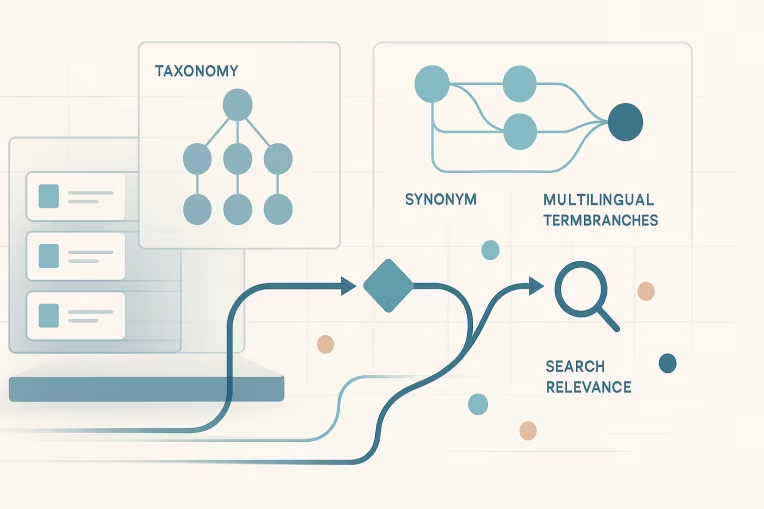
Search teams usually discover synonym problems after relevance has already started to drift. A query that used to return the right product pages suddenly broadens too far. An acronym begins matching unrelated content. A newly approved editorial term never surfaces older but still valid material. None of these issues are usually caused by one bad rule alone.
In enterprise Drupal platforms, search behavior changes whenever structured content, taxonomy, editorial conventions, and search configuration move at different speeds. Synonyms are often treated as a tactical tuning layer, but they behave more like governance infrastructure. They sit between how authors describe content, how business teams classify it, and how search engines expand or normalize user queries.
That is why Drupal search synonym governance matters. The goal is not to create the largest possible synonym list. The goal is to maintain stable meaning as the platform evolves.
Why synonym tuning becomes a governance problem
Synonym management looks deceptively simple at first. Teams identify a few common variants, add them to a search engine configuration, and see immediate improvements. Over time, however, synonym rules accumulate faster than the organization can evaluate them.
A structured Drupal platform creates several moving parts:
- content types define where important terms appear
- taxonomies define controlled language for classification and navigation
- editors introduce natural language variants in titles, summaries, and body content
- business teams rename programs, products, or services
- regional and multilingual teams localize terminology differently
- search teams adjust expansion logic to protect recall or precision
If these changes are not coordinated, search begins to reflect historical compromises instead of current information architecture. A synonym that once improved findability can later obscure critical distinctions. A taxonomy term may be retired while its search expansion remains active. Editorial language may shift toward a preferred name while the search engine keeps boosting or expanding legacy terminology.
In other words, synonym behavior becomes a governance issue because it influences meaning at the platform level, not just ranking at the query level.
The difference between taxonomy labels, editorial language, and search expansion
One of the most common sources of confusion is assuming these three things are interchangeable.
Taxonomy labels are controlled identifiers. They exist to support classification, aggregation, filtering, and internal consistency. A taxonomy term may have a display label, internal ID, parent-child relationships, and editorial rules for when it should be applied.
Editorial language is how humans naturally write. Editors may use abbreviations, legacy names, campaign phrases, or audience-specific wording in titles and descriptions. This language can be fluid even when taxonomy is tightly governed.
Search expansion is an interpretation layer. It determines whether a query for one term should also match another term, and under what conditions. Search expansion can happen at index time, query time, or through managed search rules. Regardless of implementation, it changes retrieval behavior.
That distinction matters because not every editorial variant should become a synonym, and not every taxonomy relationship should influence search expansion.
For example:
- A product taxonomy may distinguish between a formal product family name and a deprecated trade name.
- Editors may still mention the trade name when addressing existing customers.
- Search may need the trade name to retrieve the current product family page.
That does not automatically mean the two terms are fully interchangeable across all content. In some contexts, the deprecated name should retrieve the canonical page. In other contexts, it should not broaden results to every asset tagged with the new family name.
A durable model asks three separate questions:
- What is the canonical concept?
- What language variants do users and editors actually use?
- What expansion behavior is safe for search?
Treating those as separate decisions reduces accidental overreach.
Common failure modes: false matches, stale synonym sets, regional conflicts
Synonym drift usually appears in recognizable patterns.
False matches happen when a term expands too broadly. Acronyms are a classic example. A short abbreviation may be valid for one product line, one regulatory program, and one internal department. If search expands it globally without field or context controls, precision drops quickly.
Stale synonym sets appear when business terminology changes but search rules do not. The organization may rebrand a service, retire a label, or split one concept into two more specific concepts. Search still reflects the older conceptual model, so queries begin returning results that are technically related but no longer editorially correct.
Regional conflicts are common in multi-market platforms. One term may be the approved label in one country, while another region uses a different spelling or even a different concept boundary. A synonym set that improves recall in one locale can produce misleading matches in another.
Regulated terminology collisions are especially risky. In healthcare, finance, legal, or public-sector contexts, terms that look similar may carry different obligations. Broad expansion can unintentionally blend content that should remain distinct.
Unreviewed accumulation is another frequent issue. Synonym files and managed dictionaries often grow through support tickets and isolated tuning requests. Each request can be reasonable on its own, but the collection becomes inconsistent because there is no clear review model for overlap, reversibility, or lifecycle status.
These failure modes are rarely solved by adding more rules. They are solved by making synonym decisions traceable and governed.
Where synonyms should live and who should own them
The wrong ownership model is one of the fastest ways to create drift.
If synonyms live only in search-engine configuration, search teams become the default owners of business language. That usually fails because they do not control taxonomy design or editorial standards.
If synonyms live only in editorial guidance documents, the search layer lacks enforceable structure. Authors may understand preferred naming, but query interpretation still depends on unmanaged technical rules.
A better approach is to define a lightweight operating model with clear roles:
- Content architecture owns canonical concepts, content model implications, and taxonomy relationships.
- Editorial governance owns preferred labels, naming conventions, and legacy language guidance.
- Search or platform engineering owns implementation behavior, deployment controls, and observability.
- Business stakeholders approve domain-critical distinctions, especially for regulated or market-sensitive terminology.
The artifact itself can take different forms depending on tooling. Some organizations maintain a structured synonym registry in version control. Others manage approved synonym mappings in a governed spreadsheet or internal product catalog before transforming them into search-engine configuration. The exact storage location matters less than the control model.
A useful governed synonym record usually includes:
- canonical term or concept ID
- variant term
- locale or region scope
- synonym type, such as equivalent, one-way, deprecated, or alias
- rationale for the rule
- owner or approving team
- date introduced
- review date or expiration trigger
- implementation target if multiple search stacks exist
This turns synonym management from a hidden search tweak into an accountable content-system decision.
Multilingual and multi-region search complications
Multilingual search governance is where simplistic synonym strategies break down fastest.
Different languages do not just provide alternate labels for the same concept. They can reshape the concept itself. A term in one language may map imperfectly to another due to regulation, market practice, or domain nuance. Direct equivalence is not always safe.
Drupal platforms that operate across locales often need to distinguish between:
- translation equivalents n- regional spelling variants
- local market labels
- legacy brand names carried forward in one region but not another
- borrowed English acronyms that are not universally understood
A synonym strategy that ignores these distinctions can damage both recall and trust.
For example, a regulated service may be marketed under one audience-friendly phrase in one country and a more formal statutory term in another. If both are added as global synonyms, users may retrieve content that appears relevant linguistically but is not correct for their jurisdiction.
Governance patterns that help include:
- scoping synonym rules by locale rather than treating them as universal
- distinguishing translation from search expansion
- documenting when a regional label is equivalent, adjacent, or merely related
- reviewing acronym behavior separately for each language and market
- validating search behavior against localized content sets, not just translated interfaces
In practice, multilingual search governance is less about creating one master synonym list and more about maintaining a policy for how local term maps are approved, tested, and retired.
Release workflow for synonym changes and relevance testing
Synonym changes should be released with the same discipline as schema or taxonomy changes, especially in enterprise Drupal environments.
The underlying search technology may be Solr, Elasticsearch, or a managed search platform, but the governance principle is consistent: search rule changes need release controls because they alter retrieval logic across many pages at once.
A pragmatic workflow often includes the following phases.
1. Request and classification
Capture the change request with context. Is this a new alias, a deprecated term, a regional label, an acronym, or a canonical rename? What user problem is it intended to solve?
2. Concept review
Confirm whether the terms are truly equivalent. If they are not, decide whether one-way expansion, curated boosts, redirects, or content updates are safer than synonym expansion.
3. Taxonomy and content impact review
Check whether the change reflects a taxonomy change, a content migration issue, or an editorial inconsistency. Sometimes the right fix is not search tuning at all.
4. Test query definition
Create a compact test set of high-value queries. Include expected positives, expected exclusions, known ambiguous cases, and locale-specific variants.
5. Controlled deployment
Release synonym updates through the same environment pathway used for other platform changes. Avoid direct production edits that bypass auditability. This is where Drupal governance architecture and Drupal search architecture intersect most clearly.
6. Post-release observation
Review query behavior after deployment. Look for zero-result reduction, but also inspect whether false positives, result dilution, or facet pollution increased.
This workflow matters because synonym updates are easy to underestimate. A small rule can affect search results sitewide, including search pages, autocomplete, API consumers, and downstream analytics.
Validation signals: query logs, zero-result patterns, false-positive review
Good governance depends on evidence, but not all signals are equally useful.
Teams often focus first on zero-result queries. That is a valuable starting point, because missing results can expose terminology gaps quickly. But zero-result reduction alone is not enough. Broad synonyms can eliminate zero results while making the results less trustworthy.
More reliable validation combines several signals:
- query logs to identify common variants, acronyms, misspellings, and evolving terminology
- zero-result patterns to surface unmet vocabulary expectations
- false-positive review to catch cases where synonym expansion widened results too far
- top-query spot checks for critical journeys such as product discovery, support, or policy lookup
- locale-specific reviews to detect regional mismatches hidden by aggregate metrics
- editorial feedback from teams who know when search is surfacing outdated or non-canonical language
It also helps to separate metrics by query class. A navigational query for a product acronym should not be evaluated the same way as a broad informational query about a service category.
When organizations mature their validation practice, they usually maintain a living relevance test set. This does not need to be overly complex. Even a curated list of business-critical queries with expected result characteristics can improve consistency across releases.
The key is to validate both sides of relevance:
- did the change improve retrieval where users were previously failing?
- did the change introduce new ambiguity where users previously succeeded?
That balance keeps governance grounded in actual search quality rather than one-dimensional tuning goals.
A durable governance model for Drupal search relevance
A durable model does not assume synonyms can solve every vocabulary problem. Instead, it treats synonyms as one mechanism inside a broader search architecture.
For Drupal teams, that usually means aligning four layers:
- content model: where important terms appear and how structured fields are used
- taxonomy model: what the official concepts are and how they relate
- editorial model: what language authors should prefer, preserve, or retire
- search model: which term relationships are safe to operationalize in retrieval
When these layers are coordinated, synonym governance becomes simpler. When they are not, search becomes the place where unresolved language decisions accumulate.
A practical governance baseline might include:
- a named owner group for synonym policy
- a distinction between equivalent, one-way, and deprecated mappings
- locale-aware review rules
- version-controlled change history
- required test queries for every non-trivial change
- periodic review of high-impact synonyms such as acronyms and regulated terms
- explicit triggers tied to taxonomy changes, rebranding efforts, and model updates
This approach is especially important on structured content platforms because search relevance does not only depend on ranking logic. It depends on whether the organization preserves stable meaning while its content system evolves.
If taxonomy terms change, editorial naming shifts, and search rules evolve independently, relevance will usually drift. Not because Drupal is weak at search, but because the governance boundary between language and retrieval has been left undefined.
The most resilient teams close that gap. They treat synonym behavior as part of architecture, not as a cleanup task after launch. That shift makes search more predictable, more explainable, and more sustainable as enterprise content grows in complexity. Work on taxonomy alignment and Drupal content architecture often determines whether synonym governance stays manageable over time.
Tags: Drupal, Drupal search synonym governance, Drupal search relevance, taxonomy and search alignment, multilingual search governance, Solr synonym management, structured content search