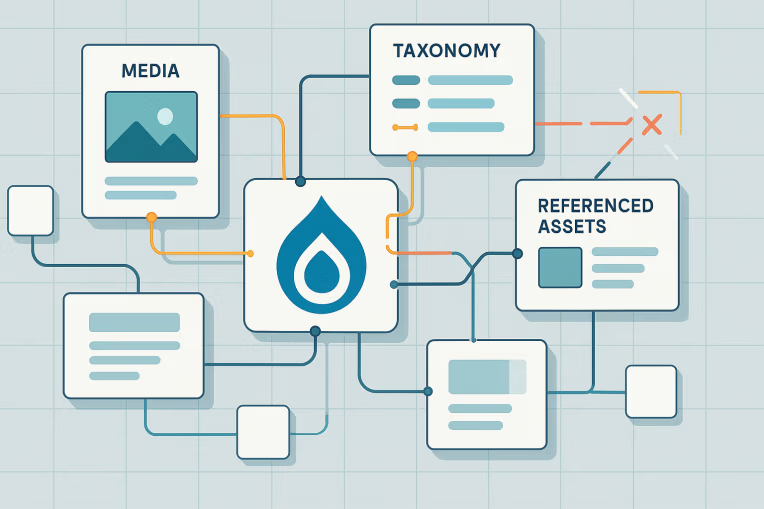
Migration planning often begins with counts: how many nodes, media items, terms, paragraphs, users, and files are in the current Drupal estate. Those numbers are useful, but they do not describe whether the content still behaves like a connected system.
That gap matters. A page can exist, a component can render, and a record can be included in an export, while the relationships that make the experience usable have already degraded over time. Editors may have worked around missing references. Templates may be silently falling back. Search results may surface incomplete items. APIs may return content objects whose expected related entities no longer resolve.
A Drupal content reference audit addresses that hidden layer. Instead of asking only how much content do we have, it asks what depends on what, where are those dependencies stored, and how reliable are they today.
For enterprise migration programs, that is not a minor technical detail. Relationship integrity can change migration sequencing, affect transformation logic, expand remediation effort, and alter what “done” should mean in validation. If teams surface those conditions late, replatform risk often appears as surprise complexity rather than as an explicit planning input.
Why record counts hide relationship risk
Record counts describe inventory. Migration delivery depends on behavior.
A Drupal node may look complete in a spreadsheet, but its actual published experience can rely on multiple dependency layers:
- entity reference fields linking authors, products, events, locations, or related content
- taxonomy terms used for categorization, filtering, routing, or personalization
- media entities referenced in structured fields or embedded inside rich text
- internal links to legacy node paths, aliases, files, or documents
- reusable paragraph or block content shared across multiple pages
- view, display, or API assumptions that expect related data to be present
When those relationships are degraded, simple volume metrics can understate effort in several ways.
First, migration mapping becomes less deterministic. If a field is supposed to reference a valid entity but often points to deleted or inaccessible content, the team has to decide whether to repair, remap, suppress, or retire the relationship.
Second, front-end and template logic becomes harder to trust. Components built around a content architecture usually assume a minimum set of related entities exists. Once those assumptions fail, template exceptions, empty cards, missing labels, and broken navigation patterns become common.
Third, acceptance criteria become blurry. A migration can technically complete while still shipping a platform where connected content no longer works as intended.
This is why relationship integrity should be treated as a distinct readiness workstream, not as a side note inside broad content inventory or generic QA.
The reference types teams usually miss before migration
Most teams remember to look at structured entity reference fields. Fewer look beyond them.
In long-running Drupal implementations, relationship surfaces often spread across editorial patterns, historical modules, and markup habits that accumulated over years. The result is that the official content model tells only part of the story.
Commonly missed dependency types include:
- Orphaned entity references: fields that still store target IDs for entities that were deleted, unpublished, access-restricted, or moved out of use.
- Soft references in body fields: links or embeds inside rich text that behave like relationships but are not governed by structured validation in the same way as entity reference fields.
- Media dependencies in markup: images, files, or embedded assets inserted through body content, WYSIWYG markup, or legacy embed patterns rather than through normalized media references.
- Taxonomy drift: terms that changed meaning over time, duplicated vocabularies, near-identical labels, or inconsistent application across content types.
- Shared reusable content with unclear ownership: paragraphs, blocks, or reusable fragments that appear local to editors but actually affect many pages.
- Alias and path assumptions: internal links that rely on historical URL aliases rather than canonical identifiers.
- Headless/API relationship expectations: consumer applications expecting related content arrays, term metadata, media formats, or nested references that are inconsistently populated.
These conditions do not always create visible platform failures in the source system. Drupal sites often tolerate imperfect relationships because years of editorial workaround, custom rendering logic, or conditional template behavior have made the problems less obvious.
That tolerance disappears during migration. The destination platform typically requires clearer mapping rules, cleaner source assumptions, and more explicit validation logic.
How broken relationships affect templates, APIs, search, and editorial workflows
Broken content relationships are rarely isolated to one output channel.
In coupled Drupal rendering, missing references can break components that expect linked items for cards, related content modules, accordions, downloads, event metadata, or taxonomy-driven landing pages. Sometimes the break is obvious. Sometimes the template simply renders empty containers, generic labels, or fallback behavior that degrades the experience without producing an error visible to business stakeholders.
In API and headless contexts, the impact can be even more direct. An API contract may assume a related image exists, a taxonomy field returns a stable concept hierarchy, or a linked content item contains normalized metadata for another channel. If the source relationships are incomplete or inconsistent, downstream consumers have to defend against nulls, unresolved dependencies, or unexpected structures. That can turn a migration issue into an integration issue.
Search and discovery are also affected. Taxonomy mismatches and missing relationships can weaken filtering, reduce relevance, and create misleading result sets. Content may still be indexed, but without the metadata or associations that make it findable in the right contexts.
Editorial workflows degrade too. Teams lose confidence when reused content appears in some placements but not others, when related content modules pull poor matches, or when media references require manual cleanup after import. That trust problem matters. Even if technical migration success criteria are met, editors may judge the platform by whether relationships behave predictably.
This is one reason relationship integrity should be assessed early: it influences not only data migration logic, but also the credibility of the post-migration operating model.
Audit methods for entity references, embedded media, and internal links
A practical audit does not need to start with a perfect enterprise-wide model. It needs a disciplined way to discover dependency patterns, sample risk, and classify what matters.
A useful sequence often looks like this:
-
Prioritize high-value content domains
Start with content types, page templates, and delivery channels that matter most to launch scope. Not every part of the estate needs the same level of inspection. -
Map declared relationship fields
Document structured entity reference fields, taxonomy fields, media fields, reusable component relationships, and any nested content structures. This establishes the official relationship model. -
Identify undeclared dependency surfaces
Review body fields, long text fields, legacy embed patterns, internal link usage, and file references stored in markup. These often carry hidden migration effort. -
Sample rendered outputs and source records together
Compare what editors see on the page, what templates expect, and what the stored data actually contains. This helps surface conditional logic, fallback behavior, and workarounds that schema review alone will miss. -
Classify failure modes
For each dependency type, determine whether the issue is an orphaned target, deprecated pattern, inconsistent taxonomy usage, inaccessible media item, malformed link, or ambiguous relationship. -
Quantify enough to plan, not merely to count
Exact precision is not always required at discovery stage. What matters is estimating how often a pattern occurs, where it clusters, and whether it affects critical templates or downstream consumers.
For structured references, look at whether target entities exist, whether bundles align with field expectations, and whether content marked as reusable is actually governed as shared content.
For embedded media, distinguish between normalized media entity usage and direct file or markup-based embeds. That difference has major implications for migration logic, especially when the destination model expects centralized media governance.
For internal links, inspect whether links resolve through stable identifiers, aliases, or hardcoded paths. Links that worked in the legacy estate because of routing history may fail once URL strategy changes.
For taxonomy, go beyond term counts. Review whether terms represent stable concepts, whether parent-child structures are meaningful, and whether editorial teams used the same vocabulary consistently across content types and channels.
The key is not to chase every anomaly equally. The key is to surface dependency patterns that materially affect delivery scope, transformation design, or post-launch trust.
Triage: rebuild, repair, remap, or retire
Not every broken relationship should be fixed before migration.
That is an important planning principle, especially in enterprise programs where deadlines, business priorities, and platform change windows are constrained. The purpose of a Drupal content reference audit is not to produce an idealized cleanup backlog. It is to support rational decisions.
A useful triage framework is:
- Rebuild when the relationship is business-critical but the current pattern is too degraded or inconsistent to migrate directly.
- Repair when the relationship model is still valid and targeted cleanup can restore integrity with manageable effort.
- Remap when the source relationship exists, but the destination architecture should express it differently.
- Retire when the relationship no longer supports meaningful user or editorial value and should not be carried forward.
Examples help clarify the distinction.
A related-content field used on high-traffic product pages may justify repair if only a manageable subset of references are orphaned. A body-field embed pattern used across thousands of pages may justify remapping into a more governed media approach rather than preserving the legacy behavior exactly. A duplicated taxonomy vocabulary with overlapping concepts may need partial rebuild for priority domains and retirement for low-value legacy sections.
Triage should consider at least four factors:
- business criticality
- prevalence of the issue
- effort to remediate or transform
- consequence of leaving the issue unresolved at launch
This keeps teams from defaulting to two unhelpful extremes: either trying to cleanse everything, or pretending relationship defects can be deferred without delivery impact.
Turning audit findings into migration scope and validation rules
An audit only creates value if its findings change planning and execution.
At minimum, relationship integrity findings should feed three migration workstreams.
First, they should refine scope assumptions. If content contains widespread soft references, inconsistent media patterns, or taxonomy drift, migration estimates should reflect that complexity. This may change effort for transformation logic, editorial remediation, or both.
Second, they should inform destination architecture decisions. Relationship failures can reveal where the future model needs stricter validation, clearer governance, or simpler reuse rules. That is especially important when moving from a flexible, historically customized Drupal estate into a more standardized platform model. In practice, that often overlaps with Drupal content architecture work rather than migration scripting alone.
Third, they should shape validation planning. Relationship-specific validation rules often matter more than raw record parity. Examples include:
- referenced entities resolve in priority content types
- media dependencies render in required placements
- migrated internal links do not point to deprecated paths
- taxonomy relationships support expected search and filtering behavior
- API responses include required related objects for consuming applications
- reusable content updates propagate where the new model expects shared behavior
These rules should be prioritized around launch-critical journeys, not only around source-system completeness.
This is also where collaboration matters. Architects, migration leads, content owners, and front-end teams should agree on what level of relationship fidelity is required for launch, what can be remediated later, and what should be intentionally deprecated.
Without that alignment, relationship defects tend to reappear late in UAT as seemingly disconnected issues: a broken card here, an empty listing there, an API consumer missing media metadata somewhere else. In reality, those are often symptoms of the same underlying dependency problem that discovery could have surfaced earlier.
A more realistic definition of migration readiness
Migration readiness is not just knowing how many records exist. It is knowing whether the content can survive a platform transition without losing the relationships that make it useful.
For Drupal estates that have evolved over many years, relationship integrity often sits in the blind spot between content strategy, technical architecture, and delivery planning. Entity references, taxonomy structures, embedded media, and internal links may all look manageable until teams test how they behave under a new model.
A focused Drupal content reference audit brings that risk forward. It helps teams separate high-value relationships from legacy noise, identify hidden dependency surfaces, and make explicit decisions about what to rebuild, repair, remap, or retire.
That is the practical value of the exercise. It does not promise a perfectly clean source system. It gives migration teams a better basis for estimating effort, designing transformations, setting validation rules, and protecting confidence in the migrated experience. In larger replatform programs, that kind of discovery typically feeds directly into Drupal migration planning, and in estates with years of accumulated legacy behavior it often sits within broader Drupal legacy system modernization work.
When relationship integrity is assessed early, scope becomes more honest, architecture becomes more deliberate, and launch quality is less likely to depend on discovering broken connections at the worst possible moment.
Tags: Drupal, Drupal content reference audit, Drupal migration readiness, entity reference integrity, media dependency audit, taxonomy relationship mapping, Enterprise CMS