When a headless platform is young, a shared GraphQL API often looks like a clean architectural choice. One schema can unify content from systems such as Drupal or WordPress, support a Next.js or React frontend, and give downstream teams a flexible way to query exactly what they need.
The problem usually appears later.
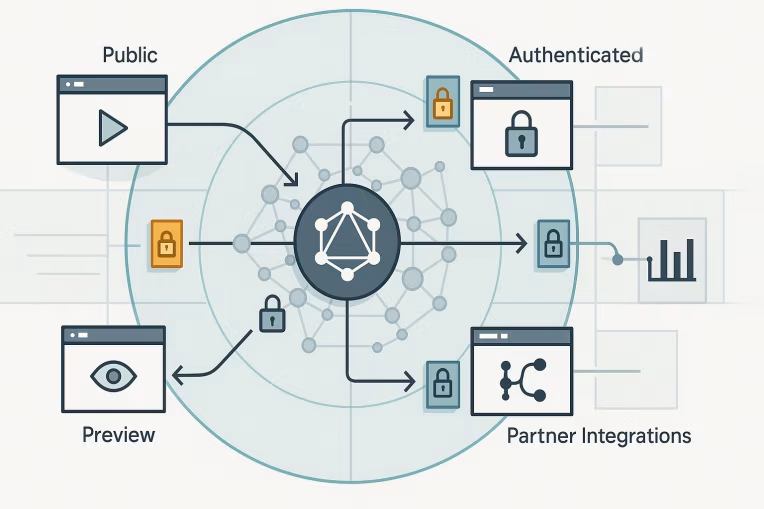
What started as a content delivery layer for public pages begins serving authenticated user journeys, editorial preview, QA environments, partner integrations, and internal applications. The schema may still look coherent, but the trust assumptions behind each use case are no longer the same. At that point, the GraphQL layer is not just a convenience interface. It becomes an authorization boundary, whether the organization has designed it that way or not.
That is where risk grows. Not because GraphQL is inherently unsafe, but because mixed-access platforms often separate decisions that need to be designed together: schema visibility, token scope, resolver behavior, preview access, cache variation, and operational ownership.
This is why GraphQL authorization boundaries deserve explicit attention in enterprise digital platforms.
Why shared GraphQL layers become risky in mixed-access platforms
In many headless programs, the platform evolves in stages:
- a public website launches first
- preview is added for editors and stakeholders
- a logged-in user area is introduced later
- internal tools or partner portals begin consuming the same content model
- more frontend teams adopt the shared API because it already exists
Each addition is reasonable in isolation. Together, they can turn one API into a broad risk surface.
The issue is not only whether a user is authenticated. It is whether the platform has clear answers to questions such as:
- Which parts of the schema are intended to be discoverable publicly?
- Which fields are safe for any consumer with a valid token, and which require stricter context?
- How is preview differentiated from production access?
- Can one token query both public content and sensitive internal fields?
- Does caching vary correctly by identity, token scope, environment, or viewer role?
- Who approves new fields that expose unpublished, segmented, or commercially sensitive data?
If those answers live in different places, teams often end up with accidental exposure rather than deliberate access control. A resolver may correctly check identity, but a CDN may still cache the wrong response. A schema may hide internal pages in the frontend, while introspection or permissive queries still reveal structure. A preview token may be treated as a convenience credential, even though it effectively grants visibility into unpublished material.
In other words, the boundary problem is architectural. The API sits at the intersection of content modeling, application delivery, identity, and operations.
The common boundary failures: public schema leakage, preview abuse, role drift, cache contamination
Most enterprise teams do not fail because they ignored security entirely. They fail because the system becomes layered in ways that make responsibilities ambiguous.
A few failure modes appear repeatedly.
Public schema leakage
A shared schema can expose more than intended even when sensitive UI routes are protected.
Typical examples include:
- types or fields that reveal internal business concepts
- unpublished or restricted relationships that remain queryable through generic resolvers
- discoverable schema elements that help consumers infer private content structures
- overly broad search or listing queries that were created for internal tools but remain reachable from less trusted contexts
Not every leaked field is a breach-level issue, but leakage expands the attack and governance surface. It also makes future control harder because downstream consumers may start depending on fields that were never meant to be broadly available.
Preview abuse
Preview is often the most underestimated access mode in headless platforms.
Editorial preview needs legitimate exceptions. It may need to surface draft content, unpublished revisions, segmentation states, scheduled changes, or branch-specific rendering behavior. If preview access is implemented as a lightly protected variant of production, teams can unintentionally create a privileged path that is easier to obtain than true internal access.
Preview becomes especially risky when:
- preview tokens are long-lived and broadly shared
- preview traffic is not isolated by environment
- preview responses can be cached beyond their intended audience
- preview access is granted at the endpoint level without content- or field-level limitation
- the same schema and query patterns are used for both public and preview contexts without strong runtime checks
Role drift
Role models often start simple and grow messy.
A team may begin with anonymous, editor, and admin roles. Later it adds partner users, support agents, QA reviewers, market-specific teams, and service accounts for frontend builds. Over time, permissions accumulate faster than they are reviewed.
This creates drift in two directions:
- horizontal drift, where a role gains access to more content domains than intended
- vertical drift, where a role gradually receives more privileged operations or fields
In GraphQL, role drift can be hard to spot because access is distributed across resolvers, directives, token issuers, source CMS permissions, and sometimes custom business rules.
Cache contamination
Enterprise teams increasingly place GraphQL behind gateways, edge caches, or CDN-assisted delivery. That improves performance, but it can also undermine authorization if cache keys do not reflect the actual trust boundary.
Common issues include:
- authenticated responses cached under keys that do not vary by identity or scope
- public and preview responses sharing cache behavior
- persisted queries treated as inherently safe even when response visibility differs by viewer
- partial response caching at layers that are not aware of field-level authorization
A correct authorization check at the resolver is not enough if a later delivery layer serves the result to the wrong audience.
Authorization models: endpoint split, schema scoping, field-level checks, token-scoped access
There is no universally best pattern for every enterprise platform. The right model depends on content sensitivity, team maturity, operational overhead, and how many consumer types the platform must support.
What matters most is that the organization chooses boundaries intentionally.
1. Endpoint split
In this model, different audiences use different GraphQL endpoints, gateways, or API products.
Examples might include:
- a public content endpoint
- a preview endpoint restricted to editorial workflows
- an authenticated application endpoint
- a partner-facing endpoint with narrower contracts
Benefits:
- easier mental model for consumers
- clearer operational controls per audience
- stronger isolation for preview and internal use cases
- simpler cache and CDN policy separation
Tradeoffs:
- duplicated schema composition work in some implementations
- more platform surface area to maintain
- risk of divergence between endpoints if governance is weak
Endpoint split is often a strong choice when trust models are materially different. It can be simpler than forcing one shared endpoint to express every boundary internally.
2. Schema scoping
Schema scoping keeps a common GraphQL foundation but exposes different schema views to different consumers or token classes.
This can be implemented by:
- publishing distinct schemas for public, preview, and internal consumers
- filtering fields and types based on audience context
- generating consumer-specific contracts from a broader internal schema
Benefits:
- stronger control over discoverability
- fewer accidental dependencies on internal fields
- better alignment between intended audience and available contract
Tradeoffs:
- more complexity in schema tooling and documentation
- potential friction for teams expecting one universal schema
- careful testing required to ensure schema filtering matches resolver behavior
Schema scoping is useful when the platform wants a shared data model but not a universally visible contract.
3. Field-level checks
Field-level authorization keeps one endpoint and often one schema, but each resolver or field enforces runtime checks.
This pattern is flexible and sometimes necessary, especially when access depends on user context, region, entitlement, or object ownership.
Benefits:
- supports nuanced business rules
- allows mixed visibility within the same type
- can reduce schema duplication
Tradeoffs:
- easy to get wrong when implemented inconsistently
- hard to reason about at scale without strong standards
- can create hidden behavior that is not obvious from schema design alone
- increases test burden significantly
Field-level checks are rarely sufficient as the only boundary mechanism for a broad enterprise platform. They work best when combined with stricter upstream scoping.
4. Token-scoped access
Token-scoped access defines what a consumer can request based on the token's audience, claims, purpose, or granted scopes.
Typical distinctions include:
- public delivery tokens
- preview-only tokens
- build-time service tokens
- user-session tokens for authenticated journeys
- partner tokens bound to a narrow integration purpose
Benefits:
- aligns access with consumer intent
- supports least-privilege design
- helps operational teams reason about blast radius when credentials leak or are misused
Tradeoffs:
- requires disciplined token issuance and rotation practices
- scope naming can become confusing over time
- token scope alone does not solve cache or schema discoverability issues
In practice, token scoping is most effective when paired with environment isolation and clear schema or endpoint segmentation.
How preview, editorial QA, and partner access complicate the model
The hardest access decisions in headless platforms are often not about public pages or fully internal systems. They sit in the gray areas between them.
Preview and editorial QA
Editors and stakeholders need to validate content before publication. That can involve draft content, future states, personalized variants, and content relationships that should never appear in public responses.
Safe preview patterns often include:
- separate preview environments or domains
- preview-specific tokens with narrow lifetime and purpose
- explicit cache bypass or strict cache variation for preview traffic
- access tied to editorial identity rather than shared secrets alone
- logging and observability for preview-only queries
The key principle is to treat preview as a privileged mode, not as a slightly modified public mode.
Partner access
Partner integrations are frequently over-broadened because the shared API already exists. Instead of defining a contract for the partner use case, teams sometimes hand out a generic token and rely on convention.
That creates long-term governance problems. A partner token may survive multiple schema changes and gradually gain access to fields that were added for unrelated internal consumers.
A safer approach is to define partner access as its own product boundary, with:
- narrow token scopes
- contract-level documentation
- explicit versioning or deprecation rules
- approval for schema changes that affect partner-visible types or fields
Internal applications
Internal tools can justify richer query capabilities, but they should not automatically inherit authority over the shared content graph. Internal does not mean unrestricted.
Many organizations benefit from distinguishing between:
- internal read access for operational workflows
- editorial access to unpublished content
- administrative access to sensitive business data
- service access for builds, indexing, or migration jobs
These categories often need different credentials, different logging expectations, and different cache policies.
Caching, persisted queries, and CDN behavior under authenticated access
A GraphQL authorization design is incomplete unless it includes delivery behavior.
This matters because modern web platforms optimize aggressively. Responses may pass through API gateways, reverse proxies, CDNs, application-layer caches, or framework-level data caches. If those layers are not aligned with the access model, the platform can produce correct authorization decisions and still expose the wrong content.
Cache variation must reflect trust boundaries
At minimum, teams should be able to explain how cache keys vary across:
- anonymous versus authenticated access
- public versus preview traffic
- environment or branch context
- token scope or audience
- locale, region, or market when access is segmented that way
If the platform cannot describe this clearly, it is usually a sign that caching was designed separately from authorization.
Persisted queries are useful, but not a permission model
Persisted queries can reduce query abuse, simplify caching, and make operational review easier. They can be a very strong control in public delivery scenarios.
But persisted queries do not replace authorization.
A persisted operation can still return inappropriate fields if the underlying schema and resolver checks are too broad. It can also be reused across contexts that should not share the same result visibility.
Treat persisted queries as a way to constrain execution patterns, not as proof that the access boundary is solved.
CDN behavior needs explicit rules
For mixed-access platforms, it is often wise to define delivery classes rather than one universal cache strategy. For example:
- aggressively cacheable anonymous public content
- restricted but cache-aware authenticated content with clear variation rules
- preview responses that bypass shared edge caches or use tightly segmented keys
- internal application traffic that avoids public CDN layers entirely
That model is usually easier to operate than trying to retrofit fine-grained authorization into a single blanket caching policy.
Governance patterns for ownership, review, and deprecation of access rules
Technical controls degrade without governance.
In enterprise web platforms, access decisions often span multiple teams: CMS owners, frontend teams, identity teams, platform engineering, and security stakeholders. If no one owns the whole boundary, risky changes can enter through normal delivery work.
Useful governance patterns include:
Clear ownership of access decisions
Define who approves:
- new externally visible types and fields
- preview capabilities
- partner-facing schema changes
- service account scopes
- cache policy changes for mixed-access routes
This does not need to become heavy process, but it should be explicit.
Access reviews tied to schema change
When schema changes are proposed, review more than the data model. Review:
- intended audience
- discoverability implications
- token scopes required
- whether field-level checks are needed
- cache behavior under each consumer type
- deprecation impact on existing clients
This is especially important when a field is added for one consumer but appears in a shared graph.
Deprecation as a security and governance tool
Deprecation is not only for API cleanliness. It helps reduce long-term exposure.
Old fields, temporary preview helpers, or broad internal queries often remain long after their original use case has ended. Without a deprecation process, those artifacts become permanent surface area.
Observability by access context
Logs and dashboards should make it possible to distinguish:
- public traffic
- preview traffic
- authenticated user traffic
- partner traffic
- internal service traffic
That visibility helps teams understand who is using which parts of the graph and whether boundary assumptions still match reality.
A decision framework for choosing the right boundary model
For most enterprise headless teams, the question is not whether to secure GraphQL. It is how to choose a boundary model that fits the platform's complexity without overwhelming delivery.
A practical decision framework can start with these questions.
1. How different are the trust models?
If public, preview, partner, and authenticated use cases have materially different trust assumptions, stronger segmentation is usually justified. Separate endpoints or scoped schemas often become easier to govern than one universal graph.
2. How sensitive is the content and metadata?
The more value there is in unpublished content, internal taxonomy, campaign timing, or commercially sensitive relationships, the less appropriate a broadly discoverable shared contract becomes.
3. How many consumer teams are involved?
A single team can sometimes manage a more nuanced shared model. Multi-team platforms usually benefit from clearer product boundaries because organizational complexity becomes a technical risk factor.
4. How mature is identity and token governance?
If token issuance, rotation, audience definitions, and environment isolation are already disciplined, token-scoped patterns become more realistic. If not, simpler segmentation may be safer operationally.
5. What level of caching optimization is required?
If the business depends on heavy CDN acceleration for public content, do not let authenticated or preview traffic weaken that posture accidentally. Delivery requirements should influence boundary design from the start.
6. What is the editorial usability cost?
The safest model is not always the most workable one. Editorial teams need preview and QA workflows that are reliable and understandable. The right choice balances least privilege with practical publishing operations.
7. Can the organization sustain the model operationally?
Fine-grained field authorization looks elegant on paper, but it can become difficult to test and govern. Conversely, strict endpoint separation may be operationally simpler if the team can support multiple API products cleanly.
A useful default for many enterprise platforms is:
- isolate preview from public delivery
- use token scopes aligned to consumer purpose
- limit schema visibility wherever practical
- apply field-level checks only where real business context requires them
- design cache behavior as part of the authorization model, not after it
That is not a universal formula, but it is often a more stable starting point than a single shared graph with loosely defined runtime rules.
Conclusion
Headless platforms often adopt GraphQL to reduce integration friction and improve frontend flexibility. Those benefits are real. But once the same API begins serving public content, authenticated journeys, preview workflows, and internal consumers, the GraphQL layer becomes a strategic control point.
That is why GraphQL authorization boundaries should be treated as a platform architecture decision, not just a resolver implementation detail.
The most resilient teams define boundaries explicitly across schema design, token scope, environment isolation, preview handling, and cache behavior. They also accept that different audiences may deserve different contracts, even when the underlying content model is shared.
The goal is not maximum restriction for its own sake. It is creating a system where simplicity, editorial usability, and operational control stay in balance. When those boundaries are intentional, a shared GraphQL layer can remain an asset. When they are implicit, it can quietly become one of the platform's hardest risks to govern.
In practice, that usually means aligning GraphQL schema governance, security and access control architecture, and delivery-layer behavior such as caching across layers rather than treating them as separate workstreams. Teams facing this challenge in large-scale environments often encounter the same governance and delivery tensions seen in platforms like UNCCD and Bayer.
Tags: GraphQL authorization boundaries, Headless, GraphQL security, API governance, Enterprise digital platforms, Preview authorization