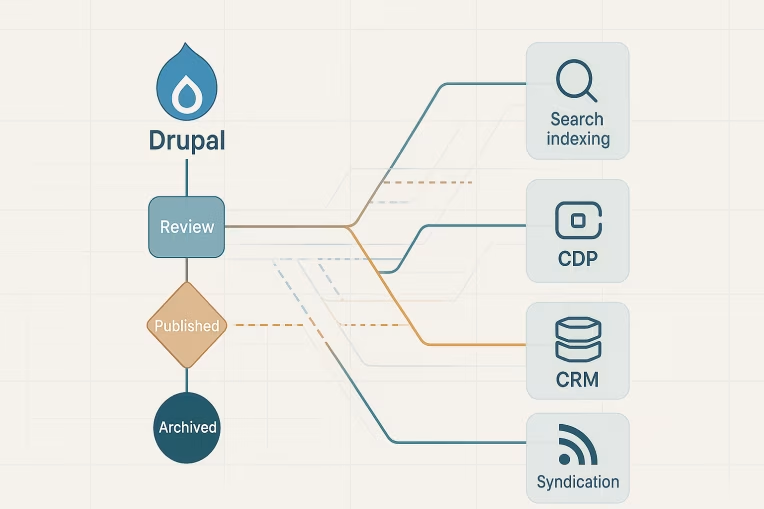
On many enterprise Drupal platforms, workflow design starts in the CMS and stops there. Editors need a way to move content from draft to review to publication, so teams configure states that make sense inside the authoring interface. The problem appears later, when search platforms, customer data systems, CRM integrations, caches, feeds, and notification services all begin reacting to those same states as if they mean the same thing.
They usually do not.
A state label like Published may be sufficient for an editor who only needs to know whether a page is visible on the website. It is rarely sufficient as a downstream contract. Search may need to know whether content is indexable. A CDP may need to know whether the content is eligible for personalization. CRM-triggered alerts may need to know whether the content is approved for customer communications. A syndication feed may need to know whether rights, locale, and embargo checks are complete.
That is why Drupal workflow state mapping should be treated as an integration architecture concern, not just an editorial configuration exercise. The goal is not merely to create workflow states. The goal is to define what each state means, who owns that meaning, which downstream actions it should allow, and which actions it must prevent.
Why workflow states fail outside the CMS
Workflow states often fail in downstream systems because they are created to solve editorial coordination, not system interoperability.
Inside Drupal, a state can be intentionally broad. In review might simply mean that someone other than the author should look at the content. Published might mean the page should render publicly. Those meanings can be good enough for day-to-day editorial use.
Outside Drupal, broad meanings become operational risk.
A downstream consumer usually needs more precision than the editorial team originally intended. Consider a few common failure modes:
- Search indexes content as soon as it sees
Published, even though legal approval is still pending. - A cache invalidation service purges immediately on state change, exposing a page before a scheduled campaign launch.
- A CDP receives a publish event and starts targeting content that is live on the site but not yet approved for personalization.
- A CRM integration sends a notification about a resource that is technically reachable but missing required regional disclaimers.
- A feed consumer republishes content externally even though syndication rights were never confirmed.
In each case, the system is not necessarily broken. It is following an unclear contract.
This is the hidden issue: editorial workflows often encode human process, while downstream systems require machine-actionable semantics. If the state model does not bridge that gap, each consuming system invents its own interpretation. That is where inconsistency begins.
The hidden assumption behind “published”
The word Published tends to carry an unspoken assumption: that one state can answer every question about readiness.
In practice, enterprise platforms usually need to answer several different questions:
- Is this content publicly accessible?
- Is it intended to be indexed by search engines?
- Is it approved for internal or external syndication?
- Is it eligible for campaign activation or personalization?
- Is it complete in all required locales or channels?
- Is it within a valid business time window?
- Is it safe to notify subscribers or downstream systems?
A single boolean interpretation of publication collapses all of those questions into one. That can work on a small site with few integrations. It usually does not hold up on a larger platform.
A safer framing is this: Published is not a universal truth. It is one state in one system, and it must be translated into explicit downstream permissions and behaviors.
For example, content can be:
- visible on the web but excluded from search
- approved for search but not for syndication
- scheduled for launch but not yet cache-purgeable
- live in one locale but restricted in another
- archived from primary navigation but still retained for compliance
Once teams accept that Published is not a sufficient contract, workflow design becomes more disciplined. The discussion moves from labels to semantics.
Common downstream consumers: search, CDP, CRM, cache, feeds, notifications
The most useful workflow mapping work starts by identifying consumers and documenting what they actually need from the CMS.
Search
Search systems usually care about more than page visibility. They may need signals for:
- indexable versus non-indexable status
- canonical URL readiness
- locale completeness
- effective start and end dates
- content removal or deprecation
If search reacts only to Published, results can become stale or misleading. A page may stay in the index long after business owners consider it retired. Or it may appear before required metadata is ready.
CDP and personalization layers
A CDP or personalization engine often treats published content as available inventory for targeting. That can be dangerous when a piece is live but not yet approved for audience activation.
This commonly happens when editorial publication and campaign readiness are separate decisions. The content exists, but its use in segmentation, recommendations, or triggered experiences still requires another approval step.
CRM and notification systems
CRM-connected workflows may generate alerts, emails, sales prompts, or customer service cues. Those systems need confidence that the content is not only accessible, but intentionally distributable.
If notification systems subscribe directly to broad publish events, they can send messages too early, too late, or based on content later rolled back.
Cache and delivery layers
Cache invalidation often looks straightforward until scheduling, rollback, and multi-region release patterns are involved.
A state transition that should prepare content for launch is not always the same transition that should trigger cache purge. If those are treated as identical, teams can expose incomplete content or create inconsistent page delivery across channels.
Feeds and syndication consumers
Feeds often require stronger publication semantics than the website itself. External consumers may need confirmation of rights, category mapping, embargo release, content completeness, or structured field validation.
If syndication follows website publication automatically, content can leak into channels that have stricter business rules than the primary site.
Internal operational consumers
Not all consumers are customer-facing. Analytics tagging workflows, translation pipelines, QA queues, and governance dashboards also depend on state changes. Poorly defined states create operational ambiguity here too.
The lesson is simple: each consumer needs a clear answer to a specific business question. Workflow mapping should capture those answers explicitly rather than assuming one shared meaning.
State mapping patterns: draft, review, approved, scheduled, live, archived, restricted
There is no single correct enterprise workflow, but there are useful patterns. The important design choice is to separate editorial progress from downstream eligibility where necessary.
Below is a practical way to think about common states.
Draft
Draft usually means content is being created or materially revised.
Typical downstream rule:
- no external propagation
- no search indexing
- no notifications
- no syndication
This sounds obvious, but it matters when autosave, preview APIs, or content lake integrations are involved. Some platforms accidentally expose draft-like data to downstream services because transport is tied to save events rather than governed transitions.
Review
Review often indicates editorial, legal, brand, compliance, or stakeholder evaluation.
Typical downstream rule:
- still not externally active
- may be visible to preview systems only
- may be eligible for QA tooling but not customer-facing channels
The key is to avoid treating review as an integration trigger unless a consumer explicitly supports preview or preflight workflows.
Approved
Approved is one of the most useful states to define carefully because it often means different things to different teams.
For some organizations, approved means the content body is final but release timing is pending. For others, it means all business stakeholders have cleared the content for any downstream use.
Those are not equivalent meanings.
A safer pattern is to document exactly what approvals are complete and which downstream consumers may now act. For example:
- search metadata approved
- syndication rights approved
- campaign usage approved
- locale validation complete
If that level of detail is too granular for the state model itself, capture it in release flags, validation fields, or policy checks rather than burying it in assumptions.
Scheduled
Scheduled is where many enterprise failures begin.
A scheduled state may mean:
- the content has a future go-live date
- the content is approved for launch pending time window
- the website should switch at a specific timestamp
- downstream systems should prepare but not activate
Search indexing, cache purge, feed emission, and notifications often need different timing behavior here. A system that treats Scheduled as effectively live may fire too early. A system that ignores it entirely may miss the launch window.
Teams should define whether scheduled content emits pre-launch events, launch events, or both.
Live
Live should represent a state with very clear operational meaning.
For many platforms, this is the best candidate for public accessibility and downstream activation. But even here, it helps to specify the actual allowed behaviors:
- public rendering allowed
- cache purge allowed
- search indexing allowed or denied
- personalization eligibility allowed or denied
- syndication allowed or denied
- notifications allowed or denied
In other words, Live should not just be a label. It should map to a controlled set of downstream consequences.
Archived
Archived is often overlooked because teams think of it as a content lifecycle concern rather than an integration concern.
But archive behavior matters a great deal downstream. Should search remove the item immediately? Should feeds emit a deletion or tombstone event? Should analytics dimensions persist? Should customer-facing links redirect or return a non-indexable fallback?
An archive state without corresponding downstream rules often leads to stale search results and orphaned external references.
Restricted
Some content is valid but intentionally limited by audience, geography, role, or channel. A Restricted state, or an equivalent access pattern, can help avoid overloading Published with access nuances.
Downstream rules here may need to distinguish between:
- authenticated but indexable internal content
- region-limited content
- licensed content excluded from feeds
- time-bound access for campaigns or partners
This is especially important when multiple systems consume the same content but operate under different entitlement assumptions.
Event contracts and payload design for workflow transitions
State mapping becomes reliable when it is backed by explicit event contracts.
Instead of forcing every downstream consumer to query Drupal and infer meaning from raw state names, publish well-defined events that describe both the transition and its business implications.
A useful transition event often includes:
- content identifier
- content type
- current state
- previous state
- transition timestamp
- effective start and end dates if applicable
- locale or market scope
- canonical URL or route reference
- visibility status
- indexability status
- syndication eligibility
- personalization eligibility
- notification eligibility
- actor or source of change
- correlation or trace identifier
The point is not to create a bloated payload. The point is to avoid forcing every consumer to reinterpret editorial intent from incomplete data.
For example, a transition to Live might still carry indexable: false and syndicationEligible: false. That tells downstream systems that public rendering is allowed but some other actions are not.
That approach is usually safer than using state name alone as the trigger.
A few practical design principles help:
Keep state names stable, and put interpretation in contract documentation
Renaming states can break integrations unexpectedly. Even if the meaning stays the same for editors, downstream consumers may depend on exact values. Stable identifiers with versioned documentation reduce drift.
Distinguish transition events from snapshot APIs
Consumers often need both:
- transition events for near-real-time reactions
- snapshot or read APIs for reconciliation and recovery
Events tell a system what changed. Snapshots help it verify current truth after outages, missed messages, or rollback scenarios.
Design for idempotency
Workflow transitions can be retried, replayed, or emitted more than once. Downstream systems should be able to process duplicate events safely.
Make effective dates explicit
Do not assume the event timestamp equals launch time. Scheduled publication, delayed deactivation, and regional rollout patterns all require explicit effective windows.
Include removal semantics
Unpublish, archive, expire, and delete are not interchangeable. Each may require different downstream behavior. Your event model should not flatten them into a generic not published outcome.
Governance rules for exceptions, manual overrides, and rollback
Even a well-designed workflow will face exceptions. Governance determines whether those exceptions remain manageable or become permanent ambiguity.
A few rules are especially valuable.
Define ownership of state semantics
Someone must own the meaning of each state and each downstream mapping. If editorial owns labels, integration teams own event contracts, and channel teams independently interpret both, drift is almost guaranteed.
A better model is shared governance with clear decision rights:
- editorial defines authoring needs
- platform architecture defines system semantics
- channel owners validate downstream consequences
- operations defines support and recovery procedures
Document manual override paths
Enterprise platforms often need urgent releases, emergency takedowns, or temporary bypasses. Those should be designed deliberately, not improvised.
For example, if operators can mark content live outside normal review, ask:
- which downstream events should still fire?
- which validations may be skipped?
- how is the override flagged for audit and reconciliation?
- who is notified?
An undocumented override is usually where the cleanest workflow model breaks first.
Plan rollback as a first-class scenario
Rollback is not just a reverse publish action. It may mean:
- restore previous content version
- remove current content from search
- reverse syndication eligibility
- reissue cache invalidations
- suppress or compensate for previously sent notifications
If rollback procedures are not mapped ahead of time, teams often discover that downstream systems have already acted in ways that are hard to undo.
Separate policy exceptions from state model complexity
Not every edge case deserves a new workflow state. Too many states can make the editorial experience unusable and the integration model brittle.
A good rule is to add a state only when it represents a durable business meaning with distinct downstream consequences. Use flags, validations, or exception handling for narrower cases.
Validation checklist before launch or replatforming
Before launching a new Drupal workflow or replatforming an existing one, it helps to run a structured validation pass.
Use a checklist like this:
- For each workflow state, can every stakeholder describe its meaning in the same way?
- For each downstream consumer, is there a documented mapping from state or transition to action?
- Is
Publishedbeing used as a shortcut for multiple different business conditions? - Are scheduled launches modeled with explicit effective dates and activation behavior?
- Do search, cache, CDP, CRM, and syndication systems have different eligibility rules documented?
- Are archive, expire, unpublish, and delete treated as distinct outcomes where necessary?
- Are locale, region, or audience restrictions represented clearly enough for consumers?
- Can downstream consumers recover from missed or duplicated events?
- Are manual overrides audited and operationally safe?
- Is rollback behavior defined for each major consumer?
- Are contract changes versioned and communicated across teams?
- Is there a reconciliation process to compare CMS truth with downstream system state?
This kind of review usually surfaces hidden assumptions quickly. If two teams answer the same question differently, the workflow contract is not finished.
A practical way to implement safer state contracts
If your current platform already relies on ambiguous state meanings, the answer is not necessarily to redesign the entire editorial workflow at once.
A practical path is usually incremental:
- Inventory downstream consumers. List every system that reacts to content lifecycle changes.
- Document current assumptions. Capture what each consumer believes
Draft,Published,Archived, and other states mean today. - Identify conflict points. Look for places where one state drives incompatible actions across systems.
- Define business semantics. Write plain-language rules for visibility, indexability, eligibility, retention, and timing.
- Map states to downstream permissions. Treat state names as inputs, not complete decisions.
- Strengthen event payloads. Add the fields consumers need so they do not infer too much from labels alone.
- Add reconciliation and rollback procedures. Assume missed events and operator exceptions will happen.
- Train editors and operators. Governance fails if the people using the workflow do not understand its operational consequences.
This approach preserves editorial usability while making integrations more reliable.
Conclusion
The central mistake in many enterprise Drupal platforms is not that the workflow is too simple or too complex. It is that workflow states are treated as editorial labels first and system contracts only by accident.
That is why downstream behavior becomes inconsistent. Search, CDP, CRM, cache, feeds, and notification systems are all trying to answer different questions from the same ambiguous signal.
A stronger approach to Drupal workflow state mapping starts by defining the business meaning of each state, then translating that meaning into explicit downstream rules, event contracts, and governance procedures. When teams do that well, Published stops being an overloaded guess and becomes just one part of a more reliable content lifecycle model.
For enterprise digital platforms, that shift is not theoretical. It is how you reduce stale search results, premature activations, missed notifications, and operational surprises during launch, rollback, and replatforming. In other words, it is how you make workflow work outside the CMS, not just inside it.
Tags: Drupal, Drupal workflow state mapping, Drupal editorial workflow integrations, CMS workflow governance, search indexing workflow, CDP publishing events, enterprise digital platforms