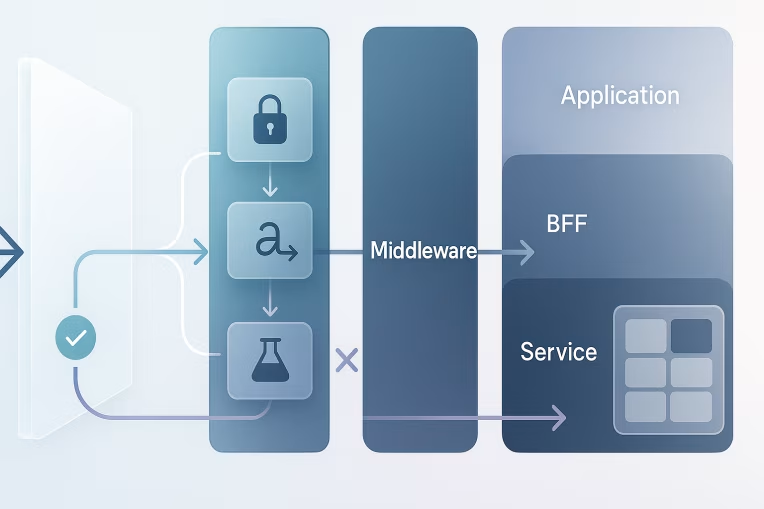
Middleware is attractive because it sits early in the request path. It can inspect a request before page code runs, influence routing, and enforce cross-cutting behavior in one place. For enterprise teams, that makes it feel like the natural home for many platform concerns.
That instinct is understandable, but it is also where trouble starts.
When too much responsibility collects in middleware, it stops being a lightweight request filter and becomes an edge control plane. At that point, small changes can affect every route, every cache decision, and every downstream service. Debugging becomes harder because behavior is split across runtime layers. Ownership becomes blurred because platform, frontend, identity, and experimentation teams all want to add rules in the same place.
A healthy Next.js middleware architecture is not about using middleware everywhere. It is about choosing a narrow set of concerns that benefit from early execution, limited context, and globally consistent behavior.
Why middleware expands faster than teams expect
Middleware tends to grow for organizational reasons as much as technical ones.
First, it offers leverage. One change can affect all applications or all routes in a deployment. That is appealing when a team needs to introduce a redirect strategy, locale normalization, bot filtering, or authentication checks across a large surface area.
Second, it looks simpler than it often is. A rule that seems small in isolation can have system-wide implications once you account for caching, rewrites, cookies, request headers, and failure behavior.
Third, middleware attracts shared concerns from multiple teams:
- platform teams want central routing and traffic controls
- security teams want early auth and bot defenses
- marketing teams want experiment assignment and campaign-aware redirects
- regional teams want locale negotiation and geo-aware entry behavior
- product teams want route-specific exceptions
Each addition can be defensible. The problem is the combined effect.
As responsibilities accumulate, middleware becomes harder to reason about because it operates under a constrained model:
- it should execute quickly
- it has limited business context compared with application code
- it often affects cache keys and CDN behavior
- it sits before many of the logs and traces developers normally rely on
- failures may block the request before the app can recover gracefully
That combination is why enterprise platforms should treat middleware as a governed boundary, not just a convenient extension point.
The legitimate use cases for Next.js middleware
Middleware is most effective when the logic is:
- request-oriented rather than business-oriented
- lightweight and deterministic
- broadly applicable across many routes
- useful before application rendering begins
- safe to execute with limited context
In practice, strong middleware candidates usually include the following.
URL normalization and redirect handling
Canonicalization is a good fit for middleware when rules are stable and easy to evaluate. Examples include:
- enforcing trailing slash policy
- redirecting legacy paths to new structures
- normalizing host or protocol expectations
- removing or preserving selected query parameters
These rules benefit from early handling because they avoid unnecessary app execution and make external traffic behavior consistent.
Lightweight locale negotiation
Locale selection can belong in middleware when it is limited to initial request shaping. For example:
- choosing a default locale from URL, cookie, or
Accept-Language - redirecting users from a generic entry point to a locale-prefixed route
- preserving locale in simple rewrites
This works best when locale resolution is deterministic and does not require deep personalization, entitlement data, or expensive service calls.
Coarse authentication gating
Basic authentication checks can be appropriate when middleware is only determining whether a request appears authenticated enough to proceed. For example, checking for the presence of a session token or a signed cookie before allowing access to a protected route segment can be reasonable.
The key word is coarse. Middleware is well suited to simple gatekeeping, not full authorization decision trees.
Request segmentation for experiments or bot handling
Edge request inspection can help with:
- assigning users into simple experiment buckets
- detecting obvious bot traffic patterns
- setting request headers that the application can later interpret
- routing some requests to different entry experiences
This is useful when the logic is stable, transparent, and limited in scope. The edge can classify or annotate a request, but it should not become the sole source of complex decisioning truth.
Early rewrites for platform routing
In multi-brand or multi-tenant platforms, middleware can assist with resolving an incoming hostname or path pattern to the correct application area. This can be valuable when the routing rule is structural and does not require rich business context.
For example, mapping brand-a.example.com and brand-b.example.com into different application spaces is a reasonable use of early routing logic.
What should not live in middleware
A useful test is this: if the logic depends on deep domain knowledge, multiple downstream systems, or nuanced failure handling, it probably does not belong in middleware.
Complex authorization
Authentication and authorization are not the same thing.
Middleware can check whether a user appears signed in. It should usually not decide whether that user can access a specific resource based on roles, accounts, entitlements, geography, product state, or record-level permissions. Those decisions often require data access, consistency guarantees, and auditability that belong in the application or BFF layer.
Putting complex authorization in middleware creates several problems:
- policy logic becomes harder to test in business terms
- authorization context may be incomplete at the edge
- failures may deny valid users or allow inconsistent behavior
- duplicating rules between middleware and APIs becomes likely
If the app or API must still enforce authorization, middleware should not pretend to be the final authority.
Business-rule personalization
Personalized pricing, catalog visibility, customer-tier experiences, and workflow state are application concerns. They rely on domain data and often change with business logic releases.
When these rules move into middleware, teams create a split-brain system: one set of request decisions at the edge and another set of rendering or API decisions inside the app. That usually increases defect risk rather than reducing it.
Data fetching with operational dependencies
If middleware depends on remote services for feature flags, user profiles, customer accounts, entitlement checks, or content decisions, every request becomes vulnerable to that dependency. This increases tail latency and introduces failure coupling between edge routing and backend availability.
Sometimes teams accept this tradeoff without realizing they have elevated a formerly optional backend call into a mandatory precondition for all traffic.
A safer pattern is often:
- do minimal classification in middleware
- pass stable hints downstream via headers or cookies when appropriate
- let the application or BFF perform data-aware decisions where fallback behavior is easier to control
High-churn product logic
Middleware should not become the fastest place for any team to inject behavior. If product squads frequently need route-specific exceptions, experiment conditions, campaign rules, or one-off logic, middleware will turn into a policy patchwork.
High-churn logic belongs closer to the application teams that own its outcomes and tests.
Edge auth, localization, and experiment boundaries
These are the three areas where enterprise teams most often need clearer boundaries.
Authentication middleware boundaries
A practical boundary is:
- middleware can verify whether a request has enough session evidence to continue
- the application or BFF performs authoritative identity, session, and permission validation
That means middleware might:
- redirect anonymous users away from protected route groups
- preserve return URLs for sign-in flows
- attach a lightweight auth state marker for downstream use
But it should usually avoid:
- calling multiple identity services to enrich the session
- making resource-level access decisions
- embedding complex exception rules for different products or account types
If a route truly cannot tolerate any unauthenticated app execution, use middleware for the earliest gate. But keep the rule narrow and ensure the app still validates access independently.
Localization middleware boundaries
Localization is a common edge success story when teams keep it focused on entry behavior.
Middleware is a good place to:
- negotiate locale from path, cookie, domain, or browser preference
- redirect to the canonical localized path
- maintain consistent locale URL structures across regions
It is a poor place to:
- decide content availability by market using dynamic business rules
- fetch translation eligibility from remote systems
- merge locale selection with customer-specific entitlements
A good pattern is to let middleware choose the most likely locale path, then let the application own content, fallback, and business availability decisions.
Experimentation boundaries
Experimentation at the edge can be useful, but only when the experiment requires early routing or cache-safe segmentation.
Good candidates include:
- assigning a stable anonymous bucket
- rewriting to one of two entry experiences
- setting a simple header or cookie that downstream rendering can use
Poor candidates include:
- experiments that depend on authenticated customer context
- experiments with many segment rules and exception layers
- experiments that dramatically expand cache variation
- experiments that cannot be observed end to end
In enterprise environments, experimentation logic often outgrows middleware because teams want richer targeting. Once segmentation depends on CRM state, subscription level, or historical behavior, the application or BFF is usually the better decision layer. Teams that need reliable exposure and attribution across those boundaries usually benefit from a dedicated experimentation data architecture.
Cache keys, rewrites, and failure behavior
Middleware decisions do not exist in isolation. They influence how responses are cached, varied, and invalidated.
That is why cache key design should be part of middleware governance from the beginning.
Cache variation discipline
Every request attribute used by middleware can potentially create a new response variant:
- locale
- host
- cookie presence
- experiment bucket
- geo signal
- device classification
If teams combine too many of these dimensions, cache efficiency degrades quickly. Even if the site still works, the platform may lose the benefits of shared caching and predictable response behavior.
A safer approach is to keep the number of cache-affecting dimensions deliberately small. Ask whether a middleware decision truly needs to change the rendered response for all downstream layers, or whether it can be handled later in the app with more context.
Rewrites versus redirects
Rewrites are powerful because they preserve the visible URL while routing internally. Redirects are clearer because they move the browser to a new canonical URL.
Use rewrites when you need internal route resolution without changing the user-facing address. Use redirects when canonicalization, SEO clarity, or user-visible navigation matters.
The risk comes when middleware chains multiple rewrites and conditional redirects. That can create behavior that is difficult to trace and easy to break during rollout.
In enterprise systems, establish simple conventions such as:
- canonical URL fixes use redirects
- tenant or app-space internal mapping uses rewrites
- only one layer owns legacy redirect policy
- middleware should not perform multi-step routing transformations unless the chain is explicitly documented
Failure behavior
One of the most important architecture questions is: what happens when middleware cannot decide?
Common failure modes include:
- missing or malformed cookies
- timeout or unavailability of a remote decision source
- unexpected geo or locale input
- experiment assignment errors
- route mapping configuration drift
For each middleware concern, define whether failure should be:
- fail open: allow the request through with reduced behavior
- fail closed: block or redirect the request
- fail safe to a default: use a canonical locale, route, or experience
Many enterprise teams discover too late that they have made middleware fail closed for concerns that were never critical enough to justify global request blocking.
As a rule, only security-critical gates should default toward hard denial. Most other concerns should degrade gracefully.
Observability and release controls for middleware changes
Middleware is infrastructure-like code, even when it lives near the frontend stack. It deserves stronger release discipline than typical route-level changes.
Logging and tracing
At minimum, teams should be able to answer:
- which middleware rule matched this request
- whether the request was redirected, rewritten, or passed through
- which decision inputs mattered
- whether a fallback path was used
- how the middleware outcome affected downstream handling
That does not mean logging sensitive data or every header value. It means producing structured, privacy-safe signals that let operators reconstruct behavior.
A useful practice is to assign stable identifiers to rule sets or decision branches. Then traces and logs can show not just that middleware executed, but which branch executed.
Metrics
Key metrics often include:
- redirect rate by route group
- rewrite rate by tenant or hostname
- auth-gated request volume
- fallback rate for locale or experiment decisions
- error rate for middleware execution paths
- cache hit impact after rule changes
These help teams distinguish between expected traffic shaping and unintended global side effects.
Controlled rollout
Because middleware can affect the whole platform, release controls matter. Common practices include:
- feature flags for new rule paths
- staged rollout by route segment or host
- explicit review for cache-affecting changes
- rapid rollback paths that do not require coordinated downstream deployments
The main goal is to avoid turning a small routing change into a platform-wide incident.
Ownership clarity
Middleware should have named owners, not just contributors. If multiple teams can add logic, define:
- who approves new middleware use cases
- which concerns require architecture review
- who owns incident response for edge behavior
- which rules belong to platform versus product teams
Without ownership boundaries, middleware grows through convenience rather than design.
A decision framework for placing logic at edge, app, or BFF
When evaluating a new concern, a lightweight placement framework can prevent architectural drift.
Ask these questions in order.
1. Does the logic need to run before application code?
If the answer is no, it probably does not need middleware.
Strong reasons for early execution include canonical redirects, basic route gating, or structural request normalization.
2. Can the decision be made with limited context?
If the logic needs customer records, entitlement graphs, pricing rules, or multiple backend calls, it belongs in the app or BFF.
Middleware should make decisions from stable request signals, not deep domain state.
3. Is the rule deterministic and broadly shared?
Middleware is better for platform-wide policies than for route-level product behavior. If the rule will need many exceptions soon, keep it closer to the owning application.
4. What is the cache impact?
If the decision introduces new response variants, define them explicitly. If teams cannot clearly explain the resulting cache key strategy, the logic is probably in the wrong layer or not yet sufficiently designed.
5. What is the failure mode?
If failure handling is ambiguous, middleware is a risky placement. The edge should not host logic whose outage semantics are unclear.
6. Who owns the outcome?
If the logic is owned by a product or domain team and changes frequently, the application or BFF is usually the better home. Shared platform teams should own stable cross-cutting behavior, not all possible request decisions.
A practical summary looks like this:
- Edge middleware: canonical redirects, lightweight locale negotiation, coarse auth gating, simple request classification, structural rewrites
- Application layer: page-level logic, personalized rendering, complex experiment behavior, domain-aware content decisions
- BFF or API layer: authoritative authorization, user/account enrichment, entitlement checks, aggregated business decisions across services
That division is not absolute, but it is a strong default for enterprise delivery.
Closing perspective
Middleware is valuable precisely because it is close to the request boundary. That is also why it needs discipline.
For enterprise platforms, the goal is not to maximize edge logic. The goal is to keep edge logic small, fast, legible, and governable. When middleware is reserved for early, deterministic, cross-cutting concerns, it can reduce duplication and improve consistency. When it becomes a catch-all for identity, localization, experimentation, and product logic, it creates a fragile control layer that is difficult to observe and risky to change.
A mature Next.js middleware architecture treats the edge as a narrow policy boundary. Let middleware classify and shape requests where that creates clear value. Let the app and BFF own the decisions that require richer context, stronger guarantees, and clearer business accountability. On larger multi-brand platforms, this kind of boundary-setting often sits alongside broader edge rendering architecture decisions and routing governance, as seen in programs such as Organogenesis.
That boundary is what keeps an enterprise Next.js platform scalable not just in traffic, but in team complexity.
Tags: Next.js middleware architecture, Frontend Architecture, Enterprise digital platforms, edge middleware governance, BFF boundaries, cache key design