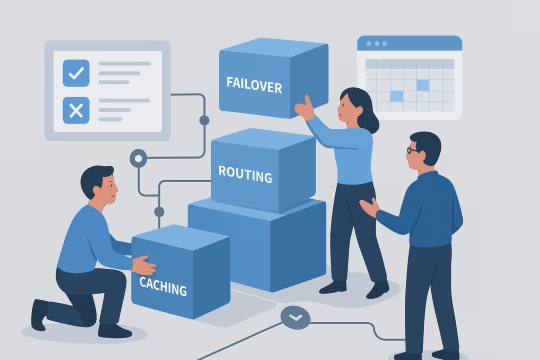
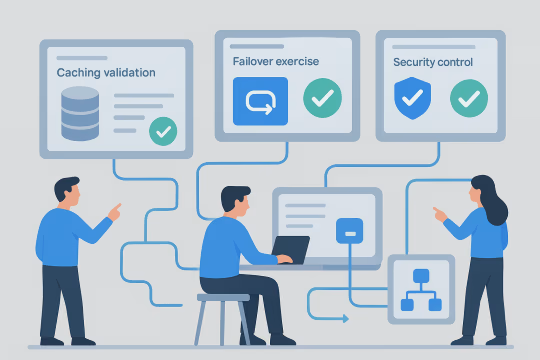
Core Focus

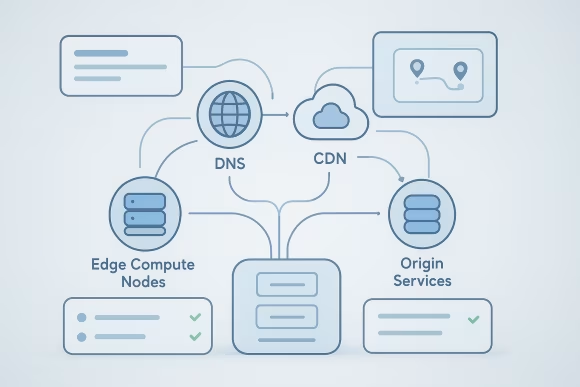
CDN and cache topology
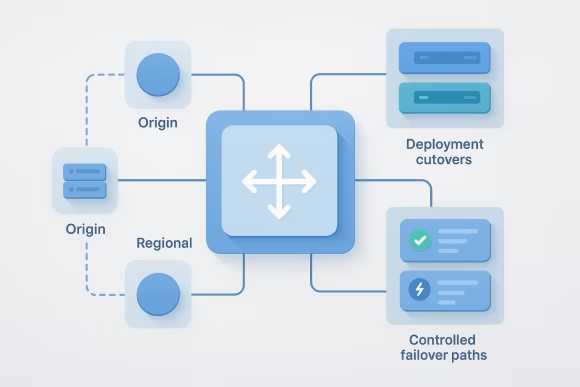
Traffic routing and failover
Origin protection patterns
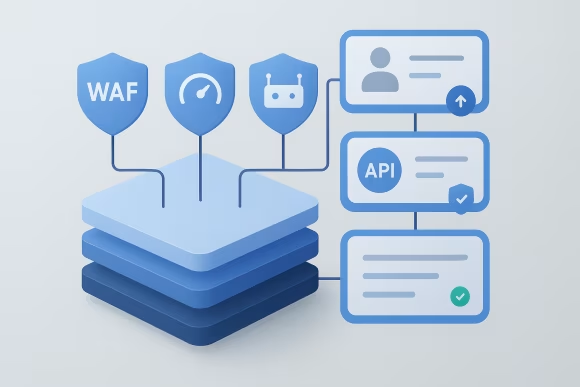
Edge security controls

Best Fit For

  • Multi-region headless delivery
  • High-traffic marketing sites
  • API-driven frontend platforms
  • Multi-brand domain portfolios

Key Outcomes

  • Lower latency variance
  • Reduced origin load
  • Predictable cache behavior
  • Controlled incident blast radius

Technology Ecosystem

  • Edge networks and CDNs
  • Cloud load balancers
  • DNS and TLS automation
  • Observability toolchains

Delivery Scope

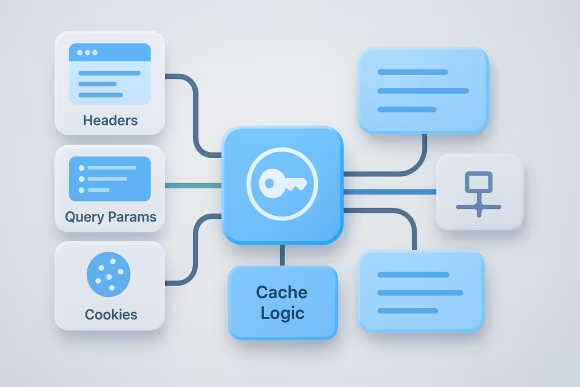
  • Cache key design
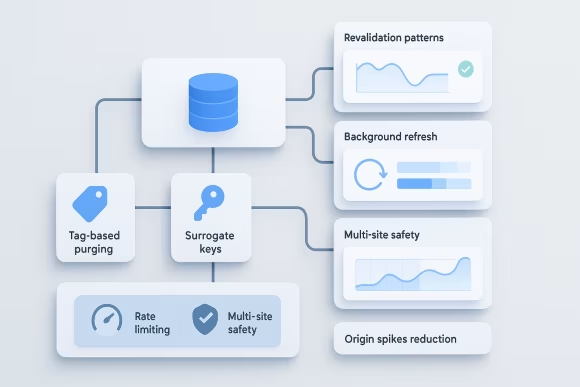
  • Purge and revalidation flows
  • WAF and rate limiting
  • Runbooks and governance

Uncontrolled Edge Configuration Increases Latency and Risk

As headless platforms scale, edge configuration often grows organically: new domains are added, caching rules diverge by team, and routing exceptions accumulate to handle special cases. Over time, the edge layer becomes a collection of implicit decisions spread across CDN settings, DNS records, and application assumptions. Performance becomes inconsistent across geographies, and troubleshooting requires deep tribal knowledge of how requests traverse the stack.

These issues compound for engineering teams because edge behavior is frequently outside standard software delivery workflows. Changes may be applied directly in vendor consoles, lack version control, and bypass review and testing. Cache keys drift from application semantics, leading to hard-to-reproduce bugs such as serving personalized content from shared caches, stale API responses, or unexpected authentication behavior at the edge. When incidents occur, teams struggle to isolate whether the failure is in origin services, routing, TLS, or caching.

Operationally, the platform absorbs unnecessary risk: origin services are exposed to avoidable load, failover paths are untested, and security controls are inconsistent across properties. Release velocity slows because teams cannot predict the impact of edge changes, and remediation often relies on emergency configuration edits rather than controlled rollback mechanisms.


Edge Architecture Delivery Process

Platform Discovery

Review current edge topology, domains, traffic patterns, and origin dependencies. Capture constraints such as compliance, authentication flows, personalization, and multi-site requirements. Establish baseline metrics for latency, cache hit ratio, error rates, and origin load.

Request Path Mapping

Model end-to-end request flows for key user journeys and API calls. Identify cacheable vs non-cacheable paths, vary conditions, and headers/cookies that influence behavior. Document failure modes and current fallback behavior across regions.

Edge Topology Design

Define CDN and routing architecture including POP strategy, origin shielding, multi-origin patterns, and failover. Specify DNS, TLS termination, and certificate automation approach. Align topology with headless rendering, API gateways, and static asset delivery.

Caching Strategy Design

Design cache keys, TTLs, stale-while-revalidate patterns, and purge/revalidation flows. Define rules for authenticated traffic, personalization, and preview environments. Establish guardrails to prevent cache poisoning and accidental shared caching of private responses.

Security Controls Definition

Specify WAF rules, bot management, rate limiting, and request validation at the edge. Align with zero-trust principles, secret handling, and secure headers. Define how security policies are promoted across environments with auditability.

Implementation as Code

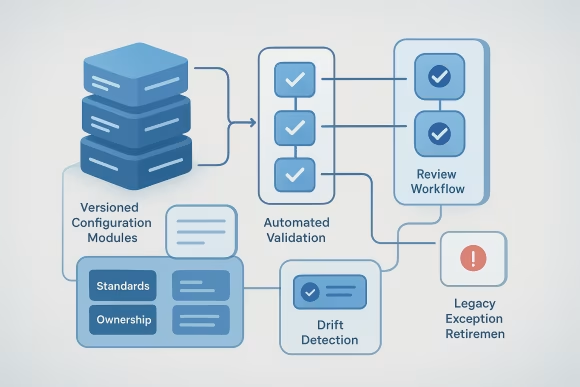
Implement edge configuration using version-controlled artifacts and repeatable pipelines where supported. Standardize environment promotion, change review, and rollback. Validate configuration parity across domains and properties to reduce drift.

Observability and SLOs

Instrument edge logs, metrics, and tracing correlation to origin services. Define SLOs for latency, availability, and error budgets, with alerting tuned to edge-specific signals. Provide dashboards that separate edge, network, and origin concerns.

Operational Governance

Establish runbooks, incident playbooks, and change management for edge updates. Define ownership boundaries between platform, application, and security teams. Schedule periodic reviews to retire exceptions, validate failover, and recalibrate caching rules.

Core Edge Architecture Capabilities

This service establishes the technical foundations for operating an edge layer as part of a headless platform, not as a set of isolated CDN settings. The focus is on deterministic request handling, explicit caching semantics, controlled routing and failover, and security policies that can be audited and promoted across environments. Capabilities are designed to reduce configuration drift, improve diagnosability, and keep edge behavior aligned with application and API architecture as the platform evolves.

Capabilities
  • CDN topology and configuration design
  • Cache key and TTL strategy
  • Purge and revalidation architecture
  • Routing rules and failover patterns
  • WAF, rate limiting, bot controls
  • Origin shielding and protection
  • Edge observability and SLOs
  • Runbooks and change governance
Target Audience
  • Platform engineers
  • Infrastructure teams
  • DevOps engineers
  • Site reliability engineering
  • Security engineering
  • Digital platform owners
  • Enterprise architects
Technology Stack
  • Edge computing patterns
  • CDN configuration and tuning
  • Cloud platforms
  • DNS and traffic management
  • TLS and certificate automation
  • WAF and bot mitigation
  • Log pipelines and metrics
  • Infrastructure as code workflows

Delivery Model

Engagements are structured to make edge behavior explicit, testable, and governable. Delivery combines architecture definition with hands-on implementation and operational enablement, so teams can safely evolve edge configuration alongside application and platform changes.

Delivery card for Discovery and Baseline[01]

Discovery and Baseline

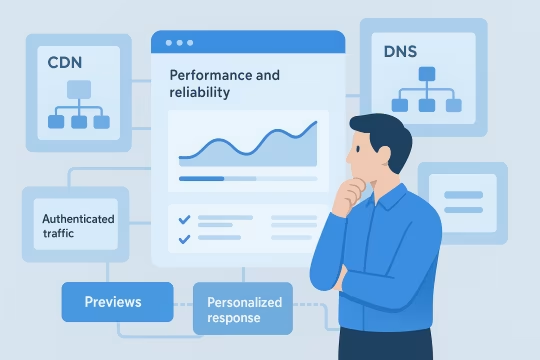
Collect current CDN, DNS, and origin configurations and map them to platform requirements. Establish baseline performance and reliability metrics, and identify high-risk paths such as authenticated traffic, previews, and personalized responses.

Delivery card for Architecture Definition[02]

Architecture Definition

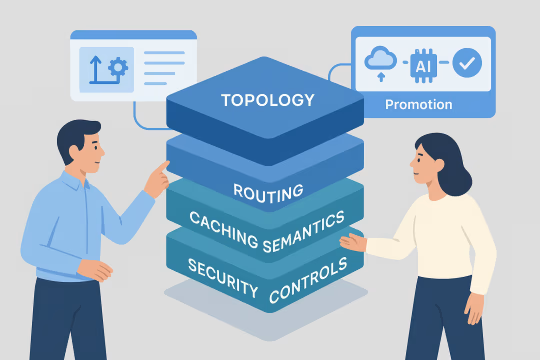
Produce an edge reference architecture covering topology, routing, caching semantics, and security controls. Define environment strategy and promotion workflow so configuration changes follow the same rigor as software releases.

Delivery card for Implementation Planning[03]

Implementation Planning

Break the target architecture into incremental changes with rollback points. Define test scenarios for caching, routing, and failover, and align the plan with release calendars and operational constraints.

Delivery card for Configuration Implementation[04]

Configuration Implementation

Apply routing, caching, and security rules using repeatable, reviewable mechanisms where possible. Standardize rule structure across domains and ensure parity between environments to reduce drift and unexpected behavior.

Delivery card for Validation and Testing[05]

Validation and Testing

Validate cache behavior, header handling, and routing outcomes using synthetic tests and controlled traffic. Exercise failover paths and confirm that security controls do not break legitimate API and frontend flows.

Delivery card for Observability Enablement[06]

Observability Enablement

Implement dashboards and alerting for edge-specific signals such as cache hit ratio, regional latency, and edge error classes. Ensure logs support incident investigations and correlate to origin services for end-to-end diagnosis.

Delivery card for Operational Handover[07]

Operational Handover

Deliver runbooks, change procedures, and ownership boundaries for ongoing edge operations. Provide training for teams responsible for day-to-day updates and incident response, including safe rollback and emergency controls.

Delivery card for Continuous Improvement[08]

Continuous Improvement

Schedule periodic reviews to retire exceptions, tune caching, and validate resilience assumptions. Evolve the edge model as new domains, products, and headless services are introduced, keeping governance aligned with platform growth.

Business Impact

A well-architected edge layer improves platform predictability: performance becomes measurable and repeatable, operational risk is reduced through controlled change, and origin services are protected from avoidable load. The impact is most visible in release safety, incident response speed, and the ability to scale traffic and properties without multiplying configuration complexity.

Lower Latency Variance

Consistent caching and routing reduce performance differences across regions and networks. Teams can tune for predictable TTFB and reduce regressions caused by ad hoc edge changes.

Reduced Origin Load

Improved cache hit ratios and origin shielding decrease backend traffic and connection pressure. This often delays infrastructure scaling needs and reduces the likelihood of cascading failures under peak demand.

Safer Releases

Versioned, reviewable edge configuration reduces emergency console edits and untracked changes. Clear rollback points and validated routing rules make cutovers and migrations less risky.

Faster Incident Triage

Edge-aware observability separates CDN, routing, TLS, and origin issues quickly. Better signal quality reduces time spent guessing where failures occur and improves mean time to recovery.

Improved Resilience

Designed failover paths and health checks prevent single-region or single-origin dependencies from taking down the platform. Controlled degradation patterns keep critical journeys available during partial outages.

Stronger Security Posture

Consistent WAF, rate limiting, and request validation reduce exposure to common edge-layer threats. Governance and auditability help maintain policy consistency across domains and environments.

Reduced Configuration Drift

Standardized rule structures and promotion workflows keep properties aligned as the platform grows. Teams spend less time reconciling differences between environments and less time maintaining legacy exceptions.

Scalable Multi-Site Operations

A reference edge architecture enables new domains and brands to be onboarded with predictable patterns. This reduces per-site customization and keeps operational overhead manageable as the estate expands.

FAQ

Common questions about edge infrastructure architecture for headless platforms, covering architecture, operations, integrations, governance, risk, and engagement.

How do you design an edge architecture for a headless platform?

We start by modeling the request paths that matter: public pages, API calls, authenticated journeys, previews, and asset delivery. For each path we define where decisions are made (DNS, CDN, edge compute, origin), what can be cached, and what must pass through. That produces an explicit contract for headers, cookies, cache keys, and error handling. From there we design topology: how many origins exist, whether they are regional, how origin shielding is applied, and what failover looks like. We also define routing rules (host/path based, canary, blue/green) and the operational boundaries between application and platform teams. Finally, we design observability and governance as first-class architecture concerns: what telemetry is required at the edge, how configuration is versioned and promoted, and how changes are validated. The goal is deterministic behavior under load and during incidents, not just a fast happy path.

What caching patterns work well for API-driven and personalized experiences?

For API-driven delivery, caching needs to be tied to application semantics rather than URL shape alone. We typically define cache keys that include only the dimensions that truly change the response (for example locale, device class, or a small set of query parameters). For personalization and authenticated traffic, we avoid shared caching unless there is a safe segmentation strategy (such as per-user cache, token-bound caching, or edge-side composition that keeps private data out of shared caches). We often use a layered approach: aggressively cache static assets and public HTML, selectively cache API responses that are safe and stable, and use stale-while-revalidate to smooth traffic spikes. Where preview and editorial workflows exist, we design explicit bypass mechanisms and separate preview domains or headers to prevent accidental cache pollution. The key is to document and test the caching contract: which headers/cookies are allowed, what varies responses, and how invalidation is triggered when content or configuration changes.

How do you operationalize edge configuration changes safely?

Safe operations require treating edge configuration as part of the delivery system. We aim for version-controlled configuration, peer review, and environment promotion (dev/stage/prod) where the CDN and DNS tooling allows it. Even when vendor consoles are involved, we define a controlled workflow with change records, approvals, and rollback steps. We also define validation gates: synthetic checks for routing outcomes, cache behavior verification (hit/miss, vary dimensions), TLS and header validation, and security policy checks. For high-risk changes, we use staged rollout patterns such as canary domains, weighted routing, or time-boxed rule activation. Operationally, we provide runbooks and incident playbooks that include “safe toggles” (for example bypass cache, disable a rule set, or route to a fallback origin) and clear ownership boundaries. The objective is to reduce emergency edits and make edge changes predictable and reversible.

What metrics and logs are essential for running the edge layer?

At minimum, teams need visibility into latency (TTFB and total), cache performance (hit ratio, byte hit ratio, revalidation rates), error classes (4xx/5xx split by edge vs origin), and regional variance. We also track origin load indicators that the edge influences: request rate, connection reuse, timeouts, and retry behavior. For logs, we prioritize fields that support correlation and diagnosis: request ID propagation, host/path, cache status, selected origin, TLS details, WAF/rate-limit outcomes, and timing breakdowns. Where possible, we align edge request IDs with application tracing so a single user request can be followed from edge to API to downstream services. Alerting should be tuned to edge-specific failure modes: sudden cache hit drops, regional spikes in 5xx, elevated origin timeouts, or WAF false positives. Dashboards should separate edge configuration issues from application regressions to reduce time-to-triage.

How does edge architecture integrate with CI/CD and infrastructure as code?

Integration depends on the capabilities of the CDN/DNS providers and the organization’s delivery tooling. We typically define a pipeline that can validate and promote edge configuration alongside application releases. That includes linting and policy checks (naming, forbidden patterns), automated tests against a staging edge environment, and controlled promotion to production. Where infrastructure as code is feasible, we structure configuration into reusable modules: shared security baselines, standard caching rules, and per-domain overrides. We also define secrets handling and access controls so pipelines can apply changes without broad human access to production consoles. The practical goal is to reduce drift and align change cadence: application teams can ship features without breaking cache semantics, and platform teams can evolve routing and security policies without surprising application behavior. Clear interfaces and automated validation are more important than any single tool choice.

How do you integrate edge routing with multi-region origins and API gateways?

We start by defining the origin model: active-active, active-passive, or regional affinity based on data residency, latency, and dependency constraints. For API gateways, we define how hostnames and paths map to gateway routes, and where authentication and rate limiting should occur (edge vs gateway) to avoid duplicated or conflicting policies. Routing rules are then designed to be explicit and testable: path-based routing for static assets vs APIs, host-based routing for multi-brand setups, and controlled failover rules that avoid flapping. Health checks must reflect real dependency health, not just TCP reachability. We also pay attention to headers and caching interactions: ensuring the edge forwards only necessary headers, normalizes where appropriate, and does not inadvertently vary caches on noisy headers. Finally, we ensure observability can attribute errors to the selected region/origin so teams can see whether issues are localized or systemic.

How do you prevent configuration drift across many domains and properties?

Drift is usually a governance problem more than a technical one. We address it by defining a reference edge architecture and a set of reusable configuration building blocks: baseline security rules, standard caching patterns, logging formats, and routing conventions. New domains should be onboarded by composing these blocks rather than starting from scratch. We also define ownership and change boundaries: which teams can change global baselines, which teams can apply per-domain overrides, and what review is required. Where possible, we implement automated checks that detect divergence from baselines and flag risky patterns such as caching on cookies, missing security headers, or inconsistent TLS settings. Periodic reviews are part of the model. Edge estates accumulate exceptions over time; scheduled audits help retire legacy rules, validate that failover still works, and ensure that configuration remains aligned with the evolving headless application and API architecture.

What governance model works for edge security policies (WAF, rate limiting, bots)?

A practical model separates global security baselines from application-specific rules. Global baselines include consistent TLS settings, standard security headers, bot and abuse protections, and default rate limits. Application-specific rules cover known API endpoints, authentication flows, and legitimate high-volume patterns that would otherwise trigger false positives. We recommend policy-as-code where supported, with a promotion workflow and audit trail. Changes should be reviewed by both platform and security stakeholders, and tested in a staging environment with representative traffic. For urgent incidents, define an emergency procedure with time-boxed changes and mandatory post-incident review. Governance also includes measurement: track false positive rates, blocked request trends, and the operational cost of exceptions. The goal is to keep policies effective without turning the edge into a fragile set of one-off rules that only a few people understand.

What are the main risks when implementing edge caching and how do you mitigate them?

The primary risks are serving incorrect content (privacy or personalization leakage), serving stale content longer than intended, and creating hard-to-debug inconsistencies between regions. These typically come from cache keys that include the wrong dimensions, caching responses that should be private, or relying on implicit defaults in CDN behavior. Mitigation starts with an explicit caching contract: define which endpoints are cacheable, what varies the response, and which headers/cookies are allowed. We implement guardrails such as bypass rules for authenticated traffic, strict cache-control handling, and response validation (for example ensuring private responses are not cached). We also design safe invalidation mechanisms and rate-limited purge workflows. Testing is essential: we validate cache hit/miss behavior, vary conditions, and purge outcomes in staging and with controlled production experiments. Observability then provides ongoing assurance by monitoring cache hit ratio shifts, unexpected header patterns, and regional divergence that indicates misconfiguration.

How do you design for resilience and avoid cascading failures at the edge?

Cascading failures often happen when the edge amplifies origin instability: aggressive retries, long timeouts, or cache bypass during incidents can overwhelm backends. We design resilience by defining strict timeout and retry policies, using origin shielding to reduce fan-out, and ensuring the edge can serve stale content when appropriate. We also design explicit failover behavior. That includes health checks that reflect real service health, circuit-breaker style routing rules to avoid flapping, and clear degradation modes (for example serving cached pages, simplified responses, or maintenance content) when dependencies are unavailable. Operationally, we validate resilience through controlled exercises: simulate origin failures, test regional failover, and verify that observability clearly shows which origin is selected and why. The objective is predictable failure modes and fast recovery, rather than relying on untested assumptions about CDN behavior.

What does an engagement typically deliver and what inputs do you need from our team?

Typical outputs include an edge reference architecture, documented request and caching contracts, routing and failover design, security policy structure, and an observability model with dashboards and alerting recommendations. Where implementation is in scope, we also deliver versioned configuration artifacts, environment promotion workflows, and runbooks for operations and incident response. From your team we need access to current CDN/DNS configurations, domain inventory, traffic and performance data, and an overview of origin services (headless CMS, APIs, rendering layer, authentication). We also need to understand constraints such as compliance requirements, data residency, and release processes. We work best with a small cross-functional group: platform/infra, application engineering, and security. That ensures caching and routing decisions align with application behavior, and that governance is realistic for day-to-day operations.

How does collaboration typically begin for edge infrastructure architecture work?

Collaboration usually starts with a short discovery phase focused on mapping your current edge and origin landscape. We run working sessions to identify critical request paths, domains, and environments, then review existing CDN/DNS settings, security policies, and operational practices. We also capture baseline metrics such as latency by region, cache hit ratio, origin load, and incident history. Next, we align on scope and constraints: which properties are in scope, what changes are allowed within your governance model, and how we will validate changes safely. We agree on success criteria (for example target cache hit ratio ranges, failover objectives, or SLOs) and define a delivery plan with incremental milestones and rollback points. Once the plan is approved, we move into architecture definition and implementation in parallel: producing the reference model and applying changes in controlled increments, with your team involved in reviews, testing, and operational handover so ownership is clear from the start.

Define your edge delivery architecture

Let’s review your current edge topology, caching semantics, and routing controls, then define an actionable architecture plan that improves resilience and operational predictability for your headless platform.

Oleksiy (Oly) Kalinichenko

Oleksiy (Oly) Kalinichenko

CTO at PathToProject

Do you want to start a project?