Core Focus

Drupal content extraction
Target content model design
API delivery contracts
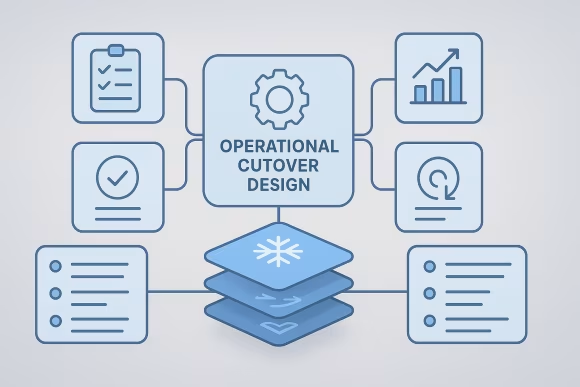
Cutover and rollback planning

Best Fit For

  • Multi-site Drupal estates
  • Decoupled frontend roadmaps
  • Platform modernization programs
  • Complex editorial workflows

Key Outcomes

  • SEO and URL continuity
  • Reduced legacy coupling
  • Repeatable migration pipelines
  • Validated content parity

Technology Ecosystem

  • Drupal
  • Headless CMS
  • Next.js
  • GraphQL and REST

Delivery Scope

  • Inventory and mapping
  • ETL and validation
  • Redirects and analytics parity
  • Operational runbooks

Legacy CMS Coupling Blocks Platform Evolution

As Drupal platforms grow over years, content models accumulate inconsistencies, custom modules become hard to replace, and delivery concerns (rendering, caching, personalization, integrations) get tightly coupled to the CMS runtime. Teams often inherit multiple sites with divergent field definitions, duplicated taxonomies, and undocumented editorial workflows, making change analysis slow and risky.

This coupling impacts architecture and delivery. Frontend teams are constrained by CMS release cycles, integration patterns vary by site, and API surfaces are either incomplete or shaped by historical implementation details rather than product needs. Content reuse across channels becomes expensive because the system was optimized for page rendering, not structured content delivery. Data quality issues emerge when references, media, and translations are handled differently across properties.

Operationally, migrations attempted without a structured approach lead to partial parity, broken URLs, and inconsistent redirects. Cutovers become high-risk events because rollback paths are unclear, data sync is manual, and validation is limited to spot checks. The result is delayed launches, increased maintenance overhead, and a platform that cannot evolve predictably as requirements change.

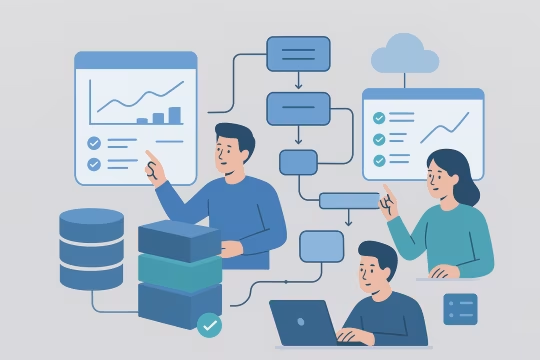
Drupal Migration Delivery Process

Platform Discovery

Assess the Drupal estate: versions, modules, content types, taxonomies, media, workflows, and integrations. Establish migration goals, constraints, and non-functional requirements such as SEO parity, performance, security, and editorial continuity.

Content Inventory

Create a measurable inventory of entities, fields, references, translations, and file assets. Identify content ownership, lifecycle states, and data quality issues that will affect mapping, transformation rules, and acceptance criteria.

Target Architecture

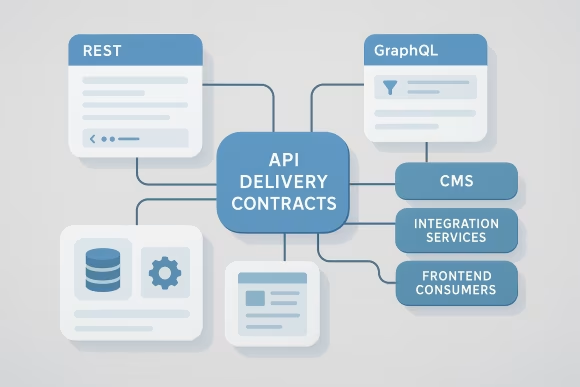
Define the target delivery model (composable or headless), API strategy (REST/GraphQL), and runtime responsibilities across CMS, frontend, and integration layers. Specify environments, deployment boundaries, and operational controls for the new platform.

Model and Mapping

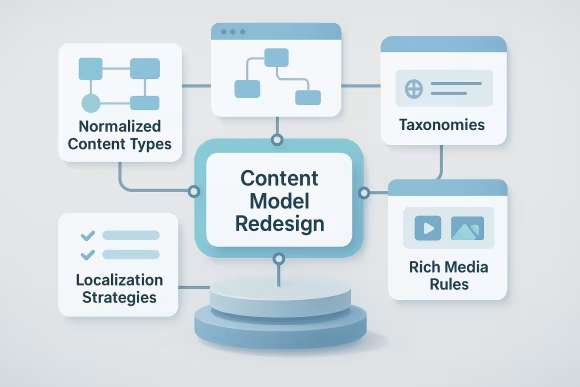
Design the target content model and map Drupal structures to new types, fields, and relationships. Document transformation rules for references, rich text, media, and localization, including how legacy exceptions will be handled or retired.

Migration Pipelines

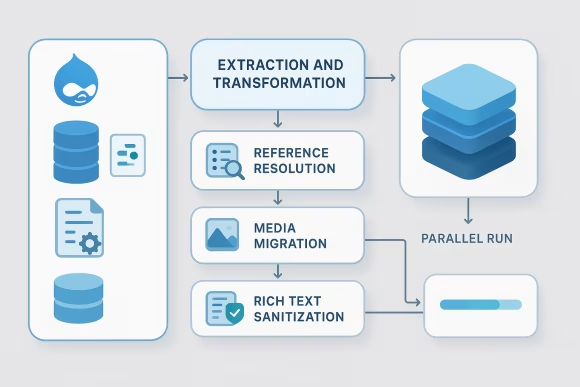
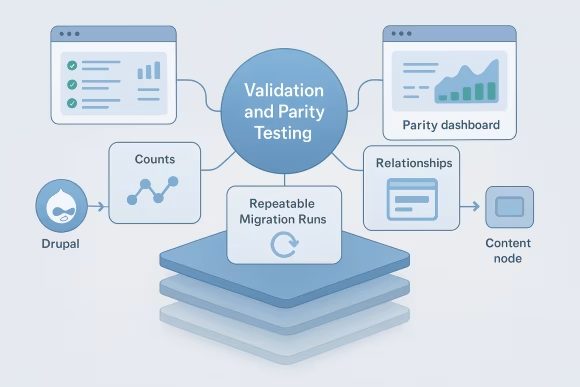
Implement repeatable extraction, transformation, and load pipelines with deterministic outputs. Include idempotent runs, incremental sync where needed, and validation checkpoints to compare counts, relationships, and critical field values.

Frontend Transition

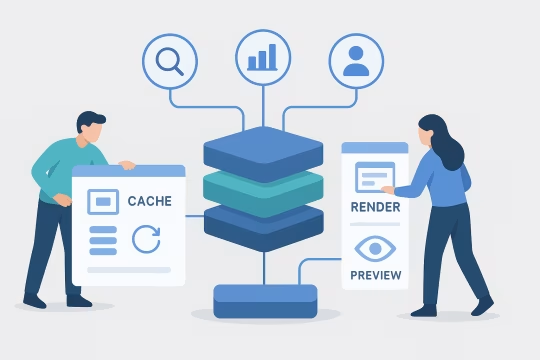
Adapt or rebuild presentation in a decoupled frontend (for example Next.js) and align it with the new content APIs. Implement routing, rendering strategies, caching, and preview flows that match editorial and release requirements.

SEO and Cutover

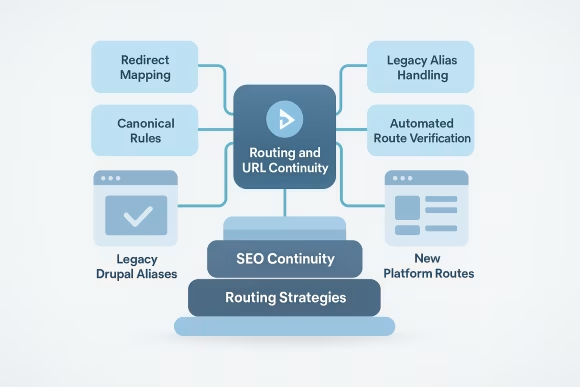
Build URL mapping, redirect rules, canonical handling, and analytics parity. Plan cutover steps, freeze windows, and rollback procedures, including data sync strategy and verification scripts for post-launch validation.

Governance and Handover

Deliver runbooks, data contracts, and ownership boundaries for ongoing evolution. Establish monitoring, migration job observability, and change processes for content model updates to prevent drift across teams and environments.

Core Migration Engineering Capabilities

This service focuses on engineering capabilities required to move from Drupal without losing operational control. It establishes explicit content contracts, repeatable migration pipelines, and API-first delivery patterns that support decoupled frontends. The work emphasizes validation, parity checks, and controlled cutover to reduce risk while enabling a platform architecture that can evolve independently across CMS, frontend, and integrations.

Capabilities
  • Drupal estate assessment and inventory
  • Target content model and mapping
  • Content extraction and ETL pipelines
  • REST and GraphQL API design
  • Next.js routing and rendering transition
  • SEO redirects and canonical strategy
  • Cutover runbooks and rollback planning
  • Migration validation and parity testing
Audience
  • CTO
  • Platform Architects
  • Digital Strategy Teams
  • Engineering Managers
  • Product Owners
  • Web Platform Teams
  • Enterprise Architecture
  • Content Operations Leads
Technology Stack
  • Drupal
  • Content extraction pipelines
  • GraphQL
  • REST API
  • Next.js
  • Headless CMS
  • Docker
  • CI/CD for migration jobs
  • Redirect mapping tooling
  • Observability and logging

Delivery Model

Delivery is structured to reduce migration risk while enabling parallel progress across content, APIs, and frontend delivery. Each phase produces artifacts that can be validated independently, supporting incremental migration runs and controlled cutover planning.

Delivery card for Discovery and Scope[01]

Discovery and Scope

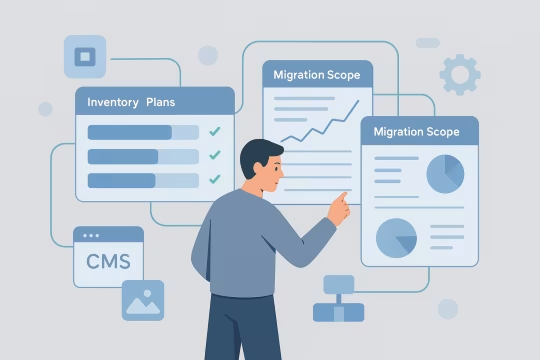
Run stakeholder and engineering workshops to define migration drivers, constraints, and acceptance criteria. Produce an inventory plan, risk register, and a migration scope that separates must-have parity from intentional changes.

Delivery card for Architecture and Contracts[02]

Architecture and Contracts

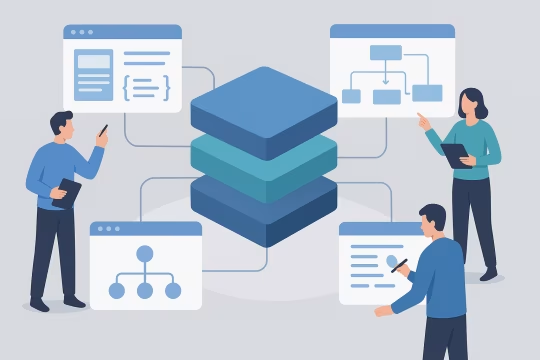
Define the target architecture, content delivery contracts, and operational boundaries. Document API schemas, routing strategy, preview requirements, and environment topology to ensure teams can build against stable interfaces.

Delivery card for Content Modeling[03]

Content Modeling

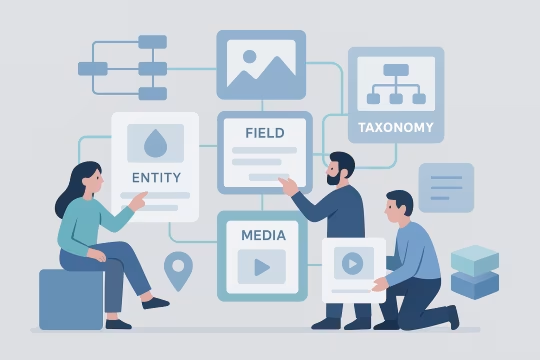
Design the target content model and mapping from Drupal entities, fields, and taxonomies. Validate the model with representative content and editorial workflows, including localization and media handling decisions.

Delivery card for Pipeline Implementation[04]

Pipeline Implementation

Build extraction and transformation pipelines with repeatable runs and deterministic outputs. Implement logging, metrics, and failure handling so migrations can be executed safely across environments and during parallel run.

Delivery card for Integration and Frontend[05]

Integration and Frontend

Implement API consumption patterns and transition the frontend delivery layer, commonly to Next.js. Align caching, rendering, and preview flows with operational needs and ensure integrations (search, analytics, identity) are compatible with the new architecture.

Delivery card for Testing and Validation[06]

Testing and Validation

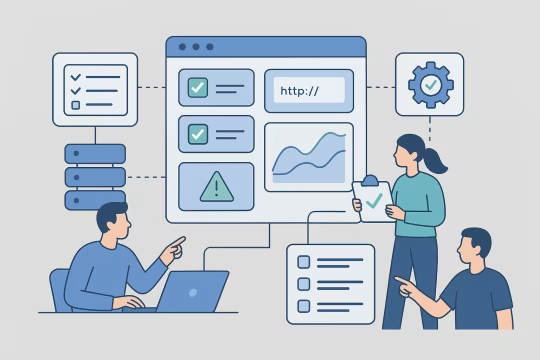
Execute parity testing across content, URLs, and critical journeys. Automate verification where possible and run performance and reliability checks to confirm the new delivery path meets non-functional requirements.

Delivery card for Cutover and Stabilization[07]

Cutover and Stabilization

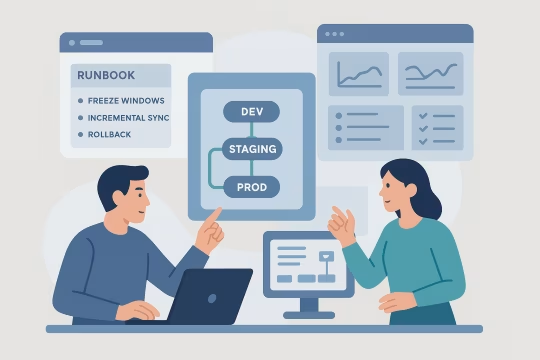
Perform cutover using a documented runbook, including freeze windows, incremental sync, and rollback procedures. Stabilize with monitoring, post-launch verification, and prioritized remediation of any parity gaps discovered in production.

Delivery card for Governance and Evolution[08]

Governance and Evolution

Hand over documentation, data contracts, and operational runbooks. Establish governance for content model changes, API versioning, and ongoing migration or consolidation work as the platform continues to evolve.

Business Impact

A structured migration reduces uncertainty in platform modernization by making data movement, API behavior, and cutover steps explicit and testable. The result is a platform that can evolve with clearer ownership boundaries and lower operational risk during change.

Lower Cutover Risk

Cutover is planned as an operational procedure with verification and rollback paths. This reduces reliance on manual checks and limits the blast radius of last-minute issues during launch windows.

SEO Continuity

URL mapping, redirects, and canonical rules are treated as first-class migration artifacts. This helps preserve search equity and reduces post-launch remediation work caused by broken routes or inconsistent indexing signals.

Faster Frontend Iteration

Decoupled delivery enables frontend teams to release independently of CMS runtime changes. This improves throughput for UI and performance work while keeping content governance in the CMS layer.

Reduced Legacy Coupling

Responsibilities are separated across content, APIs, and presentation. This makes future platform changes more predictable and reduces the need to carry forward Drupal-specific implementation constraints.

Improved Data Quality

Inventory, mapping, and validation expose inconsistencies in legacy content models and references. Addressing these issues during migration improves downstream reuse, search behavior, and analytics reliability.

Operational Transparency

Migration pipelines and runbooks create observable, repeatable processes. Teams gain clearer insight into what changed, what failed, and how to rerun or extend migrations without ad-hoc scripts.

Clearer Platform Governance

Explicit contracts for schemas, routing, and integrations support controlled evolution. This reduces drift across teams and environments and makes future consolidation or replatforming work less disruptive.

FAQ

Common questions about migrating from Drupal to composable or headless architectures, covering architecture decisions, operational planning, integrations, governance, and risk management.

How do you decide between composable and headless when migrating from Drupal?

We start by separating two decisions that are often conflated: (1) where content is authored and governed, and (2) how experiences are composed and delivered. A headless approach typically centralizes authoring in a CMS and delivers structured content via APIs to multiple channels. A composable approach goes further by decomposing capabilities (search, personalization, forms, DAM, experimentation) into independently owned services. The decision is driven by operating model and integration complexity. If the primary goal is decoupled frontend delivery with a stable content backbone, headless is often sufficient. If multiple teams need to own different capabilities with independent roadmaps and procurement, composable can be a better fit, but it requires stronger governance around contracts, observability, and change management. We document target-state responsibilities (CMS vs frontend vs integration layer), define API contracts, and validate the approach against non-functional requirements such as preview, caching, localization, and editorial workflow parity. The outcome is an architecture decision record that is testable against real content and delivery scenarios, not just diagrams.

What happens to Drupal-specific features like Views, blocks, and custom modules?

Drupal features usually fall into three categories during migration: content modeling concerns, presentation concerns, and business logic concerns. Views and blocks often mix all three, so we decompose them into explicit responsibilities. For example, a View that lists content by taxonomy becomes a query capability in the API layer (filtering, sorting, pagination) plus a frontend rendering pattern. Blocks typically map to reusable content components or composition patterns in the target CMS. Custom modules are assessed for whether they implement business rules, integrations, or editorial workflow extensions. Business rules may move to an application service, integration layer, or serverless function depending on latency and security requirements. Workflow extensions may be replaced by native CMS capabilities or by external approval tooling. We avoid a one-to-one “rebuild everything” approach. Instead, we inventory each feature, define the target implementation pattern, and decide whether to replace, retire, or re-implement. This keeps the migration focused on platform evolution rather than recreating historical coupling.

How do you run the migration without long content freezes?

We design for repeatable migration runs and, where required, incremental synchronization. The approach typically includes an initial bulk migration to establish the target dataset, followed by scheduled delta runs that capture changes made in Drupal while the new platform is being built and tested. To enable this, we use deterministic identifiers, track last-modified timestamps or change logs, and implement idempotent load behavior so reruns do not create duplicates. We also define a clear “source of truth” window: at some point close to cutover, content changes may be restricted to specific types or workflows to reduce divergence. Operationally, we align the plan with editorial calendars and release governance. The output is a cutover runbook that specifies when freezes apply (if any), what content can still change, how deltas are applied, and how verification is performed. This reduces the risk of a big-bang freeze while keeping data consistency manageable.

What environments and tooling do you recommend for migration execution?

We treat migration code as production-grade software: versioned, testable, and runnable in controlled environments. A common setup includes containerized migration jobs (for example using Docker) with environment-specific configuration for source Drupal access, target CMS/API credentials, and logging destinations. We typically recommend at least three environments: development for pipeline iteration, staging for full-scale rehearsal with representative datasets, and production for cutover execution. Staging should mirror production constraints such as rate limits, API quotas, and network access. Tooling needs include: structured logging, metrics for throughput and failures, and artifact storage for reports (counts, validation summaries, redirect maps). Where possible, we integrate migration runs into CI/CD so reruns are consistent and auditable. The goal is to avoid one-off scripts executed from laptops and instead provide a repeatable operational process.

How do you handle integrations like search, analytics, and identity during a Drupal migration?

We map integrations by responsibility and data flow rather than by Drupal implementation. For search, we identify indexing sources, document structures, and update triggers. In a headless/composable model, indexing may be driven by CMS webhooks, scheduled jobs, or event streams, and the frontend may query search directly rather than via the CMS. For analytics, we focus on continuity of measurement: pageview semantics, route changes, campaign parameters, consent behavior, and key events. If URLs change, we plan mapping and reporting adjustments. For identity, we review authentication flows, session handling, and authorization boundaries, especially if Drupal previously handled both content and access control. The integration plan is validated end-to-end in staging: content changes propagate, search results match expectations, analytics events fire correctly, and identity constraints are enforced. This reduces surprises where the CMS migration is “done” but the platform is not operationally complete.

Can we keep Drupal as a content source while moving the frontend to Next.js?

Yes, and it is often a pragmatic transition step. Drupal can act as a content source via REST or GraphQL while a Next.js frontend takes over routing, rendering, and performance responsibilities. This can reduce time-to-value by decoupling frontend delivery first, then migrating content and editorial workflows later. However, it requires clear contracts and constraints. You need stable API shapes, a strategy for previews, and agreement on which system owns routing and URL aliases. You also need to account for Drupal-specific behaviors that may not translate cleanly to API delivery, such as complex Views logic or block placement rules. We typically recommend defining a “strangler” boundary: which pages or sections move first, how caching is handled, and how SEO signals remain consistent. This approach can reduce risk, but it should still be managed as a staged migration with explicit milestones to avoid creating a long-lived hybrid that is hard to operate.

How do you govern content model changes after the migration?

Post-migration governance is primarily about preventing schema drift and breaking changes for consumers. We recommend treating the content model and APIs as contracts with versioning rules, review gates, and automated checks. This includes naming conventions, required fields, localization rules, and relationship constraints. Operationally, we define ownership: who can change the model, who approves changes, and how changes are communicated to frontend and integration teams. For API delivery, we align on compatibility policies (for example, additive changes are allowed without coordination, but removals require deprecation windows). We also recommend maintaining a lightweight catalog of content types and their consumers, plus automated validation in CI for schema changes. The objective is to keep the platform evolvable without reintroducing the uncontrolled divergence that often accumulates in long-running Drupal estates.

How do you manage redirects, URL ownership, and routing decisions across teams?

We establish URL ownership as an explicit architectural decision: which system is authoritative for route generation and how legacy aliases are represented. In many migrations, the frontend becomes the routing authority, while the CMS provides slugs and structured fields used to compose routes. Redirects are treated as data, not ad-hoc configuration. We generate redirect maps from the legacy Drupal alias set, normalize patterns, and store them in a system that can be tested and deployed (for example, edge configuration, application middleware, or a dedicated redirect service). We also define rules for canonical URLs, trailing slashes, and parameter handling. Governance includes a change process: how new routes are introduced, how old routes are deprecated, and how teams validate that redirects remain correct over time. This reduces the risk of SEO regressions caused by uncoordinated routing changes after launch.

What are the biggest risks in migrating from Drupal, and how do you mitigate them?

The most common risks are (1) incomplete parity requirements, (2) hidden coupling in Drupal implementations, (3) data quality issues, and (4) operational cutover gaps. Parity risk occurs when teams assume “content migration” is enough, but critical behaviors like permissions, previews, redirects, and search are not specified. We mitigate this by producing an inventory and acceptance criteria early, including a list of critical journeys and non-functional requirements. Hidden coupling is addressed through dependency analysis of modules, Views, blocks, and integrations, with explicit target patterns defined for each. Data quality risk is managed with validation at scale: counts, required fields, relationship integrity, and representative render checks. Operational risk is reduced with rehearsed cutover runbooks, incremental sync where needed, and rollback planning. The goal is to convert unknowns into testable artifacts before the launch window, not during it.

How do you ensure security and compliance during the migration?

We address security and compliance across three areas: data handling, access control, and operational execution. For data handling, we classify content and user data, define what is migrated, and ensure extraction and storage follow retention and encryption requirements. Migration logs are designed to avoid leaking sensitive fields. For access control, we map Drupal roles and permissions to the target model. In headless/composable setups, authorization often shifts to an identity provider and API gateway or application layer. We define which APIs are public, which require authentication, and how tokens and secrets are managed across environments. Operationally, we use least-privilege credentials, segregated environments, and auditable CI/CD pipelines for migration jobs. We also include security review checkpoints for new endpoints, webhook configurations, and any data export mechanisms. This keeps modernization work aligned with enterprise security expectations rather than treating it as a one-time data move.

What does a typical migration timeline look like for an enterprise Drupal estate?

Timelines depend on estate size, integration complexity, and how much of the experience layer changes. As a reference, an enterprise migration usually includes: discovery and inventory (2–6 weeks), target architecture and content model design (3–8 weeks), pipeline implementation and iterative runs (4–12 weeks), frontend transition work in parallel (variable), and cutover rehearsal plus launch (2–6 weeks). The critical factor is parallelization. Content modeling, pipeline work, and frontend delivery can proceed concurrently once contracts are defined. Another factor is whether you need incremental sync and parallel run; this adds engineering effort but reduces freeze requirements. We plan the work around measurable milestones: inventory completeness, model sign-off, first full migration run, parity validation thresholds, redirect coverage, and cutover rehearsal success criteria. This provides predictable decision points for go/no-go rather than relying on a single end-date estimate.

How does collaboration typically begin for a Drupal migration program?

Collaboration typically begins with a short discovery engagement focused on making the migration measurable and de-risked. We start by aligning stakeholders on goals (modernization drivers, target channels, editorial needs), then perform a structured inventory of the Drupal estate: content types, volumes, taxonomies, media, workflows, integrations, and URL patterns. From that, we produce a migration blueprint: target architecture options, recommended sequencing (what moves first), content model mapping approach, API contract outline, and an operational cutover plan including SEO continuity. We also identify key risks and the validation strategy needed to prove parity. The output is a scoped delivery plan with milestones and artifacts, plus a clear engagement model for how teams work together (roles, decision cadence, environments, and handover expectations). This ensures implementation starts with explicit contracts and acceptance criteria rather than assumptions carried over from the legacy Drupal build.

Plan a controlled Drupal migration

Let’s assess your Drupal estate, define target architecture options, and produce a migration plan with measurable parity, SEO continuity, and a cutover runbook.

Oleksiy (Oly) Kalinichenko

Oleksiy (Oly) Kalinichenko

CTO at PathToProject

Do you want to start a project?