Large CMS migrations rarely fail because teams forgot to move content from one system to another. They fail because the final transition from old platform to new platform exposes timing, ownership, and validation problems that looked manageable in lower environments.
That is why a CMS cutover rehearsal matters. It is the closest thing a program has to a controlled preview of the go-live event: what gets extracted, what changes late, what must be validated, who signs off, and what happens if something critical does not pass.
In enterprise programs, the challenge is usually not whether to rehearse. It is how to rehearse realistically when the business cannot accept a long content freeze. Editorial teams still need to publish. Campaigns still launch. Product details still change. Legal and compliance updates can still arrive late.
A week-long freeze can reduce variability, but it can also hide weaknesses in migration design by shifting operational pain back to the business. The more mature approach is to decide deliberately where a freeze is truly necessary, where delta migration logic can absorb change, and what validation scope is required to support a controlled cutover.
Why cutover rehearsals fail in enterprise migrations
Many rehearsals are labeled successful even when they do not meaningfully reduce go-live risk. That usually happens for one of a few reasons.
First, the rehearsal is performed on content that is too old. If the migrated dataset is materially different from the expected go-live state, the team proves only that a historical migration worked once. That is useful for baseline confidence, but it is not enough for final cutover readiness.
Second, the rehearsal validates technology but not operations. A migration script may complete, but that does not mean business owners know how to review pages, analytics teams know how to verify tagging, or support teams know how incidents will be triaged during the cutover window.
Third, the rehearsal scope is too narrow. Teams often check page rendering and sample content structure, but leave out redirects, search behavior, authentication dependencies, permissions, forms, personalization rules, analytics continuity, or downstream integrations.
Fourth, ownership is unclear. If nobody owns the decision about whether defects are acceptable, the program can drift into false confidence. A rehearsal is not just a technical run; it is a governance exercise.
Finally, the rehearsal may assume an unrealistic freeze. If the only way the process succeeds is by stopping content operations far longer than the business will ever approve, the rehearsal has not validated the real go-live model.
The difference between technical rehearsal and business-ready rehearsal
A technical rehearsal proves that migration components can execute. A business-ready rehearsal proves that the organization can complete cutover with acceptable risk.
Both matter, but they answer different questions.
A technical rehearsal typically asks:
- Can extraction, transformation, and load processes complete in the required sequence?
- Can infrastructure, environments, and deployment steps be coordinated?
- Can the target platform ingest content and configuration as expected?
- Can the team repeat the procedure reliably?
A business-ready rehearsal asks broader questions:
- What happens to content changes made after the main migration snapshot?
- Which teams validate URLs, search, analytics, permissions, and integrations?
- How long do review and approval windows actually take?
- What defects are tolerable for go-live, and which trigger rollback or delay?
- How is the organization informed about freeze rules, blackout periods, escalation paths, and ownership?
An enterprise migration needs both levels. Early rehearsals can be mostly technical. Later rehearsals should increasingly resemble the real cutover window, including realistic content churn, real approval paths, and business sign-off timing.
If the rehearsal does not test the actual decision-making model, it is not a reliable predictor of cutover success.
When a content freeze is necessary and when it is lazy risk transfer
A content freeze is not inherently wrong. In many programs, some freeze period is necessary. The issue is whether the freeze is being used intentionally or simply as a substitute for migration design.
A freeze is often justified when:
- highly regulated content requires exact final-state verification
- the target model cannot safely process specific late-stage changes
- critical URL, navigation, or taxonomy changes need a stable validation baseline
- cross-channel dependencies make last-minute divergence too risky
- staffing and operational coverage cannot support continuous delta handling
A freeze becomes lazy risk transfer when it is used to avoid solving problems that should be designed for, such as:
- repeatable delta extraction for recently updated content
- controlled migration of newly created items after a main baseline load
- documented handling for deletes, unpublishes, and scheduled changes
- clear sequencing between content migration, redirect activation, search indexing, and analytics verification
- role-based sign-off on a limited but meaningful validation scope
In other words, the question is not whether a freeze exists. The question is whether the freeze duration and scope are driven by real constraints or by the absence of a credible content freeze strategy.
A short, targeted freeze around final publication, DNS change, redirect activation, or specific high-risk content sets can be reasonable. A broad, prolonged freeze across the entire estate often signals that the cutover plan is not mature enough.
Designing delta migration logic for late content changes
If the business cannot sustain a long freeze, the migration design must account for change between the baseline migration and final cutover. That is where delta migration validation becomes central.
At a practical level, delta migration logic usually needs to address a few categories of change:
- newly created content
- updated content
- deleted or unpublished content
- asset updates and replacements
- metadata or taxonomy changes
- workflow or publication status changes
- URL-affecting changes such as slugs or path hierarchy
The design does not need to eliminate all risk. It needs to make late changes visible, processable, and testable.
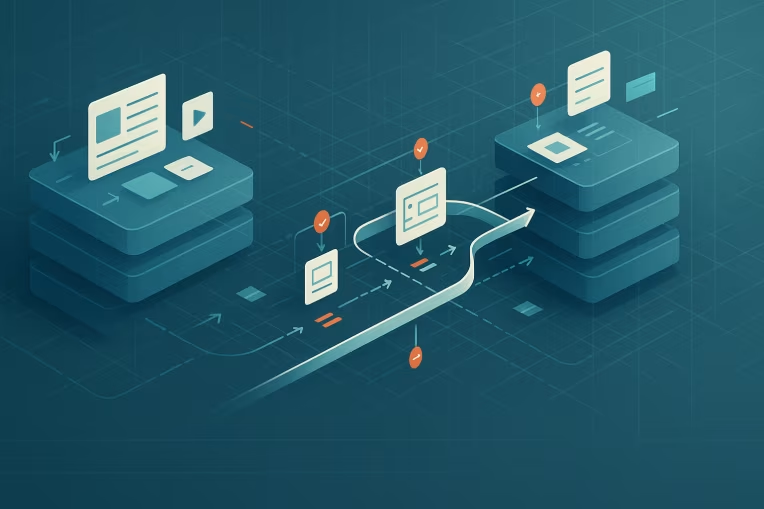
A common approach is to separate migration into stages:
- Baseline migration for the large body of content and assets.
- Incremental delta runs on content changed since the last successful baseline or delta window.
- Final synchronization window during cutover for the last permitted set of changes.
For that model to work, teams usually need explicit decisions on several points.
How will changes be detected?
That may be through modified timestamps, audit logs, workflow events, export manifests, or other source-system signals. Whatever mechanism is chosen should be stable enough to avoid both missed updates and uncontrolled duplication.
What is the system of record during the transition window?
During rehearsals and final cutover, ambiguity here causes defects. Editorial teams need clear rules: where content can still be edited, when those changes will be migrated, and which changes are prohibited after a defined checkpoint.
How are collisions handled?
If content has been migrated, then manually adjusted in the target environment, later delta runs can overwrite those changes unless governance is clear. Rehearsals should test whether target-side edits are allowed and what protections exist.
How are dependent objects sequenced?
A content item may reference media, taxonomy terms, related content, user permissions, or structured components. Delta logic should preserve integrity, not just move isolated records.
What happens to deletes and unpublishes?
These are often under-modeled. If source content is removed or unpublished late, the cutover plan needs rules for whether the target should archive it, unpublish it, redirect it, or leave it for manual handling.
A good rehearsal plan does not just run the delta process. It seeds realistic examples of late changes and checks whether the process handles them cleanly.
Validation layers: content, URLs, integrations, search, analytics, permissions
Validation should be layered. Not everything deserves the same depth of review, but every high-risk area needs a defined owner and pass/fail threshold.
Content validation
This is the most visible layer, but not the only one. Teams should verify that:
- critical content types render correctly
- required fields are populated
- structured content maps correctly to target templates or components
- embedded media and internal references resolve correctly
- publish states are correct
- scheduled or time-sensitive content is handled as expected
Sample-based validation is common, but it should be risk-based rather than random. High-traffic pages, legally sensitive content, conversion paths, and representative edge cases deserve priority.
URL and redirect validation
URL integrity is often a go-live-critical area. Validation can include:
- key URLs resolving correctly on the target site
- redirect rules covering changed paths
- canonical behavior where relevant
- preservation of important deep links
- expected response behavior for retired content
For large estates, this normally combines automated checks with manual review of critical URL sets.
Integration validation
Many migrations depend on services outside the CMS itself. Examples can include:
- identity or SSO flows
- forms and submission handlers
- CRM or marketing platform connections
- commerce or product data feeds
- translation workflows
- DAM, search, or personalization services
A cutover rehearsal should test the integration behaviors that matter on day one, not just confirm that connectors exist.
Search validation
Search is often treated as a post-launch tuning task, but basic search readiness can materially affect launch quality. Teams should check:
- whether content is indexed in the correct scope
- whether key pages are discoverable
- whether labels, metadata, and filters behave plausibly
- whether excluded or restricted content stays excluded
This does not require perfect relevance tuning before launch, but it does require confidence that search is operational and not exposing major gaps.
Analytics validation
Analytics failures can make an otherwise successful launch hard to govern. Continuity checks often include:
- page tagging present on key templates
- event tracking on important interactions
- environment-specific configurations working correctly
- expected data-layer or metadata output
- continuity in measurement for major conversion paths
The goal is not exhaustive reporting validation during cutover. It is ensuring the organization does not lose visibility into business performance immediately after launch. In more complex estates, this kind of instrumentation continuity benefits from the same schema and governance discipline used in event data platform architecture.
Permissions and access validation
Permissions are frequently overlooked in rehearsals because they are harder to inspect quickly than page rendering. But access defects can create both operational and compliance risk.
Validation should cover:
- authoring access by role
- workflow permissions
- restricted or gated content behavior
- administrative access boundaries
- inheritance or group mapping rules where applicable
This matters especially in programs moving between platforms with very different security and editorial models, such as traditional CMS-to-headless or one enterprise CMS to another. Where that shift includes API-first delivery and changed governance boundaries, headless CMS architecture decisions directly affect what can be validated during rehearsal.
Rehearsal runbooks, ownership, and rollback criteria
A rehearsal becomes actionable when it is documented as an operational event, not just a technical activity.
That means building a runbook with enough specificity that another qualified team could understand the sequence and decision model. The runbook should usually include:
- cutover objectives and assumptions
- scope included and excluded from rehearsal
- freeze rules and editorial communications
- environment readiness checks
- migration step sequence with estimated durations
- delta processing steps
- validation tasks by team and owner
- escalation routes for defects
- go/no-go checkpoints
- rollback criteria and responsibilities
- post-cutover monitoring tasks
The point is not bureaucracy. It is reducing ambiguity at the moment ambiguity is most expensive.
Ownership is equally important. Each validation domain should have a named owner with authority to assess readiness. For example:
- platform or engineering lead for migration execution
- content operations lead for editorial readiness and high-risk content review
- SEO lead for URL and redirect checks
- analytics lead for tracking verification
- product or business owner for final business acceptance
Without this, defects tend to get discussed rather than resolved.
Rollback criteria should be explicit before the rehearsal begins. A program should know which failures are:
- acceptable for remediation after go-live
- acceptable only with a temporary workaround
- unacceptable and therefore launch-blocking
Examples of launch-blocking conditions often include systemic URL failure, broken authentication on critical journeys, severe analytics blindness on key paths, widespread content corruption, or inability to process final approved deltas safely.
Not every issue warrants rollback. But if rollback exists only as a vague safety concept rather than an operational decision tree, it is unlikely to help under time pressure.
A phased approach to final cutover readiness
Teams often get more value from multiple rehearsals with increasing realism than from one large rehearsal near the end.
A practical CMS migration rehearsal plan can be phased.
Phase 1: Prove the mechanics
Early rehearsals should confirm that baseline migration, deployment, and environment setup work end to end. The focus is technical repeatability, defect discovery, and timing estimates.
At this stage, the program is learning:
- whether migration logic is stable
- whether data mapping assumptions hold
- where transformation edge cases appear
- how long major steps actually take
Phase 2: Introduce realistic change
Once baseline migration is credible, rehearsals should incorporate late content changes, partial editorial activity, and delta processing. This phase tests whether the design supports business continuity.
The program should examine:
- which types of change can be safely absorbed by delta runs
- where manual intervention is still required
- how small a freeze window can be without undermining confidence
- what validation can be automated versus manually reviewed
Phase 3: Rehearse operational cutover
Later rehearsals should simulate the real event as closely as possible. That includes named owners, timed checkpoints, sign-offs, communications, and issue escalation.
This phase answers the practical question: if this were the real weekend or release window, would the organization know what to do?
Phase 4: Define final readiness thresholds
Before the actual cutover, the team should agree on objective readiness criteria. For example:
- no unresolved defects in launch-blocking categories
- acceptable delta migration accuracy on tested scenarios
- validated redirect coverage for priority URL sets
- confirmed analytics and integration readiness for critical journeys
- sign-off from business, content, platform, and operational owners
These thresholds help prevent the common pattern where teams continue to discover risk but move forward because the date has become immovable.
A controlled cutover is not one with zero uncertainty. It is one where uncertainty has been narrowed, categorized, and assigned to owners with agreed responses.
Final thoughts
Enterprise CMS migrations do not become safer because a program declares a long content freeze and hopes stability follows. They become safer when the team rehearses the cutover that will actually happen.
That usually means combining a sensible freeze strategy with well-designed delta migration logic, layered validation, and an operational runbook that reflects real ownership. Some organizations will still need a longer freeze because of regulatory, architectural, or staffing constraints. Others can reduce freeze duration substantially through repeatable incremental migration and disciplined governance.
The important point is not to treat the freeze itself as the risk strategy. The strategy is the combination of sequencing, validation, and decision-making that lets the business move to the new platform with confidence. In enterprise replatforming work, that usually sits inside a broader content platform architecture and migration delivery model rather than a one-off launch checklist.
A strong cutover rehearsal gives leadership something more useful than optimism: evidence that the migration can be completed, checked, and either accepted or stopped for the right reasons. Programs that have gone through large-scale consolidation efforts such as UNCCD or integration-heavy platform modernization like Copernicus Marine Service tend to learn this lesson early: rehearsal quality is inseparable from governance quality.
Tags: CMS cutover rehearsal, Enterprise digital platforms, Content Operations, Enterprise CMS migration cutover, Delta migration validation, Controlled cutover