 [01]
[01]Discovery and Audit
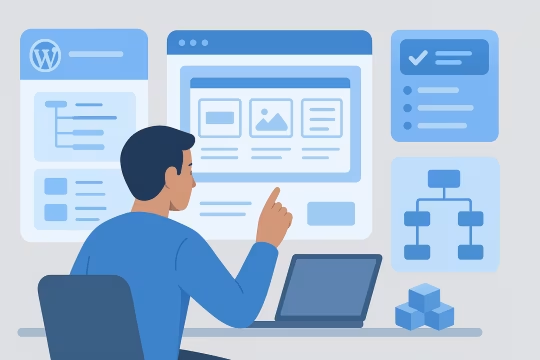
Review the WordPress implementation, content structures, plugins, and operational constraints. Produce an inventory of page types, templates, SEO rules, and editorial workflows to define scope and migration sequencing.
WordPress to headless migration services separate content management from presentation so teams can evolve the frontend independently, adopt modern delivery frameworks, and reduce coupling between editorial workflows and runtime performance. In a typical Headless WordPress Next.js migration, the work includes content model rationalization, API-first WordPress content delivery design, frontend integration, and a controlled cutover strategy that protects URLs, metadata, and publishing operations.
Organizations usually need this capability when WordPress has become a bottleneck for multi-channel delivery, performance targets, or frontend modernization. A headless approach enables a stable content layer with well-defined contracts (schemas, queries, and versioning), while product teams iterate on the user experience using a framework such as Next.js.
The work is primarily architectural and operational: defining the target state, mapping content and taxonomies, implementing a WordPress GraphQL content API migration approach (when applicable), and aligning preview, publishing, and cache invalidation with deployment workflows. The result is a platform that supports incremental evolution, clearer ownership boundaries, and a more maintainable path for future integrations and channel expansion.
Core Focus
Best Fit For
Key Outcomes
Technology Ecosystem
Delivery Scope
As WordPress platforms grow, the theme layer often becomes the de facto application layer. Business logic, rendering concerns, and content structure accumulate inside templates and plugins, making change difficult to isolate. Teams start avoiding necessary refactors because each update risks breaking pages, navigation, or editorial flows, and performance improvements are constrained by server-side rendering patterns and plugin interactions.
This coupling creates architectural friction: content models are shaped by theme constraints rather than domain needs, integrations are implemented inconsistently across plugins, and API-first WordPress content delivery is hard to introduce without reworking assumptions embedded in the theme. When organizations begin exploring how to migrate WordPress to headless architecture, they often discover that API access is either absent or treated as an afterthought, and that routing, metadata, and template behavior are implicitly encoded across the stack. Product teams struggle to deliver new experiences across channels because the CMS and frontend are tightly bound, while platform engineers spend time debugging runtime issues caused by mixed responsibilities and unclear boundaries.
Operationally, releases become high-risk. Small changes require broad regression testing, preview behavior is unreliable across environments, and SEO concerns (URLs, canonical tags, structured data) make cutovers difficult. Without a structured, SEO-safe headless WordPress migration strategy, organizations either postpone modernization or attempt a “big bang” rebuild that increases delivery risk and extends time-to-value.
Assess the current WordPress architecture, theme responsibilities, plugin landscape, and content model complexity. Capture critical paths such as routing, SEO metadata, editorial workflows, and runtime performance constraints to define migration boundaries and risks.
Define the headless target state, including content ownership, API boundaries, rendering strategy (SSR/SSG/ISR), and environment topology. Establish non-functional requirements such as caching, availability, observability, and release controls.
Rationalize post types, taxonomies, custom fields, and relationships into a stable domain model. Document mapping rules, validation constraints, and backward-compatibility needs to support incremental migration and predictable API behavior.
Design the GraphQL schema, query patterns, and authorization approach for content delivery and preview. Define versioning and deprecation rules so frontend teams can evolve safely without breaking editorial operations or downstream consumers.
Implement Next.js routing, templates, and data-fetching aligned to the API contract. Build URL mapping, metadata generation, and structured data handling to preserve SEO behavior and ensure parity with the legacy site.
Create repeatable migration scripts for content, media, and redirects, with idempotent runs across environments. Add validation checks for completeness, link integrity, and field-level transformations to reduce manual remediation.
Run functional, content parity, and SEO regression testing across representative page types. Validate preview and publishing flows, cache invalidation, and edge cases such as localization, pagination, and canonicalization.
Plan staged rollouts, rollback procedures, and monitoring for the cutover window. Establish governance for schema changes, content model evolution, and operational runbooks so the headless platform remains maintainable post-launch.
This service focuses on the engineering capabilities required for WordPress to headless migration services: moving from a coupled WordPress runtime to an API-first content platform with a decoupled frontend. The emphasis is on stable contracts, predictable routing and SEO behavior, and operational controls that support incremental migration. Where appropriate, this includes a WordPress GraphQL content API migration approach and Next. js integration patterns that keep editorial workflows reliable and observable.
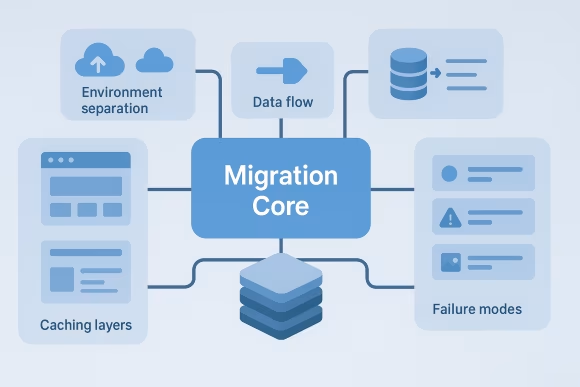
Define an incremental migration strategy that supports coexistence, staged cutovers, and controlled parity validation. The architecture covers environment separation, data flow, caching layers, and failure modes so teams can migrate page types and content domains without destabilizing the platform.
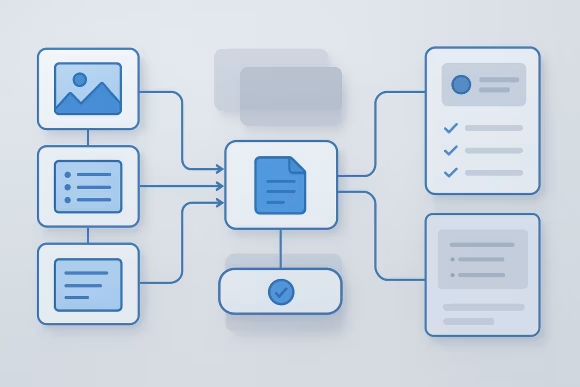
Translate WordPress structures into a coherent domain model with explicit relationships, validation rules, and naming conventions. This includes rationalizing custom fields and taxonomies, reducing accidental complexity, and documenting ownership so future changes are intentional and testable.

Implement a GraphQL contract that reflects the domain model and supports efficient frontend queries. Capabilities include schema modularization, query cost considerations, pagination patterns, and versioning/deprecation rules to keep API evolution predictable across teams.
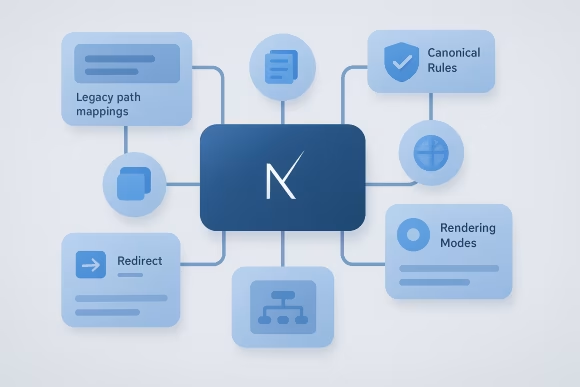
Engineer deterministic routing in Next.js that preserves existing URL structures, canonical rules, and redirect behavior. This includes mapping legacy paths, handling edge cases (pagination, archives, localized routes), and ensuring consistent metadata generation across rendering modes.

Build preview mechanisms that align WordPress editorial actions with headless rendering, including draft visibility, authentication, and environment-aware previews. Ensure publishing triggers cache invalidation or revalidation so content changes propagate reliably and measurably.

Implement structured handling for titles, descriptions, canonical tags, hreflang, robots directives, and structured data. Validate parity against the legacy platform and provide automated checks to prevent regressions during incremental migration and ongoing releases.
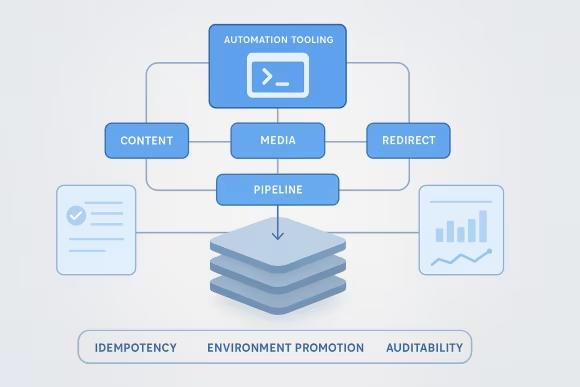
Create repeatable scripts and pipelines for content, media, and redirect migration with validation and reporting. Tooling is designed for idempotency, environment promotion, and auditability so teams can rerun migrations safely as models and rules evolve.

Instrument the headless stack with logging, metrics, and tracing aligned to content delivery and rendering. Establish dashboards and alerting for API latency, build/revalidation behavior, cache hit rates, and error budgets to support stable operations after cutover.
Engagements follow an engineering sequence from discovery and audit through target architecture, content/API contract implementation, Next. js integration, and staged cutover. The delivery model is designed to reduce risk in WordPress to headless migration services by using incremental rollout, explicit parity checks for routing and SEO, and repeatable automation for content and redirect migration.
[01]Review the WordPress implementation, content structures, plugins, and operational constraints. Produce an inventory of page types, templates, SEO rules, and editorial workflows to define scope and migration sequencing.
 [02]
[02]Define the target headless architecture and a phased migration plan with clear milestones. Align rendering strategy, caching, environments, and non-functional requirements with platform constraints and release governance.
 [03]
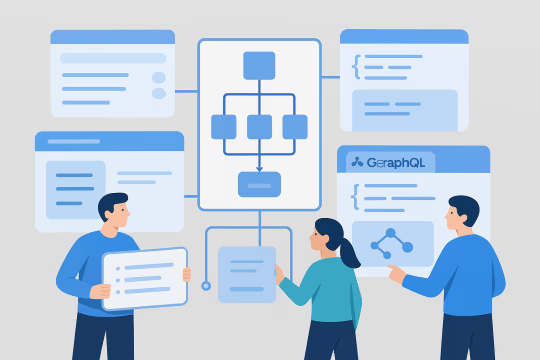
[03]Design the content model mapping and implement the GraphQL contract required by the frontend. Establish schema governance, versioning expectations, and query patterns to keep integration stable over time.
 [04]
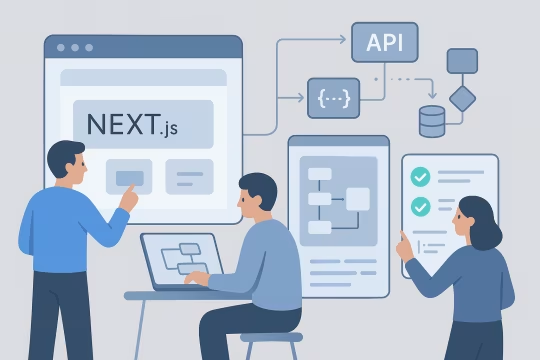
[04]Implement Next.js templates, routing, and data access aligned to the API contract. Add metadata generation, structured data, and parity checks for critical page types before expanding coverage.
 [05]
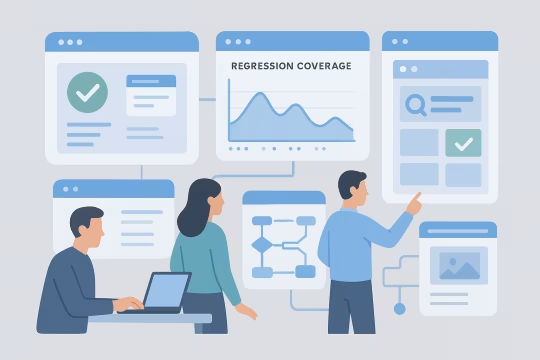
[05]Run automated and manual validation for content parity, SEO behavior, and editorial flows. Include performance checks, preview verification, and regression coverage for routing, redirects, and edge cases.
 [06]
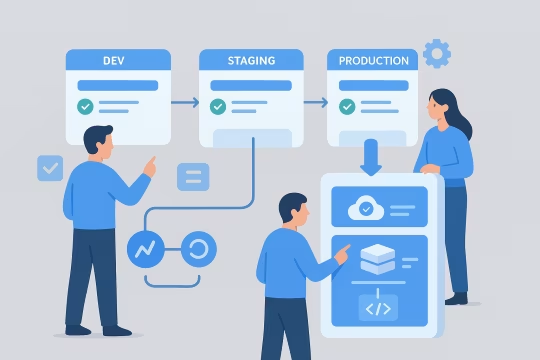
[06]Execute staged releases with monitoring and rollback plans. Validate redirects, indexing signals, and runtime behavior in production, and coordinate freeze windows and content sync as needed.
 [07]
[07]Deliver runbooks, dashboards, and governance processes for schema and content model changes. Ensure teams can operate preview, publishing, caching, and incident response with clear ownership boundaries.
A well-governed WordPress-to-headless migration reduces coupling and improves the platform’s ability to evolve without destabilizing content operations. For enterprise decoupled WordPress platform migration programs, the impact is typically seen in more independent release cycles, lower regression risk through contract-driven integration, and improved performance and observability across the delivery stack.
Decoupled delivery allows product teams to ship UI changes without coordinating WordPress theme releases. Clear API contracts reduce integration churn and make changes easier to scope and test.
Incremental migration and parity testing reduce the likelihood of SEO regressions and broken routing. Rollback plans and staged cutovers provide operational control during high-impact releases.
Next.js rendering strategies and CDN caching provide more predictable performance under load. Revalidation and cache controls reduce origin pressure compared to coupled runtime rendering patterns.
Separating content management from presentation clarifies ownership between editorial operations and engineering teams. This reduces cross-team blocking and makes platform responsibilities easier to govern.
Business logic moves out of templates and ad-hoc plugin behavior into explicit services and contracts. This lowers maintenance overhead and makes future upgrades and security work more manageable.
API and rendering layers can be instrumented with consistent metrics and tracing. Teams gain clearer insight into latency, error rates, cache behavior, and content delivery bottlenecks.
A headless content layer supports reuse across web, apps, and other channels without duplicating presentation logic. This enables channel expansion with less rework and fewer inconsistencies.
These related services are natural extensions of a WordPress to headless migration—covering adjacent work in headless CMS architecture, API-first content delivery, GraphQL/API platform design, and operational readiness for decoupled web platforms.
Enterprise API design for scalable, secure foundations
API-first platform design with clear domain boundaries
Composable DXP content architecture and API-first platform design
API-first enterprise headless CMS platform architecture for content delivery
Structured schemas for an API-first content strategy
Enterprise content migration with API-first content delivery
Decoupled Drupal + Next.js migration for modern frontend delivery
Contract-first headless API development for enterprise delivery
Headless CMS API integration, contracts, and integration layer engineering
Common architecture, operations, integration, governance, risk, and engagement questions for WordPress-to-headless migrations.
Most migrations converge on a split architecture with WordPress retained as the editorial system and a separate delivery layer responsible for rendering and edge performance. A common pattern is WordPress as the content source, a GraphQL layer (native or via a plugin/adapter) as the contract, and a Next.js application for rendering using SSR, SSG, or ISR depending on content volatility and personalization needs. Key architectural decisions include where content transformation happens (at ingestion, in the API layer, or in the frontend), how media is served (WordPress, object storage, or an image CDN), and how caching is coordinated (CDN, application cache, and API cache). For enterprise environments, we also define environment topology (dev/test/stage/prod), identity boundaries for preview and admin access, and observability requirements. The goal is to make the content layer stable and governed while allowing the experience layer to evolve independently. That requires explicit contracts, versioning expectations, and a routing/URL strategy that preserves SEO behavior during incremental cutover.
We decide rendering mode per route type, based on content change frequency, traffic patterns, and operational constraints. SSG works well for largely static marketing pages and documentation where builds can be scheduled and content changes are predictable. SSR is appropriate for highly dynamic pages where freshness is critical and caching can be applied at the edge. ISR is often the default for editorial platforms because it balances performance with controlled freshness via revalidation. The decision also depends on preview requirements. Editorial preview typically needs SSR-like behavior (or a preview route that bypasses caching) so drafts render immediately. For ISR, we define revalidation triggers: time-based, webhook-based on publish events, or a combination. We also evaluate the impact on build times, failure modes (what happens if revalidation fails), and monitoring. A migration should not force a single rendering strategy across the entire site. A mixed approach reduces risk and keeps operational complexity proportional to actual needs.
Operationally, you move from a single runtime (WordPress + theme) to multiple deployable components: the content system, the API contract layer, and the frontend delivery application. This introduces clearer boundaries but also requires explicit runbooks for deployments, cache invalidation/revalidation, and incident response across components. Teams typically add monitoring for API latency and error rates, frontend rendering failures, build/revalidation queues, and CDN cache behavior. Release management becomes more flexible because frontend changes can ship independently, but governance is needed for schema changes and content model evolution so the API contract remains stable. Editorial operations also change: preview flows may use authenticated preview routes, and publishing may trigger webhooks to revalidate pages. We document these workflows and ensure they work across environments (staging vs production) with predictable permissions and auditability. The net effect is usually better control and observability, provided the platform is instrumented and ownership boundaries are agreed early.
We design caching as a layered system: CDN caching for rendered pages and assets, application-level caching for server-rendered routes (when used), and API caching for GraphQL responses where appropriate. The key is to align cache lifetimes with editorial expectations and to make invalidation predictable. For Next.js ISR, we typically implement webhook-driven revalidation on publish/update events, scoped to affected routes. That requires a mapping from content entities to URLs (including taxonomy pages, listings, and related content). For SSR routes, we rely on edge caching with controlled TTLs and cache keys that reflect locale, personalization, or authentication state. We also define safe fallbacks: what happens if revalidation fails, how stale content is tolerated, and how to observe cache hit rates and revalidation latency. This is paired with runbooks and dashboards so operations teams can diagnose freshness issues without guesswork.
We prefer a single primary contract to reduce integration complexity and governance overhead. GraphQL is often chosen because it supports typed schemas, predictable query patterns, and frontend-driven data selection, which helps when building multiple page types and components in Next.js. That said, REST can be appropriate for simpler use cases or when existing endpoints are stable and well-understood. In some migrations, both are used temporarily: REST for legacy endpoints and GraphQL for new page types, with a plan to converge. The decision depends on content model complexity, performance requirements, and the team’s ability to govern schema evolution. Regardless of protocol, we define contract rules: authentication/authorization, pagination, error handling, rate limits, and versioning/deprecation. The goal is to avoid “API drift” where the frontend compensates for inconsistent content structures, which becomes a long-term maintenance burden.
We treat URL and metadata parity as first-class migration requirements. Early in the project we inventory existing URL patterns, canonical rules, pagination behavior, and metadata sources (titles, descriptions, Open Graph, structured data). We then implement deterministic routing in Next.js and a mapping layer that ensures the same output for equivalent content. Redirects are handled through an explicit redirect map, ideally generated from the legacy routing rules and validated against crawl data. We test redirects and canonical tags in staging using automated checks and sample crawls, and we validate edge cases such as trailing slashes, query parameters, and localized routes. During cutover, we monitor indexation signals, 404 rates, and redirect chains. If the migration is incremental, we ensure mixed-mode routing does not create duplicate content. The objective is to make the new platform behave identically from a crawler’s perspective while improving performance and maintainability behind the scenes.
Governance starts with treating the schema as a product interface. We define ownership, review workflows, and a change policy that includes versioning expectations, deprecation windows, and compatibility checks. For GraphQL, this often includes schema linting, breaking-change detection in CI, and a documented pattern for adding fields versus changing semantics. On the content side, we establish conventions for field naming, relationship modeling, and validation rules so the model remains coherent as new features are added. We also define how editorial requirements are translated into model changes, and how those changes are communicated to frontend teams. A practical approach is to maintain a lightweight contract document: key types, query patterns, and route mappings. Combined with automated tests and release notes, this reduces the risk of silent breaking changes and helps multiple teams work in parallel without destabilizing the platform.
Preview and publishing are operational workflows, so governance focuses on permissions, environment separation, and predictable triggers. We define who can preview drafts, how preview authentication works, and how preview routes bypass caching safely. We also document how publishing events trigger revalidation and what the expected propagation time is. Editorial governance includes content validation rules, required fields for SEO, and constraints that prevent incomplete content from being published into critical templates. If multiple sites or brands are involved, we define tenancy rules and shared component constraints so content reuse does not create unexpected coupling. We also recommend runbooks for common editorial incidents: preview not updating, published content not visible, and media rendering issues. Clear ownership between content operations and engineering reduces escalations and keeps the platform stable as teams and content volume grow.
The main risks are SEO regressions, content parity gaps, and operational instability during cutover. SEO risk comes from changes in URLs, canonicalization, metadata generation, and redirect behavior. We mitigate this with early parity requirements, automated checks, redirect validation, and staged rollouts with monitoring. Content parity risk appears when WordPress content structures are inconsistent or when theme logic implicitly shapes output. We mitigate this by auditing page types, documenting transformation rules, and building validation tooling that checks completeness and field-level mappings across environments. Operational risk includes cache invalidation errors, preview failures, and revalidation bottlenecks. We mitigate this by designing caching and revalidation as explicit components, instrumenting them, and providing runbooks and rollback plans. Incremental migration reduces the blast radius and allows teams to learn and adjust before full cutover.
Incremental migration is often the safer path, especially for large sites with many page types and integrations. Common incremental patterns include migrating a subset of routes first (for example, marketing pages), running the new frontend alongside the legacy site, and progressively expanding coverage. Another pattern is to keep WordPress as the authoring system while introducing the headless frontend route by route. Incremental approaches require careful routing and canonical rules to avoid duplicate content and inconsistent metadata. They also require a clear contract boundary so both systems can coexist without diverging content behavior. A full cutover can be appropriate when the legacy platform is unstable or when the content model must change significantly. In that case, we still apply incremental principles internally: validate parity on representative page types, automate migrations, and stage releases to reduce risk during the final switch.
A typical engagement includes platform discovery, target architecture definition, content model mapping, API contract implementation, Next.js integration for key page types, migration automation, and parity testing leading to a staged cutover. We also include governance and operational handover so the platform can be maintained and evolved after launch. From your side, we usually need access to the WordPress codebase and environments, a content export or database access (as appropriate), analytics and SEO tooling access for validation, and stakeholders for editorial workflow mapping. We also need clarity on non-functional requirements such as performance targets, availability expectations, and compliance constraints. We work best with a small core group: a platform owner, an engineering lead, and an editorial representative. This keeps decisions timely, especially around content model trade-offs and URL/SEO parity requirements.
Collaboration typically begins with a short discovery phase focused on constraints and risk. We start with stakeholder interviews (platform, product, and content operations) and a technical audit of the WordPress implementation: theme responsibilities, plugin dependencies, custom fields, routing rules, and current deployment practices. Next, we define a target architecture and an incremental migration plan that prioritizes high-value routes and de-risks SEO and editorial workflows early. This includes agreeing on the API contract approach (GraphQL vs REST), rendering strategy in Next.js, and the operational model for preview, publishing triggers, and caching. The output of this initial phase is a concrete backlog and roadmap: page types to migrate, content model mapping rules, integration requirements, testing strategy, and cutover plan. With that in place, implementation proceeds in measurable increments with parity checks and governance built into the delivery workflow.
These case studies showcase real-world implementations of headless CMS architectures and modern frontend integrations similar to the WordPress to Headless Migration service. They highlight content modeling, API-first content delivery, frontend modernization with frameworks like Next. js, and operational strategies for scalable, multi-channel content platforms. The selected examples provide measurable proof of performance improvements, editorial workflow enhancements, and platform evolution aligned with headless migration principles.
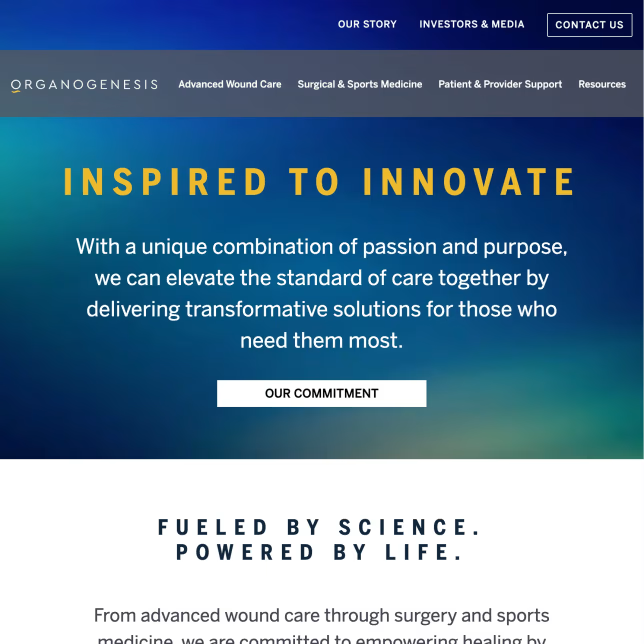
Organogenesis faced operational challenges managing multiple brand websites on outdated platforms, resulting in fragmented workflows, high maintenance costs, and limited scalability across a multi-brand digital presence.
The transformation reduced time-to-deliver marketing updates by 20–25%, improved Lighthouse scores to ~90+, and delivered a scalable multi-brand foundation for long-term growth.
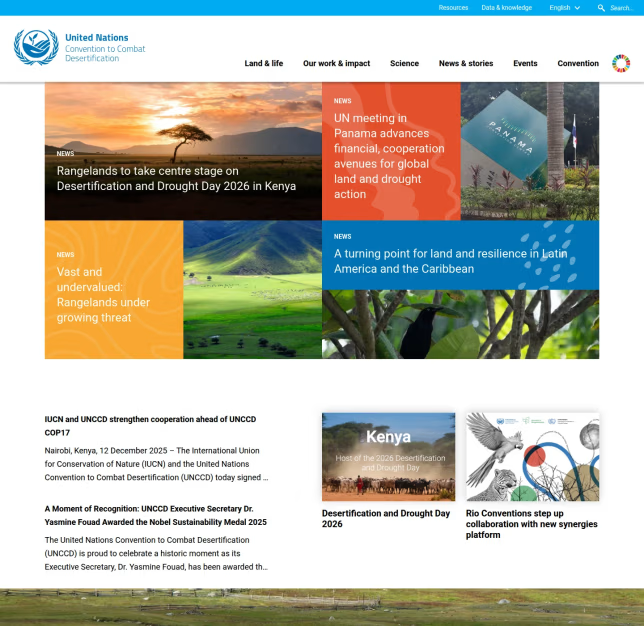
UNCCD operated four separate websites (two WordPress, two Drupal), leading to inconsistencies in design, content management, and user experience. A unified, scalable solution was needed to support a large-scale CMS migration project and improve efficiency and usability.
The modernization effort resulted in a cohesive, user-friendly, and scalable website, improving content management efficiency and long-term digital sustainability.
It was my pleasure working with Oleksiy (PathToProject) on a new Drupal website. He is a true full-stack developer—the ideal mix of DevOps expertise, deep front-end knowledge, and the structured thinking of a senior back-end developer.
He is well-organized and never lets anything slip. Oleksiy understands what needs to be done before being asked and can manage a project independently with minimal involvement from clients, product managers, or business analysts.
One of the best consultants I’ve worked with so far.

Andrei Melis
Technical Lead at Eau de Web
Oleksiy (PathToProject) is demanding and responsive. Comfortable with an Agile approach and strong technical skills, I appreciate the way he challenges stories and features to clarify specifications before and during sprints.

Olivier Ritlewski
Ingénieur Logiciel chez EPAM Systems
Oleksiy (PathToProject) was the Lead Developer on a number of client projects which I managed. He is highly skilled and incredibly hardworking. When assigning work to him, I could always rely on it being completed to a high quality and on time.
His technical expertise was valued across the team and he was often our 'go to' for technical challenges, which he loved to get stuck into. Oleksiy is proactive and engaged in a professional manner with our clients.
I have no hesitation in recommending him.

Daniela Graf
Senior Project Manager | Change Mgmt Practitioner | Process Improvement Geek
These articles dig into the architecture, content modeling, and governance issues that shape a successful WordPress to headless migration. They add practical context on legacy content extraction, integration patterns, and the contracts that keep Next. js and CMS delivery maintainable over time.
Let’s review your current WordPress architecture, define the target headless model, and map an incremental migration plan that protects SEO, editorial workflows, and operational stability.