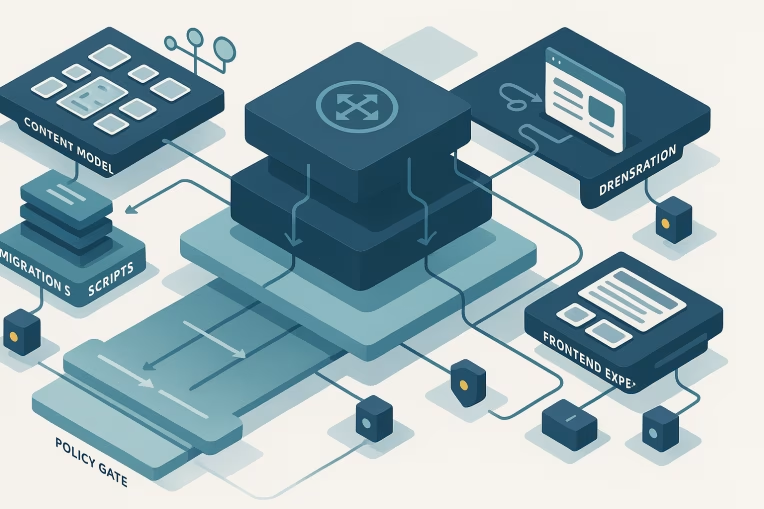
Teams often adopt Contentful environments to reduce release risk. The logic is sound: make changes in a safe environment, validate them, then promote with confidence.
That works well for a single team with a narrow content model and tightly aligned release cycles. It becomes much harder when the platform serves multiple brands, markets, or product teams. In those cases, environments are not just a technical safety mechanism. They become part of the operating model.
The common failure is not that teams use environments incorrectly. It is that they treat promotion as if it only applies to content types and fields. In practice, enterprise platforms usually promote at least four interdependent things: content model changes, content migrations, app or extension configuration, and frontend assumptions. When those move on different timelines without explicit rules, publishing can break in ways that are difficult for editors to predict and difficult for developers to diagnose.
For organizations building enterprise web platforms, the real question is not whether to use environments. It is how to govern promotion so that teams can move independently without creating hidden release dependencies.
Why environment-based delivery gets risky as teams and brands multiply
In a small implementation, environment promotion can remain mostly informal. A developer updates a content type, runs a migration, checks preview, and asks editors to continue working.
In a multi-team platform, that same process becomes fragile because the environment boundary is carrying more kinds of change than the organization acknowledges.
A few common scaling factors increase risk:
- Multiple teams own different sections of the model.
- Regional or brand teams publish on different calendars.
- Frontend applications consume content differently across channels.
- Editors depend on app configuration, validations, and reference structures that are not always promoted together.
- Preview, delivery, and build processes may point to different environments or aliases during transition periods.
At that point, promotion stops being a simple handoff from development to production. It becomes a coordination event between platform engineering, CMS administration, content operations, and editorial stakeholders.
This is especially true in organizations that need both central platform governance and local market flexibility. A global team may want consistent modeling standards, while local teams need to release content on their own schedule. Without a clear promotion contract, one team can unintentionally block another by introducing model constraints or dependencies that are valid in development but not yet safe in production.
The four things teams promote on different timelines: models, entries, apps, and frontend assumptions
When teams say they are promoting a Contentful change, they often mean only the content model. That is usually too narrow.
A more useful governance lens is to treat promotions as coordination across four change categories.
1. Content model changes
This includes new content types, added fields, changed validations, reference rules, editor interface adjustments, and field requirement changes.
These are often managed through migration scripts or other controlled change mechanisms. They are visible, versionable, and usually treated as technical work.
The problem is that model changes are only safe if the rest of the system is prepared for them.
2. Entry and asset state changes
A new required field is not production-ready if existing entries do not have valid values. A new reference rule is not safe if editors do not yet have the target content available. A renamed field may be harmless structurally but disruptive if downstream consumers still depend on old content semantics.
This is why content migrations matter. Some changes can be deployed as schema-first updates. Others need entry transformations, backfills, or editorial remediation before promotion should be allowed.
3. App, extension, and configuration dependencies
Teams sometimes underestimate how much publishing behavior depends on configuration around the model.
Examples include:
- Custom apps used for field editing or validation workflows
- Sidebar tools and editorial workflow helpers
- Environment-specific settings for integrations
- Webhook behavior tied to publish events
- Preview-related configuration used by editors or QA teams
If a model assumes a custom editor experience or a workflow aid that is not aligned across environments, editors can be left with incomplete or confusing publishing behavior.
4. Frontend assumptions and delivery contracts
The frontend often encodes expectations that are not expressed directly in the CMS model. A component may assume a field is always present, a reference always resolves, or a content type includes a specific variant structure.
Those assumptions may live in:
- Rendering components n- GraphQL queries or CDA/CPA consumption logic
- Static generation pipelines
- Preview applications
- Validation layers inside integration services
A model change that looks backward compatible inside Contentful can still break preview or production rendering if consumers have not been prepared.
That is why Contentful environment promotion governance should be treated as a platform concern, not only a CMS administration task.
Failure patterns: broken previews, validation mismatches, missing fields, and blocked editors
When promotion rules stay implicit, the same failure patterns appear repeatedly.
Broken previews
Preview commonly fails before production does because preview paths tend to expose draft content, evolving schemas, and partial migrations earlier.
Typical causes include:
- Preview apps pointing at an environment that contains schema changes but not migrated entries
- New required fields missing on existing draft content
- Rendering logic expecting fields that are not yet present across all entry variants
- Reference chains that now require content not yet created in the target environment
Editors experience this as randomness: one entry previews correctly, another does not, and the root cause is hard to see from the UI.
Validation mismatches
Validation changes can create a gap between what the environment allows structurally and what teams are operationally ready to support.
For example, making a field required may be technically correct for all future entries but operationally unsafe for existing content. Tightening allowed values can also block updates to older entries that were previously valid.
This often surfaces at the worst time: an editor makes a small update to an unrelated field and suddenly cannot publish because the entry now fails a new validation rule.
Missing fields and null-heavy content states
A field can exist in the model without being reliably usable in the content estate.
This matters when developers deploy frontend logic based on field availability before migration coverage is complete. In enterprise setups, content is rarely uniform. Some brands, regions, or legacy sections may lag behind. If those differences are not accounted for, the frontend becomes brittle.
Blocked editors and emergency workarounds
When production promotion is poorly sequenced, editorial teams often absorb the operational cost. They may be asked to republish content in a narrow window, manually backfill values, stop working in certain sections, or delay campaign launches until technical teams resolve an issue.
That is not just inconvenient. It is a sign that the release process is pushing coordination risk onto the least appropriate part of the organization.
Promotion contracts between CMS admins, developers, and editorial teams
A useful way to reduce these issues is to define a promotion contract.
A promotion contract is not a vendor feature. It is an agreed set of rules that describes what must be true before a change can move between environments, who validates it, and how release dependencies are communicated.
For Contentful-based platforms, a practical promotion contract usually includes the following.
Change classification
Not every CMS change needs the same process. Teams should classify changes by operational risk, for example:
- Low risk: additive optional fields, non-breaking UI configuration updates
- Managed risk: new content types, changed reference structures, new editor workflows
- High risk: required fields, field removals, validation tightening, changes with frontend dependencies, changes affecting multiple brands or regions
This helps avoid over-governing simple work while forcing more discipline around changes that can affect publishing.
Explicit dependency mapping
Before promotion, teams should identify whether the change depends on:
- Migration scripts
- Editorial backfill work
- Frontend deployment
- Preview configuration updates
- Integration or webhook updates
- Coordinated release timing across markets or brands
The point is to make the hidden dependency visible early, not during production rollout.
Shared release ownership
Promotion should not be owned by developers alone or by CMS administrators alone.
A stable model is shared ownership:
- Platform or CMS owners approve model integrity and environment readiness.
- Developers confirm application compatibility and rollback feasibility.
- Content operations or editorial leads confirm business readiness, freeze windows, and remediation plans.
This structure is especially helpful in enterprise content platforms where the people closest to the content are not the same as the people deploying the code.
When to use migration scripts, freeze windows, and staged rollout lanes
There is no single promotion pattern that fits every Contentful implementation. The right mechanism depends on the shape of the change.
Use migration scripts for repeatable structural changes
Migration scripts are appropriate when the model itself is changing and you need a repeatable, auditable way to move those changes between environments.
They are particularly valuable for:
- Creating or modifying content types and fields consistently
- Enforcing standard promotion steps across teams
- Reducing manual environment drift
- Supporting reliable validation in non-production environments before rollout
Scripts are not enough by themselves, but they are the foundation of disciplined model promotion.
Use content migrations when schema changes affect existing entries
If a new model introduces requirements that old entries do not satisfy, teams should treat entry transformation as part of the release, not as optional cleanup.
This can include:
- Backfilling default values where appropriate
- Re-shaping references
- Splitting or consolidating legacy fields
- Flagging entries that need manual editorial completion
The key governance question is simple: can production promotion happen before entry state is safe? In many cases, the answer should be no.
Use freeze windows for disruptive or wide-reaching changes
Freeze windows are not always necessary, but they can be useful when:
- Validation rules are tightening across heavily used content types
- Editors are actively publishing campaign content during rollout
- Multiple teams depend on the same shared model area
- The rollback path is limited or operationally expensive
A short, well-communicated freeze window is often safer than allowing partial publishing during a structurally sensitive release.
Use staged rollout lanes for additive but dependent changes
Some changes are best rolled out in stages:
- Deploy backward-compatible frontend support.
- Promote additive model changes.
- Run migrations or editorial backfill.
- Switch rendering logic or enable new editorial workflows.
- Remove legacy support later.
This staged approach is often more sustainable than trying to force a clean cutover in one step, especially on platforms with multiple delivery teams.
Handling cross-space or multi-region dependencies
Enterprise platforms rarely operate in a single isolated content space. Even when the core implementation is in one Contentful footprint, dependencies may extend across regions, brands, business units, or connected systems.
That creates governance challenges that environment promotion alone does not solve.
A few patterns deserve specific attention.
Shared versus local model ownership
If one team owns the base model and other teams extend it operationally, the promotion process needs a clear boundary between global standards and local release freedom.
Without that boundary, a centrally managed change can arrive in a way that is technically valid but locally disruptive.
Useful questions include:
- Which content types are globally governed?
- Which validations are mandatory everywhere?
- Which fields support regional flexibility?
- Who approves breaking changes to shared structures?
Cross-space integration assumptions
If content is synchronized, referenced indirectly, or consumed by external services, promotion readiness depends on more than one environment state. Teams need to verify that dependent systems can handle the new structure before production rollout.
This does not require overcomplication. It simply means that the release checklist should reflect system boundaries realistically.
Multi-region editorial sequencing
Regions often do not publish at the same time or with the same staffing model. A model change may be acceptable for one market this week and disruptive for another.
Governance should account for that by defining:
- Which changes require central scheduling
- Which changes can be adopted market by market
- How temporary compatibility is maintained during staggered rollout
This is one reason enterprise teams often invest in content platform architecture and headless content modeling upfront. The delivery model becomes easier to govern when the schema is designed with rollout boundaries in mind.
Validation and rollback checks before production promotion
Production promotion should have a concrete readiness gate. It does not need to be bureaucratic, but it should be systematic.
A practical pre-promotion check can include the following.
Model validation
Confirm that the target environment contains the intended schema and nothing manual has drifted from the controlled change path.
Entry-state validation
Check whether existing entries still meet the rules of the promoted model. If they do not, identify whether automated migration, manual remediation, or deferred enforcement is the correct path.
Preview validation
Validate representative preview scenarios, not only happy-path entries. Include older content, region-specific variants, and entries with incomplete relationships where those exist operationally.
Frontend compatibility validation
Confirm that consuming applications can tolerate both old and new states if the rollout is staged. If they cannot, the deployment order must change.
Editorial workflow validation
Ensure that the people creating and publishing content can still complete core tasks without hidden blockers. This is especially important when custom apps, sidebars, or workflow conventions are involved.
Rollback feasibility
Teams often discuss rollback too abstractly. In content platforms, rollback may be asymmetric:
- Code can be rolled back quickly.
- Schema changes may be harder to reverse cleanly.
- Entry transformations may not be trivially reversible.
- Editors may already have created content in the new structure.
For that reason, the safer question is often not "can we roll back everything" but "what is the lowest-risk containment plan if this promotion causes issues?"
That may mean:
- Re-pointing traffic or preview to a stable environment or alias strategy already in use
- Temporarily disabling frontend use of a new field
- Relaxing validation if editors are blocked
- Deferring feature activation while preserving non-breaking model additions
Careful planning here reduces the temptation to make production fixes manually under pressure.
Operating model checklist for sustainable environment governance
The teams that scale best with Contentful environments usually treat governance as a lightweight operating model rather than a sequence of ad hoc approvals.
A sustainable checklist often looks like this:
- Define promotion lanes for low-risk, managed-risk, and high-risk CMS changes.
- Require version-controlled model changes for shared or production-facing schema updates.
- Document dependencies between model changes, entry migrations, app configuration, and frontend releases.
- Decide which changes are allowed to be additive-first and which require synchronized rollout.
- Establish editorial communication rules for freeze windows, remediation work, and publish-impacting changes.
- Validate preview and production consumption paths separately where they behave differently.
- Use representative content samples from multiple brands, markets, or lifecycle states during testing.
- Record a containment plan for changes that are hard to roll back fully.
- Review environment drift regularly so manual changes do not become invisible release debt.
- Revisit governance whenever the number of teams, brands, or delivery channels increases.
The value of this checklist is not process for its own sake. It is that it makes release safety predictable without forcing every team into the same cadence.
For organizations investing in headless CMS architecture, content platform architecture, or static site generation architecture, this is where technical design and operating design meet. A good platform model is not only flexible in code. It is governable in production.
Contentful environments can absolutely support fast, multi-team delivery. But speed comes from explicit promotion rules, not from environments alone. Once teams recognize that they are promoting models, entries, apps, and frontend assumptions together, the path to stable publishing becomes much clearer.
The practical takeaway is simple: if content model changes can break publishing, then promotion governance belongs in the core delivery system. Make the dependencies visible, define promotion contracts, validate operational readiness, and design rollout lanes that respect both technical and editorial reality. That is what turns environments from a safety illusion into a scalable platform practice.
Tags: Content Operations, Contentful, Headless CMS, Content Modeling, Platform Governance, Enterprise Web Platforms