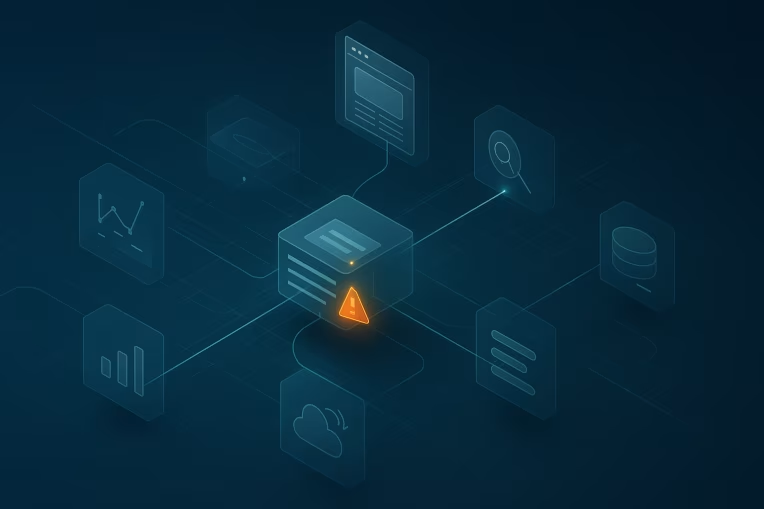
In mature headless environments, publishing is rarely just a CMS action. It is a platform event.
A single content change can affect rendered pages, navigation structures, search indexes, XML feeds, webhook subscribers, personalization rules, analytics classification, edge caches, and downstream data consumers that never appear in the authoring interface. When teams treat publishing as an isolated entry update, they often discover problems only after release: missing pages, stale search results, broken cards, incomplete feeds, inconsistent personalization, or unexpected cache behavior.
That is why enterprise teams increasingly need a headless publishing dependency graph: a practical way to model what consumes content, how that consumption happens, and what can break when a field, schema, relationship, or publishing workflow changes.
This is not a vendor-specific feature claim. It is an operating capability. Some organizations implement it through architecture documentation, validation services, release workflows, content contracts, and observability tooling. Others start with simpler dependency registers and evolve toward more automated impact analysis over time. What matters is not the label. What matters is whether teams can answer a basic pre-publish question with confidence:
If this content changes, what else changes with it?
Why headless publishing failures are usually dependency failures
When publishing incidents happen in enterprise headless stacks, the root cause is often described too narrowly. Teams may say:
- the page failed to build
- the API returned bad data
- search did not update
- the feed consumer broke
- the cache served stale content
Those are symptoms. The deeper issue is usually that the organization lacks a complete view of headless content dependencies.
Headless delivery separates concerns by design. That separation creates flexibility, but it also distributes risk. The CMS owns structured content. Frontend applications own rendering. Search platforms own indexing and retrieval. Personalization engines own audience logic. Edge infrastructure owns cache invalidation. Integration services own syndication and webhooks. Analytics layers may classify or enrich content again.
Each system can be independently useful. Together, they form an interdependent publishing chain.
Without a dependency graph, teams rely on partial indicators:
- CMS previews that show only one rendering path
- build logs that reflect frontend compilation but not downstream consumers
- webhook success codes that say a request was delivered, not that processing succeeded
- search monitoring that detects lag after publication rather than before
- tribal knowledge held by a few architects or platform engineers
This is why publish risk often feels unpredictable even in technically sophisticated stacks. The platform is not actually unpredictable. The dependencies are simply under-modeled.
A dependency-graph approach helps teams move from reactive debugging to publish impact analysis. Instead of waiting for breakage, they define the consumer landscape in advance and use it to guide validation, ownership, and release decisions.
What belongs in a publishing dependency graph
A useful dependency graph is broader than page composition. It should capture both direct and indirect dependencies.
Direct dependencies usually include:
- CMS content types and fields
- references between entries
- page routes and templates
- frontend components that expect specific structures
- build pipelines or renderers consuming the content API
Indirect dependencies often include:
- search indexing jobs and ranking fields
- personalization inputs and audience attributes
- feeds for apps, partners, or syndication endpoints
- analytics taxonomies, metadata mappings, or event payloads
- digital asset relationships from a DAM
- cache keys, purge rules, and revalidation triggers
- webhook subscribers and downstream transformation services
For enterprise use, the graph should describe at least five dimensions.
1. The source object
What changed?
Examples include:
- an entry
- a content type
- a field definition
- a taxonomy term
- a linked asset
- a workflow or publishing state
2. The consuming system
Who uses it?
Examples include:
- Next.js web applications
- static export jobs
- search pipelines
- mobile apps
- feed generators
- personalization services
- analytics enrichment jobs
3. The contract
How is it consumed?
This is where many teams are weakest. A dependency is not just a connection. It is an expectation. The consumer may depend on:
- field presence
- field type
- allowed values
- relationship cardinality
- localization behavior
- publish timing
- sort order
- image rendition availability
4. The criticality
How much damage can occur if the contract breaks?
Not all dependencies deserve the same release controls. A broken promotional ribbon and a broken product availability feed should not be treated equally.
5. The detection and recovery path
How would you know it failed, and how would you fix it?
A graph becomes operationally useful when it links dependencies to validation rules, monitoring, owners, and rollback or reconciliation procedures.
At first, this can live in a spreadsheet, service catalog, architecture registry, or structured documentation. Over time, stronger implementations encode parts of the graph into automated validation, schema rules, integration tests, and publish workflows.
Common hidden consumers: search, feeds, personalization, analytics, static builds, edge caches
Many organizations understand page rendering dependencies fairly well. Fewer understand the hidden consumers that create enterprise publish risk.
Search is one of the most common blind spots.
A content editor may update title, summary, tags, or taxonomy assignments expecting a straightforward page change. In practice, those fields may also control:
- search result titles and snippets
- filtering and faceting behavior
- synonyms or ranking inputs
- index freshness rules
- recommendations based on classification
If search indexing lags, rejects malformed content, or depends on fields no longer populated, the page may look correct while discovery is broken.
Feeds and syndication endpoints are another frequent source of downstream breakage.
Feeds often depend on rigid contracts because they serve external channels, internal aggregators, apps, or partner systems. A small editorial change in one field can affect:
- required feed inclusion logic
- ordering and completeness
- field formatting or normalization
- image references
- category mappings
These consumers are easy to miss because they are rarely represented in content authoring previews.
Personalization systems can be even harder to trace.
A piece of content may be used not only as displayed copy but as input into audience targeting, variant selection, or recommendation logic. If taxonomies change or metadata becomes inconsistent, personalization quality can degrade without causing a visible system error.
Analytics and measurement layers also consume content more than teams expect.
Content identifiers, categories, campaign labels, and page metadata often flow into analytics events and dashboards. Schema or taxonomy changes can quietly degrade reporting consistency, which becomes a business issue long after the content was published.
Static builds and incremental rendering workflows introduce timing dependencies.
In a Next.js environment, for example, a CMS publish event may trigger on-demand revalidation, selective rebuilds, queued generation, or fallback rendering behavior. If the relationship map is incomplete, teams may invalidate too little and leave stale pages live, or invalidate too much and create unnecessary operational load. This is exactly where static site generation architecture decisions need to reflect real content dependencies rather than isolated route logic.
Edge caches add another layer.
Many enterprises optimize delivery with CDN and edge caching strategies tied to route patterns, tags, surrogate keys, or API responses. A correct CMS change can still result in an incorrect user experience if cache invalidation does not align with the actual dependency map.
The practical lesson is simple: if a system consumes content in any form, it belongs in the dependency graph.
How to classify dependency criticality before release
Not every dependency needs the same approval path or validation depth. A workable publish impact analysis model should classify criticality so teams know where to invest control.
A useful framework typically considers three factors.
Business impact
Ask what happens if the dependency fails.
- Does a failure affect revenue, compliance, or core user journeys?
- Does it degrade discoverability, reporting, or personalization quality?
- Is the impact internal, external, or partner-facing?
Technical fragility
Ask how likely the dependency is to fail when change occurs.
- Is the consumer tightly coupled to field structure?
- Does it rely on optional fields that are inconsistently populated?
- Is processing asynchronous, eventually consistent, or hard to observe?
- Does the consumer have strict contract parsing?
Recoverability
Ask how quickly the issue can be detected and corrected.
- Can the team roll back quickly?
- Is reindexing straightforward?
- Can a feed be replayed?
- Can stale cache be purged safely?
- Will data need reconciliation after the incident?
From these factors, teams can define practical categories such as:
- Critical: release-blocking dependencies tied to core journeys, regulated outputs, or high-value downstream systems
- Important: non-blocking but high-visibility dependencies that need validation and monitoring
- Routine: lower-risk consumers where issues are acceptable within normal operational tolerance
The goal is not a perfect scoring model. The goal is consistent decision-making.
For example, a taxonomy change might be considered:
- critical for search facets and navigation logic
- important for personalization segmentation
- routine for an internal analytics enrichment field
This avoids a common enterprise failure mode: applying the same publish process to every change regardless of actual downstream risk.
Preview, validation, and publish-time impact checks
Preview is necessary, but preview alone is not enough.
Most CMS previews answer a narrow question: How will this content render in one experience? Enterprise publishing needs to answer broader questions:
- Which consumers are affected?
- Which contracts are at risk?
- Which validations must pass before publish?
- Which post-publish checks confirm downstream completion?
That is where publish-time impact checks become valuable.
A mature validation approach often includes several layers.
Schema and contract validation
Before content is published, validate structural expectations such as:
- required fields for specific destinations
- allowed value sets
- relationship presence and cardinality
- asset readiness
- localization completeness
- compatibility with known consumer contracts
This reduces preventable breakage at the source.
Dependency-aware preview
Where possible, preview should expose more than one rendered page. It can also surface affected routes, dependent modules, related feed items, or search documents likely to change. Even partial visibility is better than treating each entry as isolated.
Impact summaries at publish time
A strong platform capability is the ability to show authors or approvers what a publish event may trigger.
For example:
- pages likely to revalidate
- search collections likely to reindex
- feeds likely to regenerate
- webhook consumers expected to process the change
- critical downstream systems requiring confirmation
This does not need to be fully automated on day one. Some organizations begin with manually curated impact notes for high-risk content types.
Post-publish confirmation and reconciliation
Publish should not be considered complete just because the CMS accepted the change. Teams should confirm that downstream processing happened as expected.
Common checks include:
- build or revalidation success
- index update completion
- webhook processing acknowledgment
- cache invalidation completion
- feed regeneration status
- comparison of expected versus actual downstream artifacts
This is where reconciliation matters. If a publish event should have produced six updated routes, two index documents, and one feed change, the platform should ideally help verify that those outcomes occurred.
Not every enterprise can implement full reconciliation immediately. But even targeted checks for high-risk content domains can significantly reduce CMS publish risk.
Operating model: who owns dependency mapping and change review
Dependency mapping is not just a technical artifact. It is an operating model.
If ownership is vague, the graph becomes outdated and stops influencing decisions. In most enterprises, responsibility should be shared but clearly partitioned.
A practical model often looks like this:
CMS platform owners maintain source-model knowledge.
They typically own:
- content types and field definitions
- workflow configuration
- authoring constraints
- publication rules
- editor-facing validation
Frontend leads own rendering and route dependencies.
They typically own:
- page templates and component contracts
- static or dynamic rendering behavior
- revalidation logic
- route-level dependency behavior
Integration or platform engineering teams own downstream system contracts.
They typically own:
- webhook consumers
- feed generation services
- transformation pipelines
- cache invalidation logic
- search indexing orchestration
- observability and reconciliation paths
Content operations managers help govern practical change review.
They often own:
- release coordination for high-impact changes
- editorial process alignment
- publication windows and approvals
- communication across dependent teams
The key is to define when dependency review is required.
Not every content edit should trigger architecture review. But some changes should.
Typical review triggers include:
- schema changes
- taxonomy changes
- new downstream consumers
- changes to required fields or publishing workflows
- migration programs
- new personalization or search logic
- changes that affect syndication or partner outputs
This is where headless platform governance becomes useful. Governance should not be a bureaucracy layer added after the fact. It should provide clear thresholds, ownership, and escalation paths for changes with meaningful dependency impact. In practice, that usually sits inside broader content platform architecture decisions about contracts, ownership boundaries, and operational controls.
Recovery patterns when a content change breaks downstream systems
Even with good dependency mapping, some failures will still happen. Recovery planning matters because downstream breakage often spans multiple systems with different timing and ownership.
Useful recovery patterns include:
Fast content rollback
When the issue is source-content driven and reversible, the fastest option may be restoring the previous valid state and republishing.
Consumer-side fallback behavior
Frontend and integration consumers should avoid failing catastrophically when possible. Reasonable defaults, null handling, or safe rendering patterns can reduce the blast radius of incomplete or malformed content.
Replay and reprocessing
For asynchronous systems such as search indexing, feed generation, or webhook pipelines, replay capability is often more valuable than perfect first-pass delivery. Teams should know how to resend events, regenerate artifacts, or re-run transformations.
Cache purge and revalidation recovery
If the issue is stale delivery rather than bad source content, targeted invalidation or revalidation may resolve the incident without a full rollback.
Reconciliation jobs
When state becomes inconsistent across systems, reconciliation jobs can compare expected and actual outputs and repair missing updates. This is especially useful in environments with eventual consistency and multiple subscribers.
Incident tagging for graph improvement
Every publish incident should feed back into the dependency map. If a consumer was missed, a contract was unclear, or ownership was ambiguous, the graph should be updated as part of recovery, not treated as a separate documentation task for later.
This is how the dependency graph becomes more than a diagram. It becomes a learning system for the platform.
Implementation sequencing for enterprise teams
A common mistake is trying to build a fully automated dependency graph before the organization has agreement on core contracts and ownership. A better approach is phased.
Phase 1: make dependencies visible
Start with high-risk content domains and document:
- key content types
- known consumers
- critical fields and relationships
- system owners
- failure modes
Phase 2: define contracts and criticality
Identify which dependencies are structural, which are business-critical, and which need release review or stronger validation. This is often where headless content modeling work becomes essential, because unstable schemas and ambiguous relationships make impact analysis unreliable from the start.
Phase 3: add publish impact analysis
Introduce lightweight pre-publish checks, impact summaries, and approval paths for high-risk changes.
Phase 4: improve observability and reconciliation
Add status visibility across indexing, regeneration, feed production, and cache invalidation so teams can confirm downstream completion.
Phase 5: automate selectively
Automate where the payoff is real: contract validation, dependency-aware revalidation, event replay, and critical downstream health checks. Avoid overengineering low-value consumers.
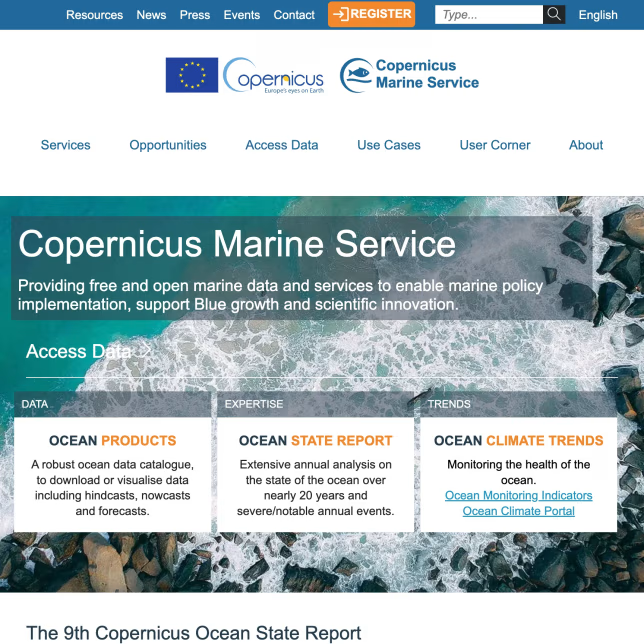
This sequencing keeps the work aligned to enterprise delivery realities. The objective is not theoretical completeness. It is safer publishing with clearer accountability. Teams modernizing toward this model often encounter the same issues seen in Copernicus Marine Service, where publishing workflows, integrations, search, and governance all had to be treated as one operating system rather than separate implementation tracks.
Final thought
Enterprise headless platforms do not become risky because they are composable. They become risky when composability outpaces visibility.
A CMS entry is never just an entry once it is connected to pages, search, personalization, feeds, analytics, and edge delivery. Publishing is a multi-system change event, whether the organization models it that way or not.
A headless publishing dependency graph gives teams a practical way to see that event more clearly. It helps architects map contracts, platform owners introduce proportionate controls, frontend leads understand rendering impact, and content operations teams publish with fewer surprises.
Most importantly, it changes the core release question from Can we publish this? to What will this publish affect, and are we ready for those effects?
That shift is often what separates a merely functional headless stack from a governable enterprise platform.
Tags: Headless, Enterprise CMS, Content Operations, Search Integration, Platform Governance, Frontend Architecture