In a coupled CMS, rollback is often imagined as a relatively contained event: revert the page, restore the database, or redeploy the application version that previously worked. In a headless platform, that mental model breaks down quickly.
Publishing is distributed. Content may live in a CMS. Delivery code may be deployed independently through a frontend pipeline. Search indexes may lag behind. Static generation may have created artifacts from a now-invalid state. CDNs may still serve responses that no longer reflect either the CMS or the last stable frontend release. Feature flags may further change what users see.
That is why headless publishing rollback architecture matters. A bad release is not just a bad moment in time. It is often a bad combination of states across systems that do not naturally move backward together.
The practical goal is not to create the illusion of a single-button undo. The goal is to define safe reversal paths, version boundaries, and operating procedures that let teams recover quickly without making the platform less reliable during the incident.
Why rollback is harder in headless than in coupled CMS platforms
Headless delivery improves flexibility, but that flexibility creates more rollback surfaces.
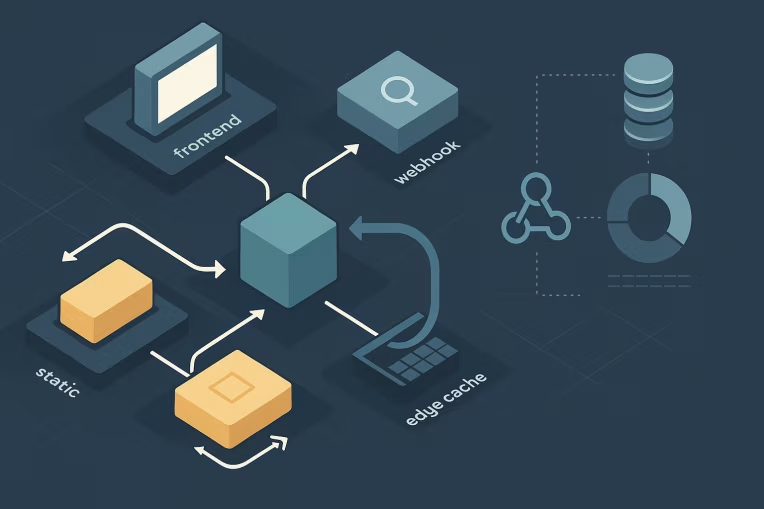
In a typical enterprise setup, a publish action can trigger or influence all of the following:
- CMS content state changes
- API payload changes consumed by multiple channels
- static or incremental builds for the website
- server-rendered frontend behavior
- search indexing updates
- personalization or targeting rules
- edge cache invalidation or delayed cache expiry
- downstream webhooks and integration jobs
The issue is not just the number of systems. It is the fact that these systems can have different guarantees:
- Some are versioned well.
- Some are eventually consistent.
- Some are append-only.
- Some are easy to redeploy but hard to reconcile.
- Some can be rolled back safely only if a dependency is rolled back first.
A coupled platform often hides those dependencies inside one runtime or one database. A headless platform makes them explicit. That is usually the right tradeoff for scale and composability, but it means rollback must be designed as part of the release model.
The rollback surfaces: CMS content, APIs, builds, search, cache, feature flags
The most useful way to approach rollback is to identify the surfaces that can drift out of sync.
CMS content state is the most obvious surface. Editors may publish entries, unpublish items, alter references, change taxonomy, or modify scheduling rules. Reverting this state may require restoring a previous revision, republishing a prior model of a page tree, or reapplying a known-good release bundle.
API responses are a separate concern, even when they originate from the CMS. A frontend may consume published content, preview content, transformed content, or aggregated content from middleware. If the transformation layer changed, restoring the CMS alone may not restore the previous response contract.
Frontend builds and deployments form another rollback surface. A Next.js or similar composable frontend may have code that assumes new fields, new routing logic, or new fallback behavior. Rolling back content without considering deployed code can leave the frontend unable to render what the CMS now serves, or vice versa.
Search indexes are frequently overlooked in rollback planning. If a bad publish pushed outdated or incorrect records into search, simply reverting the content source does not necessarily fix what users see in search results. Reindexing or restoring a previous indexed state may be required.
Edge and CDN caches can extend the incident even after core systems are repaired. Old content may persist in some regions while new content appears elsewhere. Teams need a clear policy for cache purge scope, TTL behavior, and sequencing after rollback.
Feature flags and release toggles can help reduce rollback scope, but they also create their own complexity. If a feature flag masks a code path but not the content model behind it, or if flag state changes faster than cached content, teams can still produce inconsistent live behavior.
A rollback architecture becomes stronger when these surfaces are documented explicitly, not treated as hidden implementation detail.
Failure modes that need different rollback paths
One of the biggest mistakes in enterprise publishing operations is treating every bad release as the same kind of problem. In practice, different incidents require different rollback paths.
Here are common categories.
1. Content-only error
Examples include:
- incorrect legal copy published to a live page
- product availability content exposed too early
- broken page composition caused by editorial changes
- taxonomy or navigation errors affecting discovery
In these cases, the safest rollback may be to restore or republish a known-good content revision while leaving code untouched.
2. Frontend-only error
Examples include:
- a deployment breaks rendering for a valid content model
- a route generation bug causes 404s
- a hydration or client-side interaction issue affects conversion
- a new query pattern overloads an API
Here, rolling back the application deployment may be enough if content has not changed in incompatible ways.
3. Mixed release error
These are more difficult and more common than teams expect. A content model change and frontend change may have been coordinated informally rather than through a formal release boundary. If one side moves forward and the other moves back, the platform may remain broken.
Examples include:
- a new field becomes required in the UI before content is populated everywhere
- a component expects referenced content types that are not fully published
- a frontend deployment assumes a content schema not yet available in all environments
4. Integration propagation error
The publish itself may be valid, but webhooks, search jobs, feed processors, or personalization rules may consume the wrong snapshot or fail partway through. Rolling back here may require replaying jobs, suppressing downstream updates, or forcing re-synchronization.
5. Cache coherence error
Sometimes the source of truth is fixed, but users still see the wrong experience because caches, stale artifacts, or partial invalidation preserve an old or mixed state.
Each category benefits from a different runbook, different owners, and different timing expectations.
Designing version boundaries and release checkpoints
Rollback becomes materially safer when the platform defines where a release starts and ends.
Without version boundaries, teams are effectively trying to reverse a moving target. Editors continue publishing. Code pipelines continue deploying. Search workers continue updating. During an incident, that makes it hard to answer the most basic question: what exactly are we trying to get back to?
A stronger design usually includes several checkpoints.
Content checkpoints
For high-risk releases, teams often need a way to identify a known-good content state beyond individual entry histories. That can mean:
- release bundles for groups of related entries
- scheduled publish windows with content freeze rules
- explicit promotion from staging-approved content to live-ready content
- snapshot identifiers for key landing pages, navigation, and shared components
The point is not to snapshot everything all the time. The point is to create reversible boundaries around content that ships together.
Schema checkpoints
Content model and API contract changes need special care. Backward-compatible evolution is usually safer than synchronized hard cuts. For example:
- add new fields before requiring them
- support old and new field mappings during transition
- deprecate only after delivery code no longer depends on the old structure
This reduces the chance that a rollback of one layer breaks another.
Deployment checkpoints
Frontend releases should have identifiable, reproducible artifacts. A team should know which build is currently live, which build was previously stable, and what runtime configuration was attached to each.
Operational checkpoints
Search index versions, cache purge events, feature flag states, and integration job execution windows should be observable enough to reconstruct the release path. You do not need perfect distributed tracing to do this well, but you do need enough release metadata to support high-pressure decision-making.
In practice, a checkpoint model often answers four questions:
- What changed?
- In what order did it change?
- Which dependencies consumed that change?
- What is the last known-good composite state?
Rollback patterns for content-only, frontend-only, and mixed releases
A useful rollback architecture does not prescribe one universal reversal. It defines patterns.
Content-only rollback
This pattern is appropriate when content is clearly the source of the incident and code remains compatible.
A safe sequence often looks like this:
- Pause nonessential publishing on affected content domains.
- Identify the last known-good content state for the impacted pages, components, or taxonomies.
- Restore or republish the prior content revisions.
- Re-run dependent processes where needed, such as page regeneration or targeted indexing.
- Purge or refresh edge caches for impacted paths.
- Validate live output using both API-level and browser-level checks.
The main risk here is assuming content rollback is isolated when dependencies have already propagated. If search, feeds, or navigation caches were updated, those may need explicit reconciliation.
Frontend-only rollback
This pattern is appropriate when the deployed application is broken but the content source remains valid.
A typical sequence includes:
- Confirm that the previous deployment artifact is still compatible with current live content.
- Repoint traffic or redeploy the last stable frontend version.
- Verify runtime configuration, environment variables, and feature flags match the expected state of that deployment.
- Invalidate build artifacts or caches that may continue to serve pages generated by the faulty release.
- Run smoke tests against high-value journeys and content-heavy templates.
The hidden failure mode is content drift. If editors published content assuming the new frontend behavior, the previous deployment may not render those changes correctly.
Mixed release rollback
This is where architectural maturity matters most.
Mixed incidents often require a decision between two strategies:
- roll both content and frontend back to the last known-good checkpoint
- move one layer forward quickly with a hotfix because reverse compatibility is too risky
The right choice depends on dependency direction.
If the frontend requires a schema that the old content state does not satisfy, rolling the frontend back first may be safer. If the content was published into a structure the old frontend cannot interpret, content rollback may need to happen first. In some cases, the least risky approach is not a rollback at all but a narrow stabilizing patch that restores compatibility.
A practical mixed-release runbook often includes:
- freezing content updates for impacted models or page groups
- identifying the exact compatibility boundary between content schema and deployed code
- deciding whether rollback or hotfix has lower blast radius
- sequencing search and cache operations only after core state is stable
- validating representative pages, APIs, and discovery flows before declaring recovery
The key lesson is that rollback design should follow dependency maps, not organizational assumptions.
Recovery sequencing and dependency awareness
During an incident, teams often focus on speed. Speed matters, but sequencing matters more.
A rollback that happens in the wrong order can extend the outage or create a second incident. For example:
- Purging edge caches before restoring source state can spread broken responses faster.
- Reindexing search before content is stabilized can lock in incorrect records again.
- Rolling back code before confirming schema compatibility can trade one failure for another.
- Republishing content while webhooks are still active can retrigger bad downstream updates.
A safer mental model is to work from source of truth outward.
That often means:
- Stabilize the authoritative source state.
- Restore compatible delivery logic.
- Reconcile dependent indexes and generated artifacts.
- Refresh caches.
- Validate the user-visible experience.
That sequence is not universal, but it is usually better than starting with the most visible layer.
For enterprise teams, dependency awareness should be written down before incidents happen. A simple matrix is often enough:
- publishing action
- downstream systems affected
- whether each system is pull- or push-based
- whether rollback is possible, replay-based, or rebuild-based
- ownership and expected recovery time
This turns rollback from institutional memory into operating practice.
Reconciliation after rollback: restoring trust in live state
Teams often declare success too early. The page looks right again, the deployment is stable, and traffic recovers. But in headless environments, rollback is not complete until the live state is trustworthy across channels and dependencies.
Reconciliation matters because rollback can leave residue:
- partial search mismatches
- stale cache variants
- orphaned scheduled content
- downstream feeds with incorrect records
- analytics annotations that do not reflect the actual incident timeline
- editors unsure whether it is safe to resume publishing
A disciplined reconciliation phase usually includes:
State verification
Confirm that CMS content, rendered pages, API responses, search results, and high-value journeys all reflect the intended recovered state.
Queue and webhook review
Check whether failed or delayed jobs need to be replayed, canceled, or deduplicated.
Flag and configuration review
Validate that emergency feature flag changes, temporary routing rules, or protective throttles are either formalized or removed.
Editorial reset
Make clear which content can safely be republished and whether any changes made during the incident need to be re-entered.
Incident documentation
Capture the actual rollback path taken, what dependencies complicated recovery, and what release boundary was missing.
The broader goal is to restore confidence in the platform, not only restore uptime.
Operational runbooks and ownership for high-pressure incidents
Even strong architecture underperforms without clear operating ownership.
Rollback incidents in headless environments often cut across multiple teams:
- content operations
- CMS platform owners
- frontend engineering
- DevOps or platform engineering
- search or discovery teams
- QA or release management
When ownership is vague, teams lose time debating authority instead of reducing blast radius.
A practical runbook should define at least the following:
Incident classification
Is this content-only, frontend-only, mixed, integration, or cache-related?
Decision authority
Who can pause publishing, roll back code, disable webhooks, trigger cache purges, or suspend search jobs?
Known-good reference points
Where are the last stable content checkpoint, frontend artifact, and release notes recorded?
Validation scope
Which pages, templates, geographies, and channels must pass before recovery is accepted?
Communication model
Who updates editors, executives, customer-facing teams, and technical responders?
Post-incident follow-through
What changes to release design, tooling, or compatibility policy will reduce recurrence?
The best runbooks are not overly abstract. They name the real dependencies, real commands, real dashboards, and real owners used by the organization.
Practical design recommendations for enterprise teams
For organizations refining their content rollback strategy or broader headless release recovery approach, a few principles consistently help.
Design for compatible rollback, not perfect rollback.
Trying to make every system instantly reversible can become expensive and unrealistic. A more durable goal is to ensure that important systems can be restored to a compatible and trustworthy state through known procedures.
Separate high-risk changes from routine publishing.
Schema changes, homepage restructures, navigation updates, and major frontend releases should not be treated the same way as ordinary editorial edits.
Make propagation visible.
If search, builds, and edge invalidation happen after publish, teams should be able to see whether those actions completed, failed, or are still in flight.
Prefer additive evolution in content models and APIs.
Backward compatibility gives teams more options during rollback and reduces the chance that content and code become mutually dependent on a single release moment.
Document sequencing.
A publish rollback workflow should say not only what to reverse, but in what order and with which checks.
Practice with realistic incidents.
Tabletop exercises and release game days are useful because rollback problems are often coordination problems as much as technical ones.
Conclusion
Headless platforms make publishing more flexible, scalable, and composable, but they also make bad releases more distributed. That is why rollback should be treated as a publishing architecture concern, not an afterthought and not a mythical single-button capability.
The enterprise teams that recover most effectively are usually not the ones with the most tools. They are the ones that have defined release boundaries, mapped dependencies, preserved known-good checkpoints, and assigned operational ownership before something goes wrong.
If content, code, search, caches, and delivery workflows can move independently, rollback has to be designed with the same discipline. Done well, that does more than reverse mistakes. It reduces blast radius, shortens recovery, and makes the live platform easier to trust under pressure.
Many of the hardest rollback issues also trace back to weak content platform architecture, especially where schema evolution, API contracts, and downstream integrations were never given explicit compatibility rules.
Where static builds and CDN behavior are part of the failure path, teams also benefit from a clearer static generation architecture so regeneration, artifact invalidation, and cache refresh happen in a controlled order.
That pattern shows up in real delivery work as well. For example, the Organogenesis platform modernization emphasized release governance and predictable multi-site delivery, while the Alpro implementation highlighted incremental builds, search integration, and publishing behavior across a global headless stack.
Tags: Headless, Enterprise Architecture, Content Operations, Frontend Engineering, Release Management, Search, CDN, Digital Platforms