

 [01]
[01]Discovery and Inventory
Run a structured inventory of Sitecore content, templates, media, and integrations. Establish scope boundaries, content ownership, and constraints such as compliance, localization, and editorial freeze requirements.
Drupal migration readiness
Use a Drupal health check to surface content mapping gaps, integration dependencies, governance risks, and cutover blockers before migration plans harden.
Built for teams preparing Sitecore to Drupal migration decisions.
No login required. Takes 2–3 minutes.
Sitecore to Drupal migration services are a structured enterprise CMS migration from Sitecore that moves content, information architecture, and critical integrations into Drupal without losing editorial capability, governance, or operational stability. The work typically includes content model migration from Sitecore to Drupal (templates/fields to Drupal entities), Sitecore content extraction, API-driven content migration, and CMS data validation testing against functional and content parity requirements.
Organizations pursue this when Sitecore implementations become costly to evolve, difficult to integrate with modern delivery stacks, or constrained by legacy content structures and deployment processes. Migration is not only a data move; it is an opportunity to rationalize content types, reduce duplication, standardize taxonomy, and align editorial workflows with current operating models.
A well-engineered migration supports scalable platform architecture by establishing clear content contracts, repeatable migration pipelines, and integration boundaries (REST APIs, search, identity, and downstream consumers). It also enables controlled migration cutover planning, parallel run strategies, and post-launch stabilization so the Drupal platform can continue to evolve with predictable delivery and lower operational risk.
Core Focus
Best Fit For
Key Outcomes
Technology Ecosystem
Delivery Scope
As Sitecore implementations mature, content structures often drift from the original information architecture. Teams accumulate inconsistent templates, duplicated fields, and ad-hoc taxonomies to meet delivery deadlines. Over time, editorial workflows become fragile, content reuse declines, and the platform becomes harder to extend without unintended side effects.
Engineering teams then face compounding complexity: integrations are tightly coupled to legacy data shapes, content delivery paths are inconsistent, and environment parity is difficult to maintain. Migration attempts stall when content inventories are incomplete, mapping decisions are not governed, and validation is treated as a manual exercise. Without repeatable pipelines, each migration run becomes a one-off effort, making defect triage and regression control difficult.
Operationally, these issues surface as extended release freezes, risky cutovers, and prolonged stabilization periods. Stakeholders lose confidence in timelines because content parity is unclear, redirect strategies are incomplete, and downstream consumers (search, analytics, CRM, or apps) break due to unversioned API contracts. The result is a platform that cannot evolve predictably and carries ongoing delivery and maintenance overhead.
Assess the current Sitecore estate: content inventory, templates, workflows, media libraries, and integration touchpoints. Define migration scope, non-functional requirements, and constraints such as editorial freeze windows, compliance needs, and parallel-run expectations.
Translate Sitecore templates and fields into Drupal content types, paragraphs/components, taxonomies, and media entities. Establish naming conventions, required/optional fields, validation rules, and content contracts for downstream consumers.
Design the migration pipeline: extraction strategy from Sitecore, transformation rules, and import mechanisms into Drupal. Define idempotent runs, delta migration approach, error handling, and how to track source-to-target identifiers for traceability.
Implement automated migration scripts and jobs using Drupal migration tooling and APIs. Include media handling, link rewriting, taxonomy normalization, and user/editorial metadata where required. Ensure runs are repeatable across environments.
Recreate or refactor key integrations using REST APIs and documented contracts. Validate authentication patterns, payload shapes, and failure modes. Where needed, introduce compatibility layers to reduce downstream change during cutover.
Run automated and sampled validation for content counts, field-level mapping, URL integrity, and rendering outcomes. Establish reconciliation reports and defect workflows so mapping changes and re-runs are controlled and auditable.
Define cutover steps, freeze strategy, delta migration timing, and rollback criteria. Coordinate DNS, redirects, cache warmup, and monitoring. Prepare runbooks for launch day operations and incident response.
Monitor platform health, content integrity, and integration error rates after cutover. Address edge cases, tune performance, and harden operational processes. Transition to a backlog for iterative improvements and governance.
This service focuses on the engineering foundations required for controlled CMS replatforming from Sitecore to Drupal. It emphasizes explicit content contracts, governed content model mapping, and repeatable API-driven content migration pipelines so runs can be validated and re-executed safely. The approach also covers integration parity and migration cutover planning to keep downstream systems stable as Drupal becomes the new system of record.

Define target content models in Drupal with clear field semantics, validation rules, and reusable structures (e.g., paragraphs and taxonomies). This establishes stable content contracts for templates, APIs, and downstream consumers, reducing ambiguity during migration and enabling consistent evolution after launch.
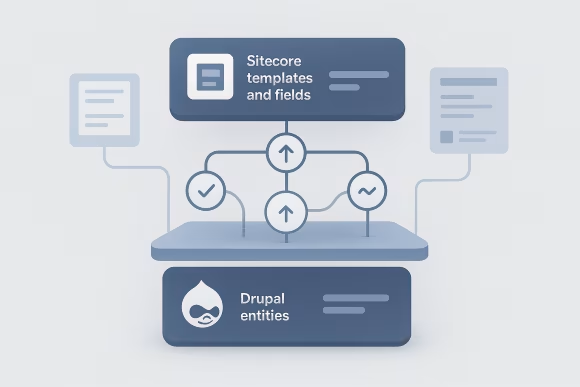
Create a governed mapping from Sitecore templates and fields to Drupal entities, including normalization rules for legacy inconsistencies. Mapping includes required/optional logic, default values, and transformations (dates, references, rich text). The output is maintained as versioned documentation and executable rules.
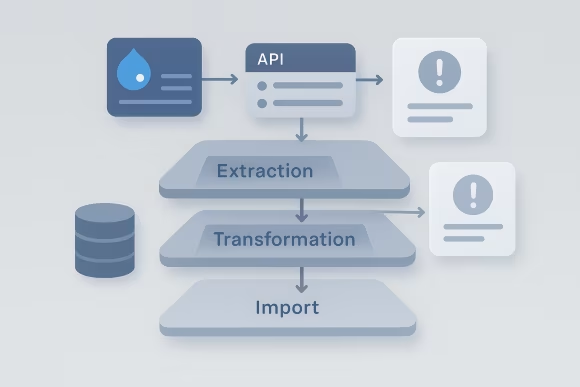
Implement repeatable extraction, transformation, and import workflows using Drupal migration tooling and APIs. Pipelines are designed to be idempotent, support re-runs, and produce actionable error reporting. This enables iterative refinement without turning each migration run into a manual project.
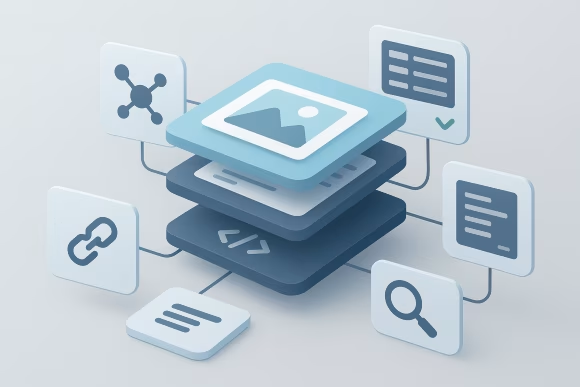
Migrate images, documents, and embedded assets with stable identifiers, metadata preservation, and link rewriting. Address edge cases such as duplicate assets, missing renditions, and legacy file paths. Ensure Drupal media entities align with governance and delivery requirements.
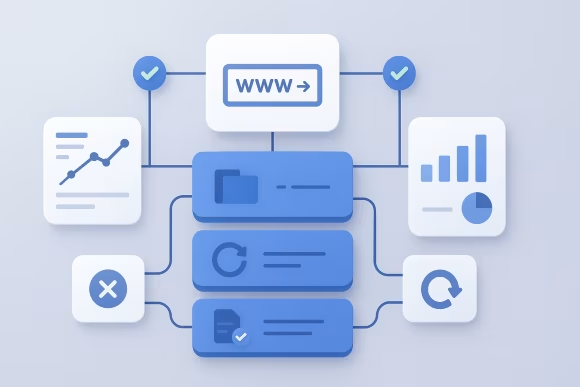
Preserve SEO and inbound link integrity through URL mapping, redirect generation, and canonical rules. Validate redirect coverage and detect collisions or loops. Where URL structures change, implement deterministic mapping to keep analytics and external references stable.
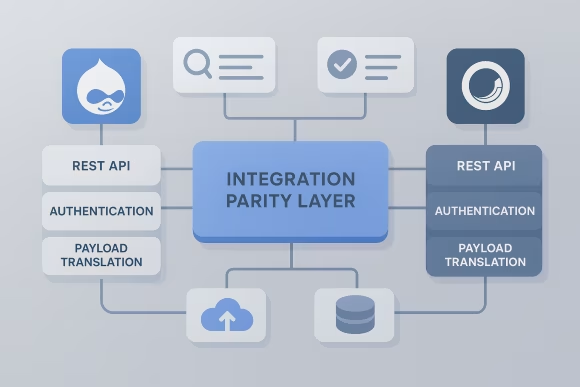
Rebuild or adapt integrations so Drupal can replace Sitecore without breaking dependent systems. Define REST API contracts, authentication patterns, and payload compatibility. Where necessary, introduce translation layers to decouple consumers from legacy data shapes during transition.
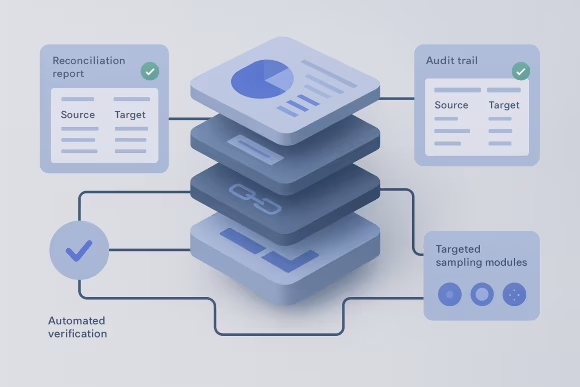
Produce reconciliation reports for content counts, field-level completeness, reference integrity, and rendering checks. Combine automated verification with targeted sampling for high-risk content. Track source-to-target IDs to support auditability, defect triage, and repeatable remediation.

Engineer cutover procedures that account for editorial freeze, delta migration, cache behavior, and monitoring. Define rollback criteria and operational runbooks. This reduces launch risk by making the transition a controlled operational event rather than an ad-hoc deployment.
A focused Drupal health check highlights where content structure, integration parity, upgrade readiness, and migration governance need attention first.
Delivery follows a clear engineering sequence: discovery and Sitecore content inventory, content model migration and mapping, implementation of repeatable API-driven migration pipelines, integration parity validation, and migration cutover planning through launch and stabilization. Each phase produces measurable artifacts (mapped models, executable runs, reconciliation reports, and runbooks) to reduce uncertainty and support controlled execution.
[01]Run a structured inventory of Sitecore content, templates, media, and integrations. Establish scope boundaries, content ownership, and constraints such as compliance, localization, and editorial freeze requirements.
 [02]
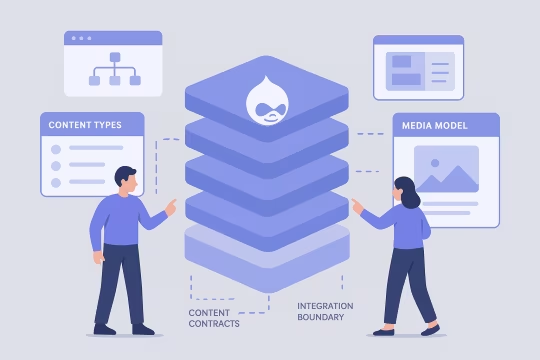
[02]Define Drupal information architecture, content types, taxonomy strategy, and media model. Document content contracts and integration boundaries so migration and downstream consumers have stable expectations.
 [03]
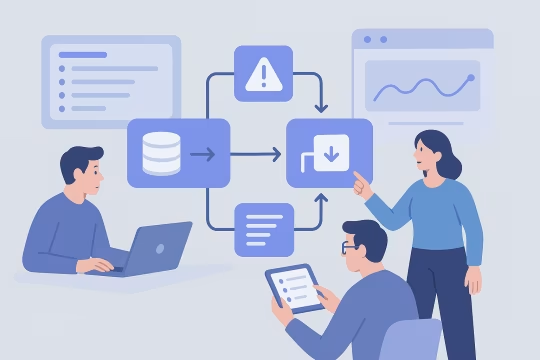
[03]Build automated extraction, transformation, and import workflows with repeatable runs. Implement error handling, logging, and traceability so mapping changes can be applied safely across environments.
 [04]
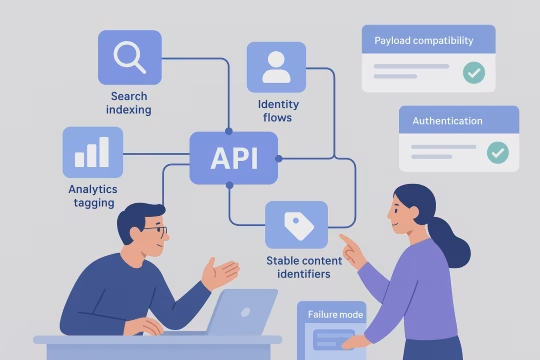
[04]Recreate required integrations and validate payload compatibility, authentication, and failure modes. Coordinate dependencies such as search indexing, analytics tagging, and identity flows that rely on stable URLs and content identifiers.
 [05]
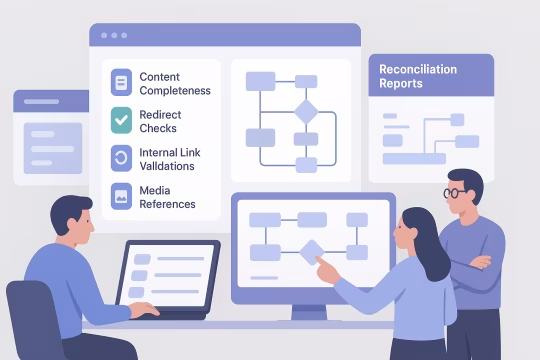
[05]Execute reconciliation reporting and targeted QA for high-risk content and templates. Validate redirects, internal links, media references, and content completeness, then iterate on mapping rules and re-run migrations as needed.
 [06]
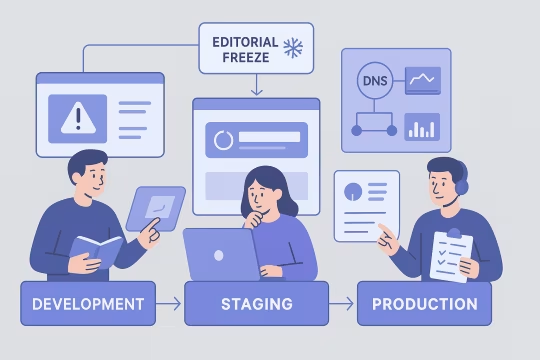
[06]Plan and execute cutover steps including editorial freeze, delta migration, DNS and routing changes, cache warmup, and monitoring. Provide runbooks and on-call coverage aligned to agreed rollback criteria.
 [07]
[07]Monitor platform health and integration error rates post-launch, then address defects and edge cases. Transition to a prioritized backlog and hand over operational documentation, dashboards, and governance practices.
A controlled enterprise CMS replatforming from Sitecore to Drupal reduces delivery risk while improving the platform’s ability to evolve. By making content structures explicit and migration runs repeatable—with CMS data validation testing and reconciliation—teams gain more predictable timelines, clearer governance, and a Drupal 10/11 foundation that supports ongoing product development without reintroducing legacy constraints.
Cutover planning, delta migration, and rollback criteria turn launch into a controlled operational event. This reduces the probability of extended outages and limits the blast radius of unexpected content or integration issues.
Repeatable pipelines and reconciliation reporting replace manual, one-off migration runs. Teams can estimate effort based on measurable mapping progress and defect trends rather than subjective readiness.
Explicit content models, validation rules, and taxonomy standards reduce drift over time. Editorial teams gain clearer structures, and engineering teams avoid reintroducing inconsistent templates and ad-hoc fields.
Rationalized content structures and documented integration contracts reduce ongoing support burden. This makes enhancements and upgrades less disruptive and decreases time spent on regression triage.
Parity checks and contract-driven APIs reduce downstream breakage during and after migration. Dependent systems can transition with fewer emergency fixes and clearer ownership of data shapes and responsibilities.
Target architecture aligned to Drupal 10/11 patterns supports future upgrades and platform evolution. This reduces long-term technical debt compared to carrying forward legacy constraints into the new system.
Migration logging, validation reports, and post-launch monitoring provide evidence-based visibility into platform health. Operations teams can detect anomalies early and respond with runbooks rather than ad-hoc troubleshooting.
Before roadmap commitment
Review the Drupal architecture, governance controls, and integration readiness behind your migration so teams can sequence work with less rework and fewer launch risks.
Related services that commonly support Sitecore replacement with Drupal, including Drupal platform migration, platform architecture and modernization, migration engineering, and API integration workstreams.
Drupal content migration engineering for data, content, and platform change
Content and integration migration with controlled cutover
Secure, Structured Drupal 7 Website Upgrade to Drupal 11/12
Custom modules, extensions, and feature engineering
Enterprise Drupal upgrade strategy for upgradeable delivery
Legacy CMS to Drupal migration planning and execution
WordPress to Drupal migration services with content integrity
Enterprise Drupal Technical Assessment & Drupal Health Check
Roadmaps, governance model design, and platform decision frameworks
Answers to common questions about Sitecore to Drupal migration services—covering how to migrate from Sitecore to Drupal, content model mapping, integrations, validation, cutover risk, governance, and engagement approach.
We start with a content inventory and template analysis to understand what is actually used, not just what exists. Sitecore templates and fields are grouped into business concepts (page types, reusable blocks, taxonomies, media). We then design Drupal entities (content types, paragraphs/components, taxonomies, media) with explicit field semantics, cardinality, validation rules, and reference patterns. A key step is deciding what becomes a reusable component versus a page-level field set. We also normalize legacy inconsistencies (e.g., multiple fields representing the same concept) and define controlled vocabularies where free text has created reporting and filtering issues. The output is both documentation and executable mapping rules used by the migration pipeline. This keeps architecture decisions testable: if the model changes, we can re-run migrations and validate the impact. We also review the model against non-functional requirements such as localization, workflow, permissions, and API consumption so the target architecture supports the platform’s long-term operating model.
We treat multi-site and multi-language as first-class architecture concerns because they affect content modeling, URL strategy, and operational processes. For multi-site, we identify shared versus site-specific content, taxonomy, media, and configuration. In Drupal, this often results in a combination of shared content types with site-specific fields, domain-based routing, and clear ownership rules for shared assets. For multi-language, we map Sitecore language versions to Drupal’s translation model and define how fallbacks should behave. We also validate that editorial workflows, permissions, and publishing states work consistently across languages. URL patterns, hreflang requirements, and redirect rules are designed early so SEO and analytics remain coherent after cutover. Migration pipelines are built to preserve language relationships and site associations, including stable identifiers for cross-language references. We run reconciliation reports per site and per language to confirm completeness and to detect partial translations, orphaned references, or inconsistent taxonomy usage before launch.
A cutover plan is a sequenced runbook that coordinates editorial activity, migration execution, infrastructure readiness, and validation gates. We typically define: (1) an editorial freeze window, (2) a final full migration run, (3) a delta migration approach for content changes during the freeze (if required), (4) DNS/routing changes, (5) cache warmup and search indexing, and (6) post-cutover verification. We also define roles and escalation paths for launch day: who approves go/no-go, who monitors logs and dashboards, and who can execute rollback steps. Validation gates include redirect coverage, critical page rendering checks, integration smoke tests, and content parity sampling for high-risk sections. For enterprise environments, we plan for parallel run where feasible (e.g., keeping Sitecore available internally) and we document rollback criteria in advance. The goal is to avoid improvisation: every step is rehearsed in a staging environment with production-like data volumes.
Operational stability is addressed through environment parity, performance baselines, and post-launch monitoring. Before cutover, we validate that the Drupal runtime (PHP, database, caching layers, container resources) is sized for expected traffic and content volume. We also test migration-generated content for patterns that can cause performance issues, such as overly deep entity reference graphs or unbounded queries. After launch, we monitor application logs, database performance, error rates from integrations, and page-level performance indicators. We use this data to prioritize stabilization work: query optimization, cache configuration, media delivery tuning, and background job scheduling. We also focus on operational hygiene: documented runbooks, backup/restore procedures, and repeatable deployment processes (often container-based). The objective is to ensure the platform can be operated predictably by internal teams, not just delivered as a one-time project artifact.
We begin by cataloging integration consumers and classifying them by dependency type: content delivery, search indexing, identity, analytics, CRM, or downstream applications. For each integration, we document the current contract (endpoints, payloads, authentication, SLAs) and identify whether the consumer can change or requires backward compatibility. On the Drupal side, we implement REST-based interfaces and data models that meet the required contracts. When consumers cannot change quickly, we introduce a compatibility layer that translates Drupal data into legacy shapes, or we version APIs so consumers can migrate incrementally. We validate integrations with contract tests and environment-specific configuration management. During cutover, we coordinate sequencing so dependent systems switch at the right time (e.g., search re-indexing after final migration). This reduces the risk of partial migrations where content is live but integrations still point to the old system of record.
We treat identity and workflow as part of the operating model, not just configuration. First, we document current roles, permissions, approval steps, and publishing states in Sitecore, including any custom logic. We then map these to Drupal roles, permissions, and workflow states, identifying gaps where Drupal needs customization or where the process should be simplified. If identity is integrated with enterprise SSO, we validate authentication flows and group-to-role mapping early, because it affects editorial access during migration testing. For permissions, we test representative user journeys (author, editor, publisher, admin) against real content structures to ensure access boundaries are correct. Workflow parity is validated with scenario testing: drafts, scheduled publishing, translations, and rollback of changes. The goal is to avoid a successful content migration that fails operationally because editors cannot perform day-to-day tasks in the new platform.
We establish a mapping governance process with clear ownership and change control. Mapping rules are treated as versioned artifacts: when a field mapping or content model decision changes, it is recorded with rationale, impact assessment, and an agreed re-run plan. This prevents “silent” changes that invalidate previous validation results. Scope drift is managed by defining what is in-scope content, what is archived, and what is intentionally redesigned. We use content inventories and stakeholder sign-off to avoid migrating unused or low-value content by default. For enterprise programs, we often create a decision log that captures trade-offs (e.g., preserve legacy structure vs. normalize for future reuse). We also define acceptance criteria for parity: which sections require strict equivalence, which can change, and what “good enough” means for edge cases. This keeps engineering work aligned with business priorities and reduces late-stage surprises.
Post-launch governance focuses on preventing content model drift and integration contract erosion. We recommend establishing ownership for content types, taxonomies, and reusable components, along with a lightweight change process for introducing new fields or templates. This avoids the gradual accumulation of one-off structures that make future migrations and upgrades difficult. For integrations, we recommend versioned API contracts, documented payloads, and monitoring of error rates and latency. Changes should be reviewed for backward compatibility and tested in staging with representative data. Operational governance includes release management, environment parity, and routine maintenance such as dependency updates and security patching. If the platform supports multiple teams, a shared backlog and architectural review cadence helps align changes across domains. The intent is to keep Drupal evolvable: predictable upgrades, controlled complexity, and clear accountability for platform decisions.
The highest-risk areas are usually (1) unclear content inventory and ownership, (2) hidden coupling through integrations, (3) URL and redirect integrity, and (4) media and rich-text edge cases. Content risk appears when stakeholders assume templates are used consistently, but real content contains exceptions, missing fields, or embedded assets that do not follow standards. Integration risk often comes from undocumented consumers: scheduled jobs, third-party tools, or downstream systems that rely on Sitecore-specific identifiers or data shapes. Without early discovery, these break at cutover. URL risk is significant for enterprise sites with long-lived inbound links and SEO equity. Redirect coverage, canonical rules, and analytics continuity must be validated with data, not assumptions. We mitigate these risks by making them measurable: inventories, contract documentation, automated link checks, reconciliation reports, and rehearsed cutover runbooks. The goal is to surface uncertainty early, when architectural decisions and mapping rules can still be adjusted safely.
We combine automated reconciliation with targeted sampling. Automated checks compare source and target counts by content type, language, and site; validate required fields; detect broken references; and verify URL mapping and redirect generation. We also track source-to-target identifiers so we can trace defects back to specific Sitecore items and mapping rules. For data quality, we run rule-based validations: date formats, taxonomy normalization, duplicate detection, and link integrity (internal and external). Media validation includes file presence, metadata completeness, and reference correctness in rich text. Sampling is used for high-risk areas where rendering or editorial semantics matter: landing pages, complex components, and regulated content. We define acceptance criteria with stakeholders and use checklists to keep sampling consistent. The objective is to avoid “spot checking” as the primary control. Instead, parity becomes a set of repeatable reports that can be re-run after each migration iteration and used as evidence for go/no-go decisions.
Client-side roles usually include a platform owner (or product owner), an enterprise architect or lead engineer, and representatives for content and operations. The platform owner helps prioritize scope decisions (what to migrate, what to redesign, what to retire). The architect/lead engineer supports integration discovery, security constraints, and target-state alignment. Content stakeholders are essential for content inventory validation, taxonomy decisions, and workflow acceptance. They also help define what “parity” means for different sections of the site. Operations or SRE participation is important for environment parity, deployment processes, monitoring expectations, and cutover readiness. We also recommend identifying owners for downstream systems (search, analytics, CRM, identity) early. Migration success depends on coordinated changes across these dependencies, and having named owners reduces delays during integration validation and launch planning.
We structure work so migration engineering runs in parallel with ongoing delivery where possible. Early phases focus on discovery, target content contracts, and pipeline setup without requiring a full editorial freeze. We then iterate migration runs in lower environments using snapshots so teams can validate outcomes while production continues. To minimize disruption, we define a clear freeze window only for the final cutover, and we plan delta migration if content continues to change. We also coordinate integration changes using versioned contracts or compatibility layers so downstream teams can migrate incrementally. We use measurable checkpoints—mapped models, successful repeatable runs, reconciliation targets, and cutover rehearsal—so stakeholders can make informed decisions without stopping delivery for long periods. The goal is to keep the program predictable and to avoid late-stage “big bang” surprises that force extended release freezes.
It depends on risk tolerance, timelines, and how much the current information architecture is constraining delivery. A like-for-like migration reduces change surface area and is often appropriate when the primary goal is to change platforms while keeping editorial and UX disruption low. It also helps when many downstream systems depend on existing URLs and content semantics. A redesign during replatforming can be valuable when the current model is clearly misaligned with how teams work today (e.g., duplicated templates, poor reuse, inconsistent taxonomy). However, redesign increases complexity because it changes both the platform and the content contract at the same time. A common enterprise pattern is staged modernization: migrate core content with controlled normalization, then iterate on redesign after launch using Drupal’s component and content modeling capabilities. This approach keeps cutover risk manageable while still delivering structural improvements that reduce long-term maintenance overhead.
We aim for production-like environments and repeatable data snapshots so migration results are comparable across iterations. Typically, we establish a Docker-based local workflow for developers and at least one shared integration environment where pipelines can run against representative data volumes. For data, we use controlled exports or API-based snapshots from Sitecore, with clear labeling (date, scope, language/site coverage). Each migration run is associated with a snapshot version and a mapping version so results can be reproduced. This is critical for defect triage: if a content issue appears, we need to know whether it is caused by source data, mapping rules, or pipeline behavior. We also manage secrets and environment-specific configuration for integrations (endpoints, credentials) so that testing is realistic without leaking production access. This operational discipline reduces surprises when moving from staging rehearsals to the final cutover run.
Rich text is often where legacy inconsistencies accumulate: inline styles, embedded media, hard-coded links, and references to legacy file paths. We handle this by defining transformation rules that clean or normalize markup where appropriate, rewrite internal links to the new URL structure, and convert embedded assets into Drupal media references when feasible. Validation includes automated link checking (detecting broken internal links and malformed URLs) and media reference verification (ensuring referenced files exist and are accessible). For high-visibility pages, we also perform rendering checks to confirm that transformed content displays correctly in the target theme and component system. When rich text contains patterns that cannot be reliably transformed, we flag them early and agree on remediation strategies: targeted manual fixes, content redesign, or preserving legacy markup with controlled constraints. The goal is to avoid discovering these edge cases during cutover week.
We produce documentation that is tied to executable artifacts. This typically includes: a content inventory summary, target content model definitions, mapping specifications (field-level rules), migration pipeline architecture, and reconciliation reports. Where possible, mapping rules are stored alongside code and treated as versioned configuration. We also document operational runbooks: how to run migrations, how to interpret logs, how to re-run specific subsets, and how to handle common failure modes (missing references, media download errors, API throttling). For enterprise contexts, we include traceability guidance: how to locate a migrated item’s source record and which mapping version was applied. This documentation supports audits, onboarding, and future replatforming or consolidation work. It also reduces dependency on individual team members by making migration behavior explicit and repeatable rather than tribal knowledge.
Rollback strategy depends on whether Drupal becomes the system of record immediately and how long Sitecore remains operational. We define rollback criteria in advance (e.g., critical rendering failures, integration outages, unacceptable content gaps) and ensure the ability to revert routing/DNS and re-enable Sitecore delivery if required. Practically, rollback planning includes: keeping Sitecore content in a known state during the freeze window, preserving infrastructure readiness for Sitecore, and ensuring that changes made during the cutover window can be reconciled. If delta migration is used, we define how to handle content edits made in Drupal during the launch period should a rollback occur. Even when full rollback is unlikely, having a documented plan reduces decision latency during incidents. It also forces clarity on operational dependencies such as caching, search indexing, and identity flows that must be restored consistently if traffic is redirected back to the legacy platform.
Collaboration typically begins with a short discovery phase focused on reducing uncertainty. We start with stakeholder workshops and technical interviews to understand the Sitecore estate, business constraints, and the target operating model. In parallel, we request access to key artifacts: template definitions, content inventories (or the ability to generate them), integration documentation, and environment details. The first concrete outputs are a scoped migration plan and a target-state outline: content model direction, integration touchpoints, migration pipeline approach, and a cutover strategy with initial assumptions. We also define acceptance criteria for parity and identify the highest-risk areas that need early proof (e.g., complex page types, multi-language, media-heavy sections). From there, we move into an implementation backlog with measurable checkpoints: mapped models, repeatable migration runs, reconciliation targets, and a cutover rehearsal plan. This creates a shared baseline for timeline, responsibilities, and decision-making before significant engineering effort is committed.
These case studies showcase enterprise-level Drupal platform migrations, consolidations, and modernization efforts that align closely with Sitecore to Drupal migration services. They highlight practical implementations of content model migration, automated pipelines, integration parity, and governance strategies that ensure scalable, maintainable Drupal platforms with validated content and stable delivery.
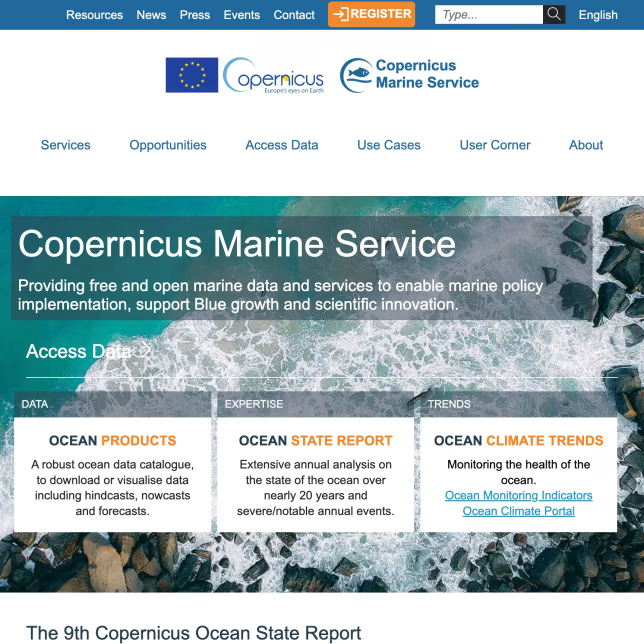
The existing marine data portal relied on three unaligned WordPress installations and embedded PHP code, creating inefficiencies and risks in content management and usability.
The new Drupal DXP streamlined content operations and improved accessibility, offering scientists and businesses a more efficient gateway to marine data services.
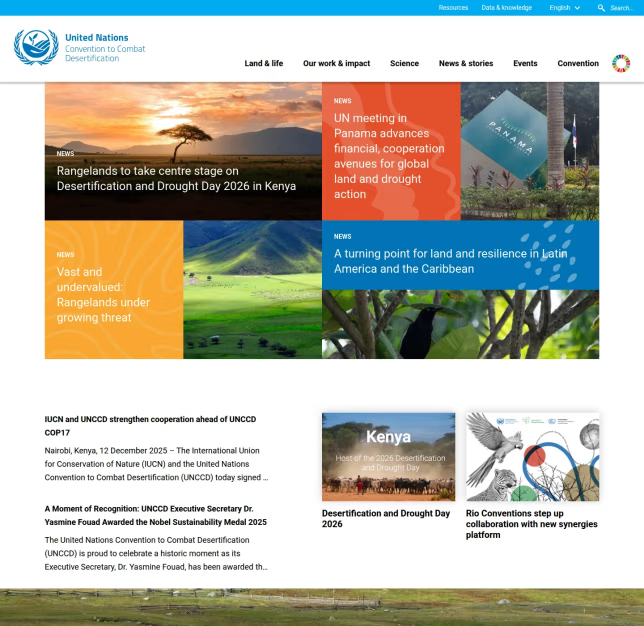
UNCCD operated four separate websites (two WordPress, two Drupal), leading to inconsistencies in design, content management, and user experience. A unified, scalable solution was needed to support a large-scale CMS migration project and improve efficiency and usability.
The modernization effort resulted in a cohesive, user-friendly, and scalable website, improving content management efficiency and long-term digital sustainability.
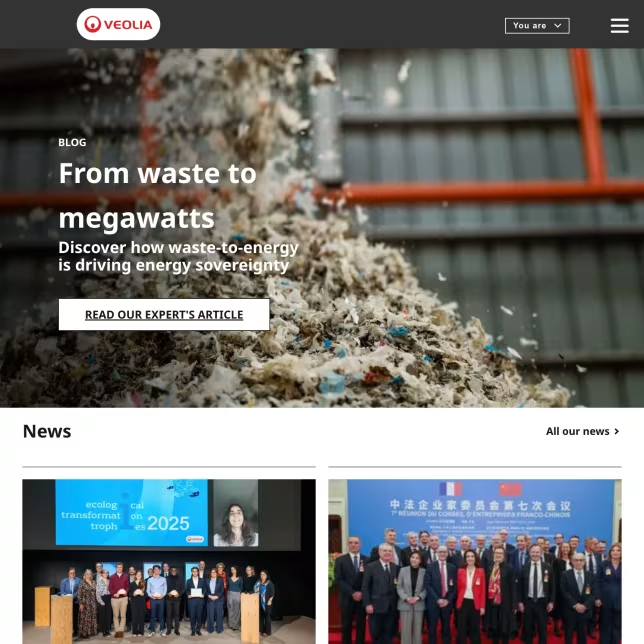
With Drupal 7 reaching end-of-life, Veolia needed a Drupal 7 to Drupal 10 enterprise migration for its Acquia Site Factory multisite platform—preserving region-specific content and multilingual capabilities across more than 200 sites.
The platform was modernized into a stable, scalable multisite foundation with improved performance, maintainability, and long-term upgrade readiness.
Oleksiy (PathToProject) and I worked together on a Digital Transformation project for Bayer LATAM Radiología. Oly was the Drupal developer, and I was the business lead. His professionalism, technical expertise, and ability to deliver functional improvements were some of the key attributes he brought to the project.
I also want to highlight his collaboration and flexibility—throughout the entire journey, Oleksiy exceeded my expectations.
It’s great when you can partner with vendors you trust, and who go the extra mile.

Axel Gleizerman Copello
Building in the MedTech Space | Antler
Oleksiy (PathToProject) is demanding and responsive. Comfortable with an Agile approach and strong technical skills, I appreciate the way he challenges stories and features to clarify specifications before and during sprints.

Olivier Ritlewski
Ingénieur Logiciel chez EPAM Systems
As Dev Team Lead on my project for 10 months, Oleksiy (PathToProject) demonstrated excellent technical skills and the ability to handle complex Drupal projects. His full-stack expertise is highly valuable.

Laurent Poinsignon
Domain Delivery Manager Web at TotalEnergies
These articles cover the migration planning, content governance, validation, and asset modeling issues that typically shape a successful Sitecore to Drupal program. They add practical context for teams assessing how to move content, integrations, and editorial operations into a maintainable Drupal platform.
Share your current Sitecore scope, integration landscape, and constraints. We’ll define target content contracts, a repeatable migration approach, and the validation and cutover plan needed for a low-risk transition to Drupal.