



 [01]
[01]Discovery and Inventory
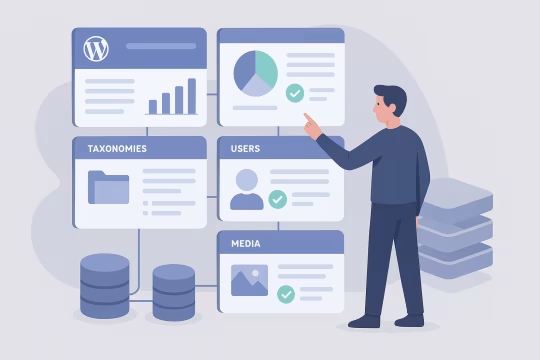
Collect a complete view of WordPress content, taxonomies, users, media, and plugin-driven data. Identify edge cases and define what will be migrated, transformed, consolidated, or retired.
Drupal migration readiness
Use a Drupal health check to surface content model gaps, migration pipeline risks, redirect issues, and cutover blockers before roadmap commitments are locked.
Built for teams planning WordPress to Drupal migration, replatforming, or phased cutover.
No login required. Takes 2–3 minutes.
WordPress to Drupal migration services provide a controlled transition of content, media, URLs, and key site behaviors from a WordPress implementation into a Drupal platform with a defined content model and operational governance. The work goes beyond moving pages: it requires mapping WordPress posts, taxonomies, users, and custom fields into Drupal entities, fields, and relationships that can support future growth. For many teams, this answers a practical question: how to migrate from WordPress to Drupal without carrying forward structural drift and hidden plugin-driven complexity.
Organizations typically pursue Drupal 10 migration from WordPress when WordPress structures have become inconsistent across sites, when editorial workflows require stronger governance, or when platform teams need a more extensible architecture for integrations, multilingual delivery, and multi-site operations. Migration engineering reduces risk by making data transformations explicit, automating repeatable runs, and validating outcomes against measurable acceptance criteria.
A well-executed migration establishes a maintainable Drupal foundation: content types aligned to business domains, predictable URL and redirect behavior, and a migration pipeline that can be re-run during development and cutover. This supports scalable platform evolution while keeping editorial continuity and search equity intact.
Core Focus
Best Fit For
Key Outcomes
Technology Ecosystem
Platform Integrations
As WordPress implementations grow over time, content structures often drift. Custom fields are added inconsistently, taxonomies overlap, and plugins introduce implicit data models that are hard to reason about. When a migration is approached as a one-time export/import, teams typically discover late that critical relationships, media references, and URL patterns do not translate cleanly into the target platform.
These issues surface as architectural friction in the new system. Drupal requires explicit modeling of entities, fields, and relationships; without a defined mapping strategy, the resulting platform inherits ambiguity and becomes difficult to extend. Engineering teams spend time building ad-hoc fixes for edge cases, while content teams encounter missing metadata, broken embeds, inconsistent author attribution, and unexpected formatting differences.
Operationally, the lack of a repeatable migration pipeline increases cutover risk. Teams cannot reliably re-run migrations during development, making QA incomplete and forcing manual corrections close to launch. Redirect gaps and URL changes can degrade search performance, while incomplete validation creates long-term maintenance overhead as defects are discovered in production rather than during controlled testing.
Review the WordPress estate, including content types, taxonomies, users, media libraries, plugins, and URL patterns. Identify data sources (database, APIs, exports) and define migration scope boundaries, including what is transformed, retired, or rebuilt in Drupal.
Define Drupal content types, fields, entity relationships, and moderation workflows aligned to domain needs. Produce a mapping specification from WordPress structures (posts, terms, meta) to Drupal entities, including normalization rules and required data quality fixes.
Design the migration pipeline using Drupal Migrate and supporting tooling. Establish environments, configuration management, and repeatable execution patterns, including incremental runs, idempotency expectations, and how to handle deltas during the stabilization period.
Implement extract and transform steps from WordPress sources, including MySQL queries, serialized/meta parsing, and media reference resolution. Apply deterministic transformations for taxonomy consolidation, author mapping, date handling, and HTML/content cleanup where required.
Implement Drupal migration configurations and custom process plugins for complex mappings. Migrate content, media, users, and relationships with traceability, ensuring each migrated record can be reconciled back to its WordPress source identifiers.
Run automated and manual validation against agreed acceptance criteria: record counts, field completeness, media integrity, link checks, and spot audits for representative content. Produce reconciliation reports and iterate until migration results are stable and repeatable.
Plan the cutover runbook, including content freeze windows, final delta migration, and DNS/application switch procedures. Implement redirect rules and URL alias strategies to preserve inbound links and ensure predictable routing behavior post-launch.
Monitor logs, editorial feedback, and content defects after launch. Address residual edge cases, optimize migration performance for future runs if needed, and document governance for ongoing content modeling and platform evolution.
This service focuses on building a controlled, testable WordPress content model migration to Drupal with explicit content modeling and repeatable execution. The emphasis is on deterministic transformations, traceable mappings, and migration QA and reconciliation that can be automated and re-run throughout delivery. The result is a Drupal platform foundation that is structurally consistent, integration-ready, and upgrade-ready for Drupal 10 today and Drupal 11 adoption as content volumes and editorial complexity increase.
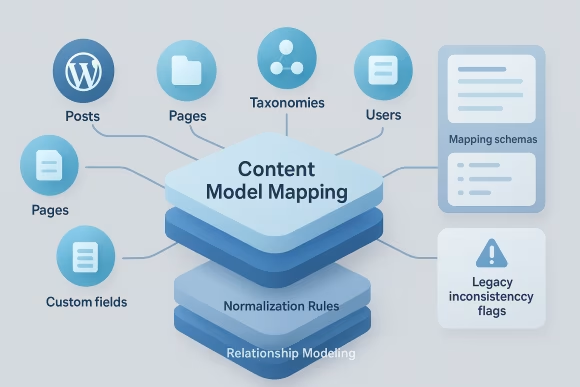
Define a precise mapping from WordPress posts, pages, taxonomies, users, and custom fields into Drupal entities and fields. This includes normalization rules, relationship modeling, and handling of legacy inconsistencies so the target model supports future extensibility rather than mirroring historical drift.

Create a repeatable migration architecture using Drupal’s Migrate ecosystem and supporting scripts. Pipelines are designed for multiple runs across environments, with predictable ordering, dependency handling, and clear separation between configuration, code, and environment-specific concerns.

Implement custom process plugins and transformations for complex WordPress data such as serialized meta, embedded shortcodes, and mixed-format HTML. Transformations are deterministic and testable, enabling consistent results across repeated runs and reducing manual remediation during QA and cutover.
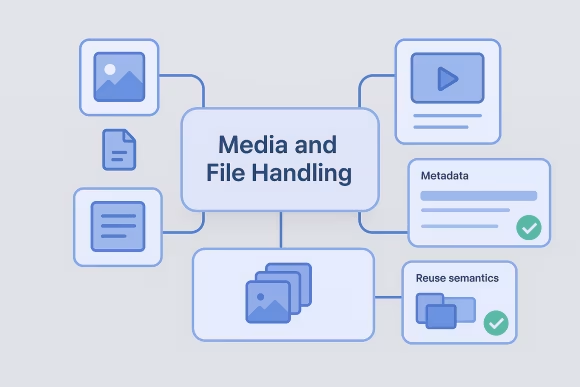
Migrate media libraries with correct file references, alt text, metadata, and reuse semantics. This includes resolving embedded media in rich text, handling duplicates, and ensuring Drupal media entities are structured for downstream use in components, search indexing, and content governance.
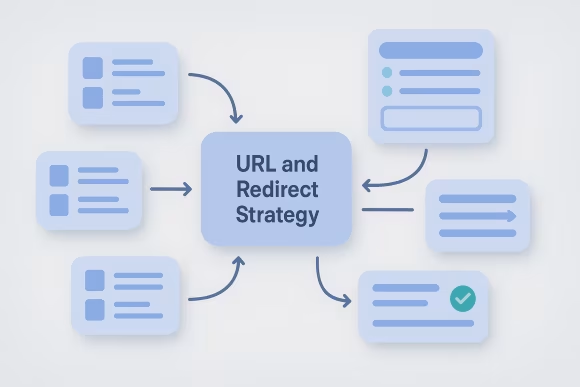
Design URL alias rules and redirect mappings to preserve link equity and user navigation. The approach accounts for WordPress permalink patterns, taxonomy-driven paths, and legacy exceptions, producing a maintainable redirect set and clear ownership for ongoing URL governance.
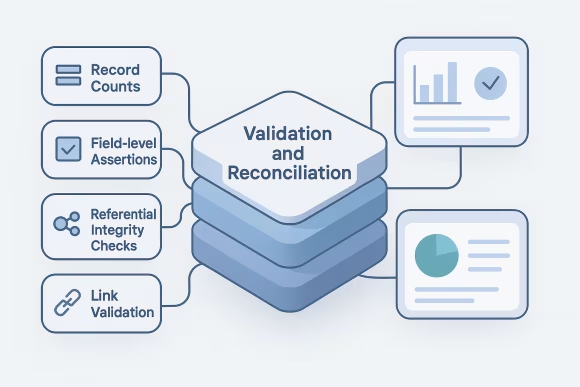
Establish validation criteria and reconciliation reporting to confirm completeness and correctness. This includes record counts, field-level assertions, referential integrity checks, link validation, and sampling strategies that provide confidence in both data quality and migration repeatability.

Produce an operational cutover plan covering content freeze, final delta migration, rollback considerations, and environment readiness checks. Runbooks are written for execution by platform teams, with clear responsibilities, timing, and verification steps to reduce release risk.
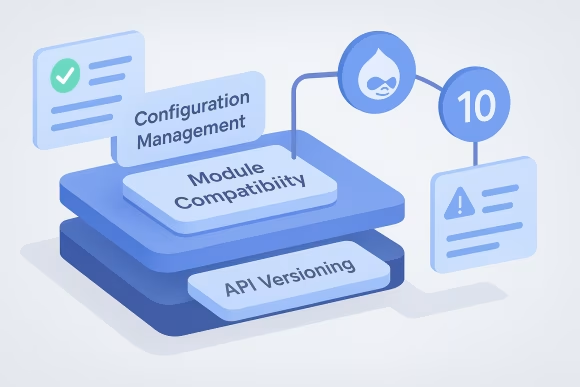
Ensure the migration approach aligns with modern Drupal patterns and version roadmaps, including configuration management and module compatibility. The target platform is structured to support Drupal 10 today and reduce friction when adopting Drupal 11, avoiding migration logic that depends on deprecated APIs.
Review the Drupal architecture, governance decisions, upgrade readiness, and integration dependencies that affect migration quality, repeatability, and launch confidence.
Engagements follow an engineering sequence from discovery and content model mapping through pipeline implementation, iterative migration runs, and cutover. The delivery model is designed for Drupal 10 migration from WordPress with repeatable execution, measurable validation, and clear runbooks that support long-term, upgrade-ready platform evolution.
[01]Collect a complete view of WordPress content, taxonomies, users, media, and plugin-driven data. Identify edge cases and define what will be migrated, transformed, consolidated, or retired.
 [02]
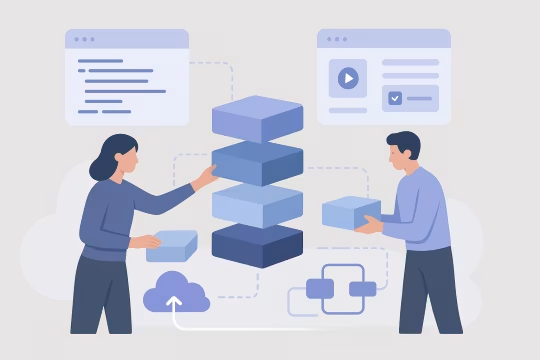
[02]Design the Drupal content model and editorial workflow to match domain needs and governance requirements. Produce mapping specifications and acceptance criteria that engineering and content stakeholders can validate.
 [03]
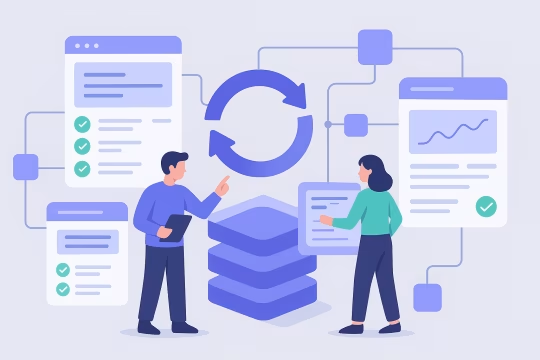
[03]Build migration configurations and custom transformations using Drupal’s migration tooling. Establish repeatable execution across environments and ensure migrations can be re-run safely during development and QA.
 [04]
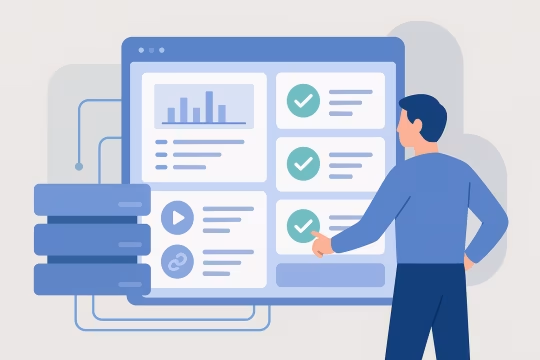
[04]Execute migrations in cycles to validate mappings, performance, and content fidelity. Use feedback from audits and editorial review to refine transformations and close gaps before cutover.
 [05]
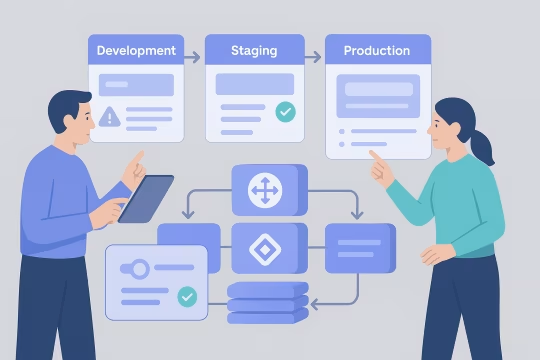
[05]Validate completeness and correctness using reconciliation reports, sampling, and automated checks. Confirm media integrity, internal links, taxonomy behavior, and URL outcomes against agreed criteria.
 [06]
[06]Run the final migration with a defined content freeze and delta strategy. Apply redirects, verify routing and critical journeys, and coordinate release steps with platform operations.
 [07]
[07]Monitor production behavior and resolve migration-related defects with traceability to source data. Address residual edge cases, optimize performance, and document operational ownership for ongoing content governance.
A controlled WordPress to Drupal migration reduces platform risk by making data transformations explicit, testable, and repeatable. For enterprise CMS migration WordPress to Drupal, this improves long-term maintainability by establishing governed content structures, predictable URLs and redirects, and operational runbooks that support ongoing evolution and Drupal upgrade readiness.
Repeatable migration runs and reconciliation reporting reduce uncertainty during launch. Teams can validate outcomes early and avoid last-minute manual fixes that introduce production instability.
A defined Drupal content model and workflow reduces structural drift over time. Editorial teams gain clearer rules for reuse, metadata, and lifecycle management, which supports consistent publishing at scale.
Migration transformations normalize legacy inconsistencies instead of carrying them forward. This reduces the need for special-case code paths and simplifies future enhancements to content types and integrations.
A well-structured Drupal foundation enables new features without reworking core content structures. Platform teams can add channels, integrations, and new content patterns with less re-architecture.
A deliberate URL and redirect strategy preserves inbound links and reduces broken navigation. This supports stable indexing behavior and reduces operational overhead responding to SEO and content defects.
Documented runbooks and automated pipelines make the process auditable and repeatable. This is valuable for multi-site rollouts, phased migrations, and future platform changes that require re-imports or backfills.
Clear mappings, deterministic transforms, and testable migration steps reduce time spent debugging opaque data issues. Engineers can focus on platform capabilities rather than manual content correction.
Before migration buildout
A focused Drupal health check helps your team confirm architecture choices, reduce cutover risk, and prioritize the fixes that matter before implementation expands.
These related services are common next steps after WordPress to Drupal migration services, extending Drupal platform evolution, content governance, upgrades, and integration readiness once the core content model and migration pipeline are stabilized.
Content and integration migration with controlled cutover
Drupal content migration engineering for data, content, and platform change
Enterprise Drupal upgrade strategy for upgradeable delivery
Drupal Major Version Upgrades: Drupal 8/9/10 to 11/12
Drupal major version upgrade services with dependency and code remediation
Custom modules, extensions, and feature engineering
Enterprise CMS modernization services for legacy Drupal estates
Content model mapping and automated migration pipelines
Legacy CMS to Drupal migration planning and execution
Common questions from platform and content stakeholders planning a WordPress to Drupal migration, covering architecture, operations, integrations, governance, risk, and engagement.
We start by treating the WordPress dataset as evidence, not as the target architecture. During discovery we inventory post types, taxonomies, templates, custom fields, and plugin-driven metadata, then identify where the same business concept is represented in multiple ways. From there we define Drupal content types and reusable entities (for example, people, locations, products, documents) and map WordPress records into those structures. Where WordPress has free-form fields or overloaded taxonomies, we introduce normalization rules: controlled vocabularies, field splitting/merging, and relationship modeling. We also define required vs optional fields and validation constraints so the target model supports governance. The output is a mapping specification that is explicit about transformations, defaults, and exceptions. This specification becomes the contract for migration implementation and QA, and it is reviewed with content architects and platform owners to ensure the model supports future growth (multisite, multilingual, personalization, or API delivery) without reworking core structures.
Migrating everything into nodes is usually the fastest path but rarely the most maintainable for enterprise platforms. Drupal’s strength is explicit modeling: nodes for primary content, media entities for assets, and custom entities (or paragraphs/components) for reusable structured data. We decide based on how the information is used: reuse frequency, governance requirements, integration needs, and editorial workflows. Media should typically become Drupal media entities so assets can be reused across content types with consistent metadata (alt text, licensing, ownership). Reusable domain objects (for example, offices, authors, product references, policy documents) often belong in custom entities to avoid duplication and to support API consumers. We also consider performance and operational complexity. More structure can improve consistency but increases modeling and migration effort. The goal is a balanced model that supports future platform evolution while keeping editorial operations practical and the migration pipeline testable and repeatable.
We design migrations to be repeatable and environment-aware. In practice this means: deterministic source queries, stable identifiers mapped to Drupal IDs, and a clear strategy for updates vs re-imports. We typically run migrations many times as the Drupal build evolves, so the pipeline must support re-running without accumulating duplicates or breaking references. We separate migration configuration and custom code from environment-specific settings, and we version control everything. For each run we generate reconciliation outputs (counts, missing fields, failed rows) so teams can compare results between iterations. When content changes in WordPress during the project, we define a delta approach: either incremental migrations for changed records or a final full run after a content freeze. The choice depends on volume, editorial activity, and cutover constraints. The operational goal is to avoid “one-shot” migrations that cannot be reproduced under QA conditions.
Cutover planning starts early because it affects how we design the migration pipeline and validation. A typical cutover includes: a defined content freeze window (or a delta strategy), a final migration run in the production-like environment, verification steps, and a controlled switch of traffic. We produce a runbook that lists prerequisites (environment readiness, backups, credentials, redirect rules, monitoring), the exact sequence of commands or pipeline steps, and acceptance checks (critical pages, search, forms, authentication, media rendering, and analytics tags). We also define rollback criteria and what “rollback” means in your context (DNS revert, application switch, or content restore). For enterprises with multiple stakeholders, we include a communication plan and a clear ownership model during the cutover window. The objective is to make cutover an operational procedure, not an improvised event.
We first identify the source of truth for identity. In many enterprise environments, WordPress users are not the authoritative identity store; SSO or an external IdP may be required. If WordPress is the source, we migrate users with careful handling of usernames, emails, and role mappings, and we define how passwords are treated (often requiring resets if hashing schemes differ). Roles and capabilities in WordPress do not map 1:1 to Drupal roles and permissions. We translate them into Drupal roles aligned to editorial responsibilities and governance, then apply permissions based on Drupal’s security model. If SSO is in scope, we focus on attribute mapping (groups, departments, entitlements) and how those attributes drive Drupal roles. The migration pipeline then links content ownership and moderation history to the correct identities, preserving auditability where needed.
We start by extracting the existing URL space: permalink patterns, taxonomy-driven paths, and known exceptions. Then we define the Drupal URL alias strategy, including how aliases are generated, what is canonical, and how future changes are governed. For redirects, we generate mappings from old URLs to new canonical URLs and implement them using a maintainable mechanism (not a one-off spreadsheet applied manually). We also address internal link integrity by updating references during migration where possible, and by validating links post-migration. For SEO signals, we migrate metadata that has clear equivalents (titles, descriptions, canonical hints where applicable) and ensure that robots directives and sitemap generation are consistent with the new platform. Finally, we validate at scale: redirect coverage, status codes, and sampling of high-traffic URLs. The goal is predictable routing behavior and minimal loss of discoverability due to avoidable URL drift.
Content mapping decisions work best with shared ownership: content architects define the target information architecture and governance rules, while engineering defines what is feasible and how transformations are implemented and tested. We recommend establishing a small decision group (platform owner, content architect, engineering lead) that can resolve mapping questions quickly. Exception handling should be explicit. We maintain an exceptions log that records: the source pattern, the chosen transformation, the rationale, and how it will be validated. This prevents “silent” decisions that later surprise stakeholders. We also define acceptance criteria up front: what constitutes a successful migration for each content domain (for example, required fields present, media references intact, taxonomy assignments valid). Governance is then enforced through the target model constraints and through QA checks, not through informal expectations.
Maintainability is addressed through modeling discipline, configuration management, and operational documentation. On the modeling side, we avoid importing legacy ambiguity into Drupal by normalizing fields and relationships and by introducing controlled vocabularies where appropriate. We also ensure the model supports future change without requiring data rework for common enhancements. On the engineering side, we keep migration logic in version-controlled code and configuration, with clear separation of concerns and documentation of transformation rules. This makes the migration auditable and easier to extend for future backfills or phased rollouts. Operationally, we document ownership: who manages URL rules, taxonomy governance, media standards, and workflow changes. We also recommend post-launch monitoring and a structured backlog for residual content issues. The objective is to prevent the platform from drifting into a state where future changes require another major replatforming effort.
The most common risks are hidden data complexity and late discovery of edge cases. WordPress plugins often store content in non-obvious ways (serialized meta, shortcodes, embedded builders), and these patterns can be missed if discovery focuses only on visible pages. Another risk is assuming that a page-based structure will map cleanly into Drupal without defining a target content model. Operational risks include non-repeatable migrations, which make QA unreliable, and insufficient redirect planning, which can create broken inbound links. Media handling is also a frequent source of issues: missing files, incorrect references, duplicated assets, or loss of metadata. We mitigate these risks by doing an early inventory, building a mapping specification, implementing repeatable pipelines, and validating with reconciliation reports. We also recommend prioritizing representative content samples early (high-traffic, complex layouts, legacy exceptions) to surface complexity before timelines become constrained.
Validation combines quantitative reconciliation and qualitative review. Quantitative checks include record counts by content type, completeness of required fields, taxonomy assignment coverage, media reference integrity, and failure/error rates from migration runs. We also validate referential integrity: that relationships between items (for example, parent/child, related content, authorship) are preserved. Qualitative review uses sampling strategies agreed with stakeholders. We select representative content across domains and complexity levels, then verify rendering, formatting, embedded media, and editorial metadata. For high-risk areas we increase sampling or add targeted automated checks. Where possible, we generate reconciliation reports that link each Drupal record back to its WordPress source identifier. This traceability allows teams to investigate discrepancies efficiently and prevents “unknown unknowns” from being discovered after launch. Validation criteria are defined early so the team can measure readiness objectively.
We typically need access to the WordPress data sources and a clear view of the current estate. That includes database access or exports, a list of environments, and an inventory of plugins/themes that influence content storage. We also need stakeholder availability from content architecture and platform engineering to confirm target model decisions and acceptance criteria. From a delivery perspective, we ask for: a definition of scope (which sites, which content domains), constraints (timeline, freeze windows, compliance requirements), and integration dependencies (SSO, search, analytics, downstream APIs). If URL continuity is important, we also need access to current routing rules and any existing redirect sets. Finally, we align on how decisions will be made: who approves content model changes, who signs off on validation, and who owns cutover execution. Clear inputs and ownership reduce iteration cycles and prevent late-stage surprises.
Collaboration typically begins with a short discovery phase focused on scope, data reality, and target architecture decisions. We run working sessions with platform and content stakeholders to inventory the WordPress estate, identify high-risk content patterns (custom fields, builders, plugin data), and agree on what “done” means through measurable acceptance criteria. Next, we produce two core artifacts: a target Drupal content model proposal and a mapping specification that defines how each WordPress structure transforms into Drupal. These are reviewed and adjusted with your team before implementation begins. Once the mapping is approved, we set up the migration pipeline in a shared delivery workflow (version control, environments, run procedures) and execute iterative migration runs alongside Drupal build-out. This approach creates early visibility into data issues, supports parallel development, and provides a controlled path to cutover with clear responsibilities and verification steps.
These case studies showcase comprehensive Drupal migration and modernization efforts, including WordPress to Drupal migrations, platform consolidation, and scalable architecture design. They highlight practical applications of migration pipelines, content model mapping, and governance strategies that align closely with the service's focus on Drupal 10/11 readiness and enterprise publishing scalability. The selected examples provide measurable proof of successful content transformation, editorial workflow improvements, and platform evolution in complex, multi-site environments.
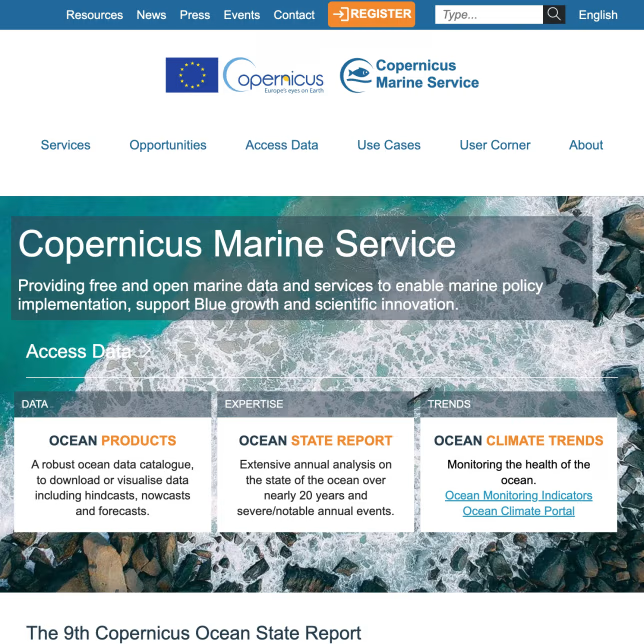
The existing marine data portal relied on three unaligned WordPress installations and embedded PHP code, creating inefficiencies and risks in content management and usability.
The new Drupal DXP streamlined content operations and improved accessibility, offering scientists and businesses a more efficient gateway to marine data services.
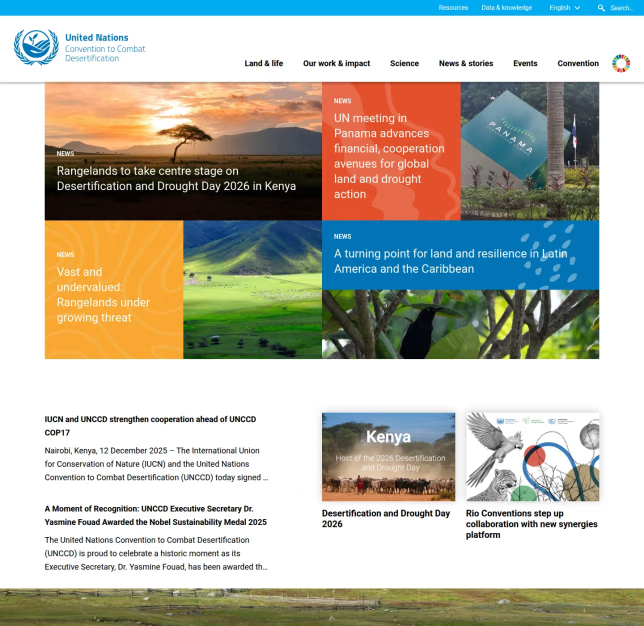
UNCCD operated four separate websites (two WordPress, two Drupal), leading to inconsistencies in design, content management, and user experience. A unified, scalable solution was needed to support a large-scale CMS migration project and improve efficiency and usability.
The modernization effort resulted in a cohesive, user-friendly, and scalable website, improving content management efficiency and long-term digital sustainability.
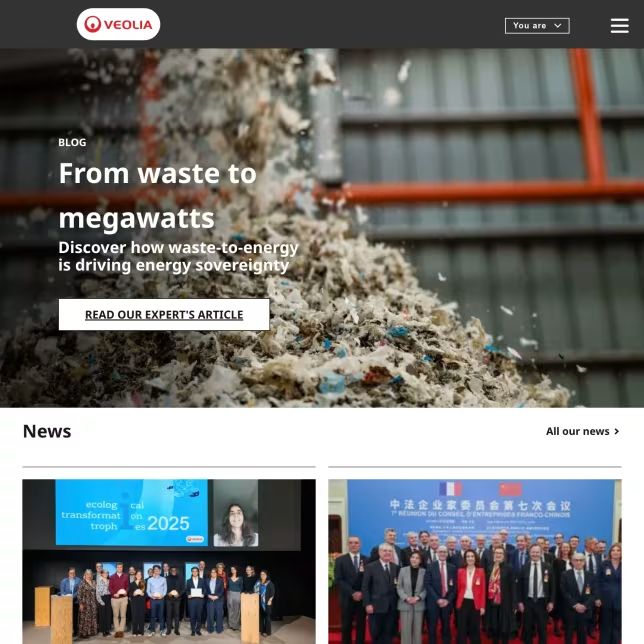
With Drupal 7 reaching end-of-life, Veolia needed a Drupal 7 to Drupal 10 enterprise migration for its Acquia Site Factory multisite platform—preserving region-specific content and multilingual capabilities across more than 200 sites.
The platform was modernized into a stable, scalable multisite foundation with improved performance, maintainability, and long-term upgrade readiness.
It was my pleasure working with Oleksiy (PathToProject) on a new Drupal website. He is a true full-stack developer—the ideal mix of DevOps expertise, deep front-end knowledge, and the structured thinking of a senior back-end developer.
He is well-organized and never lets anything slip. Oleksiy understands what needs to be done before being asked and can manage a project independently with minimal involvement from clients, product managers, or business analysts.
One of the best consultants I’ve worked with so far.

Andrei Melis
Technical Lead at Eau de Web
Oleksiy (PathToProject) is demanding and responsive. Comfortable with an Agile approach and strong technical skills, I appreciate the way he challenges stories and features to clarify specifications before and during sprints.

Olivier Ritlewski
Ingénieur Logiciel chez EPAM Systems
As Dev Team Lead on my project for 10 months, Oleksiy (PathToProject) demonstrated excellent technical skills and the ability to handle complex Drupal projects. His full-stack expertise is highly valuable.

Laurent Poinsignon
Domain Delivery Manager Web at TotalEnergies
These articles add context for teams planning a WordPress to Drupal move, from choosing the right content platform and shaping the target architecture to managing cutover, media, and structural integrity. They are useful follow-up reading for understanding the governance and implementation decisions that make a migration durable.
Share your current WordPress estate and target Drupal goals. We’ll define the content model, migration approach, validation criteria, and a cutover plan that reduces operational risk.