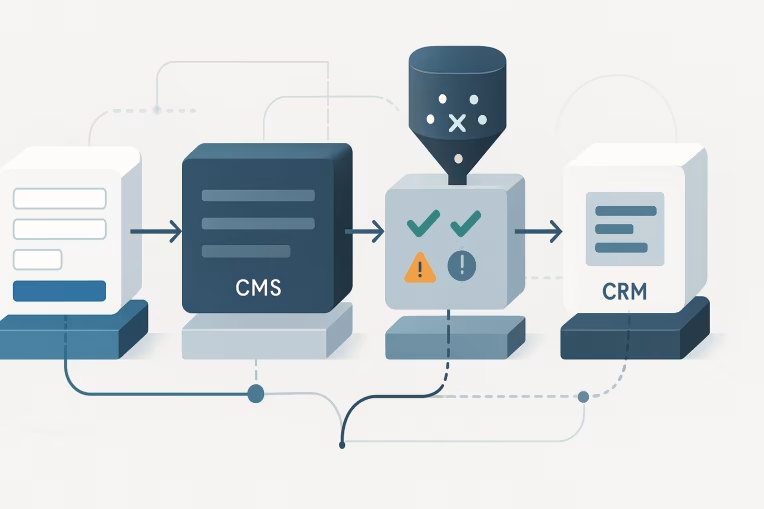
Enterprise teams often describe forms as a frontend feature, a CMS capability, or a CRM integration. In practice, reliable lead capture sits across all three, plus anti-spam controls, consent services, analytics, and operational monitoring.
That matters because many headless implementations look healthy from the browser while failing deeper in the pipeline. A user can submit a form, see a success message, and still never become a usable CRM record. Or the frontend can reject fields that the downstream system would have accepted. Or a brand team can add a hidden field in the CMS that no longer maps to the integration contract.
The result is not usually one dramatic outage. It is a slow accumulation of mismatches, retries, dropped states, and exceptions that undermine trust in the platform.
Headless architecture is not automatically better than coupled form handling. In some cases, a more integrated platform form stack reduces moving parts and simplifies operations. But when enterprises need multi-channel delivery, shared frontend systems, multi-brand governance, or specialized CRM workflows, headless forms can be the right model—if they are treated as a product and operations problem, not just a rendering task.
Why headless forms become fragile at enterprise scale
At small scale, a form can be implemented as a simple path:
- Render fields.
- Validate inputs.
- POST data.
- Show success.
At enterprise scale, each of those steps is usually split across multiple systems and teams.
A typical platform might involve:
- a frontend application or component library
- a CMS that defines form structure or content-managed labels
- validation rules in browser code and server-side services
- bot detection or rate-limiting controls
- consent and preference capture requirements
- an integration layer or middleware service
- one or more CRM or marketing automation destinations
- analytics and event instrumentation
- support or operations teams that need traceability when something fails
Fragility appears when these systems evolve independently. A new required field is added in one place but not another. A retry process creates duplicates because idempotency was never defined. A regional brand adds local consent text without preserving the legal event data needed downstream. A spam control challenge causes valid submissions to be abandoned, but the analytics team only sees the page view drop, not the validation failure reason.
In other words, lead capture reliability breaks less from visible frontend errors and more from architectural ambiguity.
The systems involved: frontend, CMS, CRM, anti-spam, consent, analytics
A useful way to improve reliability is to treat each participating system as owning a specific part of the form lifecycle.
Frontend usually owns presentation, interaction, immediate validation feedback, accessibility behavior, and submission state handling in the browser.
CMS often owns content-managed labels, help text, field ordering, conditional display rules, campaign configuration, and sometimes the form definition itself.
Validation services may own authoritative business rules, normalization, and checks that should not rely only on client execution.
Anti-spam controls own risk scoring, bot mitigation, throttling, challenge logic, or traffic reputation checks.
Consent services or policy logic own the capture of lawful basis signals, policy versions, channel preferences, and evidence required for downstream use.
Integration services own payload transformation, idempotency, retries, queueing, routing, and delivery guarantees.
CRM or downstream systems own record persistence, lead/contact creation rules, duplicate handling, enrichment triggers, and salesperson visibility.
Analytics and observability own event capture that explains what happened before, during, and after submission.
Many form programs fail because these ownership boundaries are implicit. Teams assume that a system will enforce behavior it was never designed to enforce.
A better question is not, "Where does the form live?" It is, "Which system is authoritative for each decision?"
Where contract drift starts: fields, validation, hidden states, retries
Contract drift usually begins with field-level assumptions.
The frontend might think a field is optional because the current UI does not display a required marker. The CRM mapping may treat it as required for routing. The CMS may let editors hide it for a campaign variant. All three decisions can be locally reasonable and globally inconsistent.
Common drift areas include:
- Field definitions: name, type, allowed values, max length, regex expectations, and whether empty strings are valid.
- Validation logic: browser-side rules, API-side rules, and downstream system acceptance criteria diverge over time.
- Default and hidden fields: campaign codes, source tracking, locale, consent version, sales region, and product identifiers are often injected outside visible form markup.
- Conditional states: fields that appear only for certain countries, brands, products, or user choices can create paths that downstream mapping never anticipated.
- Normalization rules: phone formats, country codes, whitespace trimming, capitalization, and multi-select serialization are handled differently across layers.
- Error semantics: one system returns "invalid," another returns "missing," and a third silently coerces the value.
- Retry behavior: a timeout may trigger a second submission even when the first was accepted, causing duplicate records or conflicting state.
This is why enterprise teams benefit from a formal submission contract rather than a loose collection of form configs.
That contract should define more than field names. It should describe:
- canonical field identifiers
- data types and constraints
- required versus optional rules by scenario
- enumerated values and ownership of those lists
- hidden/system-populated fields
- consent evidence fields
- idempotency keys or deduplication logic
- accepted error responses and retry policies
- downstream state transitions
Without that contract, headless lead capture becomes an integration guessing game.
Submission lifecycle design: draft, accepted, rejected, queued, synced
One of the most common architectural weaknesses is reducing submission state to a binary outcome: success or failure.
That model is too simple for enterprise pipelines.
A more reliable design treats submission as a lifecycle with explicit states. A representative model could include:
- Draft: the user has entered data locally, but nothing authoritative has been transmitted.
- Accepted: the platform has received a valid submission payload and stored it durably.
- Rejected: the payload failed validation, policy checks, or anti-spam gates and was not accepted.
- Queued: the submission was accepted by the platform but is awaiting downstream delivery.
- Synced: the target CRM or downstream system confirmed successful processing.
- Partially synced: one destination succeeded while another failed.
- Dead-lettered or escalated: automated retries were exhausted and human review is needed.
This distinction matters because the user-facing confirmation should align to what the platform can honestly guarantee.
For example, if the frontend displays success immediately after the integration layer accepts and persists the submission, that can be legitimate. But the operating model must then support queueing, retries, reconciliation, and alerting until downstream sync completes. Otherwise, "success" only means "the browser request ended."
A robust lifecycle design usually includes several practices:
1. Durable acceptance before expensive downstream work
If possible, accept the submission into a controlled service boundary before attempting all external calls. That reduces dependency on synchronous CRM availability.
2. Clear idempotency rules
Repeat requests happen. Browsers retry. users double-click. networks fail at awkward moments. Define how the platform identifies the same submission safely.
3. Machine-readable error categories
Separate validation failures, bot suspicions, downstream outages, mapping errors, and policy violations. These are different operational problems.
4. Reconciliation paths
If a submission is accepted but not synced, there should be a mechanism to inspect, replay, or remediate it without manual database work.
5. Auditability
Support teams need to answer: Was it submitted? Was it valid? Was it blocked? Was it queued? Was it delivered? What version of the contract applied?
This is where headless form architecture moves from UI implementation to service design.
Bot mitigation and fraud controls without breaking UX
Bot mitigation is often added late, after spam becomes visible in the CRM. By then, teams tend to bolt on controls in whichever layer is easiest to modify.
That approach can create inconsistent behavior. A frontend challenge may block some bots but not backend abuse. A server-side risk rule may reject real users without a feedback pattern the UI can explain. A hidden honeypot field may work temporarily but become easy to bypass.
A better spam control architecture is layered.
Representative controls can include:
- passive telemetry and traffic heuristics
- rate limiting by IP, session, token, or fingerprint strategy where appropriate
- challenge mechanisms triggered only when risk thresholds are crossed
- server-side validation that does not trust client completion alone
- payload scoring that considers submission timing, field patterns, and request provenance
- downstream quarantining or risk flags instead of outright rejection in ambiguous cases
The key is to decide where each control belongs and how it affects the submission contract.
For example:
- If a challenge token is required, its presence and expiry become part of the acceptance rule.
- If risk scoring can downgrade or quarantine a lead, that state should be visible operationally.
- If bot checks fail open during vendor or service degradation, that should be an intentional policy decision rather than accidental behavior.
Good architecture also considers UX impact. Over-aggressive anti-spam controls can become a lead-generation outage that nobody labels as an outage. If abandonment rises because legitimate users are challenged too often, the platform is failing even if the CRM receives less spam.
That is why anti-spam controls should be observed not only for block rate, but also for submission completion impact and false-positive investigation paths.
Multi-brand reuse vs local exceptions in form models
Multi-brand platforms often want a single reusable form engine. Local teams often want exceptions for campaign logic, regional compliance wording, field labels, routing, and integrations.
Both are reasonable.
Problems start when the shared model is either too rigid to support legitimate business differences or too permissive to preserve a coherent contract.
A useful pattern is to separate the form model into layers:
- Global core schema: canonical field identifiers, common validation primitives, submission states, observability requirements, and integration envelope.
- Brand configuration: labels, help text, conditional display, localization, and approved optional fields.
- Regional or journey-specific policy overlays: consent text, required disclosures, routing rules, and restricted field behaviors.
- Destination mappings: CRM field bindings, campaign codes, owner assignment logic, and sync transformations.
This layered model preserves reuse without forcing every brand into identical business logic.
It also clarifies what can vary safely.
For instance, a region may be allowed to change label text and add a local disclosure block, but not allowed to redefine the meaning of a canonical field like business_email or remove the consent event metadata required for downstream processing.
From an operating perspective, this reduces the chance that every new brand launch becomes a custom integration project.
Observability: what to log, trace, and reconcile
When lead capture problems reach support teams, the most damaging situation is not failure itself. It is uncertainty.
If nobody can determine whether the user submitted, whether the platform accepted, whether the anti-spam layer blocked, whether the CRM rejected, or whether analytics simply missed the event, recovery becomes slow and political.
Reliable headless lead capture needs observability designed in from the start.
At minimum, teams should be able to trace a submission across the pipeline using a stable correlation identifier. That identifier should connect:
- frontend submission attempt
- backend acceptance event
- validation result
- anti-spam decision
- queue or integration processing event
- CRM delivery attempt
- downstream success or failure outcome
Useful observability data often includes:
- contract version used at submission time
- form identifier and brand/site context
- field presence and validation result metadata without logging sensitive values unnecessarily
- consent capture outcome and policy version identifiers
- anti-spam decision category
- retry count and reason
- downstream target and mapping version
- final sync state and timestamp
Just as important is reconciliation.
Teams should be able to ask questions such as:
- Which submissions were accepted but not synced in the last 24 hours?
- Which forms are producing mapping failures after a schema change?
- Which anti-spam rule started increasing rejection rates after deployment?
- Which brand configuration introduced a missing hidden field?
Without reconciliation workflows, logs become forensic artifacts rather than operational tools.
A reference operating model for reliable headless lead capture
For most enterprise teams, the biggest improvement does not come from one new tool. It comes from adopting an operating model that treats forms as a governed cross-system product.
A practical reference model can include the following.
1. Establish canonical schema ownership
Create a source of truth for field definitions, validation semantics, consent evidence requirements, and state transitions. This does not mean every system stores the schema identically. It means one authority defines the contract.
2. Separate content management from data contract governance
Let CMS users manage labels, layout, help text, and approved configuration. Do not assume that content flexibility should extend to unconstrained data model changes. This separation is especially important in headless CMS architecture programs where editorial flexibility and integration discipline must coexist.
3. Implement server-side acceptance boundaries
Do not rely on the browser as the final authority for validation or spam controls. The acceptance service should decide whether a submission becomes durable platform state.
4. Define lifecycle states beyond success/failure
Model accepted, queued, synced, rejected, and exception states explicitly. Align frontend messaging and support workflows to those states.
5. Design idempotency and retries intentionally
Specify how duplicate submissions are detected, how safe retries work, and what happens when downstream systems are slow or unavailable.
6. Make consent capture first-class
Treat policy version, disclosure context, channel preferences, and capture timestamps as part of the contract, not as decorative content on the page. In practice, this usually requires explicit privacy and consent architecture rather than ad hoc checkbox handling.
7. Layer anti-spam controls
Use multiple signals and clear operational handling rather than depending on one UI-only mechanism. Measure both spam reduction and valid-user friction.
8. Govern reuse with controlled extensibility
Support global schema consistency while allowing brand and regional configuration in approved extension points.
9. Instrument end-to-end observability
Use traceable identifiers, structured events, and reconciliation reporting so teams can detect silent failures and recover confidently. Where analytics and operational telemetry are fragmented, stronger event tracking architecture helps keep submission events understandable across teams and tools.
10. Put change management around the contract
Form changes should be versioned, reviewed, and testable. When a field becomes required or a destination mapping changes, impacted systems should be known in advance.
A representative delivery workflow might look like this:
- product and business teams define the capture goal
- architects and integration owners define or extend the canonical contract
- frontend teams implement against versioned schema artifacts
- CMS authors configure approved presentation/content settings
- anti-spam and consent rules are validated against the same contract
- integration services persist accepted submissions and route downstream
- monitoring and reconciliation dashboards confirm pipeline health after release
This does not recreate a monolith. It creates a shared contract and operating discipline across distributed systems.
Closing perspective
Enterprise headless forms fail most often in the spaces between systems. The frontend can be polished. The CMS can be flexible. The CRM integration can appear complete. And yet the lead pipeline still degrades because no single team owns the reliability of the whole submission journey.
That is the core architectural lesson: headless lead capture is not just about rendering forms decoupled from a backend. It is about governing how data moves, how rules are enforced, how state is tracked, and how exceptions are recovered across the entire pipeline.
Teams that approach forms this way usually make better tradeoffs. They can decide when a tightly coupled platform form is simpler and when a headless model is justified. They can support multi-brand variation without losing control of canonical data. And they can detect failures before sales teams discover that leads never arrived.
Reliable headless form architecture is therefore less about choosing the most modern pattern and more about designing explicit contracts, clear ownership, and observable operations from the frontend all the way to the systems that depend on the data.
Tags: Headless, Enterprise Architecture, Frontend Engineering, CRM Integration, Lead Capture, Consent and Privacy