 [01]
[01]Discovery Workshops
Run focused sessions to capture goals, constraints, and success metrics. Establish the decision backlog and confirm which channels, brands, and products are in scope for the target architecture.
Composable DXP strategy defines how a digital experience platform is decomposed into capabilities (content, search, personalization, commerce, identity, analytics) and reassembled through APIs and an experience layer. In practice, this is headless DXP architecture planning: a target architecture that is explicit about boundaries, ownership, integration contracts, and non-functional requirements such as security, performance, and resilience.
Organizations typically need this when legacy suites, fragmented point solutions, or multiple product teams create inconsistent delivery patterns and duplicated platform work. A strategy clarifies which capabilities should be centralized vs. federated, how content and data flow across channels, and how teams can ship independently without breaking shared platform contracts.
The output is a platform-level blueprint that supports scalable engineering: reference architectures for headless CMS and API platforms, a DXP governance model for change management, and a technology roadmap for DXP modernization that prioritizes risk reduction and measurable outcomes. It enables incremental evolution while keeping operational constraints, compliance, and enterprise delivery realities in scope.
Core Focus
Best Fit For
Key Outcomes
Technology Ecosystem
Delivery Scope



As digital platforms grow, experience delivery often becomes a patchwork of CMS instances, bespoke integrations, and channel-specific frontends. Teams add capabilities (search, personalization, experimentation, DAM, commerce) opportunistically, creating overlapping responsibilities and unclear system boundaries. The result is a platform that works, but only through accumulated exceptions and undocumented dependencies.
Engineering teams then spend disproportionate effort coordinating releases, debugging cross-system failures, and negotiating data ownership. Without explicit integration contracts and a shared capability model, APIs drift, content models diverge, and the experience layer becomes tightly coupled to back-end implementation details. Architectural decisions get made locally, which increases variance in security controls, caching strategies, observability, and performance budgets.
Operationally, this fragmentation increases change risk and slows delivery. Small enhancements require multi-team coordination, incident resolution becomes harder due to limited end-to-end tracing, and migrations stall because there is no agreed target state. Over time, the platform accumulates technical debt in the form of duplicated functionality, brittle integrations, and inconsistent governance, making modernization more expensive and less predictable.
Align on business capabilities, channels, and constraints across product, engineering, security, and operations. Capture decision drivers such as time-to-market, compliance, vendor lock-in tolerance, and existing platform commitments.
Document the existing DXP landscape: systems, integrations, content flows, and ownership boundaries. Identify coupling points, duplicated capabilities, and non-functional gaps across performance, security, reliability, and observability.
Define a capability model and domain boundaries for content, experience, and data services. Clarify which capabilities are shared platform services versus product-owned components, and how they should be exposed via APIs and events.
Create a composable reference architecture covering experience layer, headless CMS, API platform, identity, and data services. Specify integration patterns, caching layers, resiliency approaches, and deployment topology assumptions.
Define API and event standards: versioning, schema governance, error handling, authentication, and rate limiting. Establish patterns for content delivery, personalization signals, and cross-channel consistency.
Set decision rights, architecture review cadence, and standards enforcement mechanisms. Define how teams propose changes, manage deprecations, and maintain reference implementations without blocking delivery.
Translate the target architecture into an incremental migration plan with milestones, dependencies, and measurable outcomes. Prioritize work by risk, value, and feasibility, including transitional architectures and coexistence patterns.
Deliver playbooks, templates, and reference implementations to accelerate adoption. Establish success metrics and a lightweight feedback loop so the strategy evolves with platform learnings and organizational changes.
This service establishes the architectural foundations required to run a composable digital experience platform as an engineered platform rather than a collection of tools. It supports enterprise composable DXP design by defining capability boundaries, integration contracts, and reference patterns for experience delivery, content operations, and API composition. The focus is on maintainability and change safety: clear ownership, predictable evolution paths, and standards that enable multiple teams to deliver independently within shared constraints.
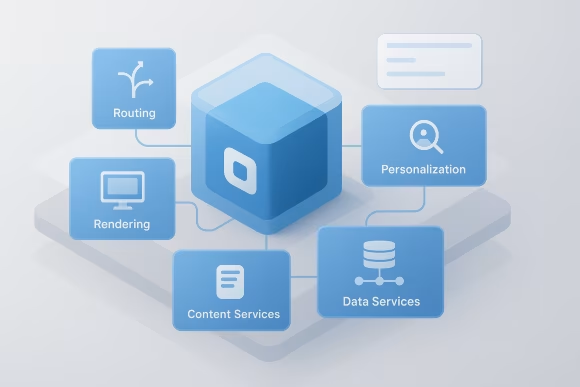
Define a capability model that separates experience concerns (routing, rendering, personalization) from content and data services. Establish domain boundaries and ownership so teams can evolve capabilities independently while maintaining clear contracts and reducing cross-team coupling.
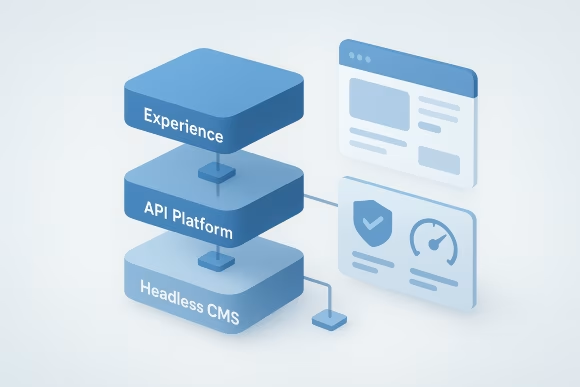
Produce a target-state blueprint for headless CMS, API platform, and experience layer composition. The architecture specifies runtime responsibilities, integration touchpoints, caching layers, and non-functional requirements so implementation decisions remain consistent across teams and products.
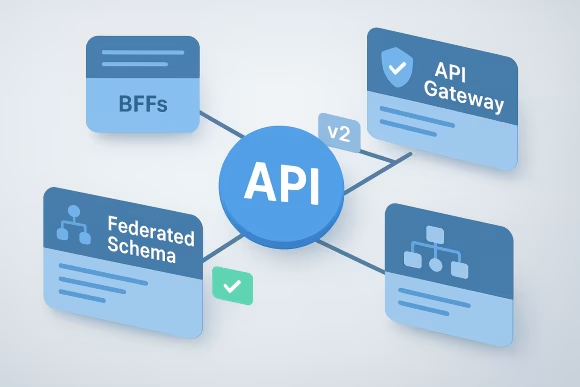
Define how experiences consume data through BFFs, API gateways, or federated schemas, depending on latency and ownership constraints. Establish versioning and compatibility rules to support parallel development, safe deprecation, and predictable consumer impact.

Design content modeling principles for reuse, localization, and multi-channel delivery. Define governance for content types, taxonomy, and validation so content operations scale without creating divergent models across brands, regions, or product lines.
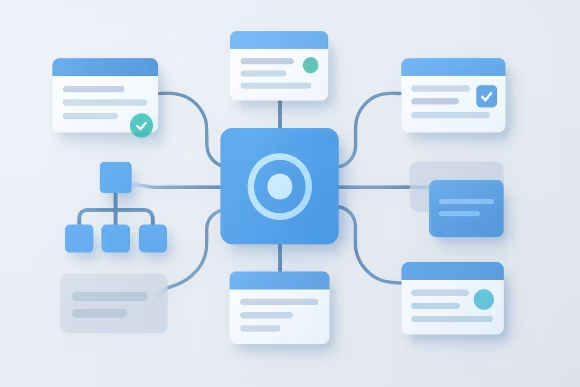
Clarify platform vs. product responsibilities, decision rights, and service ownership. Define how architecture changes are proposed, reviewed, and implemented, including how shared components are maintained without creating centralized bottlenecks.
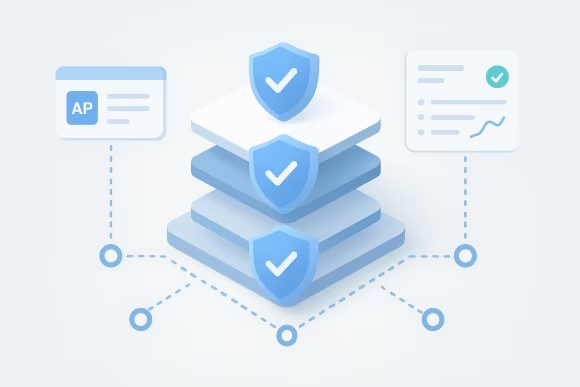
Establish security patterns for identity, authorization, secrets management, and data handling across the composable stack. Define minimum controls for API exposure, auditability, and tenant separation aligned to enterprise compliance requirements.
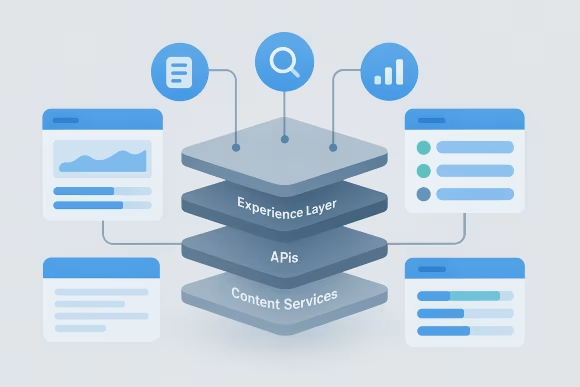
Define end-to-end observability requirements across experience layer, APIs, and content services. Specify logging, tracing, metrics, and SLOs so teams can diagnose incidents, manage performance budgets, and quantify platform reliability over time.
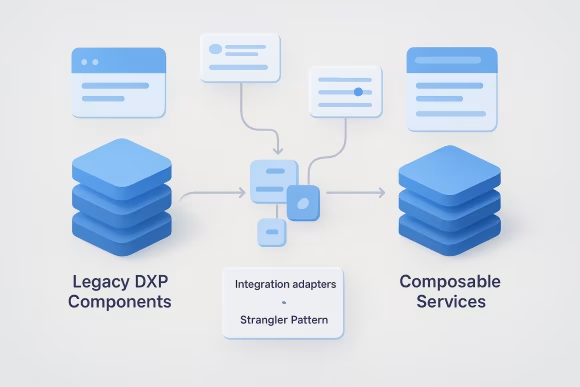
Design transitional architectures that allow legacy DXP components to coexist with composable services. Define strangler patterns, integration adapters, and sequencing strategies that reduce risk while enabling incremental delivery and measurable progress.
Engagements follow a clear engineering sequence from discovery through target-state definition and roadmap planning. The work supports API-first DXP platform strategy decisions with evidence from current-state analysis, measurable non-functional requirements, and documented trade-offs captured as architecture decisions that teams can execute and evolve.
[01]Run focused sessions to capture goals, constraints, and success metrics. Establish the decision backlog and confirm which channels, brands, and products are in scope for the target architecture.
 [02]
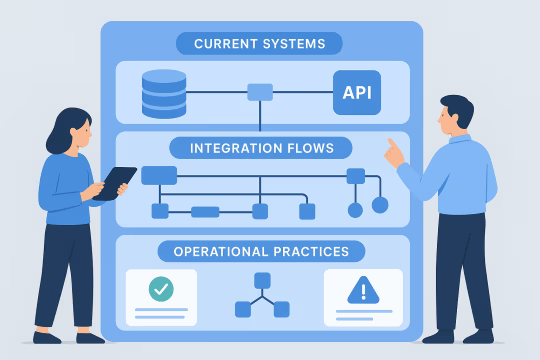
[02]Assess current systems, integration flows, and operational practices. Identify coupling, duplication, and risk hotspots, and document them as inputs to target-state decisions.
 [03]
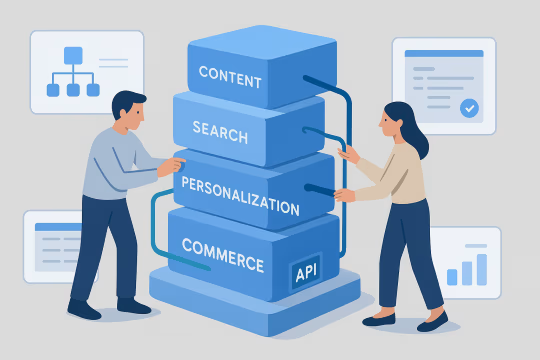
[03]Design the composable architecture and define capability boundaries, integration patterns, and non-functional requirements. Produce reference diagrams and decision records that can be used directly by delivery teams.
 [04]
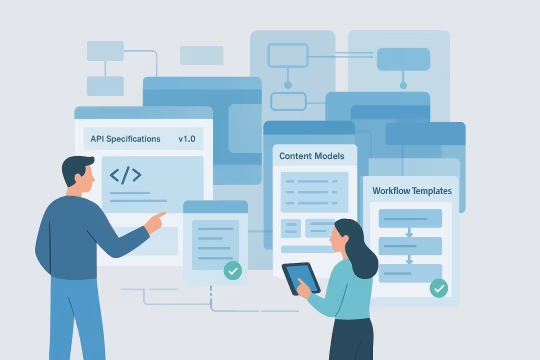
[04]Create API, content modeling, and delivery standards with examples and templates. Define how teams apply the standards in day-to-day work, including versioning, deprecation, and review workflows.
 [05]
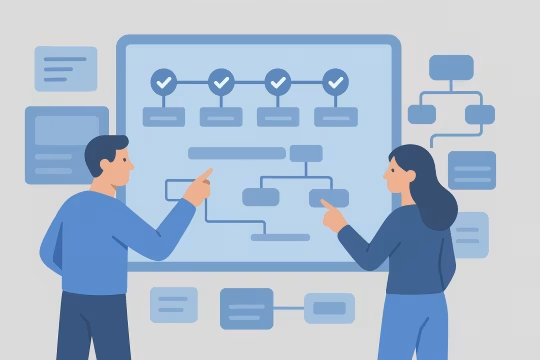
[05]Build an incremental migration plan with sequencing, dependencies, and transitional architectures. Define milestones and measurable outcomes that validate progress and reduce risk early.
 [06]
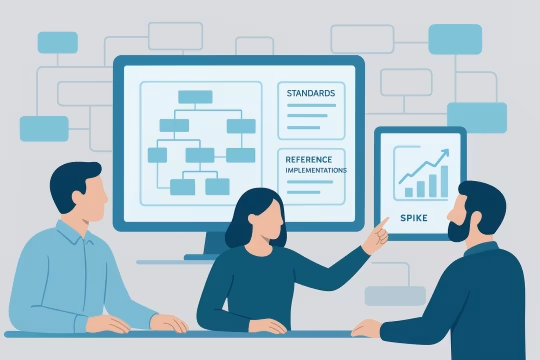
[06]Walk engineering and product teams through the architecture and standards. Provide reference implementations or spikes where needed to validate assumptions and accelerate adoption.
 [07]
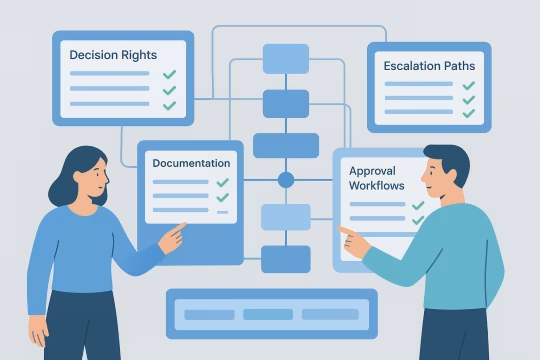
[07]Establish architecture governance routines, decision rights, and escalation paths. Define how changes are proposed and approved without slowing delivery, and how exceptions are handled and retired.
A composable DXP strategy reduces uncertainty in platform evolution by making architecture decisions explicit and operationally enforceable. The impact is realized through safer change, clearer ownership, and a DXP technology roadmap and governance model that enable incremental modernization while maintaining service reliability.
Clear capability boundaries and integration contracts reduce coordination overhead. Teams can deliver independently with fewer cross-system regressions and less rework caused by undocumented dependencies.
Standardized API versioning, deprecation rules, and governance reduce breaking changes. Operational readiness requirements (observability, SLOs) improve incident detection and shorten recovery time.
A defined experience layer and composition approach prevents frontends from binding to internal service details. This makes it easier to swap or upgrade capabilities without rewriting channel implementations.
Sequenced migration plans reduce the risk of large-bang rewrites. Transitional architectures enable coexistence so modernization can proceed while maintaining delivery commitments.
Baseline security patterns for identity, authorization, and API exposure reduce variance across teams. Consistent controls simplify audits and reduce the likelihood of gaps introduced by local implementation choices.
End-to-end observability requirements improve traceability across channels and services. Platform teams gain measurable reliability signals and clearer ownership during incident response.
Governed content models and shared standards reduce duplication and divergence. Over time, fewer bespoke integrations and fewer exceptions decrease the cost of enhancements and upgrades.
Adjacent services that extend DXP composable strategy consulting into implementable platform architecture, integration engineering, and experience-layer delivery across headless CMS and API-first DXP ecosystems.
Enterprise API design for scalable, secure foundations
API-first platform design with clear domain boundaries
Composable DXP content architecture and API-first platform design
API-first enterprise headless CMS platform architecture for content delivery
Structured schemas for an API-first content strategy
Headless architecture roadmap and target architecture definition
Target architecture and platform operating model
Contract-first headless API development for enterprise delivery
Headless CMS API integration, contracts, and integration layer engineering
Common questions about composable DXP strategy, including architecture decisions, operating model implications, integration patterns, governance, and engagement structure.
A usable composable DXP strategy produces architecture artifacts that engineering teams can implement and operate. Typical outputs include: a capability map with domain boundaries and ownership; a target reference architecture for the experience layer, headless CMS, API platform, identity, and data services; and a set of integration patterns (BFF, gateway, eventing, caching) with selection criteria. You should also expect explicit non-functional requirements and constraints: performance budgets, availability targets, security controls, content delivery requirements, and observability expectations. These are usually captured as architecture decision records and standards that can be validated during delivery. Finally, the strategy should include a migration roadmap with sequencing, dependencies, and transitional architectures. For enterprise environments, this often includes coexistence patterns with legacy DXP components, deprecation plans, and a governance model that defines decision rights and how standards evolve over time.
We start from capabilities and change boundaries rather than technology preferences. The experience layer (often Next.js or a similar framework) should own concerns that are channel-facing and benefit from rapid iteration: routing, rendering, layout composition, edge caching behavior, and orchestration that is specific to a channel’s UX needs. Backend services should own durable business capabilities and shared rules: product data, customer identity, entitlements, pricing, content management, search indexing, and personalization decisioning (where applicable). These services should expose stable contracts via APIs and/or events, with clear ownership and versioning. We also evaluate operational constraints: latency sensitivity, caching opportunities, security boundaries, and data residency. For example, if multiple channels require the same aggregation logic and it must be consistent, it likely belongs in a shared BFF or composition service rather than being duplicated in each frontend.
Composable DXP typically requires clearer separation between platform responsibilities and product responsibilities. Platform teams usually own shared capabilities such as identity integration, API gateway standards, observability tooling, CI/CD guardrails, and reference implementations. Product teams own channel experiences and product-specific services within agreed boundaries. A practical operating model defines decision rights (who can change shared contracts), review mechanisms (architecture reviews focused on interfaces and non-functional requirements), and service ownership (on-call, SLOs, runbooks). It also defines how shared components are funded and maintained so they do not become “everyone’s problem.” We aim for governance that is enforceable but lightweight: automated checks where possible (linting, schema validation, contract tests), and human review where necessary (breaking changes, security exceptions). The goal is to reduce coordination cost while keeping platform integrity.
We define non-functional requirements (NFRs) as measurable constraints tied to user journeys and operational realities. For performance, this includes page-level budgets (TTFB, LCP) and API latency targets under expected load. For reliability, it includes availability targets, error budgets, and dependency expectations (what happens when a downstream service is degraded). Security NFRs cover authentication and authorization patterns, secrets management, audit logging, and data classification rules. Observability NFRs specify required telemetry: structured logs, distributed tracing, key metrics, and correlation identifiers across the experience layer and APIs. We also include operability requirements: deployment frequency expectations, rollback strategies, and incident response ownership. These NFRs become part of standards and acceptance criteria so delivery teams can validate them continuously rather than discovering gaps late in the program.
The integration depends on whether the CMS is a system of record for content only, or also a source of structured data used across services. In most composable setups, the CMS provides content via delivery APIs, while business data (products, customers, orders) comes from dedicated services. The API platform (gateway and/or federation layer) provides consistent access patterns, authentication, rate limiting, and observability. We define clear responsibilities: content retrieval and preview flows, webhook/event triggers for publishing, and cache invalidation strategies. If content needs enrichment with business data, we typically avoid embedding business logic in the CMS; instead we use composition patterns (BFF, edge composition, or federation) with explicit contracts. We also address authoring workflows: preview environments, content staging, localization, and how content references external entities. The goal is predictable delivery behavior without creating tight coupling between CMS internals and downstream services.
We choose composition patterns based on ownership, latency, and change management. An API gateway is almost always useful for cross-cutting concerns (auth, throttling, routing, observability) but it should not become a place where business logic accumulates. BFFs are recommended when a channel needs tailored aggregation, caching, and response shaping, and when the owning team can operate it. They are effective for reducing frontend complexity and isolating channel-specific change. GraphQL federation (or similar schema composition) can work well when multiple teams own distinct domains and you need a unified query surface. It requires strong schema governance, versioning discipline, and operational maturity. If those are not in place, a simpler REST/JSON approach with well-defined contracts and selective aggregation may be more sustainable initially.
We treat APIs and schemas as shared contracts with explicit ownership and lifecycle management. Governance typically includes: a contract review process for breaking changes; versioning and deprecation policies; and automated validation in CI (linting, schema checks, backward compatibility tests). We also define a catalog approach so teams can discover existing APIs and understand usage. This includes documentation standards, example payloads, and operational metadata such as SLOs and support contacts. For larger organizations, we recommend a small architecture forum that focuses on interfaces and NFRs rather than implementation details. The goal is to keep contracts stable while allowing teams autonomy. Exceptions are allowed but time-boxed, with a plan to converge back to standards to avoid permanent fragmentation.
Content model governance prevents divergence that makes reuse and multi-channel delivery difficult. We define principles for modeling (reusable components, localization strategy, reference integrity), naming conventions, and validation rules. We also define how content types are proposed, reviewed, and evolved. A practical approach includes a content architecture owner (or small group) responsible for shared models, plus clear boundaries for product-specific models. Changes that affect multiple channels or shared rendering components require review; purely local changes can be handled by product teams. We also address lifecycle: how to deprecate fields, migrate content safely, and maintain backward compatibility for consumers. This is especially important when multiple frontends and services depend on content delivery APIs. The objective is to enable scale without turning content changes into high-risk releases.
The most common risks are organizational and architectural rather than tooling-related. A frequent issue is unclear ownership: teams build services but no one owns SLOs, on-call, or contract stability. Another risk is over-composition early on, where too many moving parts are introduced before standards, observability, and delivery discipline exist. From an architecture perspective, tight coupling can reappear in new forms: frontends binding to internal service details, gateways accumulating business logic, or content models becoming a proxy for domain data. Without explicit contracts and versioning, change risk remains high. Operational risks include increased latency from excessive network calls, inconsistent caching, and insufficient tracing across services. We mitigate these by defining composition patterns with performance budgets, establishing baseline observability, and sequencing the roadmap so foundational capabilities (identity, API standards, telemetry) precede broad decomposition.
We focus on architectural portability at the integration boundaries. That means defining stable, well-documented contracts for content delivery, domain APIs, and events, and avoiding reliance on proprietary features where they become hard dependencies. For example, we keep business logic in services we control, and treat SaaS components as replaceable capability providers behind contracts. We also recommend separating concerns: an experience layer that can consume APIs regardless of the underlying CMS, and an API platform that enforces cross-cutting policies independent of any single vendor. Data portability is addressed through clear ownership of system-of-record data and export strategies. Lock-in is not eliminated entirely; it is managed. The strategy documents where you intentionally accept dependency for speed or capability, and where you require abstraction for long-term flexibility. This makes trade-offs explicit and reduces surprise costs later.
Most strategy engagements run 4–10 weeks depending on platform complexity, stakeholder availability, and how much current-state documentation exists. A smaller scope (single brand, limited channels) may be completed faster, while multi-brand, multi-region estates with legacy DXPs and multiple delivery teams typically require more time to validate constraints and dependencies. We structure the work to deliver usable outputs incrementally: early alignment on goals and constraints, then current-state assessment, then target architecture and standards, and finally roadmap and governance. This allows decisions to be validated as we go rather than waiting for a final report. If needed, we add short technical spikes (for example, preview flow validation, API composition latency tests, or identity integration checks) to reduce uncertainty. The end state is a set of artifacts that can be executed by delivery teams with clear sequencing and acceptance criteria.
We need access to the people who understand your platform and constraints, plus enough technical evidence to avoid assumptions. Typical inputs include: system inventories (CMS, APIs, identity, analytics), integration diagrams if available, current deployment and environment topology, and any existing standards for APIs, security, and CI/CD. We also need clarity on organizational structure: which teams own which systems, how releases are coordinated, and where operational responsibilities sit. For content-heavy platforms, we include content operations stakeholders to understand authoring workflows, localization, and governance constraints. Finally, we align on measurable goals: performance targets, reliability expectations, and delivery outcomes (for example, enabling a new channel, consolidating CMS instances, or reducing release coupling). These goals shape the target architecture and roadmap prioritization.
We design the strategy as a living set of standards and decision records rather than a static document. That includes: architecture decision records (ADRs) for key trade-offs, a reference architecture that can be versioned, and playbooks for API governance, content model evolution, and observability requirements. We also define feedback loops: how teams propose changes, how exceptions are handled, and how learnings from delivery update the reference patterns. Where possible, we recommend automating enforcement through CI checks (schema validation, contract tests, linting) so standards are applied consistently without heavy process. To keep it usable, we tie standards to acceptance criteria and operational metrics (SLOs, performance budgets). This makes the strategy actionable in day-to-day engineering work and helps platform leadership measure whether the architecture is improving delivery and reliability over time.
Composable strategy treats analytics and customer data as platform capabilities with clear data contracts and governance. We define the event model (what events exist, required properties, identity linkage rules), collection architecture (client-side, server-side, edge), and how events flow into analytics warehouses and CDPs. We also address consent and privacy requirements: consent state propagation, data minimization, retention, and auditability. For enterprise environments, we define how multiple products and brands share or separate data, and how identity resolution is handled. The goal is to avoid ad-hoc tracking implementations that diverge across channels. By standardizing event schemas and instrumentation patterns, teams can add features without breaking reporting, and platform teams can maintain data quality and governance as the ecosystem evolves.
Collaboration typically begins with a short scoping phase to confirm objectives, constraints, and stakeholders. We run an initial working session with platform and architecture leads to define the decision backlog: what must be decided now (target architecture, composition pattern, governance) versus what can be deferred. Next, we agree on evidence to collect during the first two weeks: system inventory, integration touchpoints, current delivery workflow, and key non-functional requirements. We also align on the format of outputs your teams will use (reference diagrams, ADRs, standards, roadmap) and where they will live so they can be maintained. Once scope and inputs are confirmed, we schedule a cadence of workshops and reviews, identify owners for each domain area (CMS, APIs, identity, data), and start the current-state assessment. Early findings are shared continuously so decisions can be validated and adjusted before the final roadmap is produced.
These case studies showcase practical implementations of headless CMS architectures, API-first integration patterns, and composable digital experience platforms. They highlight scalable content modeling, multi-region delivery, and platform modernization strategies aligned with enterprise governance and migration roadmaps. Each example demonstrates measurable outcomes in performance, delivery acceleration, and platform operating model alignment relevant to composable DXP strategy.
Users were abandoning the website before fully engaging with content due to slow loading times and an overall poor performance experience.
The updated platform significantly improved speed and usability, resulting in higher user engagement, longer session durations, and increased content exploration.
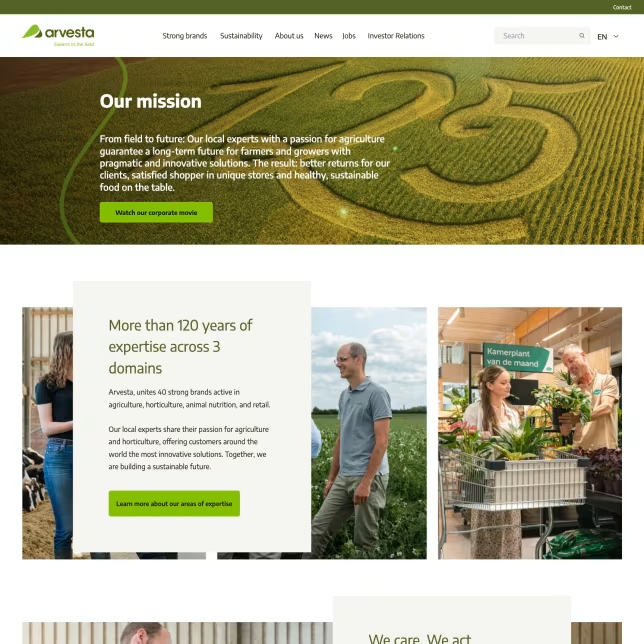
Arvesta required a modern, scalable headless CMS for enterprise corporate marketing—supporting rapid updates, structured content operations, and consistent UI delivery across multiple teams and repositories.
The platform enabled faster delivery of marketing updates, improved UI consistency across pages, and strengthened editorial operations through structured content models and reusable components.
Organogenesis faced operational challenges managing multiple brand websites on outdated platforms, resulting in fragmented workflows, high maintenance costs, and limited scalability across a multi-brand digital presence.
The transformation reduced time-to-deliver marketing updates by 20–25%, improved Lighthouse scores to ~90+, and delivered a scalable multi-brand foundation for long-term growth.
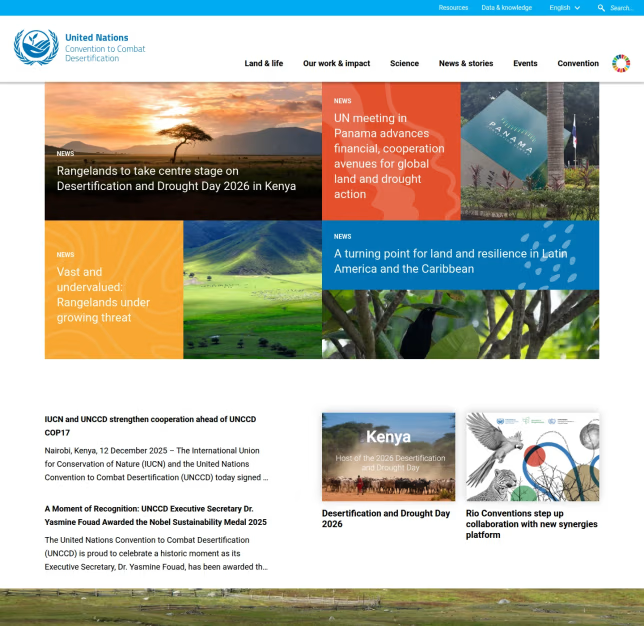
UNCCD operated four separate websites (two WordPress, two Drupal), leading to inconsistencies in design, content management, and user experience. A unified, scalable solution was needed to support a large-scale CMS migration project and improve efficiency and usability.
The modernization effort resulted in a cohesive, user-friendly, and scalable website, improving content management efficiency and long-term digital sustainability.
It was my pleasure working with Oleksiy (PathToProject) on a new Drupal website. He is a true full-stack developer—the ideal mix of DevOps expertise, deep front-end knowledge, and the structured thinking of a senior back-end developer.
He is well-organized and never lets anything slip. Oleksiy understands what needs to be done before being asked and can manage a project independently with minimal involvement from clients, product managers, or business analysts.
One of the best consultants I’ve worked with so far.

Andrei Melis
Technical Lead at Eau de Web
Oleksiy (PathToProject) worked with me on a specific project over a period of three months. He took full ownership of the project and successfully led it to completion with minimal initial information.
His technical skills are unquestionably top-tier, and working with him was a pleasure. I would gladly collaborate with Oleksiy again at any opportunity.

Nikolaj Stockholm Nielsen
Strategic Hands-On CTO | E-Commerce Growth
As Dev Team Lead on my project for 10 months, Oleksiy (PathToProject) demonstrated excellent technical skills and the ability to handle complex Drupal projects. His full-stack expertise is highly valuable.

Laurent Poinsignon
Domain Delivery Manager Web at TotalEnergies
These articles expand on the platform, governance, and implementation choices that shape a composable DXP strategy. They cover the boundaries between content, frontend, caching, and API contracts, plus the operational controls needed to migrate safely and keep teams aligned.
Let’s assess your current DXP ecosystem, agree on capability boundaries, and produce a roadmap and governance model your teams can execute with predictable change control.