Headless WordPress architecture
Validate your headless WordPress architecture
Check API contracts, content modeling, preview flow, caching, and frontend integration risks before they slow delivery.
Built for decoupled WordPress stacks, multi-channel delivery, and enterprise governance needs.
No login required. Takes 2–3 minutes.

Headless WordPress Architecture
Decoupled CMS design with API-first content delivery
Composable frontend architecture for scalable multi-channel experiences
Governable platform foundations for long-term evolution and change
Headless WordPress architecture separates content management from presentation, allowing WordPress to operate as a governed content platform while modern frontends consume content through well-defined APIs. This approach is often delivered as headless WordPress architecture services for teams building a Next.js and React headless WordPress platform with independent release cycles, multiple delivery channels, and performance characteristics that are difficult to achieve with tightly coupled themes.
Organizations typically adopt this model when they need to standardize content models, enforce API contracts, and integrate WordPress into a broader platform ecosystem that includes identity, search, analytics, and edge delivery. A sound architecture defines WordPress REST API and GraphQL headless design choices, how content APIs are exposed and secured, how preview and editorial workflows function, and how frontend applications handle routing, caching, and rendering.
The result is a platform foundation that scales across products and teams: WordPress remains a stable system of record for content, while Next.js and React applications evolve independently with clear integration boundaries, decoupled WordPress CMS governance, and operational controls.
Core Focus
Best Fit For
- Multi-site WordPress ecosystems
- Next.js or React frontends
- Teams needing independent releases
- Multi-channel content delivery
Key Outcomes
- Stable integration boundaries
- Reduced coupling and regressions
- Predictable performance characteristics
- Clear governance and ownership
Technology Ecosystem
- WordPress core and plugins
- REST API and GraphQL
- Next.js rendering modes
- Edge caching and CDN
Platform Integrations
- SSO and identity providers
- Search and indexing pipelines
- Analytics event collection
- Asset and media workflows
Problems Headless WordPress Architecture Solves
When WordPress is tightly coupled to themes and page rendering, teams often inherit a single deployment surface where content changes, plugin updates, and frontend releases collide. As sites grow into multi-site ecosystems and add new channels (web apps, kiosks, mobile, partner portals), the architecture can become fragmented: duplicated templates, inconsistent routing rules, and ad-hoc integrations that are hard to test and harder to govern.
API-driven delivery introduces its own risks when it is not designed deliberately. Without clear contracts for WordPress REST API headless or WordPress GraphQL headless endpoints, frontend teams face breaking changes, unpredictable payloads, and inconsistent content modeling across products. Preview and editorial workflows can become brittle, caching behavior can be unclear, and performance tuning turns into reactive firefighting rather than an engineered system.
Security and operations also become more complex at enterprise scale. Content API security, authentication boundaries, and rate limiting are frequently bolted on late, increasing operational risk. Over time, the platform accumulates maintenance overhead: plugin sprawl, undocumented integration points, and architectural inconsistencies that slow delivery, increase regression risk, and make long-term platform maintainability and evolution difficult.

Reduce risk across your decoupled WordPress stack
Use the Health Check to surface architecture gaps that affect performance, editorial workflows, security, and release stability.
- Audit API design
- Review preview flow
- Check caching strategy
Business Impact
A well-structured headless WordPress architecture reduces coupling between content operations and frontend releases, helping teams ship changes with less regression risk. Clear REST API and GraphQL headless design improves integration stability across products and channels, while performance-focused web architecture supports faster experiences and more predictable scaling. Stronger governance and content API security practices also reduce operational risk and lower long-term maintenance overhead.
Headless stack review
Pressure-test your WordPress architecture before scaling further
Identify weak points in API delivery, frontend coupling, authentication boundaries, and operational readiness with a focused architecture assessment.
No login required. Takes 2–3 minutes.
These related services extend the same headless WordPress architecture foundation—covering REST/GraphQL API implementation, platform modernization, analytics and CRM integrations, and broader digital experience strategy—so teams can evolve the decoupled platform without reworking core integration boundaries.
WordPress API Development
WordPress REST API engineering and GraphQL API design
WordPress GraphQL
Schema-first APIs for headless content delivery
WordPress Analytics Integration
GA4 event tracking WordPress with governed measurement
WordPress CRM Integration
WordPress lead contact sync with secure lead capture
WordPress Integrations
WordPress integration services for secure API connections
WordPress REST API
Custom WordPress REST endpoints, schemas, and authentication patterns
WordPress Platform Modernization
Upgrade-ready architecture, WordPress CI/CD and DevOps, and operational hardening
WordPress DXP
Enterprise WordPress Platform Engineering
WordPress Digital Experience Strategy
Enterprise WordPress DXP architecture and operating model
Headless WordPress and API-Driven Content Platforms
These case studies showcase modern headless CMS architectures and API-driven content delivery platforms that align with the principles of decoupled WordPress architecture. They highlight scalable content operations, multi-channel delivery, and integration with React/Next. js frontends, demonstrating real-world implementations of headless content governance and performance optimization.
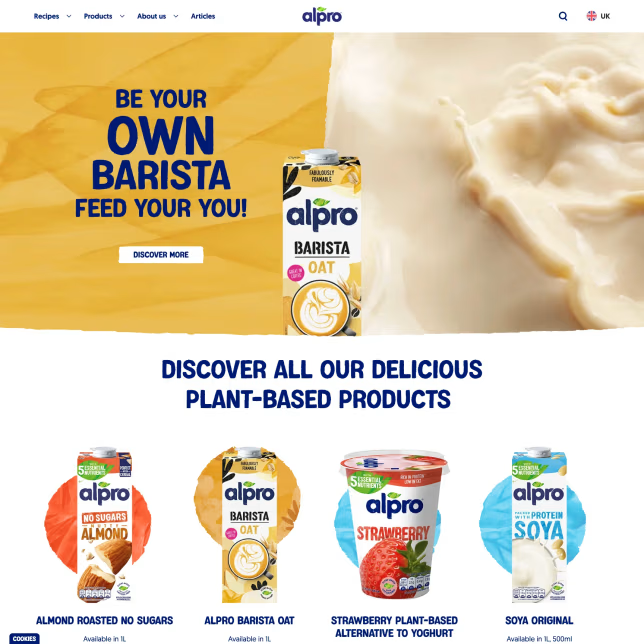
Users were abandoning the website before fully engaging with content due to slow loading times and an overall poor performance experience.
- Implemented a fully headless architecture using Gatsby and Contentful. - Eliminated loading delays, enabling fast navigation and filtering. - Optimized performance to ensure a smooth user experience. - Delivered scalable content operations for global marketing teams.
The updated platform significantly improved speed and usability, resulting in higher user engagement, longer session durations, and increased content exploration.
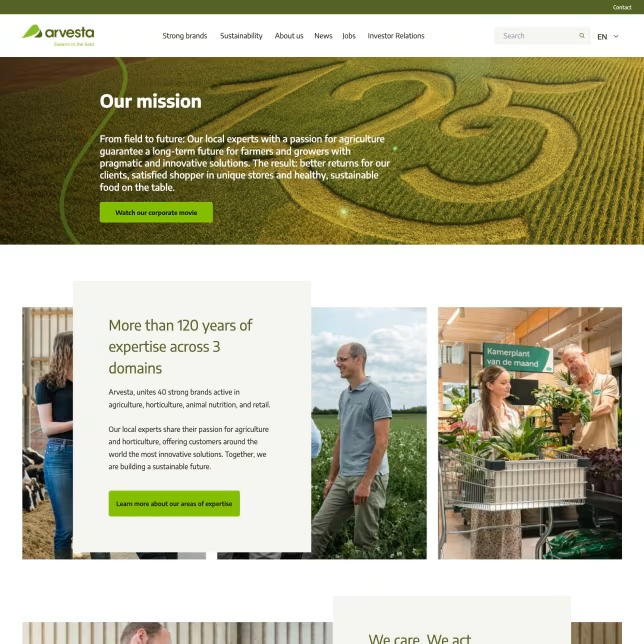
Arvesta required a modern, scalable headless CMS for enterprise corporate marketing—supporting rapid updates, structured content operations, and consistent UI delivery across multiple teams and repositories.
- Implemented a component-driven delivery workflow using Storybook variants as the single source of UI truth. - Defined scalable content models and editorial patterns in Contentful for marketing and corporate teams. - Delivered rapid front-end engineering support to reduce load on the in-house team and accelerate releases. - Integrated ElasticSearch Cloud for fast, dynamic content discovery and filtering. - Improved reuse and consistency through a shared UI library aligned with the System UI theme specification.
The platform enabled faster delivery of marketing updates, improved UI consistency across pages, and strengthened editorial operations through structured content models and reusable components.
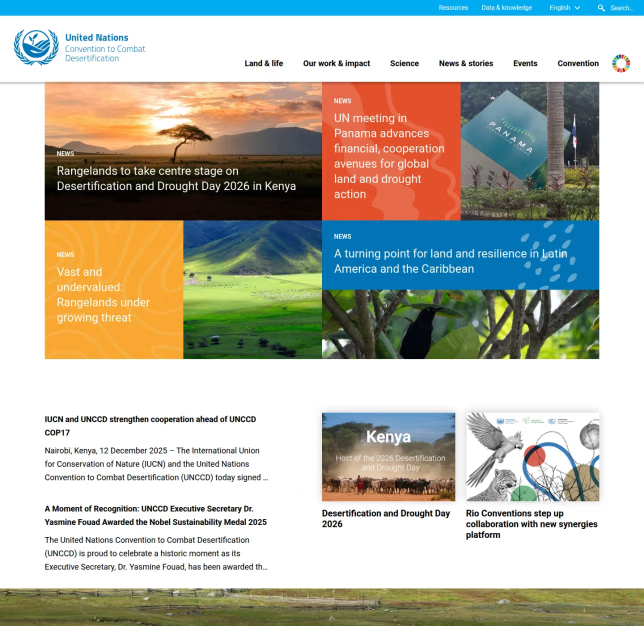
UNCCD operated four separate websites (two WordPress, two Drupal), leading to inconsistencies in design, content management, and user experience. A unified, scalable solution was needed to support a large-scale CMS migration project and improve efficiency and usability.
- Migrating all sites into a single, structured Drupal-based platform (government website Drupal DXP approach). - Implementing Storybook for a design system and consistency, reducing content development costs by 30–40%. - Managing input from 27 stakeholders while maintaining backend stability. - Integrating behavioral tracking, A/B testing, and optimizing performance for strong Google Lighthouse scores. - Converting Adobe InDesign assets into a fully functional web experience.
The modernization effort resulted in a cohesive, user-friendly, and scalable website, improving content management efficiency and long-term digital sustainability.
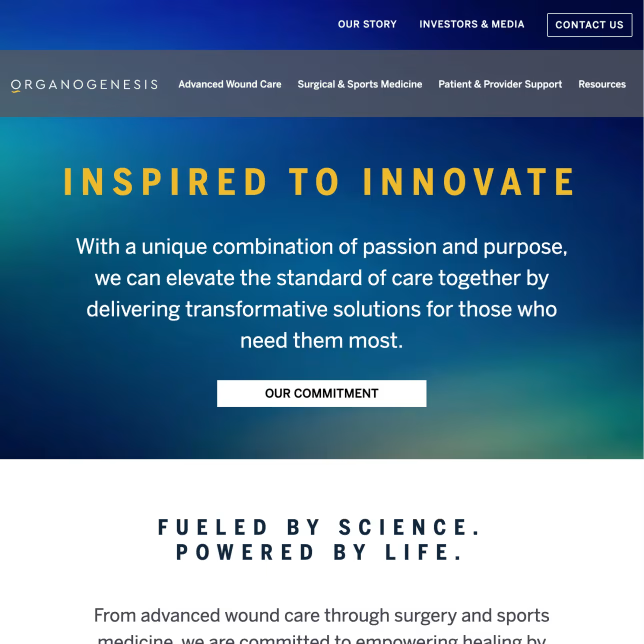
Organogenesis faced operational challenges managing multiple brand websites on outdated platforms, resulting in fragmented workflows, high maintenance costs, and limited scalability across a multi-brand digital presence.
- Migrated legacy static brand sites to a modern AWS-compatible marketing platform. - Consolidated multiple sites into a single NX monorepo to reduce delivery time and maintenance overhead. - Introduced modern Next.js delivery with Tailwind + shadcn/ui design system. - Built a CDP layer using GA4 + GTM + Looker Studio with advanced tracking enhancements.
The transformation reduced time-to-deliver marketing updates by 20–25%, improved Lighthouse scores to ~90+, and delivered a scalable multi-brand foundation for long-term growth.
It was my pleasure working with Oleksiy (PathToProject) on a new Drupal website. He is a true full-stack developer—the ideal mix of DevOps expertise, deep front-end knowledge, and the structured thinking of a senior back-end developer.
He is well-organized and never lets anything slip. Oleksiy understands what needs to be done before being asked and can manage a project independently with minimal involvement from clients, product managers, or business analysts.
One of the best consultants I’ve worked with so far.

Andrei Melis
Technical Lead at Eau de Web
Oleksiy (PathToProject) is demanding and responsive. Comfortable with an Agile approach and strong technical skills, I appreciate the way he challenges stories and features to clarify specifications before and during sprints.

Olivier Ritlewski
Ingénieur Logiciel chez EPAM Systems
Oleksiy (PathToProject) was the Lead Developer on a number of client projects which I managed. He is highly skilled and incredibly hardworking. When assigning work to him, I could always rely on it being completed to a high quality and on time.
His technical expertise was valued across the team and he was often our 'go to' for technical challenges, which he loved to get stuck into. Oleksiy is proactive and engaged in a professional manner with our clients.
I have no hesitation in recommending him.

Daniela Graf
Senior Project Manager | Change Mgmt Practitioner | Process Improvement Geek
Further Reading on Headless WordPress Architecture
These articles expand on the architecture, governance, and migration decisions that shape a successful headless WordPress platform. They cover integration patterns, content modeling, API control, and frontend delivery concerns that commonly arise when WordPress is decoupled from presentation.